Tuesday, November 12, 2013

Vintage Dinosaur Art: Dinosaurs - Giants of the Earth

Published as part of the five-book Dinosaur Dynasty series back in 1993, Giants of the Earth was my childhood introduction to pop-palaeo stalwart Dougal Dixon. Each book in the series dealt with a different aspect of dinosaur science, with this one looking at, as the cover implies, their evolutionary history. The artwork is of a surprisingly high standard for the time, even if the obligatory early '90s Sibbick rip-offs are present and correct. The cover art, by Steve Kirk, is exemplary - a couple of very small tweaks, and it would pass muster even today. And the colour scheme is quite lovely. You can't go far wrong with stripy Styracosaurus horns.


Thursday, November 7, 2013

Leonardo is Coming to Indianapolis


Robert Bakker with a model of Leonardo from the Dinosaur Mummy CSI exhibit at the Houston Museum of Natural History. Photo by Ed Schipul, via Flickr.

When I was younger, dumber, and less awestruck by my home state's natural heritage, I bemoaned the fact that Indiana had no dinosaur fossils to offer. I've gotten over that, of course, but I'm still proud that one of the finest dinosaur exhibits in the country, The Dinosphere, is housed at the Children's Museum in Indianapolis. The museum has announced that it's going to be getting a serious injection of star power next year, as Leonardo, the famous "mummy" Brachylophosaurus, is revealed to the public.

From the museum's announcement:
Leonardo is listed in the Guinness World Book of Records as having the best preserved dinosaur remains in the world. For now, visitors will be able to follow the dinosaur’s tale via his tail until the rest of his body is on display in March of 2014. At that time, Leonardo’s Lab will open for children and families to learn everything from what he had for his last meal to how he spent the last few hours of his life.

When this fossilized mummy was carefully unearthed from his grave in Malta, Montana in 2001, researchers had one of the first real looks at the skin, scales, foot pads, and even the stomach contents of the behemoths that roamed the planet 77 million years ago.
Dinosphere manager Mookie Harris - who recently returned to the museum after a stint at a Florida museum - has written about the fossil on the Children's Museum blog, so be sure to check that post out.

If you haven't read my previous posts about the Children's Museum, sit a spell and read about how awesome it is.

Tuesday, November 5, 2013

SVP Dispatches: The Body of Deinocheirus

It's been a rumor online for years. Hang around the Dinosaur Mailing List or a paleontology forum for long enough, and you'd hear it. Rumors that an old mystery might soon be solved. Rumors that expeditions to the remote Gobi have found a body. Rumors that one of the most enduring riddles of dinosaur paleontology might soon be made clear.


I'm speaking, of course, of Dienocheirus. To a dinosaur enthusiast of a certain age, that name crystallizes the mystery and frustrations of paleontology. "The Terrible Hand" was terrible for its size, terrible for its claws, and terrible because--beyond its long arms and fingers--nothing else remained. 

Copyright Luis Rey
Researchers suspected it to be an ornithomimid, albeit an uncommonly massive one. There were certain diagnostic signs to the hands, the shape of the claws, the structure of the arms, all of which pointed to a kinship with those legendarily fleet-footed animals. But what shape was Dienocheirus? Was it a massive, lumbering browser? A giant, elegant runner? Perhaps even a predator? In the absence of a body, there was no way to be sure. 

Now it seems that the wait is over. According to an abstract recently released at The Society of Vertebrate Paleontology, Dienocheirus was indeed a type of ornithomimid, one displaying skeletal traits previously unknown in that family. The abstract notes that two new specimens were discovered, with material comprising the majority of the postcranial skeleton. Gastroliths were recovered as well, which would imply a herbivorous diet. 

So what did Deinocheirus look like? Apparently it had a heavily built pelvis and hind limbs, adaptations suggesting a slower moving life style than the one practiced by its smaller cousins. Unlike the similarly robust therizinosaurs, though, Deinocheirus was narrow bodied, with tall, straight ribs. By far the most interesting bit of anatomy, however, is the fact that Deinocheirus apparently had long neural spines in the vicinity of its pelvis. The living animal was thus graced with either a sail or a hump, a trait that comes as a complete surprise. 

Copyright http://stygimolochspinifer.deviantart.com
There are still several mysteries about Deinocheirus, and these two skeletons only give rise to new questions--especially ones concerning its somewhat odd anatomy. But rejoice, nonetheless. Deinocheirus has a body, and it's weirder than anybody could have dreamed.  

The complete text of the abstract is below. 

NEW SPECIMENS OF DEINOCHEIRUS MIRIFICUS FROM THE LATE CRETACEOUS OF MONGOLIA

LEE, Yuong-Nam, Korea Institute of Geoscience and Mineral Resources, Daejeon, Korea, Republic of (South); BARSBOLD, Rinchen, Paleontological Center, Ulaanbaatar, Mongolia; CURRIE, Philip, University of Alberta, Edmonton, AB, Canada; KOBAYASHI, Yoshitsugu, Hokkaido University Museum, Sapporo, Japan; LEE, Hang- Jae, Korea Institute of Geoscience and Mineral Resources, Daejeon, Korea, Republic of (South)

The holotype of Deinocheirus mirificus was collected by the Polish-Mongolian Palaeontological Expedition at Altan Uul III in 1965. Because the holotype was known mainly on the basis of giant forelimbs with scapulocoracoids, Deinocheirus has remained one of the most mysterious dinosaurs. Two new specimens of Deinocheirus were discovered in the Nemegt Formation of Altan Uul IV in 2006 and Bugin Tsav in 2009 by members of the Korea-Mongolia International Dinosaur Expedition (KID). Except for the skull, middle dorsal and most of the distal caudal vertebrae, the right forelimb, left manus, and both pedes, the remaining parts of the skeleton (Mongolian Paleontological Center [MPC]-D 100/127) including a left forelimb clearly identifiable as Deinocheirus were collected. The humerus (993 mm in length) is longer than the 938 mm humerus of the holotype. The Altan Uul IV specimen (MPC-D 100/128) is a subadult Deinocheirus (approximately 72% of MPC-D 100/127), which consists of post-cervical vertebrae, ilia, ischia, and hind limbs. Both specimens provide important paleontological evidence for exact postcranial reconstruction of Deinocheirus mirificus. Cladistic analysis indicates that Deinocheirus is a basal member of Ornithomimosauria, but many new unique skeletal features appear to be quite different from other ornithomimosaurs. These include extreme pneumaticity of tall, anterodorsally oriented distal dorsal neural spines (7~8 times taller than centrum height) with basal webbing, fused sacral neural spines forming a midline plate of bone that extends dorsally up to 170% of the height of the ilium, ventrally keeled sacral centra, a well-developed iliotibialis flange, a posterodorsally projecting posterior iliac blade with a concave dorsal margin, a steeply raised anterior dorsal margin of the ilium, an anteriorly inclined brevis shelf, vertically well-separated iliac blades above the sacrum, an completely enclosed pubic obturator foramen, triangular pubic boot in distal view, vertical ridges on anterior and posterior edges of medial surface of the femoral head, and a robust femur that is longer than tibiotarsus. These features suggest that Deinocheirus (unlike other ornithomimosaurs) was not a fastrunning animal, but a bulky animal with a heavily built pelvis and hind limbs. However, the dorsal ribs are tall and relatively straight, suggesting that the animal was narrowbodied. A large number of gastroliths (>1100 ranging from 8 to 87 mm) were collected from the abdominal region of MPC-D 100/127, suggesting Deinocheirus was an herbivore.

This is the first of a few posts about discoveries announced at SVP 2013. Stick around through the rest of the coming week, because there's some cool stuff coming down the pipe. 

Monday, November 4, 2013

It's a great big beautiful Golden Book of Dinosaurs

While we are quite obviously rather partial to a little dinosaur-themed nostalgia here at LITC, we're nevertheless very keen to embrace the new - the latest discoveries, inventive ways of portraying our favourite beasts, and so on. How perfect, then, that Robert Bakker and Luis Rey should bring us an updated take on The Big Golden Book of Dinosaurs. The original (in its various guises; see alternative title in the photo) is one of the most fondly-remembered of all popular dinosaur books, children's or no, and paying appropriate homage to Zallinger's memorable art was certainly quite a task. Could the ever-divisive Rey meet the palaeoartistic challenge?


Wednesday, October 30, 2013

Finally, a few words on All Your Yesterdays

The original All Yesterdays, with art by John Conway and the mighty Memo, caused enough of a stir last year to break free from its 'niche publishing' status and make it into the mainstream media - even into delightful tabloid newspapers normally filled with right-wing batshittery and celebrity boobs. Now - or rather, a month ago, but I've only just caught up - the dream team brings us the fruits of their All Yesterdays art contest, which inspired artists far and wide to produce fine works of palaeontological speculation. All Your Yesterdays might be choppier than the original - that's to be expected, given the number of artists involved - but it's free, damn it, free! And considerably chunkier, too.

John Conway's bubble-headed Allosaurus, as featured in All Your Yesterdays.

Tuesday, October 22, 2013

Royal Dinostamps

If you're a Briton (like me), then you'll no doubt have heard that the Royal Mail...was privatised recently, according to Prime Directive 2 of the inordinately wealthy neoliberal androids who run the country. But don't despair! Or rather, do despair, but also pay heed to this welcome distraction. For the Royal Mail also recently issued a new set of prehistoric animal-themed stamps, illustrated by John Sibbick. There are ten to collect, each one featuring a Mesozoic creature discovered in the UK (only six of them actually feature dinosaurs).

The rather, er, mixed reaction to these stamps in Social Media Land only made me more intrigued, so off I popped to the Royal Mail website to stuff a little more cash into the foul capitalists' pockets (by which I mean, I ordered a set).

Remember, all images are copyrighted. So don't go making hipster t-shirts out of them or anything. They'll find you.

Monday, October 21, 2013

Vintage Dinosaur Art: Archosauria - Part 3

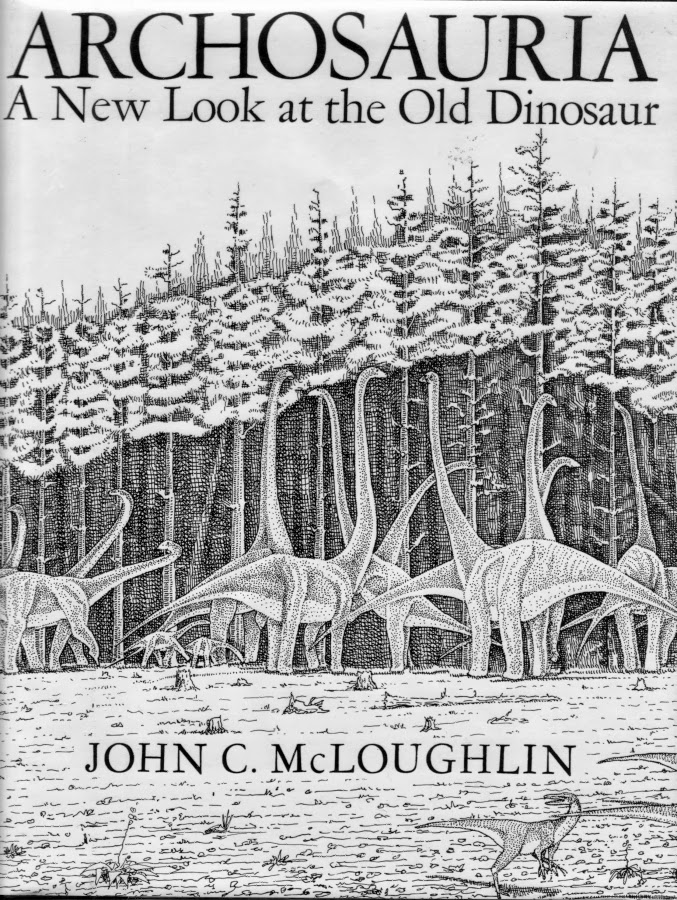
We've established by now that John McLoughlin's Archosauria was a beautifully bold, often highly prescient book, dedicated to overturning notions of dinosaurs as 'great fossil lizards' that were nature's way of killing time before those 'superior' mammals took over the place. McLoughlin illustrated feathered theropods and supercharged sauropods at a time when the number of people doing so could be counted on one hand. Given its boldness, it's surprising that Archosauria so infrequently oversteps the mark, but when McLoughlin goes too far, he has the decency to do so very memorably.


Monday, October 14, 2013

Vintage Dinosaur Art: Archosauria - Part 2

While nothing could match the feathered theropods in terms of sheer prescience, there were illustrations of other animals in Archosauria that were groundbreaking in their own, perhaps more subtle ways (and now you know I'm not referring to the ceratopsians). McLoughlin may have been skimpy on the sauropodomorphs, but what he did provide was a tantalising glimpse into an exciting new era of palaeoart.


(Yes, I'm finally doing jump breaks.)

Wednesday, October 9, 2013

And We Thought We Were Dinosaur Lovers (NSFW)

It seems like a classic "good news/bad news" story. The good news is that, for the first time in a while, the entire internet has been talking about dinosaurs. Tumblr blogs, Facebook, even Cracked--all have been devoting space to our favorite extinct animals.

The bad news is that...well...see for yourself.


The horror continues after the jump.

Tuesday, October 8, 2013

Vintage Dinosaur Art: Archosauria - Part 1

It feels like I've been waiting an age for this one, but at long last, here it is - John McLoughlin's infamous Archosauria: Or, How I learned To Stop Worrying and Love the Dinosaur Renaissance. It's a book that's come to be known among dino-geek circles for a series of reconstructions, chiefly of ceratopsians, that (even at the time) were very odd indeed. However, that's not a fair perspective on this remarkable book, for Archosauria was, in most other respects, an incredibly prescient publication - far ahead of its time in giving a new look to the old dinosaur.


At a time (1979) when the predominant image of dinosaurs, for all the advances being made in palaeontology, was still that of the slothful, oversized, cold-blooded reptile - what McLoughlin dubs 'the great fossil lizard' - Archosauria is completely unabashed in its embracing of the Dinosaur Renaissance. The writing further exudes confidence in actively attacking the outdated, old-school interpretation of dinosaurs still being promoted by palaeontology's old guard, referred to by McLoughlin (rather sarcastically) as the "Grand Old Men" and (more viciously) "stodgy professors".


In fact, McLoughlin was willing to go further than many palaeoartists have dared until very recently. Even his Triassic theropods (such as the above Coelophysis) not only sport lean frames and active poses, but a covering of fuzz, too. All of the dinosaurs in Archosauria are presented in a fetching monochrome style, devoid of backdrops, making use of stippling and crosshatching. It would have been good to see a few more animals presented as part of a wider ecosystem, rather than as isolated, itemised 'specimens', but at least McLoughlin's work is distinctive, and devoid of bland meme-following.


Perhaps my favourite spread in this book pertains to the Late Jurassic theropod Ornitholestes (here synonymised with Coelurus, a position made more-or-less untenable by subsequent studies). It's obvious when McLoughlin has better reference material for an animal, and his Ornitholestes remains remarkably accurate, even agreeing rather well with Scott Hartman's far more recent skeletal. Check out the feathery coat, too - an impressively far-sighted decision, and handled very well.


What's most remarkable about McLoughlin's Ornitholestes is that it avoids many of the unfortunate tropes that still afflict feathered nonavian dinosaur reconstructions. This is particularly clear in the animal's 'portrait', where feathers are present almost to the snip of the snout, there are no unsightly scales, and a realistic amount of flesh is applied to the mouth and skull more broadly; this is no sunken-eyed haggard-o-saur. And hey, the eye's very pretty, too. By way of contrast, McLoughlin also provides a 'great fossil lizard' version of the dinosaurs he illustrates, as shown here in the form of a naked, upright Ornitholestes with legs that could advertise jeans for Topman.


Given how good his Ornitholestes is, it's very strange that McLoughlin should fumble with the most infamous 'feathered dinosaur' of all. There are much, much worse Archaeopteryx illustrations out there, of course, but this is still a pretty ugly creation, all frayed feathers and oddly proportioned forelimbs that come perilously close to 'Wings...but with hands!'.


Equally baffling is McLoughlin's failure to stick a single plume on his Dromaeosaurus, given how obviously birdlike dromaeosaurs were known to have been even at that time. Although stippling is used to wonderful effect here, this muscle-popping, indecently naked creature hasn't aged well. At least it's a dromaeosaur feeding on a prey item smaller than itself (rather than hurling itself kamikaze-style at some much bigger ornithopod), although what it's doing with that claw is anyone's guess. I'm also tempted to suppose that the head was based on Velociraptor, rather than Dromaeosaurus, given its relative shallowness; Deinonychus still tended to be given a rather allosaur-like head at that time.


Speaking of which, time hasn't been kind on McLoughlin's work on larger theropods (here lumped together as 'carnosaurs', as was the wont of people back in the day - the lazy gits). Particularly amusing is his restoration of the rauisuchian Teratosaurus as a 'primitive theropod'. Of course - and let's be fair, now - he wasn't anything like the first to do so, with many earlier illustrators restoring the animal as a creeping, hunched-over beast in the manner of Neave Parker's Megalosaurus. The animal was finally revealed to be a rather different type of archosaur in the mid 1980s. McLoughlin's Teratosaurus, in keeping with his (now orthodox, then still quite revolutionary) view of large theropods as sprightly, active creatures, is shown accelerating forward like Niki Lauda. It also has a rather bizarre, snake-like head, with the eye set far forward in its socket, and the mandible extending waaaaay back.


Moving swiftly back to the dinosaurs-that-really-were, McLoughlin's Allosaurus is an impressively lean and muscular predator, its tail held stiffly behind as it powers forward with a vengeance. While generally proportioned very well, McLoughlin ironically perpetuates a common mistake made by Zallinger-era illustrators in replacing his allosaur's horns with a convenient, rounded 'arch' over the eye, like a monitor lizard. A pet peeve of mine and a nitpick, I realise, but in the words of Ian Malcolm, "there it is". The allosaur also illustrates McLoughlin's habit of giving his theropods uncomfortably straight legs, although how much data was freely available on that sort of thing back in the late 1970s, I don't know.


Of all his 'carnosaurs', McLoughlin's Gorgosaurus is perhaps the most interesting in that it combines traits from both old and 'new' (i.e. more rigorous, post-Renaissance) restorations of the animal. The horizontal back, elevated tail and hugely meaty thighs all feel thoroughly modern. On the other hand, there's no escaping that rather strange-looking head and neck combo. The posture appears to have been borrowed from older, more upright restorations, while the skull shape appears to have been borrowed from, well, Tyrannosaurus; note the pronounced postorbital boss and lack of pointy part in front of the eye. This also seems to be an animal that scuttles along on the tips of its claws. Of course, regardless of any nitpicks, this is still a lovely drawing and yet another laudably forward-thinking vision of an animal formerly portrayed as a slowly shuffling hulk.


And finally...an animal formerly portrayed as a slowly shuffling hulk, or in McLoughlin's words, "a lumbering tripod whose long, flexible tail dragged behind him as he moved". Contrary to this outdated, reptilian picture, McLoughlin asks us to imagine an animal that was
"...A biped rather than a tripod; he came equipped with a long and rapid stride that enabled him to catch the swift herbivores that were his food while circumventing their fearsome spines, horns, and other defenses...every detail of the tyrannosaur frame argues for an active predatory life-style."
It's enough to make you want to punch the air with glee and scream "YEAH!" (preferably while staring madly into the eyes of a friend or loved one). The illustration gets the animal's proportions, particularly the head, a little off; Trish dubbed this one "Sharkface McDerpasaurus rex". In fact, the shrinkydink head's rather disappointing all round, which is especially odd given the beautifully drawn skull on the opposite page. Still, plaudits to McLoughlin for the animal's attractive stripy styling and his own kick-ass demeanour - it's a welcome change from other late '70s books that portray T. rex as a sad, toddling fatty with brittle teeth and arms like cruelly diminutive toothpicks.

Archosauria will return!