Showing posts with label pteranodon. Show all posts

Sunday, June 2, 2013

Pterrible Courier

Pterrible Courier. Sepia ink, sepia powder, white Conté and gouache on recycled paper, 112 x 178mm.

Pterosaurs make terrible couriers. Especially of food parcels.

This is the context in which this drawing originated. I'm hard-pressed to refrain from making another self-deprecatory remark about its silliness, but I had been persuaded to share this on the grounds that pterosaurs figure so rarely among my work (thereby passing the buck altogether). I also realised rather too late how much this resembles the arm-munching T. rex in action and posture. I hope you won't upbraid.


N.

Wednesday, November 28, 2012

Archosaurs of Alabama

Welcome back, everybody! Where last we left off, I'd done a brief, illustrated survey of some notable Alabama Cretaceous marine fauna. Here, we turn out attention to some of the archosaurs that would have lived in the parts of the state not covered in seawater. 

I speak, of course, of dinosaurs. Mostly. 


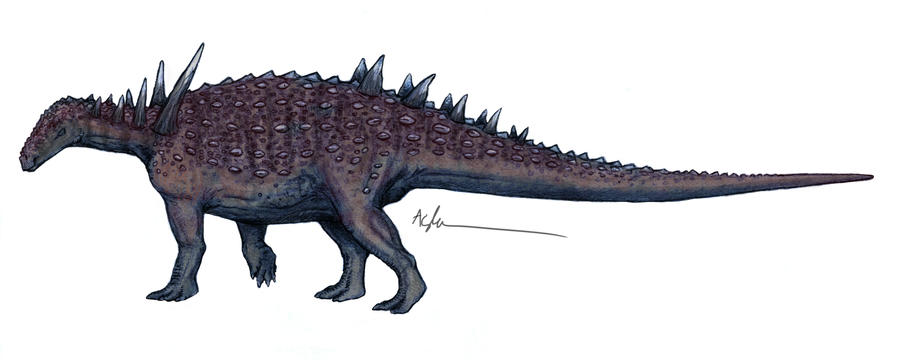
Nodosaurid  © Asher Elbein
Alabama has quite decent nodosaur remains, most of them the product of carcasses washed out to sea by floods and river currents. There, the bodies bloated and were extensively scavenged before they sank to the bottom. This is my first ever attempt at an armored dinosaur (or at least, the first I'm willing to show in public) and I initially thought of restoring it with bright warning coloration, similar to that of a hornet or a yellow jacket. Suffice to say, it didn't really work, so I defaulted to a more hippo-like pattern instead.

 I'm somewhat taken with the idea of nodosaurs dozing in mudpits, small feathered dinosaurs perching on their spikes. It might be worth illustrating at some point.

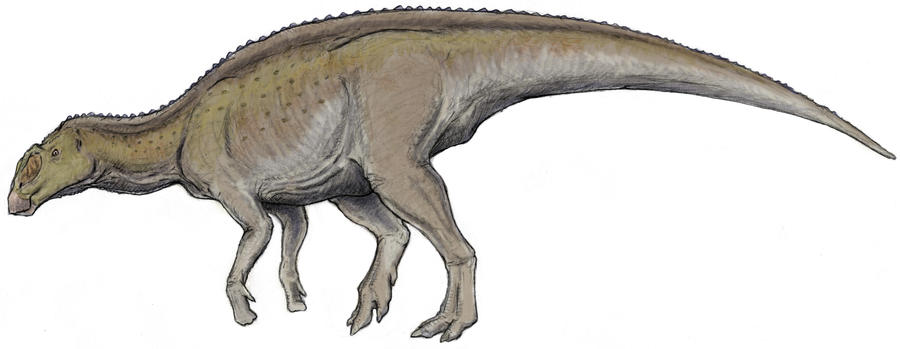
Lophorhothon © Asher Elbein
Lophorhothon is Alabama's main hadrosaurid, and like the nodosaur remains it occurs primarily in marine deposits. It has the twin dignities of being both Alabama's first recorded dinosaur genus and being one of its most taxonomically uncertain; there's some debate as to where, precisely, it fits with regards to other hadrosaurs (or if it's even a hadrosaur at all.) Following the prevailing opinion, I went ahead and restored it as something similar to Prosaurolophus. I wanted something restrained and somewhat dignified, so I turned to a color scheme reminiscent of African grazing mammals.

Dromaeosaurid  © Asher Elbein
The most speculative reconstruction of the bunch. Dromaeosaur fossils in Alabama are extremely rare, centering around a few scattered bits and a preserved feather or two. It's not that surprising; small size and light bones make dromaeosaurs fairly chancy when it comes to preservation, and in marine deposits the likelihood of a carcass lasting is virtually nil. Given that, this is best understood as guess at what an Alabama dromaeosaur might look like.

 I took this illustration as a chance to play around with some different ways to render feathers (I'm particularly proud of the neck region.) The patterns are based--extremely loosely--on the Caracara, a modern raptor that spends a fair amount of time on the ground.

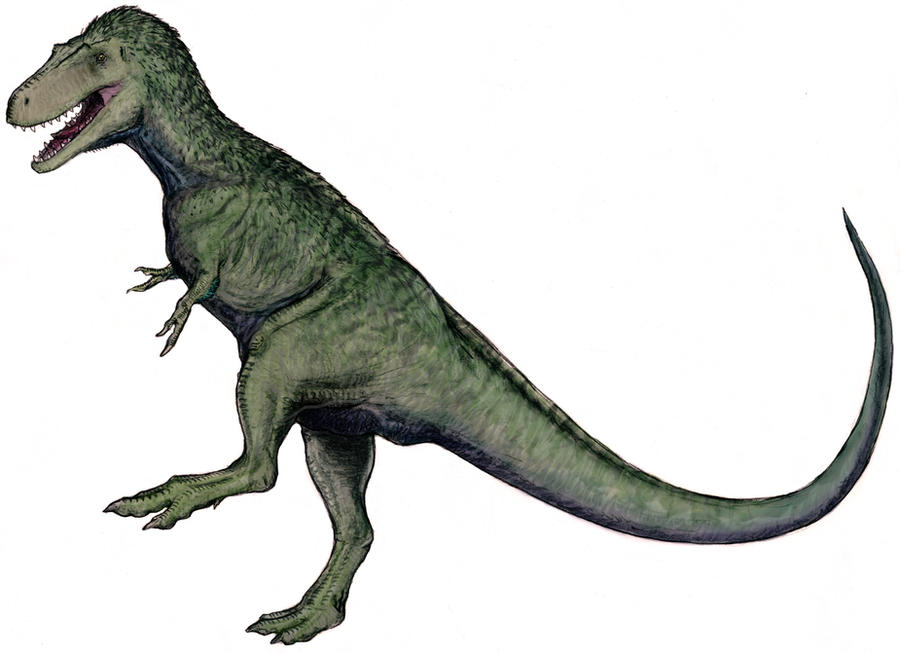
Appalachiosaurus © Asher Elbein
No Cretaceous dinosaur assemblage is complete without a big theropod, so here we have Appalachiosaurus, the 30 foot tyrannosaurid. Appalachiosaurus also has the distinction of being the most completely known theropod from the eastern coast of North America, a part of the country that lacks the excellent fossil fields out west. The mounted specimen at the McWayne Science Center shows large, three clawed arms. I'm unsure of the accuracy--nothing has apparently been published yet--so I chose to restore Appalachiosaurus as a fairly typical albertosaurid. I gave it a sparse covering of protofeathers on the head and neck, and based the coloration on that of the Emerald Swift, an extremely pretty little lizard common in Central America. There was no particular scientific reason for doing so; I just liked the challenge of adapting the color scheme to an animal of radically different size and shape.

Of all of the reconstructions, this is the one I suspect is going to be rendered invalid by later publications, but one of the nice things about paleontological art is that it affords you the opportunity to make guesses that may or may not be correct.

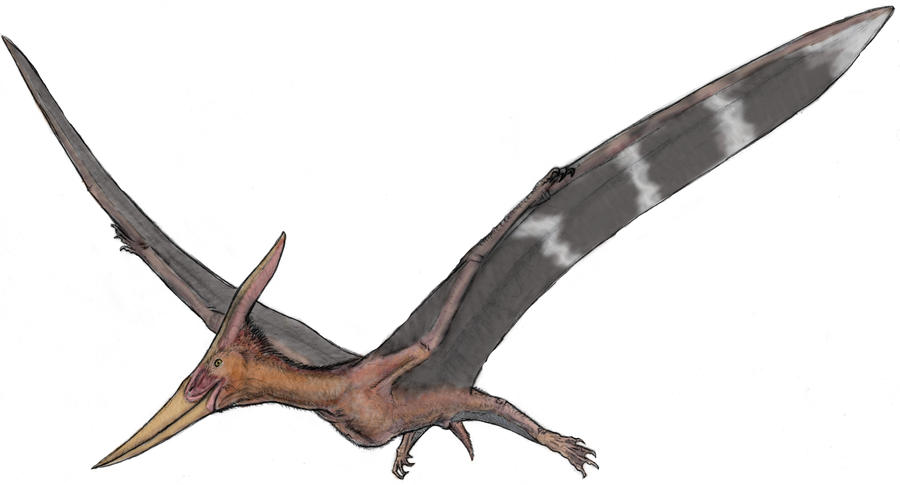
Pteranodon © Asher Elbein
Finally, Pteranodon. Probably the most famous animal in this post, and naturally so. Everybody loves Pteranodon. I chose to reconstruct this particular beast with the wing arrangement favored by John Conway, as I've always found it very aesthetically pleasing. I also gave the animal a small mane under the crest, which would fluff up for display purposes. I decided to avoid the typical sea bird coloration for this illustration. While there a good reasons to believe that Pteranodon might have been so adorned, I wanted to try something different; to wit, a giant fruit bat. I also chose to make the crest less brightly colored, again for the sake of being contrary.

And that's it, folks! This artistic summary of Alabama's Cretaceous life now draws to a close. If you liked the art, feel free to head over to ashere.deviantart.com, for all your folkloric and dinosaurian needs.

Tune in next time for more comic book dinosaurs and a dissection of why, exactly, The Valley of Gwangi is so great.


Monday, April 2, 2012

Hashtagopteryx twitterensis

pteranodon
#PterosaurMyths: Pteranodon had the most frequent occurence of tooth decay in all of the pterosauria; in fact, sometimes individuals are found with no teeth at all! This restoration correctly depicts the animal with a full compliment of teeth. Photo by Arborwin, via Flickr.

The other day, I tweeted a link to my post about the Royal Tyrrell video of Dr. Michael Habib's pterosaur lecture. It's a great talk, and could bring the general public up to speed quickly on current pterosaur research, so I mentioned that it dispels some lingering myths about pterosaurs. Desert blogger Chris Clarke decided to make this joke.


Which led to this inspired bit of hashtaggery.


It slowly grew, with Chris and I trading tweets back and forth, then more of his followers joining in... and then the dark overlord himself, PZ Myers, joined in, bringing even more folks over. It's petered out a bit, but I have a feeling it's not quite dead, so hop on over to twitter and share your own ptweets. You should also check out Darren Naish's takedown of pterosaur tropes at Pterosaur.net. And if you aren't already, do follow Chris Clarke at @canislatrans as well as Coyote Crossing and Desert Biodiversity, where he cuts through a lot of BS and writes incisively about the state of desert ecosystems.

Wednesday, March 28, 2012

The dinosaur grabs two cars and a bucket of fail

When visiting secondhand stores and browsing for dinosaur books, I buy less than I find. Often, books just aren't interesting enough to bother with. On a recent trip to a Goodwill store, I found a book that may have originally come with a Hot Wheels race track, filled as it was with Hot Wheels cars being victimized in various ways by prehistoric beasts. We often note that we don't blame illustrators for dinosaur art that is less than accurate. They're being paid to do a job, and probably don't have the luxury of fussing over details and corresponding with paleontologists. This book was the perfect example; whoever wrote it couldn't even be bothered to distinguish the animals from each other, calling each one "dinosaur." Which lead to this unfortunate page of fail.

The "dinosaur" grabs two cars

Beyond the fact that it's sadly called a dinosaur, there's so much wrong here. The bizarre crest! The teeth! The outlandishly exaggerated scale! The gross wingy tendony things! The rest of the book couldn't quite match this level of doublefacepalmitude, but I had to snap a quick photo of this one.

Got to admit though, the dinosaur-themed Hot Wheels tracks look more fun than a barrel of anurognathids.


Beat that!

Friday, June 11, 2010

Vintage Dinosaur Art: Tim and Greg Hildebrandt

The Brothers Hildebrandt, Tim and Greg, are illustrating legends, and I was heavily stoked when I came across this title at a resale shop, stuffed unceremoniously between two lesser books. Pinup girls, Darth Vader, hobbits, and Hollywood monsters have been brought to life in their unmistakable style, so it's only fitting that the greatest creatures to ever walk the Earth should as well. Titled simply Dinosaurs, it was published by Merrigold Press in 1976.

Merrigold Press Dinosaurs

Dig these hairy Pteranodons, buzzing a Pachycephalosaurus. A bonus ChasmoPointTM for not calling them dinosaurs!

Hildebrandt Pteranodons

Even the Hildebrandts weren't immune to copping a bit of Charles M. Knight's portfolio, though. Witness the latest installment in the Ornitholestes library I'm slowly amassing.

Hildebrandt Ornitholestes

It may look like a man in a suit, but this version of the tyrant king is total evil.

Hildebrandt Tyrannosaurus

I would like to see a post-renaissance take on dinosaurs from the Hildebrandts - maybe a pulpy, lurid series on Jurassic Park. Something like they did with the original Star Wars poster, you know the one with Luke raising his lightsaber above his head and Leia striking a pose at his feet. Only substitute in Alan Grant and Ellie Sattler, with T. rex instead of Darth Vader. I bet their take on the ice cream eating scene would be mind-blowing.

Thursday, May 13, 2010

Pteranodon by Buell

Pteranodon sternbergi
Pteranodon sternbergi by Carl Buell, via flickr.

In my estimation, paleoartists don't get much better than Carl Buell. I've mentioned him previously, but what the heck: this Pteranodon is fantastic. So is his other work, including my favorite rendering of the famous "walking whale" Ambulocetus. He hasn't done a lot of dinosaurs lately, but he's done some wonderful cenozoic mammals. Many of his paintings show his sense of humor, as well: for instance, the one in which he and an australopithecine knock back a couple brews. I'd imagine that the little hominid would be in for a pretty fun night around the campfire.

Be sure to check out Buell's flickr stream; he's apparently had some setbacks preventing him from establishing a better web presence, so it's the best collection of his work I've found. He was also interviewed a few years back by the science blog Unscrewing the Inscrutable.

Friday, March 26, 2010

Vintage Dinosaur Art: High-Kickin' Allosaurus

Mosozoic Spread
Here's a two-page spread from a 1979 Scholastic book called the First Picture Encyclopedia. It's a pretty sweet piece, complete with a gaggle of erupting volcanos, anachronistic fauna, Rudolf Zallinger-inspired Stegosaurus, and one heck of a high-kickin' Allosaurus, which I find particularly amusing. Not only would it be a crazy way for a big theropod to attack its prey, the stance looks pretty implausible.

The book credits four illustrators: Roy Coombs, Cliff Meadway, Mike Atkinson, and Graham Allen, with Coombs' name most prominent. None of them are particularly visible on the web. Mr. Atkinson has a website, but the style doesn't quite match what we see here.

Wednesday, March 24, 2010

The City Museum

The other major stop of our weekend trip to St. Louis was the utterly wickedly wondrous and splendid City Museum. I won't get into the whole history of it; suffice to say that it's a giant indoor playground made of salvaged building materials, and is completely bananas. I didn't go expecting a lot of Mesozoica, but I figured there had to be at least a little. I was happily surprised at what I found.

First, there's this great sauropod staircase, leading from the entry level to the mezzanine and second floor. You can barely make out her head in the first shot...

The City Museum

...so here's a close-up.

City Museum Staircase Sauropod

On the second floor is a small room of natural history type stuff, presumably from other institutions' defunct displays. I was thrilled to find a glass case containing a bunch of fossil casts, including Tapejara, Velociraptor and Masiakasaurus skulls, and some others I didn't get good pictures of. Not that these are hot stuff; I've never been good at snapping photos through glass.

The City Museum

City Museum Velociraptor

City Museum Masiakasaurus

Opposite the display case is a diorama containing various reconstructions, including Bambiraptor, Compsognathus, Sordes, and Anurognathus. They were created by Missouri's Fossilsmith studios; unfortunately, it doesn't look like they've done a lot in the last few years (or maybe they're so busy they haven't had time to update their site). Their work here is excellent. Seeing that extravagantly feathered bambi when I walked into the room was such a great surprise.

City Museum Bambiraptor

City Museum Comsognathus Couple

The room also has a case full of other assorted fossils and casts, including various pterosaurs and a reproduction of Archaeopteryx. Really, its a lot of paleo crammed into a pretty small room. There's also a Pteranodon hanging from the ceiling on the ground level, somewhat out of place as the rest of the area has an undersea theme. But I'm not complaining.

The City Museum

The City Museum

Seriously, this is a must-see if you're ever in St. Louis.