Showing posts with label dromaeosaurs. Show all posts

Wednesday, November 22, 2017

Meet the artist: Jed Taylor

As if you need any further reasons to attend TetZooCon, here's one more. A couple of years ago I ran into a fellow in the post-TZC-pub with a folder full of his own dinosaur drawings. Natee and I had a look, and were suitably impressed; there was room for improvement, but it was a very solid foundation.

Two years later, and the same bloke - Jed Taylor - approached me again in the pub. And this time, I was blown away. His dromaeosaurs are among the best I've ever seen, but it doesn't stop there; he's illustrated a plethora of dinosaurs in a gorgeous, naturalistic style that's very much in the post-Paulian (sorry again), Floof Revolution mould. Even Andrea Cau's heaped praise on his work, and he's very hard to please. I asked Jed if he could write about his work for the blog, and he supplied the following very many lovely words, which it felt quite criminal to edit down. It may be a little 'TL;DR' for some, but it wasn't for me. Enjoy.

Jed's gorgeous Acheroraptor portrait. All art © Jed Taylor, used with permission.

Monday, May 12, 2014

The Illustrated Triassic Club


Oscar, Darwin, and Wallace

Several readers may recall Marc's having covered Blackgang Chine's The Triassic Club before. After our return this Easter to view the newly installed robosaurs of Restricted Area 5, I decided to finally complete this little project which I had actually begun a year ago, that of accurately illustrating the gentlemanly trio (which, for me, also meant accurate period garments, naturally). This was not only overdue but was especially necessary, since the inclement weather during the latter part of our Isle of Wight visit prevented me from drawing a dinosaur on Shanklin beach as I did last time.

Wednesday, November 28, 2012

Archosaurs of Alabama

Welcome back, everybody! Where last we left off, I'd done a brief, illustrated survey of some notable Alabama Cretaceous marine fauna. Here, we turn out attention to some of the archosaurs that would have lived in the parts of the state not covered in seawater. 

I speak, of course, of dinosaurs. Mostly. 


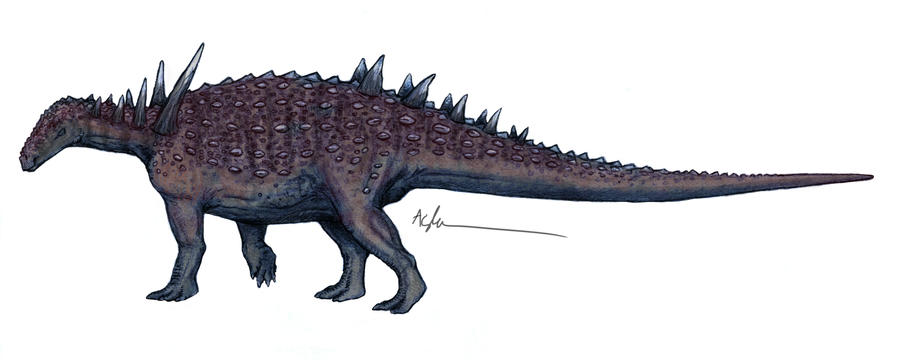
Nodosaurid  © Asher Elbein
Alabama has quite decent nodosaur remains, most of them the product of carcasses washed out to sea by floods and river currents. There, the bodies bloated and were extensively scavenged before they sank to the bottom. This is my first ever attempt at an armored dinosaur (or at least, the first I'm willing to show in public) and I initially thought of restoring it with bright warning coloration, similar to that of a hornet or a yellow jacket. Suffice to say, it didn't really work, so I defaulted to a more hippo-like pattern instead.

 I'm somewhat taken with the idea of nodosaurs dozing in mudpits, small feathered dinosaurs perching on their spikes. It might be worth illustrating at some point.

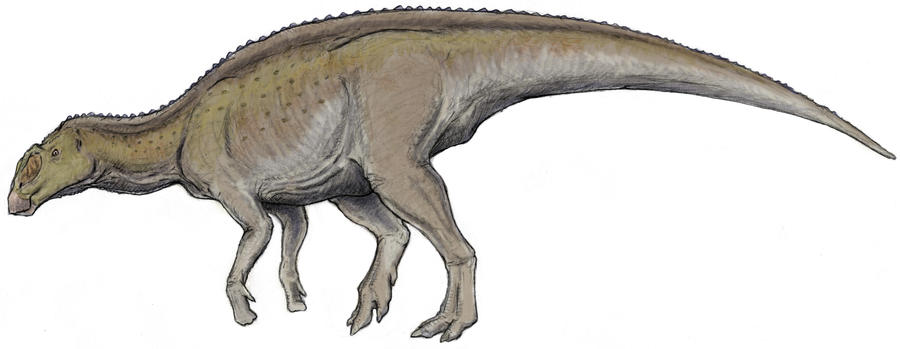
Lophorhothon © Asher Elbein
Lophorhothon is Alabama's main hadrosaurid, and like the nodosaur remains it occurs primarily in marine deposits. It has the twin dignities of being both Alabama's first recorded dinosaur genus and being one of its most taxonomically uncertain; there's some debate as to where, precisely, it fits with regards to other hadrosaurs (or if it's even a hadrosaur at all.) Following the prevailing opinion, I went ahead and restored it as something similar to Prosaurolophus. I wanted something restrained and somewhat dignified, so I turned to a color scheme reminiscent of African grazing mammals.

Dromaeosaurid  © Asher Elbein
The most speculative reconstruction of the bunch. Dromaeosaur fossils in Alabama are extremely rare, centering around a few scattered bits and a preserved feather or two. It's not that surprising; small size and light bones make dromaeosaurs fairly chancy when it comes to preservation, and in marine deposits the likelihood of a carcass lasting is virtually nil. Given that, this is best understood as guess at what an Alabama dromaeosaur might look like.

 I took this illustration as a chance to play around with some different ways to render feathers (I'm particularly proud of the neck region.) The patterns are based--extremely loosely--on the Caracara, a modern raptor that spends a fair amount of time on the ground.

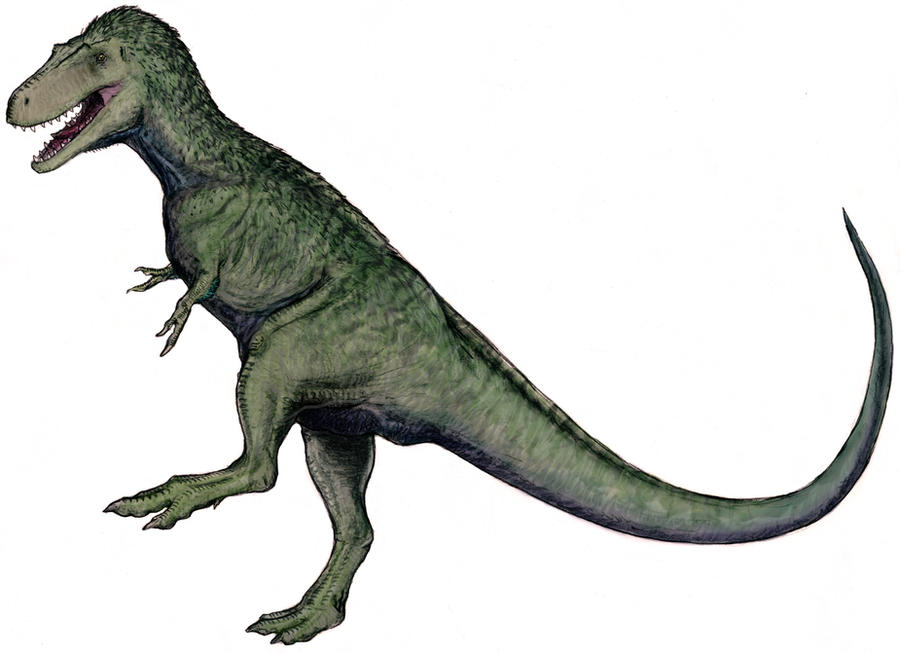
Appalachiosaurus © Asher Elbein
No Cretaceous dinosaur assemblage is complete without a big theropod, so here we have Appalachiosaurus, the 30 foot tyrannosaurid. Appalachiosaurus also has the distinction of being the most completely known theropod from the eastern coast of North America, a part of the country that lacks the excellent fossil fields out west. The mounted specimen at the McWayne Science Center shows large, three clawed arms. I'm unsure of the accuracy--nothing has apparently been published yet--so I chose to restore Appalachiosaurus as a fairly typical albertosaurid. I gave it a sparse covering of protofeathers on the head and neck, and based the coloration on that of the Emerald Swift, an extremely pretty little lizard common in Central America. There was no particular scientific reason for doing so; I just liked the challenge of adapting the color scheme to an animal of radically different size and shape.

Of all of the reconstructions, this is the one I suspect is going to be rendered invalid by later publications, but one of the nice things about paleontological art is that it affords you the opportunity to make guesses that may or may not be correct.

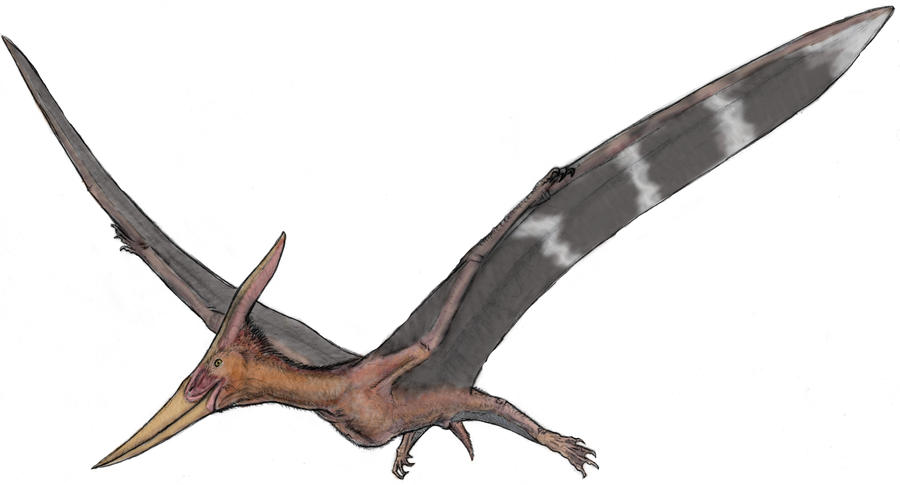
Pteranodon © Asher Elbein
Finally, Pteranodon. Probably the most famous animal in this post, and naturally so. Everybody loves Pteranodon. I chose to reconstruct this particular beast with the wing arrangement favored by John Conway, as I've always found it very aesthetically pleasing. I also gave the animal a small mane under the crest, which would fluff up for display purposes. I decided to avoid the typical sea bird coloration for this illustration. While there a good reasons to believe that Pteranodon might have been so adorned, I wanted to try something different; to wit, a giant fruit bat. I also chose to make the crest less brightly colored, again for the sake of being contrary.

And that's it, folks! This artistic summary of Alabama's Cretaceous life now draws to a close. If you liked the art, feel free to head over to ashere.deviantart.com, for all your folkloric and dinosaurian needs.

Tune in next time for more comic book dinosaurs and a dissection of why, exactly, The Valley of Gwangi is so great.


Friday, January 20, 2012

Plateosaurus didn't gallop

Recently, I finally read a paper by Heinrich Mallison entitled 'The digital Plateosaurus II: an assessment of the range of motion of the limbs and vertebral column and of previous reconstructions using a digital skeletal mount'. Yes, it's from 2010, and I should hang my head in shame for not having read it before etc. etc. But bear with me. Reading Heinrich's paper, I was reminded of an e-mail sent to us some time back by Jay Epperhart, one that I referenced in a previous post. As a reminder, it read:
"So occasionally you will make a quip along the line of 'can you believe they ['80s and '90s authors/artists] thought dromaeosaurid theropods had non-feathered pronated hands *snicker*" and I'm like 'wait, what?!' since that it what my 10-year-old self memorized."
It's all about preconceptions, you see. In case you haven't read it (in which case, shame on you, too!), in 'The digital Plateosaurus II', Mallison - utilising a painstakingly-created digital Plateosaurus skeleton - looked at (perhaps predictably, given the title) the possible range of motion of Plateosaurus' spine and limbs, and the implications for a range of reconstructions.

Photo of SMNS wrong-o-mount by Ra'ike, via Wikipedia.


In the past, Plateosaurus was often presumed to be a quadruped - or at least, capable of switching between quadrupedalism and bipedalism, but tending towards the former. Looking at it, it's quite easy to see why - with its long neck and reasonably robust forelimbs, it looks a little front heavy. Furthermore, the more derived sauropodomorphs - the sauropods - were all resolutely quadrupedal, and so it made sense for the lineage to be heading in that direction, evolutionarily speaking. In addition, trackway evidence appeared to show 'prosauropods' walking on all fours.

However, Mallison discovered that far from being a habitual quadruped, Plateosaurus was not even able to rotate its forearm so that the palms of its hands faced the ground (pronation) - in fact, the range of motion was comparable with that of the short-armed allosauroid Acrocanthosaurus. In other words, Plateosaurus was a biped whether it liked it or not.

In fact, Mallison's work had independently confirmed the conclusions of an earlier study, by Matthew Bonnan and Phil Senter, in 2007 ('Were the basal sauropodomorph dinosaurs Plateosaurus and Massospondylus habitual quadrupeds?'). Bonnan and Senter also found Plateosaurus to be an obligate biped, in spite of the great number of quadrupedal Plateosaurus reconstructions that had popped up in the many decades since the animal's discovery.

Plateosaurus gracilis correctly restored as a biped, by Nobu Tamura via Wikipedia.
Note that this species has sometimes been placed in its own genus, Sellosaurus -
Mallison's paper deals only with P. engelhardti.


In his study, Mallison found that some of said reconstructions didn't just snap the forelimbs into an impossible position, but warped much of the rest of the body as well. A quadrupedal mount in the Staatliches Museum für Naturkunde Stuttgart (SMNS) is of sufficient sprawling-limbed wrongness that, if the animal were alive "compressive forces on the forelimbs would shear the humerus from the glenoid" (p. 449). Mallison goes on to comment that
"The...overall proportions and limb positions are in direct contradiction to the adaptations to cursoriality visible in Plateosaurus, and require significant disarticulation in several parts of the skeleton."
Mallison ultimately attributes such mistakes to the need for the reconstruction to fit a preconceived notion that Plateosaurus was highly reptilian and lizard-like, with sprawling limbs and a wide ribcage.

In addition, quadrupedal reconstructions by Gregory S Paul were found to feature very significant inaccuracies, and this was especially true of a muscular reconstruction that depicted Plateosaurus in a galloping pose (if you have the 2010 Field Guide it is on page 162). The errors - including limbs in impossible positions and huge gaps in the skeleton - were inconsistent with a reliance on data provided by Friedrich von Huene (Paul had not examined the fossils). Rather, Mallison claimed that
"...the errors seem to result from a preconceived notion that prosauropods were quadrupedal, that their manual digits I were raised off the ground during locomotion...and a desire to depict the animal in as dynamic a pose as possible." (p. 455)
(An important note before I continue: I in no way wish to join in what seems like a bit of a trend for Greg Paul-bashing after his comments pertaining to copyright and skeletals. It just happens to be Paul's work that is described in this way in Mallison's paper.)

How is this relevant to Jay Epperhart's comments about dromaeosaurs? Well, just like Plateosaurus, reconstructions of these animals were long influenced by preconceived notions, leading to the reconstructions we all remember from the '90s that often flew in the face of anatomical evidence and common sense. In fact, people's notions of what these animals looked like continue to be influenced by preconceptions based on what said people think they should look like.

Pronated theropod forearms would be an obvious reference point here. They still appear regularly in art - often commercial art - but are always based on someone's preconceived notion of how a theropod should look. The same is true of scaly or near-bald dromaeosaurs; hopefully I needn't go over the evidence yet again as to why it's far, far more likely that any given dromaeosaur was feathered than not. Those who dream of scaly Deinonychus often seem to resort to the argument that 'it looks like a chicken' when (accurately) depicted with feathers - as if looking like a plucked chicken is less absurd. And let's be quite honest - an anatomically correct, naked dromaeosaur will inevitably look like it's been prepared for the dinner table.

In truth, I think it's down to the '10 year old self' coming through with preconceived notions, borne of nostalgia and a belief in what a dinosaur should look like, contrary to the evidence. But it's not the 1990s anymore, Plateosaurus didn't gallop, and Deinonychus had feathers.

And if you're angry at me now, please placate yourself with this photo of me being a dork (also featuring Plateosaurus).


Photo by Nicole Heins.


Tuesday, August 31, 2010

Bună ziua, Balaur bondoc


Balaur bondoc, by Mick Ellison. From the PNAS paper.

I love the smell of lifted embargos in the morning. Yesterday, the web exploded to life with news of a new dromaeosaur from the Haţeg Basin in Romania, newly described in the Proceedings of the National Academy of Sciences. Remember the fuss Dr. Grant made over the Velociraptor's single sickle-claw at the beginning of Jurassic Park? Well, Balaur bondoc (the "stocky dragon") had two of them. Suck on those, Telmatosaurus and Magyarosaurus.

This is a significant discovery, helping paleontologists flesh out the menagerie of strange island dinosaurs from the European archipelago during the late Cretaceous. Balaur is the first good fossil of a predatory dinosaur from the time, and provides additional insight into the unique ways animals evolve on islands, where they are isolated from their mainland brethren and have to compete for food in different ways.

Because of limits on space, and therefore food, islands often cause populations of large herbivores to reduce in size over time. About a century ago, Franz Baron Nopsca believed this to be the explanation for the herbivorous dinosaurs discovered in Transylvania, an hypothesis that took a while to gain traction, but which is now widely accepted (I wrote about the Baron and his island dwarf ideas last spring). What was eating those smaller sauropods and dantier ornithopods? One of their harrassers would have been Balaur, a scaled-up relative of Velociraptor.

One part of the island rule holds that as herbivores reduce in size to better manage scarce food sources, predators grow to take advantage of the easier prey. Balaur is only a bit larger than Velociraptor (which in reality was a fraction of the size othe JP version, leading Dan Telfer to joke that he'd punt one out of the way if it tried anything with him). But it's a lot more robust than the lithe Mongolian dromaeosaur.

Its unique features don't end with its stockiness: Balaur possessed the above-mentioned twin sickle-claws, four functional toes on its feet as opposed to the typical three for theropods, and a two-fingered hand. This was clearly a predator adapted for a unique lifestyle. Those two claws on its feet have been proposed as its main weapons - as coauthor Steven Brussatte says, "Compared to Velociraptor, Balaur was probably more of a kickboxer than a sprinter, and it might have been able to take down larger animals than itself, as many carnivores do today." The skull of Balaur has yet to be found. I'd love to see if it had additional unique features which may have been of use in taking down prey.

The authors, led by Zoltán Csiki of Bucharest University, write that Balaur's close kinship to the Mongolian Velociraptor suggests that there must have been some connection between the islands and the mainland, an idea that has been hard to state firmly until now. Those herbivorous dwarf dinosaurs of Haţeg are more primitive than their late Cretaceous relatives, suggesting that they had been isolated from their mainland families since the Jurassic. Not so with Balaur. This is an animal descended from advanced dromaeosaurs of the late Cretaceous, so it must have arrived later.

This leads to my big, possibly stupid question, which I'll nonetheless pose here. What if Balaur isn't an example of the island rule after all? Dromaeosaurs are (for the most part) small, nimble predators who may have been able to travel between the island and the mainland more easily than the herbivores. Its unique features may have been of use on the mainland, and it may have been able to access the islands by swimming. Hoping for more skeletons of an interesting new dinosaur like Balaur is a lot to ask, but I'll be interested to see where else they might turn up. Preferably with a nice, complete skull. Csiki promises functional analyses to come in this interview, which will help shed light on how this two-finger, four-toed, robustly built dude hunted.

This is the kind of new species that's easy to get excited about. It represents new and interesting variations on the classic dromaeosaur body plan. It's in a geographically interesting place. Its relation to other dromaeosaurs is significant. And it's got one heck of a cool sounding name, conjuring a positively Tolkienian mood. Balaur bondoc sounds like some dark memory from the depths of elvenlore. Anytime you're compelled to say both the genus and species name, you know you've got a keeper.

More coverage of Balaur bondoc:

Not Exactly Rocket Science
Discovery
More From Discovery: Jennifer Viegas interviews Zoltán Csiki
Nat Geo
Science Daily
DinoGoss
Dinosaur Tracking
Wired (including very cool illo of Velociraptor)
HuffPo
BBC
The Dragon's Tales
Everything Dinosaur

PS. Bună ziua = "Good day" in Romanian.

Thursday, September 17, 2009

More on Velociraptor Feet

I love the outdoors. I love rocks, big and small. I like feeling them, and I like clambering over them. But to see someone scaling a sheer wall, hundreds or thousands of feet in the air, seizes my breath. I can't imagine possessing the kind of focus it would take to perform such a feat. A common occurence in my dreams is a terrible weakness in my hands - I throw a punch and it's no more than a bop from a pillow. Something in me doubts the power in my hands, and I can't help but think they would fail me, lose grip on whatever fissure or outcrop they were holding, and I'd fall to the ground, vulture food.


Image copyright American Museum of Natural History

The above fossil, a national treasure of Mongolia, is such a rare thing that to even imagine it seems unimaginable: an actual interaction between animals, fossilized. It's a protoceratops and a velociraptor, fighting. It's believed that in the midst of their struggle, the pair were either buried in a collapsed sand dune or overtaken in a sand storm.

In the recent paper on dromaeosaur claws, Manning et al add another possible factor in the death grip. They cite a characteristic I had no idea modern perching birds possessed. And in light of the mild neurosis I mention in the opening paragraph, I'm envious.

I've always taken it for granted that some birds sleep while perched. They just do. I've never given it a second thought. It turns out that the bird doesn't have to give it any thought, either. They land on a limb, their foot grasps it. No special effort needed. The tendons that flex their toes are modified so they automatically lock the foot around the branch. If I possessed a similarly built pair of hands, well, I wouldn't need to worry about losing my grip. I'd grab a handhold, my hand would lock on it, and I could doze off. I'm sure my adrenaline would prevent me from falling asleep, but I wouldn't fear falling from the rock face as I vainly counted (bighorn) sheep.

This paper suggests that dromaeosaur feet were adapted similarly, as they have a ridge on the bones that make up their sickle-claw toe. When a pack of them ambushed an Edmontosaurus, that fearsome claw on their second toe would just lock into it. They would go about their bloody business without giving thought to maintaining a hold on their prey.

Perhaps the Velociraptor in Mongolia's treasure was literally locked to that protoceratops. The proto had its attacker's arm in its beak. They'd fought each other to a stalemate. The raptor had nowhere to lock its jaws. As Manning writes, "Unable to reposition its limbs, it was impossible for the Velociraptor to deploy its jaws and finish the attack, like two boxers hugging each other and unable to throw a punch."

Wednesday, September 16, 2009

Cowboying Up to Science

As I noted in an introductory post when I started this blog, I'm not an "armchair paleontologist," or even a "footstool paleontologist." I'm basically a dude whose childhood enthusiasm for dinosaurs never wore off. Rather, it metastasized into a love of natural history. I was lousy (or was it just lazy?) at math in school. Thus, I withered when it came time to really "cowboy up" and get into the nitty-gritty of science. I pity Mr. Cline, my poor chemistry teacher. And my lab partners, who shouldered the burden of presentations while I did the visual aids.

So I haven't read much in the way of scientific papers, the heavy sort that appear in journals. Until yesterday, when media accounts of the "climbing raptor" story left me feeling that there was something lacking. So I hopped over to The Anatomical Record online and dug into Biomechanics of Dromaeosaurid Dinosaur Claws: Application of X-Ray Microtomography, Nanoindentation, and Finite Element Analysis.

And you know what? Not so scary. Not at all. So much so, it kind of makes me even more angry that journalists - especially science journalists - so frequently get this stuff so wrong. I'm not sure how many of them actually read the papers they report on, once they figure out their angle and run the abstract through the cuisinart of their brain. These are people who are paid to do this stuff. Or in the case of freelancers, whose accuracy is important to their reputations, and therefore their future work.

The formulas used to describe the biomechanics of Velociraptor's claws are, I'll admit, opaque to me. But it certainly isn't my intent to offer a rebuttal on the fine points of the hypothesis. What interested me about this story was the way it took on a popular conception of an extinct animal and looked beyond it. Reading the abstract, discussion, and conclusions, my main difficulty was in vocabulary. But that is easy to learn. It's just a matter of looking it up, which takes mere seconds on the web.

I'm heartened by this little development. I feel more confident that I may be able to make a contribution to the Open Dinosaur Project, for example. We'll see if time permits.

And I hope that what I can do in the future is not just link to a cool story, or paraphrase it with a pithy comment or two of my own thrown in. My intention is to look at popular stories, look at the papers themselves, and maybe provide some extra meat to chew on, stuff other people may have left on the ground. I'll scavenge it, to stretch the metaphor further.

The image of a raptor using that fearsome claw to rip open a larger beast's guts and spill its viscera all over the dusty ground is a pretty picture, I'll admit. Tomorrow, I'll flesh out the newer idea Phil Manning introduces, and how something cool I learned about the feet of extant avian theropods (in fewer letters, "birds") may teach us something about the feet of Velociraptor and its kin.

Velociraptor mongoliensis
Image by Olli72, via flickr

Tuesday, September 15, 2009

Raptors Don't Grow On Trees

A few years ago, Phil Manning at the University of Manchester used a robotic simulation of the dromaeosaur sickle claw to determine how it may have been used - he wanted to test the assumption, popularized by Jurassic Park, that it was a disemboweling tool, perfect for slashing through the bellies of prey dinosaurs. The robo-claw wasn't actually able to slash through the flesh of a pig's carcass; rather, it punctured it. This led to the conclusion that raptors most likely used the claws to maintain a grip on their larger prey while ripping them up with their teeth, leading to a pretty awful, painful death by bleeding.

Manning is continuing to explore the use of dromaeosaurs' claws, and a recent study of the claws of their hands, published in the newest, dino-centric issue of the Anatomical Record, suggests that they could have supported their weight when climbing. In particular, the paper discusses the manual (hand) claws of Velociraptor mongoliensis, whose inner curve had an arc of 127 degrees, which falls between the upper limits of perching bird claws and the lower limits of trunk-climbing bird's claws. Manning also refers back to a 1969 study of Deinonychus antirrhopus, another small dromaeosaur; their pedal (foot) claws had an arc of 160 degrees, which is in line with the upper range of today's trunk-climbing birds, like woodpeckers or the nuthatches which frequent my suet block. Further studies will be devoted to Deinonychus foot claws, of which we have more good specimens than those of Velociraptor.

So the dromaeosaurs, at least the smaller ones, may very well have used their claws to climb trees as well as hang on to their dinners. Lacking any proper paleoart depicting this fascinating new idea, here's an incredibly crappy, dashed-off, proportionally inaccurate one from yours truly.
Raptor in a Tree
Image by me, via flickr