

Showing posts with label tyrannosaurus rex. Show all posts
Showing posts with label tyrannosaurus rex. Show all posts
Wednesday, September 6, 2017
Vintage Dinosaur Art: Paper Dinosaurs
Hello faithful LITC readers! I'm back from 5 weeks in the wilderness and SVP, and have a pretty cute piece of vintage dinosaur art to share with you. Today we're looking at Paper Dinosaurs: 20 Model Monsters to Cut and Fold, by David Hawcock and published in 1988 by Marshall Cavendish Books.


Tuesday, June 14, 2016
The Tyrannosaur Chronicles competition: the winners
So who wins a copy of Doctor Dave's magnum opus? Predictably, we had a slew of excellent entries for this competition (eventually), but in the end we did have to pick that half dozen. And so, in no particular order (because they all win the same prize, after all), here they are - with commentary from Niroot and I.


Tuesday, June 7, 2016
The Tyrannosaur Chronicles competition: the contenders
Like undergraduate students everywhere, you lot submitted a flurry of entries for our Tyrannosaur Chronicles competition right before the deadline. But no matter! You still got in. While the final six winners will ultimately be decided by us, I thought (as with previous competitions) it'd be fun to put up a gallery of all the entrants and gather some of your opinions before we dole out the books. So, in no particular order, here's a gallery of T. rex...TRIUMPHING!


Monday, April 25, 2016
The Tyrannosaur Chronicles book launch
Friday the 22nd April saw the official launch of Dr. David Hone’s
first book, The Tyrannosaur Chronicles (Bloomsbury Sigma),
at Queen Mary University London, in the rather lovely book-lined Octagon of
Queen’s Building -- which, if the British Museum’s Enlightenment Gallery should
fail to become my library, would serve pretty well in its stead. Dr. Dave has written
about the book’s publication on his blog, and it has already gained a deservedly positive reception, not least among which is Tom Holland’s glowing review on New Statesman. And we at Love
in the time of Chasmosaurs are very much hoping to post one or two of our
own in due course.

After an introduction by Dr. Steve Le Comber, Dr. Dave read two short extracts from the book. The first, on a method of prey despatch, was especially illuminating and memorable for me simply because the conjecture never once occurred to me, but which once posited made such elegant sense:
‘The huge caudofemoralis muscles ran from the femur and up most of the first third of the tail in all dinosaurs. The tail gave a huge amount of power to the legs for running, was full of major blood vessels and was not surrounded by bone. A heavy bite anywhere around the thigh or first part of the tail might well have crippled an animal, leaving it unable to run and bleeding badly. Also, the tail was one of the first things a pursuing hunter would encounter in a fleeing animal, so using this technique would have reduced the chase distance, which would have been important especially if the prey animal was fundamentally faster than the tyrannosaur. Notably, there are two fossil hadrosaurs showing injury to the tails from tyrannosaur bites, and another with a wound to the leg; it’s a very limited data set, but it does nonetheless point to this as a strategy.’
After the readings, the audience was treated to a live link-up via Skype with the book’s illustrator, Scott Hartman, whose trusted, accurate skeletals I’m sure require no introduction here. Dr. Dave prefaced this by pointing out the precision of Scott’s working methods, and recounting how, during the course of writing the book, when Dave was asked whether he had a second choice in mind in the event that Scott couldn’t be procured, his answer was a quite decisive ‘well, no.’

The last of the formalities was the purchasing and signing of copies of the book (all which were brought to the launch sold out), whilst guests also had time to ogle at, photograph, and even handle the various casts that were on display.


It was a great pity that Marc couldn’t make it this time, or without question there would have been some choice goofy pictures with the fantastic skull, and you would have had a superior post than this besides (in more ways than one). Never mind. I did at any rate get a picture of another star who also happened to be there.
The evening itself was rounded off with the hosts and guests
all trooping off to a nearby pub for a celebratory drink. Marc was more than
especially missed at this point. On that note, he and I have been chatting over
a little competition which we’re hoping to launch very shortly, with copies of
this very book as prizes, hurrah! Watch this space, as they say.


After an introduction by Dr. Steve Le Comber, Dr. Dave read two short extracts from the book. The first, on a method of prey despatch, was especially illuminating and memorable for me simply because the conjecture never once occurred to me, but which once posited made such elegant sense:
‘The huge caudofemoralis muscles ran from the femur and up most of the first third of the tail in all dinosaurs. The tail gave a huge amount of power to the legs for running, was full of major blood vessels and was not surrounded by bone. A heavy bite anywhere around the thigh or first part of the tail might well have crippled an animal, leaving it unable to run and bleeding badly. Also, the tail was one of the first things a pursuing hunter would encounter in a fleeing animal, so using this technique would have reduced the chase distance, which would have been important especially if the prey animal was fundamentally faster than the tyrannosaur. Notably, there are two fossil hadrosaurs showing injury to the tails from tyrannosaur bites, and another with a wound to the leg; it’s a very limited data set, but it does nonetheless point to this as a strategy.’
After the readings, the audience was treated to a live link-up via Skype with the book’s illustrator, Scott Hartman, whose trusted, accurate skeletals I’m sure require no introduction here. Dr. Dave prefaced this by pointing out the precision of Scott’s working methods, and recounting how, during the course of writing the book, when Dave was asked whether he had a second choice in mind in the event that Scott couldn’t be procured, his answer was a quite decisive ‘well, no.’

The last of the formalities was the purchasing and signing of copies of the book (all which were brought to the launch sold out), whilst guests also had time to ogle at, photograph, and even handle the various casts that were on display.


 |
| Dave points out that the manus here belongs to Albertosaurus rather than T. rex |
It was a great pity that Marc couldn’t make it this time, or without question there would have been some choice goofy pictures with the fantastic skull, and you would have had a superior post than this besides (in more ways than one). Never mind. I did at any rate get a picture of another star who also happened to be there.
 |
| Luis Rey! |

Tuesday, January 12, 2016
Vintage Dinosaur Art: Presenting Tyrannosaurus rex
While best known for her spectacular work with Dale Russell on An Odyssey in Time, the late, great Eleanor 'Ely' Kish remained active in palaeoart throughout the '80s and into the '90s, although many of the books she illustrated are now quite obscure. This would be one of those. In fact, this was one of those cases where I saw an intriguing-looking book appear on eBay for the first time, only to obtain it and realise that I had it as a kid. Given that, it unsurprisingly concerns everyone's favourite hungry hungry horror. May I present Presenting Tyrannosaurus rex.


Monday, October 13, 2014
Book Review: Tales of Prehistoric Life by Daniel Loxton
This spring, Daniel Loxton published his third and final children's book in the Tales of Prehistoric Life series: Plesiosaur Peril, the story of the dangerous life of a young Cryptoclidus in the Jurassic. It was proceeded by Ankylosaur Attack (2011) and Pterosaur Trouble (2013). Today I'll cover all three. The TL;DR version: they're great.

Daniel Loxton's name is probably recognizable to the portion of our readers who also follow skeptical media. He cowrote Abominable Science with Donald Prothero as well as writing and illustrating the children's book Evolution: How We And All Living Things Came to Be. Loxton is also well-known for his work editing the Junior Skeptic section of Skeptic Magazine. Illustrator Jim WW Smith, who has also worked for Junior Skeptic, provides work on the models for the Tales of Prehistoric Life series. Loxton provides the finishing textures and colors, as well as photographing environments.
I especially appreciate Loxton's series for taking up the mantle of the Rourke titles we've covered so many times during the Vintage Dinosaur Art series. Like the Rourke collection, each Tales of Prehistoric Life book is a narrative story, detailing interactions between temporally and geographically appropriate animals. I love this approach. When grounded in modern paleontological understanding of the life and times of the animals involved, it's both engaging and educational. Like the Rourke titles of yesteryear, each book in this series also wraps up with a brief explanation of the scientific grounding of the story.
 The Cryptoclidus family swims through a teeming Jurassic sea. © Daniel Loxton.
The animal interactions are firmly in the realm of plausibility. There are moments that seem a bit of a stretch, such as a veritable army of Saurornitholestes laying seige to the Quetzalcoatlus hero of Pterosaur Trouble. However, there's nothing more outlandish than Dinosaur Revolution's more slapstick moments. Since I'm on the record of admiring much of what that series did, you can predict my reaction here. When the Quetzalcoatus quad-launches to escape his attackers, one of them inadvertently hitches a ride before being flung onto the head shield of a Triceratops, and I couldn't help but crack a smile.
3D dinosaur art is too often only mentioned when picking out the worst offenders, so it's easy to forget that it is often done very well, and Loxton's work here is a prime example. For the most part, the animals are integrated into their photographic environments very smoothly, and interact with them believably - there is a sense of weight and heft to the animals as they walk on sand, browse vegetation, or fall into water. The experience is an immersive one, with illustrations filling entire spreads. The point of view is often right in the middle of the action. Loxton's attention to detail rewards free exploration of the environments and their inhabitants. Feathers float on the air in the midst of combat. Age and experience are obvious, as in an old ankylosaur with battle-damaged armor or a pycnofibre-covered pterosaur.

Quetzalcoatlus soars over the late Cretaceous world. © Daniel Loxton.

An Ankylosaurus couple browses in the forest. © Daniel Loxton.
Coloration is handled conservatively. There are no Rey-style color schemes. Proto-birds and dromaeosaurs are given the most colorful integument. I particularly liked the ruddy tones of Saurornitholestes, reminiscent of the Brown Thrashers who inhabit a similar woodland habitat in my neck of the... er, woods. I also enjoyed touches like subtle sexually dimorphic coloring on the Triceratops, and a seaweedy-green on the Cryptoclidus family at the heart of the most recent book. The tyrannosaurs who appear in Ankylosaur Attack and Pterosaur Trouble could do with some plumage and a splash of color (as well as some more neck musculature, which to my eye looked a little skinny). On the other hand, it's refreshing for the tyrant king to step out of the spotlight.

A Saurornitholestes pack smells something big and tasty on the wind. © Daniel Loxton.
Loxton's choices in depicting behavior are the strongest aspect of the stories, as pains are taken to focus on details of Mesozoic life lent us by recent paleontological research. Quetzalcoatlus falls prey to small dromaeosaurs because of tooth marks found on actual fossils of the great azhdarchid. It bears repeating that the pterosaur is depicted performing a quad-launch, too (a touch which pleased Mark Witton greatly). The family unit in Plesiosaur Peril is based on evidence that these marine reptiles were viviparous. It's a stretch to lump Loxton's book series in with the All Yesterdays Movement. But it is certainly complimentary in its dedication to anatomical fidelity and reasonable inference, while offering views of prehistoric life which reflects the way extant animals act rather than what Hollywood dinosaurs are asked to perform for the masses. There's no need to layer on excessive personification or spectacle after spectacle. Loxton's adherence to this is the main reason the books succeed.
 The Cryptoclidus family feeds on belemnites. © Daniel Loxton.
My only major critique is that a more readable typeface for the body copy of the books could have been chosen, but that's a small quibble in the big scheme of things. This is as good as prehistoric fiction gets. The life restorations are exactly the kind that the new generation of paleontology fans should have access to: contemporary, not stuck in decades-old knowledge. All books in the series are available at major booksellers or via Skeptic.
Around the web: Check out Loxton's post about Plesiosaur Peril at SkepticBlog. Darren Naish wrote a detailed post about the book at TetZoo - fitting since he served as technical consultant for the whole series. Adam Stuart Smith reviewed Plesiosaur Peril at Plesiosauria.com. Dispersal of Darwin's Michael Barton reviewed Plesiosaur Peril in March (and reviewed the other titles in the series previously). Ankylosaur Attack recieved positive reviews from Quill and Quire, Kirkus, and SkepticDad.
Daniel Loxton's name is probably recognizable to the portion of our readers who also follow skeptical media. He cowrote Abominable Science with Donald Prothero as well as writing and illustrating the children's book Evolution: How We And All Living Things Came to Be. Loxton is also well-known for his work editing the Junior Skeptic section of Skeptic Magazine. Illustrator Jim WW Smith, who has also worked for Junior Skeptic, provides work on the models for the Tales of Prehistoric Life series. Loxton provides the finishing textures and colors, as well as photographing environments.
I especially appreciate Loxton's series for taking up the mantle of the Rourke titles we've covered so many times during the Vintage Dinosaur Art series. Like the Rourke collection, each Tales of Prehistoric Life book is a narrative story, detailing interactions between temporally and geographically appropriate animals. I love this approach. When grounded in modern paleontological understanding of the life and times of the animals involved, it's both engaging and educational. Like the Rourke titles of yesteryear, each book in this series also wraps up with a brief explanation of the scientific grounding of the story.
The Cryptoclidus family swims through a teeming Jurassic sea. © Daniel Loxton.
The animal interactions are firmly in the realm of plausibility. There are moments that seem a bit of a stretch, such as a veritable army of Saurornitholestes laying seige to the Quetzalcoatlus hero of Pterosaur Trouble. However, there's nothing more outlandish than Dinosaur Revolution's more slapstick moments. Since I'm on the record of admiring much of what that series did, you can predict my reaction here. When the Quetzalcoatus quad-launches to escape his attackers, one of them inadvertently hitches a ride before being flung onto the head shield of a Triceratops, and I couldn't help but crack a smile.
3D dinosaur art is too often only mentioned when picking out the worst offenders, so it's easy to forget that it is often done very well, and Loxton's work here is a prime example. For the most part, the animals are integrated into their photographic environments very smoothly, and interact with them believably - there is a sense of weight and heft to the animals as they walk on sand, browse vegetation, or fall into water. The experience is an immersive one, with illustrations filling entire spreads. The point of view is often right in the middle of the action. Loxton's attention to detail rewards free exploration of the environments and their inhabitants. Feathers float on the air in the midst of combat. Age and experience are obvious, as in an old ankylosaur with battle-damaged armor or a pycnofibre-covered pterosaur.
Quetzalcoatlus soars over the late Cretaceous world. © Daniel Loxton.
An Ankylosaurus couple browses in the forest. © Daniel Loxton.
Coloration is handled conservatively. There are no Rey-style color schemes. Proto-birds and dromaeosaurs are given the most colorful integument. I particularly liked the ruddy tones of Saurornitholestes, reminiscent of the Brown Thrashers who inhabit a similar woodland habitat in my neck of the... er, woods. I also enjoyed touches like subtle sexually dimorphic coloring on the Triceratops, and a seaweedy-green on the Cryptoclidus family at the heart of the most recent book. The tyrannosaurs who appear in Ankylosaur Attack and Pterosaur Trouble could do with some plumage and a splash of color (as well as some more neck musculature, which to my eye looked a little skinny). On the other hand, it's refreshing for the tyrant king to step out of the spotlight.
A Saurornitholestes pack smells something big and tasty on the wind. © Daniel Loxton.
Loxton's choices in depicting behavior are the strongest aspect of the stories, as pains are taken to focus on details of Mesozoic life lent us by recent paleontological research. Quetzalcoatlus falls prey to small dromaeosaurs because of tooth marks found on actual fossils of the great azhdarchid. It bears repeating that the pterosaur is depicted performing a quad-launch, too (a touch which pleased Mark Witton greatly). The family unit in Plesiosaur Peril is based on evidence that these marine reptiles were viviparous. It's a stretch to lump Loxton's book series in with the All Yesterdays Movement. But it is certainly complimentary in its dedication to anatomical fidelity and reasonable inference, while offering views of prehistoric life which reflects the way extant animals act rather than what Hollywood dinosaurs are asked to perform for the masses. There's no need to layer on excessive personification or spectacle after spectacle. Loxton's adherence to this is the main reason the books succeed.
The Cryptoclidus family feeds on belemnites. © Daniel Loxton.
My only major critique is that a more readable typeface for the body copy of the books could have been chosen, but that's a small quibble in the big scheme of things. This is as good as prehistoric fiction gets. The life restorations are exactly the kind that the new generation of paleontology fans should have access to: contemporary, not stuck in decades-old knowledge. All books in the series are available at major booksellers or via Skeptic.
Around the web: Check out Loxton's post about Plesiosaur Peril at SkepticBlog. Darren Naish wrote a detailed post about the book at TetZoo - fitting since he served as technical consultant for the whole series. Adam Stuart Smith reviewed Plesiosaur Peril at Plesiosauria.com. Dispersal of Darwin's Michael Barton reviewed Plesiosaur Peril in March (and reviewed the other titles in the series previously). Ankylosaur Attack recieved positive reviews from Quill and Quire, Kirkus, and SkepticDad.
Wednesday, September 11, 2013
I really love your tyrant feet
Back at the start of the month, the distastefully talented author, artist, blogger, and nomen oblitum enthusiast Matt Martyniuk posed an interesting question on his Dino Goss blog - namely, does anyone actually have any evidence that non-avian dinosaurs possessed birdlike scutes on their feet? Well, it turns out that, in the form of Concavenator, they do, although that does limit said scutes to tetanuran theropods, and artists frequently depict animals far more distantly related to birds (even ornithischians) with them. As Matt pondered,
One other thing - I've also decided to turn this into a (very easy) COMPETITION! Hurrah! The first person to leave a comment naming all of the artists will get a rubbish dinosaur book from my out-of-control stockpile. I'll also throw in a card featuring artwork by Niroot, which I will ask him very nicely to sign.

Right, then. For starters, here's the Real Deal - sort of. These belong to a cast of 'Stan' mounted in the Oxford University Museum of Natural History, and they're really quite enormous. Check out the arctometatarsalian condition, whereby the middle metatarsal is 'pinched' between the other two.

Here's an early entry by a highly respected palaeoartist of the classic era. No sign of tarsal scutes here, but check out the rather large, apparently reversed first toe (hallux), jutting out like a spur.

This artist (signature censored, because I'm in denial) has illustrated T. rex with rather more slender, shapely toes and what appear to be weight-bearing plantar pads, in spite of also giving it a bizarre, splayed stance. The left foot in particular appears very birdlike, and the hallux is rather more stumpy.

On the other hand, this artist - working at around the same time, ish - has made the feet considerably chunkier, with soft tissue spreading much wider than the width of the bones and, by extension, the claws. No scutes here - just rounded, non-overlapping scales, like a lizard - although the artist has thought to highlight tendons.

This artist was well known for his excellently observed lizardlike scaly skin textures. The soft tissues on this tyrannosaur's feet are far more snug to the bone, with hardly any sign of fleshy pads to cushion the animal's weight.

Entering the 1970s, and there are still no scutes to be seen on this oddly rectangular-footed individual.

Finally, in the early 1970s, with the Dinosaur Renaissance underway, tarsal scutes appear on the tyrant's feet. Note also that this individual appears to be very energetic indeed - going for a jog, in fact, in stark contrast to its palaeoart predecessors.

While scutes may have started to become de rigueur back in the mid-'70s, it didn't necessarily always mean that the rest of the restoration was particularly birdlike. This model, for example, is highly crocodilian, with all manner of armour scutes covering the body - just check out that tail. The tarsal scutes, therefore, may well be unintentionally birdlike.

The same can't be said for this work; not only has clear attention been paid to the arrangement of the scutes, the general soft tissue profile of the feet (complete with skin stretching between the toes) has clearly been modelled on modern birds (see these, for example). One can obviously see appropriately huge plantar pads taking the strain and spreading as the animal walks forward; there are echoes of illustration #3, but the ankle is far slimmer.

By the time the '80s rolled around, one might have expected that all the big names would had adopted the birdlike style of illustration #8 - however, this wasn't the case. Of course, much about this illustration - from the incongruously wide stance, to the rather shapeless 'tree trunk' legs - has a distinctly retro air. However, the differences in approach are still striking; there is a complete lack of birdlike scutes and plantar pads, and the ankle joint is far less obvious.

And finally, to bring us bang up to date...a fine pair that should look quite familiar. Thoroughly modern, and yet perhaps closer in appearance to illustration #2 than illustration #8 (without the strange stance, of course).
So there you have it - my worrisome theropod foot fetish laid bare. Is this my barrel-scrapingest post yet? Not by half (have you seen some of the desperate rubbish I've come out with before?). Remember, if you can name all the artists, there's a book in it for you. Get cracking! Oh, and don't forget to buy a copy of Matt Martyniuk's superb Field Guide to Mesozoic Birds and other Winged Dinosaurs, if you haven't already - it's worth it for the beautiful artwork, with an uncommonly realistic portrayal of feathered dinosaurs, alone.
"I'm not sure when this meme began, and if it's related to the Dinosaur Renaissance when the link between birds and dinosaurs was re-established...Of course, like many paleo-memes that developed during the 1980s, the main idea seems to be using this as a flourish to make otherwise scaly dinosaurs seem more bird-like."Those who know me - even those who regularly read this blog - might be aware that I have a 'thing' for theropod feet, particularly those belonging to Manospondylus gigas. With that in mind, I thought it might be interesting, given Matt's musings, to take a look at sexy rexy feet through the decades.
One other thing - I've also decided to turn this into a (very easy) COMPETITION! Hurrah! The first person to leave a comment naming all of the artists will get a rubbish dinosaur book from my out-of-control stockpile. I'll also throw in a card featuring artwork by Niroot, which I will ask him very nicely to sign.

Right, then. For starters, here's the Real Deal - sort of. These belong to a cast of 'Stan' mounted in the Oxford University Museum of Natural History, and they're really quite enormous. Check out the arctometatarsalian condition, whereby the middle metatarsal is 'pinched' between the other two.

Here's an early entry by a highly respected palaeoartist of the classic era. No sign of tarsal scutes here, but check out the rather large, apparently reversed first toe (hallux), jutting out like a spur.
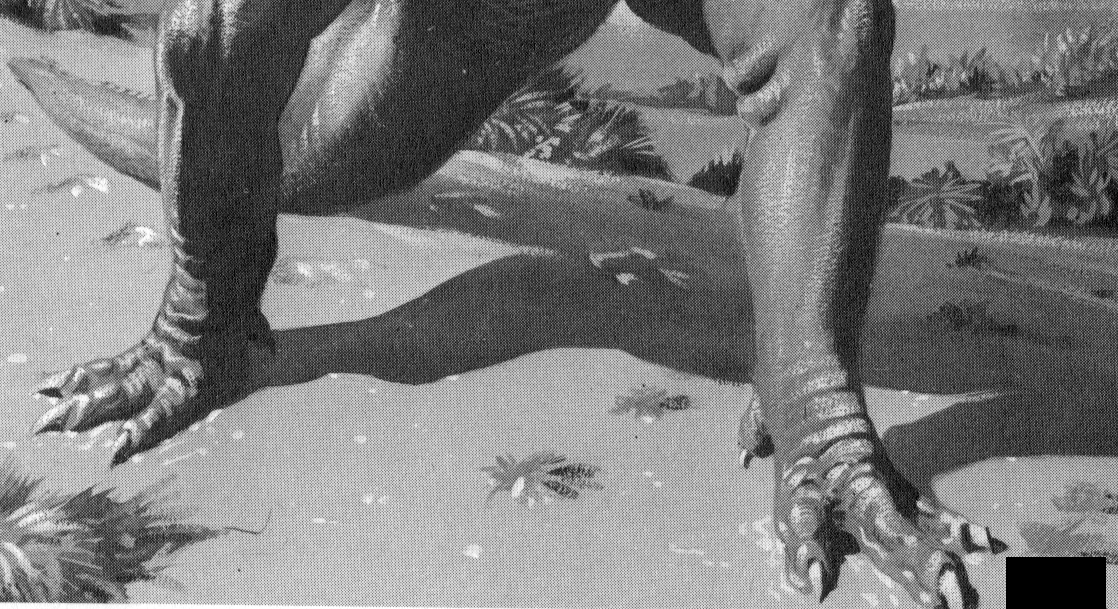
This artist (signature censored, because I'm in denial) has illustrated T. rex with rather more slender, shapely toes and what appear to be weight-bearing plantar pads, in spite of also giving it a bizarre, splayed stance. The left foot in particular appears very birdlike, and the hallux is rather more stumpy.

On the other hand, this artist - working at around the same time, ish - has made the feet considerably chunkier, with soft tissue spreading much wider than the width of the bones and, by extension, the claws. No scutes here - just rounded, non-overlapping scales, like a lizard - although the artist has thought to highlight tendons.

This artist was well known for his excellently observed lizardlike scaly skin textures. The soft tissues on this tyrannosaur's feet are far more snug to the bone, with hardly any sign of fleshy pads to cushion the animal's weight.

Entering the 1970s, and there are still no scutes to be seen on this oddly rectangular-footed individual.

Finally, in the early 1970s, with the Dinosaur Renaissance underway, tarsal scutes appear on the tyrant's feet. Note also that this individual appears to be very energetic indeed - going for a jog, in fact, in stark contrast to its palaeoart predecessors.

While scutes may have started to become de rigueur back in the mid-'70s, it didn't necessarily always mean that the rest of the restoration was particularly birdlike. This model, for example, is highly crocodilian, with all manner of armour scutes covering the body - just check out that tail. The tarsal scutes, therefore, may well be unintentionally birdlike.

The same can't be said for this work; not only has clear attention been paid to the arrangement of the scutes, the general soft tissue profile of the feet (complete with skin stretching between the toes) has clearly been modelled on modern birds (see these, for example). One can obviously see appropriately huge plantar pads taking the strain and spreading as the animal walks forward; there are echoes of illustration #3, but the ankle is far slimmer.

By the time the '80s rolled around, one might have expected that all the big names would had adopted the birdlike style of illustration #8 - however, this wasn't the case. Of course, much about this illustration - from the incongruously wide stance, to the rather shapeless 'tree trunk' legs - has a distinctly retro air. However, the differences in approach are still striking; there is a complete lack of birdlike scutes and plantar pads, and the ankle joint is far less obvious.

And finally, to bring us bang up to date...a fine pair that should look quite familiar. Thoroughly modern, and yet perhaps closer in appearance to illustration #2 than illustration #8 (without the strange stance, of course).
So there you have it - my worrisome theropod foot fetish laid bare. Is this my barrel-scrapingest post yet? Not by half (have you seen some of the desperate rubbish I've come out with before?). Remember, if you can name all the artists, there's a book in it for you. Get cracking! Oh, and don't forget to buy a copy of Matt Martyniuk's superb Field Guide to Mesozoic Birds and other Winged Dinosaurs, if you haven't already - it's worth it for the beautiful artwork, with an uncommonly realistic portrayal of feathered dinosaurs, alone.
Monday, March 25, 2013
In the midst of our recent featherless Jurassic Park posts, I recollected this drawing of mine, which I now offer as my utterly trivial contribution to the discussion.

Perhaps it panders too much to the 'Awesomebro' culture so aptly elucidated upon by John Conway, but for the present at least, I think it serves a small, if not especially profound, purpose.
I posted this drawing over on Himmapaanensis and elsewhere last summer and under quite different circumstances, a while before David very kindly invited me on as a contributor here, so I apologise to those who are seeing it again once too many times.
N
Tuesday, January 15, 2013
Repost: Tyrant of the Salvage Yards
Today, as I struggle to get into the groove of another hectic semester, I'd like to repost a piece from June of 2011 about sculptor Andrew Chase's wonderful scrap-metal Tyrannosaurus rex sculpture. It never quite got the notice I hoped it would, but maybe with another year and a half of experience under my belt, I can spread the word a little wider.
I'm not the first person to recognize the intimate relationship between art and paleontology. One of the great benefits of writing this blog has been meeting artists who inspire me with their craftsmanship, imagination, and dedication to the inherent beauty in biological forms. Even better than that is learning of the surging culture of young paleoartists hashing out their form on-line. Their ability and discipline is humbling and has spurred me on to make a career of visual science communication. So, when artist Andrew Chase emailed me about his sculpture of Tyrannosaurus rex, my mind was primed to be blown.

Here was an artist who recognized the integrity of the tyrant lizard's form. This is something I admire in the greatest paleoart, and it's the reason I harp on scientific accuracy (concerning which, I admit, I still have much to learn). The greater understanding paleontologists have given us - how dinosaurs moved, breathed and inhabited their lost worlds - has resulted in more resonant art.
I asked Andrew what drew him, as an artist, to this particular animal. "Tyrannosaurus has a purity of form that I find beautiful," he answered. "In my opinion, the T. rex is basically a mouth delivery device, everything else is subordinate to that. No goofy crests, sails, horns/protrusions for sexual display, for this baby it's all about the head. What's the tail for? To balance the head. Legs? Moving the head to the food. Brain? Overrated, keep it small and you can make the jaws bigger. Arms? Not necessary, lose 'em (well almost) and increase the size of the head. I think that singular dedication of purpose is maladaptive but really, really cool."

I told Andrew I was especially impressed that he had consulted with the University of Utah's Dr. Mark Loewen when conceiving his sculpture, and I knew that many readers would appreciate it, as well. He said, "I don't know why anybody doing this sort of project wouldn't consult with an expert. I'd be insane not to. There's literally no downside. I've made six animal sculptures so far and I've found that the closer I adhere to the animal's real physiology, the better the outcome. When I make a strong effort to be accurate, the pieces are better balanced, pose more easily, and are generally superior in every way to the one sculpture where I just eyeballed it."

Andrew's T. rex is six feet long, stands two feet at the hip, and weighs about forty pounds. It is fully articulated, as are his other animal sculptures, and he says that it's "made primarily out of recycled transmission parts, conduit, plumbing pipe and unidentifiable widgets found in industrial salvage yards."

The genesis of the sculpture was Andrew's yet-unpublished children's book, Timmy, a lonely robot tale - written and created before Wall-E - in which he says that "the Tyrannosaurus is a metal shredder, compactor and waste disposal unit. Everything and everyone will eventually pass through him. Because of this, the poor T. rex suffers the plight of undertakers everywhere and leads a somewhat lonely existence, even though he's witty, urbane, and would never intentionally eat a functioning machine."

Please head over to Andrew Chase's website to check out more of his art, including some stunning work from Timmy.
* * * * *
I'm not the first person to recognize the intimate relationship between art and paleontology. One of the great benefits of writing this blog has been meeting artists who inspire me with their craftsmanship, imagination, and dedication to the inherent beauty in biological forms. Even better than that is learning of the surging culture of young paleoartists hashing out their form on-line. Their ability and discipline is humbling and has spurred me on to make a career of visual science communication. So, when artist Andrew Chase emailed me about his sculpture of Tyrannosaurus rex, my mind was primed to be blown.
Here was an artist who recognized the integrity of the tyrant lizard's form. This is something I admire in the greatest paleoart, and it's the reason I harp on scientific accuracy (concerning which, I admit, I still have much to learn). The greater understanding paleontologists have given us - how dinosaurs moved, breathed and inhabited their lost worlds - has resulted in more resonant art.
I asked Andrew what drew him, as an artist, to this particular animal. "Tyrannosaurus has a purity of form that I find beautiful," he answered. "In my opinion, the T. rex is basically a mouth delivery device, everything else is subordinate to that. No goofy crests, sails, horns/protrusions for sexual display, for this baby it's all about the head. What's the tail for? To balance the head. Legs? Moving the head to the food. Brain? Overrated, keep it small and you can make the jaws bigger. Arms? Not necessary, lose 'em (well almost) and increase the size of the head. I think that singular dedication of purpose is maladaptive but really, really cool."

I told Andrew I was especially impressed that he had consulted with the University of Utah's Dr. Mark Loewen when conceiving his sculpture, and I knew that many readers would appreciate it, as well. He said, "I don't know why anybody doing this sort of project wouldn't consult with an expert. I'd be insane not to. There's literally no downside. I've made six animal sculptures so far and I've found that the closer I adhere to the animal's real physiology, the better the outcome. When I make a strong effort to be accurate, the pieces are better balanced, pose more easily, and are generally superior in every way to the one sculpture where I just eyeballed it."

Andrew's T. rex is six feet long, stands two feet at the hip, and weighs about forty pounds. It is fully articulated, as are his other animal sculptures, and he says that it's "made primarily out of recycled transmission parts, conduit, plumbing pipe and unidentifiable widgets found in industrial salvage yards."
The genesis of the sculpture was Andrew's yet-unpublished children's book, Timmy, a lonely robot tale - written and created before Wall-E - in which he says that "the Tyrannosaurus is a metal shredder, compactor and waste disposal unit. Everything and everyone will eventually pass through him. Because of this, the poor T. rex suffers the plight of undertakers everywhere and leads a somewhat lonely existence, even though he's witty, urbane, and would never intentionally eat a functioning machine."
Please head over to Andrew Chase's website to check out more of his art, including some stunning work from Timmy.
Wednesday, July 18, 2012
Roadside Saurians
A month or so ago, Jennie and I departed the great American Midwest for the much greater American West, in an exploration of a landscape that has been etched on my memory ever since I first glimpsed it as a kid. I've only passed through or flown over since then, so this two-week ramble around the Great Basin was long overdue. In planning the trip, we were a bit overambitious, and though we had trimmed it back once already, by the time we hit the road and got a feel for how long things actually take, we rearranged things again to lessen the amount of time driving. Hint: arriving at the gates of a national park usually entails another couple hours of driving.
Along the way, I took gigabyte upon gigabyte of photographs, which I'm only about a third of the way through sorting and processing to share at Flickr. These photos naturally included the dinosaurs we saw along the road. I'll start my short series of posts inspired by the trip with some of these charismatic creatures of the Mesozoic.
My favorite was a Spinosaurus perched outside a rock and fossil shop in Orderville, UT, a small town sitting between Bryce Canyon and Zion National Parks. As we rounded the bend in Rt. 89 into town, this guy came into view, and it was impossible not to stop.

Not the most accurate by-the-book spinosaurid you'll ever see, but refreshingly depicted in a posture that's kind of right.


For sheer volume of roadside dinosaurs, it's hard to beat Vernal, UT, a short drive from Dinosaur National Monument. Some have seen better days, such as this dopey pink sauropodosomething.

Outside of a hotel, there's a green, spiky-backed sauropodosomething with a rather uncomfortable electronic sign on its neck.

There's also a T. rex, naturally depicted in classic man-in-suit posture, as any red-blooded American tyrant dinosaur should be. He's also a bit of an angler, it would seem.

The best Vernal has to offer is a Morrison tableau featuring Ceratosaurus, Stegosaurus, and Camarasaurus.

In what must be a show of Jurassic herbivore solidarity, the young Camarasaurus has found a savior in Stegosaurus, which ably deploys its thagomizer in its defense...

... by bashing him in the tender underparts.

You want a close-up of that, don't you?

As you approach the Utah entrance of Dinosaur National Monument, a gift shop boasts a big green sauropod of its own. Like most sauropods you see on the side of the road, the sculptor likely had no specific taxon in mind. Just a long neck, long tail, and some pillar legs, and you've got what springs to 90% of folks' minds when they hear the word "dinosaur."


Now that we've come to the gate of DNM, we'll be entering the park to check out the new quarry visitor center. Before that, I'll share some vintage dinosaur art photographed in a surprising place. Stay tuned!
Along the way, I took gigabyte upon gigabyte of photographs, which I'm only about a third of the way through sorting and processing to share at Flickr. These photos naturally included the dinosaurs we saw along the road. I'll start my short series of posts inspired by the trip with some of these charismatic creatures of the Mesozoic.
My favorite was a Spinosaurus perched outside a rock and fossil shop in Orderville, UT, a small town sitting between Bryce Canyon and Zion National Parks. As we rounded the bend in Rt. 89 into town, this guy came into view, and it was impossible not to stop.
Not the most accurate by-the-book spinosaurid you'll ever see, but refreshingly depicted in a posture that's kind of right.
For sheer volume of roadside dinosaurs, it's hard to beat Vernal, UT, a short drive from Dinosaur National Monument. Some have seen better days, such as this dopey pink sauropodosomething.
Outside of a hotel, there's a green, spiky-backed sauropodosomething with a rather uncomfortable electronic sign on its neck.
There's also a T. rex, naturally depicted in classic man-in-suit posture, as any red-blooded American tyrant dinosaur should be. He's also a bit of an angler, it would seem.
The best Vernal has to offer is a Morrison tableau featuring Ceratosaurus, Stegosaurus, and Camarasaurus.
In what must be a show of Jurassic herbivore solidarity, the young Camarasaurus has found a savior in Stegosaurus, which ably deploys its thagomizer in its defense...
... by bashing him in the tender underparts.
You want a close-up of that, don't you?
As you approach the Utah entrance of Dinosaur National Monument, a gift shop boasts a big green sauropod of its own. Like most sauropods you see on the side of the road, the sculptor likely had no specific taxon in mind. Just a long neck, long tail, and some pillar legs, and you've got what springs to 90% of folks' minds when they hear the word "dinosaur."
Now that we've come to the gate of DNM, we'll be entering the park to check out the new quarry visitor center. Before that, I'll share some vintage dinosaur art photographed in a surprising place. Stay tuned!
Monday, June 4, 2012
Vintage Dinosaur Art: Rourke's Tyrannosaurus
This is a Rourke title I've been looking forward to covering here for a long time, and what a pipin' hot slab of coelurosaur meat it is. It's Tyrannosaurus rex, the favorite dinosaur you're too good to admit is your favorite. You feign interest in ornithopods, act like you like your theropods small and feathery, pretend that basal sauropodomorphs warrant more than a cursory glance. All the while, the itty bitty T. rex on your shoulder whispers in your ear: "You're mine, and you know it."

This is the seventh Rourke Publishing title we've covered in this series, so by this point, I reckon you've got the gist of what they're about. Tyrannosaurus dates to 1981, and was written by Angela Sheehan. This is the first of these posts to feature the work of George Thompson, an illustrator who suffers from the problem of sharing a name with a currently working, younger George Thompson, rendering him nigh-ungoogleable. So, on to the illustrations themselves. They're... eccentric.
For instance, our title character has a little of that stuff that drives country music superstar Trace Adkins wild.

When not proudly displaying that sumptuous derriere, Tyrannosaurus is searching for food, scaring every living thing in the vicinity away.

Except, of course for Triceratops. At this point, the two are contractually obligated to exchange blows whenever in each other's vicinity; like two aging wrestlers, they don the spandex and work up a passable substitute for the intensity of their classic battles. Don't be fooled by the wound Tyrannosaurus sports for the rest of the book: it's stage blood.

Poor, hungry Rexy also tries for a bit of hadrosaur flesh... only to find these early ancestors of the Water Horse instead, a pity. There's some pretty strange choices made here; yes, the Parasaurolophus are, like the menace lurking in the background, rendered in classic man-in-suit posture. Their snouts are bulbous instead of that distinctive wedge shape. But oddest of all are those creepy human-like hands. There's also the minor point of Parasaurolophus being known from strata several million years older than T. rex, but... those hands. Those horrifying hands.

Suddenly skinny, our hero comes across a Struthiomimus raiding a nest - also bearing a bizarre set of hands - and when it flees... the rex doesn't eat the free meal of eggs left behind. Ours is a choosy tyrant.

Luckily, a more suitable meal for the king arrives: the titanosaur Alamosaurus, as noted in the last Rourke post, also displaced from its time. As usual, the predator goes straight for the sauropod's neck, but this one seems a bit more freaked out by this turn of events than some previous appearances of the meme.

Most amazingly... he finishes the whole thing! That entire sauropod is in Rex's belly. Though the Rourke titles tend to adhere to the more reasonable, evidence-based views of the young Dinosaur Renaissance, this take on T. rex is clearly based on the old "ancient monster" mode, with a capacity for gluttony unmatched in the animal kingdom. "When he woke he might be hungry again." Really?

In the book's closing section, we get a nice heaping helping of obsolescence. These sections of Rourke books usually put the book's story into scientific context, based on the latest research. Thirty years on, it shows its age.

Tyrannosaurus as a carnosaur, not a coelurosaur! Gwangi-esque Allosaurus! Naeve Parker style skulking Megalosaurus! Best of all, the inanity of "The flying reptiles, the pterosaurs, could not really fly." Brilliant.
Previous Rourke books featured here:
Ankylosaurus (Bernard Long)
Brontosaurus (Colin Newman)
Iguanodon (Bernard Long)
Triceratops (John Francis)
Pteranodon (Doreen Edwards)
Allosaurus (Doreen Edwards)
Funny story: I scanned this book in and stitched the spreads together... because I'd missed that Terry Thielen had already added them to the Vintage Dinosaur Art Flickr group last year. C'est la vie.
This is the seventh Rourke Publishing title we've covered in this series, so by this point, I reckon you've got the gist of what they're about. Tyrannosaurus dates to 1981, and was written by Angela Sheehan. This is the first of these posts to feature the work of George Thompson, an illustrator who suffers from the problem of sharing a name with a currently working, younger George Thompson, rendering him nigh-ungoogleable. So, on to the illustrations themselves. They're... eccentric.
For instance, our title character has a little of that stuff that drives country music superstar Trace Adkins wild.
When not proudly displaying that sumptuous derriere, Tyrannosaurus is searching for food, scaring every living thing in the vicinity away.
Except, of course for Triceratops. At this point, the two are contractually obligated to exchange blows whenever in each other's vicinity; like two aging wrestlers, they don the spandex and work up a passable substitute for the intensity of their classic battles. Don't be fooled by the wound Tyrannosaurus sports for the rest of the book: it's stage blood.
Poor, hungry Rexy also tries for a bit of hadrosaur flesh... only to find these early ancestors of the Water Horse instead, a pity. There's some pretty strange choices made here; yes, the Parasaurolophus are, like the menace lurking in the background, rendered in classic man-in-suit posture. Their snouts are bulbous instead of that distinctive wedge shape. But oddest of all are those creepy human-like hands. There's also the minor point of Parasaurolophus being known from strata several million years older than T. rex, but... those hands. Those horrifying hands.

Suddenly skinny, our hero comes across a Struthiomimus raiding a nest - also bearing a bizarre set of hands - and when it flees... the rex doesn't eat the free meal of eggs left behind. Ours is a choosy tyrant.
Luckily, a more suitable meal for the king arrives: the titanosaur Alamosaurus, as noted in the last Rourke post, also displaced from its time. As usual, the predator goes straight for the sauropod's neck, but this one seems a bit more freaked out by this turn of events than some previous appearances of the meme.
Most amazingly... he finishes the whole thing! That entire sauropod is in Rex's belly. Though the Rourke titles tend to adhere to the more reasonable, evidence-based views of the young Dinosaur Renaissance, this take on T. rex is clearly based on the old "ancient monster" mode, with a capacity for gluttony unmatched in the animal kingdom. "When he woke he might be hungry again." Really?
In the book's closing section, we get a nice heaping helping of obsolescence. These sections of Rourke books usually put the book's story into scientific context, based on the latest research. Thirty years on, it shows its age.
Tyrannosaurus as a carnosaur, not a coelurosaur! Gwangi-esque Allosaurus! Naeve Parker style skulking Megalosaurus! Best of all, the inanity of "The flying reptiles, the pterosaurs, could not really fly." Brilliant.
Previous Rourke books featured here:
Ankylosaurus (Bernard Long)
Brontosaurus (Colin Newman)
Iguanodon (Bernard Long)
Triceratops (John Francis)
Pteranodon (Doreen Edwards)
Allosaurus (Doreen Edwards)
Funny story: I scanned this book in and stitched the spreads together... because I'd missed that Terry Thielen had already added them to the Vintage Dinosaur Art Flickr group last year. C'est la vie.
Subscribe to:
Posts (Atom)