Showing posts with label interview. Show all posts

Wednesday, November 22, 2017

Meet the artist: Jed Taylor

As if you need any further reasons to attend TetZooCon, here's one more. A couple of years ago I ran into a fellow in the post-TZC-pub with a folder full of his own dinosaur drawings. Natee and I had a look, and were suitably impressed; there was room for improvement, but it was a very solid foundation.

Two years later, and the same bloke - Jed Taylor - approached me again in the pub. And this time, I was blown away. His dromaeosaurs are among the best I've ever seen, but it doesn't stop there; he's illustrated a plethora of dinosaurs in a gorgeous, naturalistic style that's very much in the post-Paulian (sorry again), Floof Revolution mould. Even Andrea Cau's heaped praise on his work, and he's very hard to please. I asked Jed if he could write about his work for the blog, and he supplied the following very many lovely words, which it felt quite criminal to edit down. It may be a little 'TL;DR' for some, but it wasn't for me. Enjoy.

Jed's gorgeous Acheroraptor portrait. All art © Jed Taylor, used with permission.

Monday, December 7, 2015

Paleoartist Interview: Brian Engh

The Mill Canyon Dinosaur Trackway... now available on Yoga Pants! © Brian Engh. Shared here with permission.

Just about a year ago, the world was introduced to Aquilops, a darling little primitive ceratopsian from the early Cretaceous Cloverly Formation of North America. Farke et al's PLOS ONE description of the animal also brought the world one of the most breathtaking pieces of paleoart in recent memory, a dynamic scene by Brian Engh. Marc wrote up an in-depth analysis of the piece here, a must-read if you missed it. Since then, the hits have kept coming, with a series of hilarious (and possibly disturbing, YMMV) illustrations for the #BuildABetterFakeTheropod hashtag he originated, a pair of clashing apatosaur illustrations, two musical releases (the Jungle Cat Technique mixtape and his newest album, Gather Bones), and a gorgeous scene commissioned for the Mill Canyon Dinosaur Trackway, depicting the origin of the site. That piece can be seen at the head of this post, and you can buy prints from Brian at his website.

In 2011, invited by Glendon Mellow to take part in the ScienceOnline Sciart panel, Engh's wild Sauroposeidon illustration was a cornerstone of my portion of the chat, as I spoke about the developing paleoart paradigm that has since become known as the "All Yesterdays Movement," based on the seminal book published by Darren Naish, Memo Kosemen, and John Conway in 2012. His artwork continues to hold a prominent place in my imagination.

Sauroposeidon showdown © Brian Engh. Shared here with his permission.

In addition to his paleoart, Engh is a filmmaker, puppeteer, rapper, creature designer, and he makes art of the non-paleo variety. This disparate body of work is all imbued with a definite Enghitude. To me, it's clearly the work of a restless, adventurous spirit. He questions what is possible, never settles, and sees no obstacle that can't be turned into an opportunity. I recently interviewed Brian about his work, and I'm thrilled to share it with you.

Your first piece of published paleoart was of Spinosaurus, for the 2010 Tor Bertin paper. How did that opportunity come about?

That opportunity just came out of the blue. Tor saw my work on my website and asked me and I was super stoked to have an opportunity to get some work published, and especially a huge weird aquatic theropod. Even though he was just an undergrad and could only pay me $100, I put about a month of work into researching, sketching, gathering reference - including making a model and photographing it - and finally illustrating it.

That would have been 2009 or so, right? What was in your portfolio at that time?

Man... Honestly I don't even know... I think I've taken most of that early era stuff off my website because it's embarassingly feeble & innaccurate. I think the only piece still on my website from that era is this Acrocanthosaurus reconstruction, which was one of my first forays into combining traditional pencil drawing with painting in Photoshop. Also, most of the drawings in the "MONSTERS!" section of my portfolio are from around that time (I really need to update my website).

You've given talks about paleontology and paleoart. As a fellow paleo-freak who always looks for ways to talk about this stuff with normal people, I'm wondering what you've learned in that regard - what do you think is worth focusing on, what do people respond to?

First, and most importantly, natural sciences make sense to pretty much everyone when you explain them in simple terms, using as little jargon as possible. Paleontology is really just animals and plants doing animal and plant stuff, then dying and getting buried and all that stuff stacking up for unfathomable expanses of time. When explained in those terms I've seen people get it. On the flipside, I've been disappointed to find that people just don't care about plants. When I get to the section of my talk about plants I've literally watched people get up and leave. Which is a huge bummer, because plants are foundational to damn near every ecosystem and it's fundamentally impossible to understand any animal without them. Also they're beautiful and weird and dynamic and are texturally delicious. Whenever I go to a botanical garden I'm always touching everything up, and I really need to figure out how to translate that fascination so that people feel themselves walking in the living landscape of the deep past.

The spear bill, a giant killer heron-like ornithomimid created for the #BuildABetterFakeTheropod hashtag, © Brian Engh. Shared here with his permission.

You once wrote that you'd never seen a reconstruction of T. rex that felt "right." Has that changed?

No. I still feel like T. rex is too deeply mired in our cultural consciousness for anyone to really see it. The more people study large tyrannosaurs the more it becomes clear that they were doing something pretty unique. They were huge, insanely high metabolism predators whose bodies changed dramatically as they matured and whose jaws and dentition were specialized for bone crushing. Oh, and they probably had bird-like skin & possibly feathers. So goddamn weird. Sometimes when I stare into the eye sockets of really complete skulls and I see the gnarled rugosities surrounding them I start to get a weird feeling of this bizarre giganto bird monster with deep facial scars and mouth infections and a bulldog neck for yanking triceratops apart. But the whole time I have the sneaking suspicion that the soft tissue was doing things that we just can't imagine. Try to imagine a big male lion without ever seeing even complete soft tissue impressions of a housecat. You'd never guess he had a mane and ruled over the land with that intangible formidability that those beasts emanate... But I am currently working on an illustration of an Allosaurus that's almost starting to come close as far as character goes... almost.

I've written a bit at LITC about my perpetual dissatisfaction with dinosaur movies and documentaries, and have sort of given up hope, concluding that our best hope to recapture the adrenaline jolt of the first Jurassic Park will be games like Saurian. How hopeful are you that we'll see a major, mainstream piece of dinosaur entertainment that knocks us on our butts again?

I dunno. It could maybe happen. I've worked in the entertainment industry a bit and all my closest artist friends work full time as animators or in other aspects of the industry and there are a lot of people working really hard to make the best stuff they can. That said, the corporate side of things is definitely messing with the creative process and that makes it hard for a strong grounding in science or really any new or innovative concepts to work their way into movies. New or foreign ideas (like dinosaurs with feathers that don't roar every time prior to charging their prey) are seen by corporate executive producer types as risky, especially when the production is big and there's an ungodly mountain of money being invested into it as is pretty much always necessary to make elaborate dinosaur films.

That said, I think part of the blame for shitty representations of dinosaurs and other prehistoric animals in media should be placed squarely on the shoulders of the paleontological community. There are a lot of mediocre to downright terrible reconstructions that come out of the science side and those all influence how people on the tv/movie production side visualize prehistoric animals. Also, there's a lot of disagreement in the paleontological community, and for people on the outside who don't have a strong biology background it can be really difficult to get a sense of who actually knows wtf they're talking about. And a fair number of paleontologists, (some well known ones in particular) simply don't have a strong enough background in the biology and anatomy of extant animals. But that's changing... And so is paleoart. And so is the entertainment industry. Everything is in flux right now, and it's awesome.

So short answer: if we support good paleoart, the entertainment industry will have more good examples to draw from, but in particular support my work because I also make videos with practical creature effects and I have an idea for a low-budget dinosaur horror film that I desparately want to make because I believe in my ape viscera that a 20 foot long bipedal bird-like creature with razor sharp teeth and clawed forelimbs would make a really goddamn scary movie monster (but I need, like, 300 grand to produce the project).

A pair of Diamantinasaurus explore an ancient Australian cave, lit by glow worms. Check the whiskery faces - and read more about it from Brian and SV-POW. © Brian Engh. Shared here with permission.

How much contact, if any, have you had with prominent paleoartists? Any pieces of advice or insights they've shared that have stuck with you?

I went to SVP this year and met a handful of paleoartists, but I suppose the most prominent one I met was Julius Csotonyi. We only talked briefly, as he was working in the lobby on his laptop on his recently announced shark book. In the brief conversation I asked Julius how long a big book project like that takes and he said something like "oh, a few months" to which I had to reply "whoa! so you're putting out a new [gorgeous] illustration every 2-3 days or so??" That was a real kick in the pants. I'm meticulous and obsessive and good at thinking up a million concepts, but all of that eats up time. Julius is able to concieve and execute near-photoreal illustrations at a pace I can currently only dream of. Suddenly his success in an under-funded super-niche creative field finally made sense. He's able to blast out work at a rate that enables him to sustain a living income. But it should be impressed upon non artists that his accomplishment in that regard is herculean.

Aquilops faces down a marauding Gobiconidon, © Brian Engh. Shared here with permission.

You seem like the kind of artist who is just constantly collecting inspiration, no matter where you are. How does that influence your paleoart process? When researching a new commission, how to you organize all the disparate tendrils of inspiration? What do those earliest stages look like as you settle on a composition?

I have big trees of folders of pictures, papers and sketched out ideas on my computer and I try to make a discipline of clearly naming new files and dropping them into the folders they seem like they belong in. I also record tons of ideas on my phone when I'm away from my desk. But a lot of the inspiration for a big paleoart piece comes from the paleontologists I'm working with and the resources they provide me with. The best collaborations happen when I'm provided with tons of reference material, especially visual stuff like high res images of fossils, fossil sites and modern environmental analogues. At some point I'm going to put up an blog post outlining the best practices for paleontologists working with paleo artists, and at the top of that list of good practices is providing tons and tons of reference material.

Aquilops process sketches, © Brian Engh. Shared here with permission.

When it comes to working out the final composition I make a lot of rough sketches based on discussions about behavior and ecology and send them to my collaborators to see what people like. Ultimately though, my final composition is often strongly influenced by going outside and trying to find environments with similar characteristics to the prehistoric ones being reconstructed. As discussed in my talk and blog post on Aquilops that meant going to redwood and Sequoia forests and thinking "where would I hide in this forest if I were a rabbit sized Deinonychus snack and Sauroposeidons were moving through grazing on the giant trees?"

Process layouts for the Mill Canyon Dinosaur Trackway illustration, © Brian Engh. Shared here with permission.

In the case of my Mill Canyon Dinosaur Trackway art that process got even more specific, in that I went to the actual trackway and stood where the illustration would be placed overlooking it, and I shot a photo panorama with ReBecca Hunt-Foster and John Foster (and even their 5 year old daughter Ruby as the dromeosaur) pacing out the various trackways so I could map them out precisely from that vantage point. I then used that exact point of view to come up with a couple dozen possible layouts which I then sent to ReBecca to see what she liked. I also camped out near the site and visited it all different times of day to find the best lighting for seeing the tracks (which turns out to be just after sunrise, as depicted in the final illustration), and I also walked all around trying map out and trace the shoreline of the ancient lake so that I could reconstruct that as accurately as possible in my image. When you take the time to really look at the environment you see some interesting things. Like, the bank of the lakeshore with the most croc slides is the one best angled to catch the first rays of morning sun. I got goosebumps when I saw the sun creeping accross that ancient shoreline. I cannot emphasize enough how important going outside and looking at rocks and climbing trees and catching frogs and snorkeling is to my process. I couldn't come up with this stuff by myself. Our prehistoric planet is alive all around us.

Besides the gross anatomical stuff that tends to be whipped like a dead horse (bunny hands and the like), what are a few habits or trends in paleoart that frustrate you? Your pet peeves, as it were.

Monkey puzzle trees and the same pruned cycads and naked horsetails being the only plant life in the Mesozoic. And just generally sparse undergrowth and clean ground. It's a symptom artistic laziness and the academic view of nature that we've all been raised with. We read "Araucaria-like trees" in the literature and we look up "Araucaria" and we pick the one that looks the most unusual & "prehistoric", ignoring the fact that the umbrella topped Araucaria only grow in really specific environments and that even today there is a wide diversity of growth forms among the Araucaria (and only 2 modern species form the umbrella topped things depicted in ever paleo painting ever). Also there was without a doubt a HUGE diversity of similarly leafed trees that lived at various points over the last 200+ million years, most of which we only have fragmentary fossils of, so their actual phylogenetic affinities are really really shady, especially considering the phenotypic plasticity of many plants, conifers being no exception.

So the repetition of the same shaped trees and forest architecture in paleo art is purely memetic mimicry and not a reflection of any real knowledge about the paleoenvironment being illustrated, which therefor calls into question ideas about the behavior of all the animals depicted in that environment. What's worse is that then paleontologists sometimes start thinking that's what the landscape actually looked like and then start interpereting everything based on an imagined landscape bizarrely warped by lenses of preservation (or lack thereof), interperetation, depiction in art, mimicry of that art, and then reinterperetation of the fossil record based on that now concrete mental image. At times it gets so wonky that I start doubting that paleoart is actually even helping the science. In a perfect world, with unlimited time and money, new paleontological discoveries should be announced with a number of different artistic interperetations showing a variety of possible behaviors, environments or environmental phases. I'd love to have the time to depict Aquilops' Sequoia forest right after a seasonal brush fire (which the fossil record indicates happened there), or even a series of images depicting seasonal change in that one environment...

More 'pod warfare: Apatosaurs tussle. © Brian Engh. Shared here with permission. You can, and should, buy a print.

I'm insanely jealous of young kids today, getting to grow up in a world with an internet. Assuming you're somewhat younger than me, what role did it play for you as a budding paleontology nut?

I'm 30, so good dinosaur information wasn't freely circulating on the internet until I was in college. In those days there was wikipedia, and the dinosaur mailing list threads. A few years later, wordpress and blogspot blogs by paleontologists started popping up. It was about that time that I realized I should start trying to make a discipline of improving my dinosaur art, as drawing dinosaurs at a young age was foundational to the development of every other subsequent creative skillset. Also, most of the paleoart I was seeing online was garbage and I thought maybe I could help change that. In the process of researching and putting out work online I discovered SV-POW (Sauropod Vertebra Picture of the Week, for the uninitiated). I loved that it was written by working paleontologists, was super technical and specialized, and yet was really easy to read. So I contacted Matt Wedel just to say thanks for making all that science available. That conversation basically lead to where I'm at today, conversing with the online paleo community and working with several paleontologists to make the best reconstructions of ancient lifeforms I possibly can.

That said, I'm definitely not jealous of young kids today because a lot of parents nowadays (when they themselves aren't obsessively reliant on their device) hand kids a device to keep them busy, rather than saying, "go outside" or "go make something." And the web is weird, and not well suited to our natural means of communicating with facial expressions, non verbal cues, jokes etc. And for a lot of kids communicating and understanding the world through the internet has become the primary, formative experience. For me it was playing in the back yard and looking for bugs under bricks and catching lizards and making things out of clay and pencil on paper. I'm somewhat concerned that in some cases people cultivate a purely academic understanding of nature, an that the internet is contributing to that. But, no matter how good the wikipedia page on western fence lizards is it definitely doesn't give you a real sense of who they are and how they behave and react to the world around them and to people. And yet the internet leads us to believe we have real knowledge about them.

And to be clear, I'm guilty of this too. I don't know how many times I've been looking at a living thing and trying to figure out what it is, and then somebody tells me the name and I go "ok, that's a Townsends Warbler" and then i stop looking at it because i now have a label by which to look it up later if it should interest me to do so. But to me, animals and plants aren't just objects to memorize names of and trivia about, or data points to be categorized according to a phylogeny, they are us. They're our family members, our fellow outgrowths of this bizarre teeming planet. That wikipedia page on fence lizards might let you know a few broad, concrete things about the group of animals we call by that name, and that's fine for building a concept of big picture patterns and relationships, but it definitely doesn't tell you that if you approach certain confident individuals, particularly dominant males with bright coloration, from a low angle, moving very very slowly, and not looking directly into their eyes, you can sometimes tickle them on their chin. I have done this. It is good.


I'm grateful to Brian for taking the time to answer my questions. For more insights, be sure to read his interviews with Dinologue, Cultured Vultures, and William Norman. Also check out Asher's post from 2014 on the "Earth Beasts Awaken" videos.

And for crying out loud, visit his website, pledge at his Patreon page, follow him at Twitter, check out his tunes at Bandcamp, and spend copious amounts of your hard-earned money at his new Redbubble shop.

Friday, April 10, 2015

Interview: Angela Connor

Weave the Cosmos by Angela Connor, featuring Amaruuk, a Microraptor-inspired mythical creator.

I've admired Angela Connor's Paleo Portraits for a while, and her work has been discussed here previously (here and here). Her portraits are full of character, and in the same way that simple portraits of owls focus our attention differently than other photographs might, Angela's portraits are a way to experience these diverse, sadly extinct, animals in an intimate way. In addition to her palaeoart, Angela's body of work includes simple, engaging animations, sculpture, and fantasy illustration.

I interviewed Angela recently and I'm thrilled to share our conversation with you today.

What is your background as an artist?

I'm still very young and green, so for me, "background" kind of means creative childhood pastimes more than anything. I didn't grow up in an artsy place, but having an artist mom and getting to dabble in a lot of different media in summer workshops (drawing, painting, sculpture, and even one-offs like claymation) kept the creativity going. Plus at home we had lots of art supplies of all sorts and I loved combining them in different ways. In particular I liked making miniature animals with clay, wire, and glass beads, and of course drawing and painting were a way of life.

In high school I branched into a variety of digital stuff (digital painting, pixels, vector, 3D texturing, and web design) mostly inspired by seeing other kids on the 'net doing them and wanting to learn too. Then in college I studied graphic design for a while before changing majors to animation, where I learned that as well as 3D modeling/digital sculpture and other production-y things, but in the years after graduating I've found myself more drawn to painting, GIFs, and other odd experiments, and soon I'll be able to return to making physical crafts like I did as a kid, but now armed now with an adult brain, resources, and the existence of new tech like 3D printing.

Three of Angela Connor's Paleo Portaits: Jinfengopteryx, Styracosaurus, and Deinocheirus.

What was the inspiration for doing the Paleo Portraits series?

I don't think there was any one thing in particular that inspired it, but rather a culmination of several factors. The void that graduating college tends to create kind of makes you start asking yourself the big "Who am I, really?" sorts of questions, and for me one of the things that happened as a result was rediscovering my fascination with the history of life on Earth. I know the collective of science-types I had found online by that point, particularly the LITC and TetZoo circles, played a huge part in reigniting that flame.

I also just wanted to challenge myself to do a series, because my art tends to be one-off pieces rather than cohesive sets of any sort. A bonus is that it's also a great way to study all these different animals (and find new ones I didn't know about before!) because some degree of research is required in order to make them not terrible or too inaccurate. Comparing the myriad shapes past animals took is also good practice for when I go to design my own creatures, and indeed, several of my most-admired creature designers started with, dabble in, or are at least inspired by paleontological reconstructions.

How do you choose what animals to feature for Paleo Portraits? You've covered an impressive diversity of taxa so far.

At first it started out just being ones Scott Hartman had skeletals of, but then it kind of mushroomed out further (but still only ones with acceptable reference). Looking up one animal often leads to a wiki-walk in which I find several more animals so there's actually kind of a backlog I'll go and pick from or just start a new one, chosen more on whim than anything else. Though if there is an event or a certain animal or group is seeing a lot of press or being discussed I will sometimes use that to inform my choice. And as for the diversity, that's part of the goal of the project, though my preferences definitely still are in evidence at this stage.

More Paleo Portraits: Tylosaurus, Dimorphodon, and Psittacosaurus.

What are your early memories of dinosaur art, stories, or other media?

What exactly first sparked my interest in prehistoric life is lost to history, but I do remember having watched Jurassic Park as a wee little girl, and I can't even count how many times I saw The Land Before Time. I also remember We're Back! A Dinosaur's Story and the obscure, vaguely animated VHS version of Michael Berenstain's I ♥ Dinosaurs that got watched a lot. Later, when Walking with Dinosaurs first aired, I think I saw it at a friends' house and we got really into it.

As for books, I would have to go back to mom's and dig through the attic to find/remember any others, but the ones I can think of off the top of my head are Raptors!: The Nastiest Dinosaurs and AMNH's Book of Dinosaurs and Other Ancient Creatures. The latter of those was probably one of the first things that really introduced me to the world of prehistory beyond just the (mostly) Mesozoic rock stars, and was especially fascinating for that reason, though both books had very memorable art.

I don't think there's much outside of film/TV/books but when we got our first computer around '94-'95, (I think) it came with a bunch of these educational DOS games, one of which was called 3D Dinosaur Adventure. It's exceedingly dated now, but it blew my tiny child mind at the time and I played it to death. And, of course, we had quite a number of dinosaur toys and whatnot, in particular I remember the nice rubber models my brothers and I played with in the sandbox, and a JP raptor action figure that I actually have here in my apartment somewhere. Oh, and my favorite thing in the world when I was maybe 5 or 6 was a tiny black Dimetrodon I named "Creamy" that came in one of those novelty egg-shaped soaps.

Inspired by "Creamy," the Dimetrodon Paleo Portrait.

Walking with Dinosaurs has received surprisingly few nods in the interviews I've done, but I also was very inspired by it. Even though it's a bit dated now, I still rewatch it from time to time. do you have any favorite bits that have stuck with you?

I was only maybe twelve at the time so perhaps that is why it stuck with me. I rewatch it occasionally myself, too, as well as the Beasts and Monsters ones that came after. Walking with Monsters may actually be my favorite because of how it steps through the periods by sort of following the one lineage via those "evolution takes over" sequences in between segments while showcasing what's going on around each new iteration and its place in the ecosystem. Plus, there are scant few good programs that portray Paleozoic things or stem-mammalian ancestry in general. My soft spot for synapsids came about perhaps because of that show. My favorite bit of Walking with Dinosaurs was probably New Blood because I love origins of things and Triassic critters in general.

You've done amazing work that melds palaeoart and fantasy art - as in your gorgeous, Microraptor-inspired Amaruuk. As more non-avian dinosaurs are revealed by research to be virtual chimaeras of birds and lizards, it seems a fertile area of exploration. Can you tell us a bit about what inspired this in your own work?

Theropods to me are basically just bird dragons, two of my favorite things mixed together into something way too cool to not make a mythical mascot creature out of (though originally she was supposed to be a creation deity, a mother of all life sort of thing). Plus the ideas of mythical creatures in many ancient cultures come in part from found fossils. Extrapolating from observations and weaving tales and images from that is so very human. I love fantasy and mythos as well as real world zoology/paleontology so combining them seems only natural. Though we have a lot more data now than ancient people did, it's still fun to use it to create deities and beasts of legend.

There is another thing, though. A lot of fantasy art seems to portray creatures from a "monster" angle (though they are still inspired by real animal anatomy and so forth, and some of my favorite fantasy artists are in fact paleo nerds), or when I tell people I make creature art they say "Oh, you mean like monsters?" but personally my approach is what could be called the Alan Grant way. They're not monsters, just animals. They just do what they do. Rather than going full "awesomebro" or exploring the dark depths of the human psyche, I mostly enjoy just building on nature. That plus a little mystical majesty and the ocassional dose of childlike wonder is generally how I like my fantasy, and all the de-monstering and All-Yesterdaysing that paleoart is trying to do right now has certainly had some level of influence. Plus, I'm a 26-year-old woman who goes giddy as a schoolgirl just finding a perfectly ordinary lizard outside. Part of me just wants to put that feeling into my art, too. Life is really amazing, and fusing myth and fantasy with reality kind of brings it out for me. Heck, my piece, Guard of the East Tower, literally is that. I saw a green anole on my windowsill and painted it through the lens of fantasy.

Guard of the East Tower by Angela Connor.

Monsters are certainly central to the genre, but is there any fantasy fiction/ media that you think does a better job than most in regards to portraying creatures more as animals as opposed to monsters?

The portrayal of fantasy creatures as animals versus as monsters really depends more on what kind of story is being told and where they fit into the narrative. If it's central to the plot like a big kaiju or anomalous marauding creature in what is otherwise our reality or enemies in a video game then those are almost always monsters (though the latter also tends to have plain animals as early-on foes). But it tickles me most when creatures exist to flesh out a whole fictional world with its own ecosystem, usually an alien planet like Pandora from Avatar (I admit I'm kind of under a rock with media so I'm sure there are more that I'm simply failing to think of). Part of me really wants to see something like the Star Trek universe delve into its own planets' evolutionary histories and exobiology. More than any media or franchise, though, when I think of treating fantasy creatures as animals, my mind goes to specific artists like Terryl Whitlatch, Brynn Metheney, and Tiffany Turrill. I can't not get fired up looking at their work!

Besides a personal interest (and a real knack for it IMO), do you hope to produce palaeoart in the usual, scientific-illustration-accompanying-research-manner?

Why, thank you! While at this point I know I am nowhere near the level of people who are masters of anatomy and have their noses in up-to-date literature, I'd love to be able to have an opportunity like that in the future. Something along those lines that I really want to get into practicing for in the coming months is model making, as I think it'd be great to produce reconstructions for museums and things of that nature. Outreach about the history of life on earth is really important to me, so it would be an honor to someday be able to help actual paleontologists show their findings to the world. In the meantime I think it's also good to inject what I've gleaned from being connected to this community into hobbies and regular-people stuff, and just kind of help to normalize new discoveries. After all, I am no scientist. I just follow them on Twitter and buy their shirts, haha.


All work in this post is © Angela Connor and used with her permission. Please check out her website and purchase her fine wares at Redbubble. You can directly support her work by pledging at her Patreon page. Follow her at Twitter, DeviantArt, ArtStation, and Facebook, and Newgrounds, too. Thanks for taking the time to answer my questions, Angela!

Tuesday, December 23, 2014

Interview: The Saurian Development Team

A year ago, frustrated by the truth that the dinosaur experience I want will probably never be a goal of filmmakers, I wrote The Chase, a necessary bit of spleen-venting in the wake of Talking With Dinosaurs 3D. If you've followed my writing on Jurassic Park and other big dinosaur projects in the pop culture over the years, you'll admittedly see a bumpy ride. I've been variously resigned to the status quo, cautiously optimistic about rumored projects, and utterly deflated by studio mismanagement of promising projects (what did David Krentz do in a past life, anyway?). What was the experience I wanted from these big dinosaur projects? Let's let slightly-younger me tell you. Take it away, knucklehead:
What I want is an immersive, I-just-time-travelled-to-the-Mesozoic feel, with a great score and as little anthropomorphism as possible. There's no way that film gets made anytime soon.

There's hope, though. Who knows what will be possible as the technology gets cheaper and dinosaur fanatics get more motivated to make something on their own? Or perhaps expecting a feature film is the wrong way to look at it. Maybe the dream of an immersive exploration of prehistory is better left to game designers, like the folks behind Saurian.


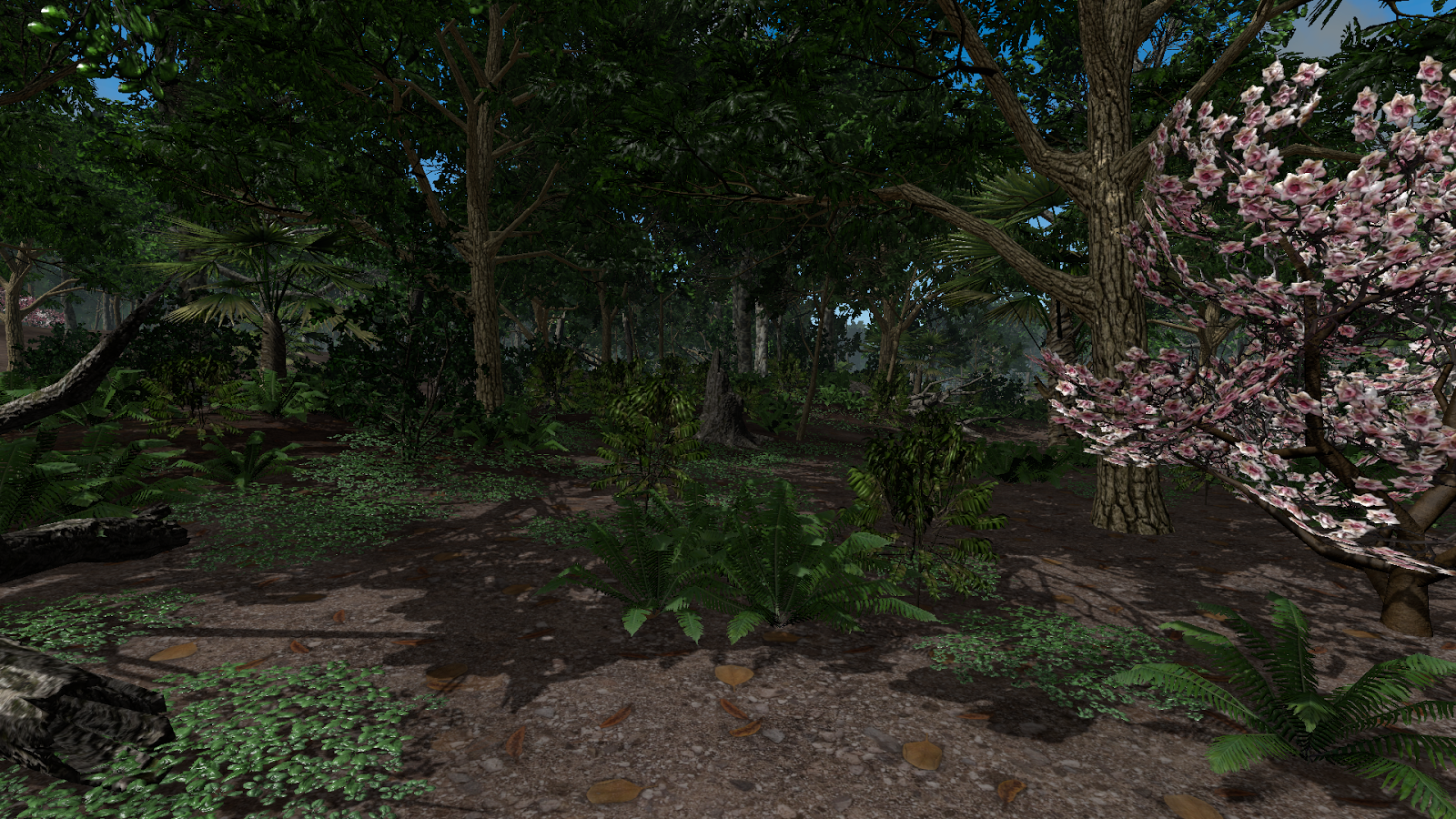
The Hell Creek ecosystem, as seen in Saurian.

Currently in development, Saurian is a survival-based game seeking to recreate the Hell Creek ecosystem of the end-Cretaceous. It's clearly a labor of love, and as news and in-progress work has been shared, I've been getting more excited. With the release of their first gameplay trailer, I thought it was a great time to interview the team about the project.


At IndieDB you write that your goal is to create "the most captivating dinosaur experience ever developed for commercial gaming, giving the player the first true chance to live like a dinosaur." What games, films, or other pieces of art or entertainment are inspirations in this quest?

Nick Turinetti, Project Lead: We’re obviously huge dinosaur fans to be making a game like this, so between all of us we’ve probably gotten our hands on every game that’s featured dinosaurs in one way or another over the past 15 years. Having said that, in our collective opinion most of them were not terribly impressive. Two games that have directly featured dinosaurs that have had real influence on Saurian would be “Big Al Game” from BBC’s Walking With Dinosaurs website (sadly no longer available) and Be the Dinosaur which was actually developed as part of a museum exhibit of the same name. Other non-dinosaur video games that have been especially influential are Far Cry 3 and 4, Red Dead Redemption, Skyrim and Dark Souls. As far as films go, we’re all fans of the original Jurassic Park. We never go a day without quoting it half a dozen times at each other. Phil Tippett’s short film Prehistoric Beast is still probably the best dinosaur film ever made, and its mood and tension are something we aspire to. Peter Jackson’s King Kong and James Cameron’s Avatar with their expansive world building have also been major sources of inspiration.


Thescelosaurus, showing off its quilly finery (top) and seeking refuge (bottom).

Are there specific pieces of paleoart that have served as inspirations for the vision of Saurian?

Tom Parker, Environment and Level Design: All of our artists are inspired beyond anything else by the collective works of Doug Henderson. If we could achieve a visual style with Saurian that resembled a Henderson painting in motion then we would consider our job well done. His Leptoceratops piece in particular captures a sense of environmental scale that we adore. His animals look like they are a part of the environment and not separate from it, which is something we want to capture. Our other key influence would be the so-called “All Yesterdays” movement, particularly the titular book and the palaeoart of Matt Martyniuk. We take on this philosophy of experimenting with interesting visual design without ever contradicting the fossil evidence. Matt Wedel of SV-POW! once said “If you go bold, you won’t be right; whatever you dream up is not going to the same as whatever outlandish structure the animal actually had. On the other hand, if you don’t go bold, you’ll still be wrong, and now you’ll be boring, too”, and this has also played a role in our creature design. I don’t know if this counts as inspiration, but we are extremely grateful for the skeletal reconstructions of Scott Hartman which allow us to get our animals as accurately proportioned as possible. Other influential palaeoartists include classics like Charles R. Knight, Zdenek Burian and James Gurney. Like Henderson, these artists are all masters of incorporating the animals into their environments.

Henderson and Tippett are certainly perfect inspirations. Prehistoric Beast really hasn’t been equalled. In every frame you can feel the love of Tippett’s team. In what ways do you hope to evoke its mood and tension?

Nick: It might sound silly but I find Prehistoric Beast legitimately chilling, and a lot of that has to do with the way Tippett portrayed the tyrannosaur; a sly, cunning predator who skulks in the shadows despite being the size of a bus, making even a peaceful meadow a dangerous place to be alone. That’s the sort of mood and tension we’d want to evoke in Saurian, both for someone playing as a predator like Tyrannosaurus or as its potential prey. Even in the game’s current (very early) state, I think we’ve started to capture it. Being chased by a T. rex is scary, but watching it move through a forest clearing and knowing it’s looking for you is scarier. Being alone in the same meadow and not being able to see it or know where it might be automatically puts a player on edge as well. I never want a player to feel completely “safe” when playing Saurian, there should always be something out there to keep you on your toes.


Triceratops takes the stage.

Why was Hell Creek chosen as the setting? Were other localities considered?

Tom: Hell Creek has always been the plan. There are a few reasons as to why it is the best choice for this kind of project. Firstly it offers a quality combination animals such as Tyrannosaurus, Triceratops, Pachycephalosaurus and Ankylosaurus that are extremely popular and instantly recognisable to the general public along with other more unique fauna that offer an interesting variety. Secondly, the formation is one of the absolute most studied and published-on in the world in terms of flora and palaeoenvironment. This is important to us as it makes our job of restoring the environment much easier and less ambiguous than other, less well-documented ages.

Nick: Another benefit is that the Hell Creek Formation records a comparatively short period of time compared to many other formations, so we can be reasonably confident that all of the animals found there did in fact form one community.

You recently brought RJ Palmer on board. How did you come to recruit him, and what has he brought to the process, besides the obvious role of creature design?

RJ Palmer, Concept Artist: I found these guys from some tumblr post that was going around. I showed them my dinosaur drawings and shoved my way onto the team. I like to think I bring an outside perspective to the group as I joined later in development and can look at things with the eye of an artist and not a scientist. I bring some connections to the party such as helping with expanding our audience.

Nick: RJ’s fresh perspective has helped push us outside of our comfort zone when it comes to creature design, and we’ve definitely improved because of it. He’s also been really good at asking the tough questions in our design process, making sure we’ve fully explored all options.


RJ Palmer's Quetzalcoatlus design, here nomming on a champsosaur.

I'm assuming that the score used in the pre-alpha gameplay trailer is not final. What do you foresee concerning the sound design? What are the challenges of bringing the environment to life through sound?

Dillon Gotham, Sound Designer: For what the future entails, many important animals (both in public conscience and in ecological importance) to be voiced are small, which present their own challenges compared to large animals, and while animals tend to be silent on the hunt, when fighting conspecifics they are not. Simple, repetitive attack sounds will not do. As for the general challenges of Saurian’s sound design, currently none of the team is reliably able to record audio in the field; it is primarily audio libraries that are available for me to work with. But that does not mean the world of Saurian and its inhabitants have to sound like it. Saurian must sound unique and charismatic, yet also as naturalistic as it looks. For animals, this means mixing and masking their individual elements to become its own character. Because the stars of the game are archosaurs, in the process of creating sound effects for Saurian I add modern archosaurs to the mix and emphasize them whenever reasonable, but there are limits; as an example, passerine birds evolved after the K/Pg mass extinction; they are almost entirely off limits as they more often than not live up to the name of “songbird.” This also means I also need to ensure there’s no songbirds in background sounds!

I've been pondering the failures and clumsy handling of dinosaur media recently - for example, the addition of voices to WWD3D and the meddling that compromised Dinosaur Revolution. It seems that the revolutionary role Jurassic Park played in dinosaur pop culture has many of us hungry for that next big moment, and all of these fumbles are more dispiriting for it. I personally think that it is going to come from gaming (Saurian is certainly the most promising project I’ve seen). Do you think there is hope for traditional storytelling media such as film and animation to tell a dinosaur story that captures popular imagination and makes dinosaur enthusiasts happy?

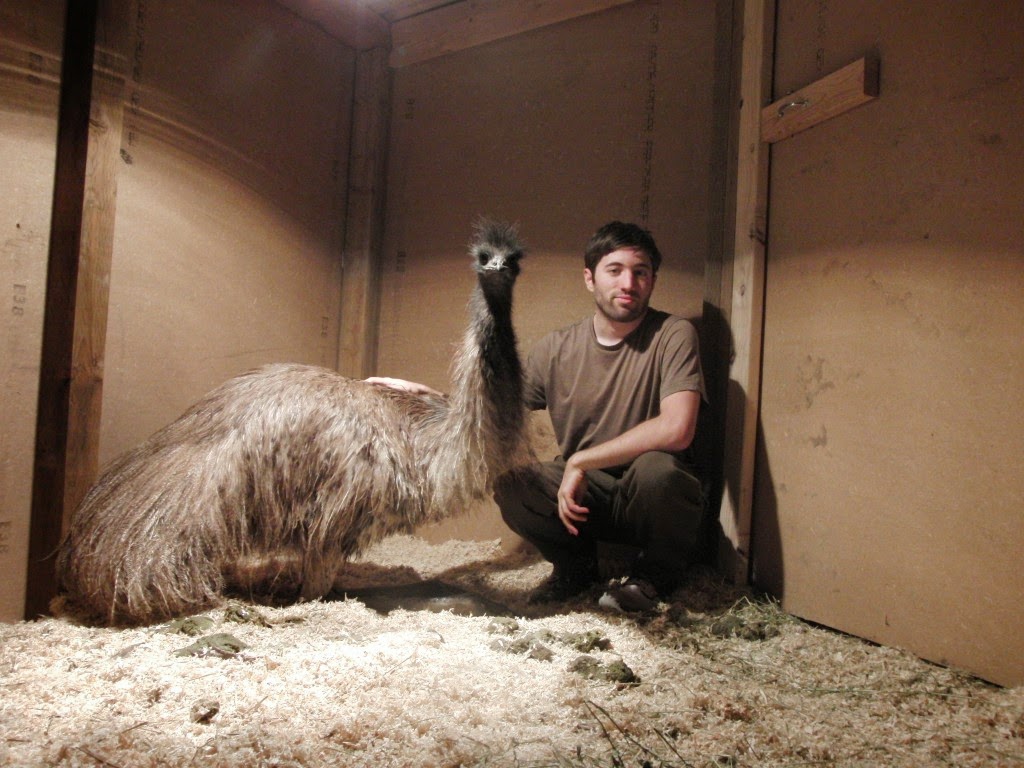
Bryan Phillips, Animator: When I set about animating one of Saurian’s animals, I tend to stay away from established media such as Jurassic Park and Walking With Dinosaurs, oddly enough shows like Big Cat Diary play a much larger role in creating the character of the animals in Saurian. We’re also probably the only game developer out there to have our own Emu and he plays a large role in the animation behind our bipeds. I do believe there is hope for new works, the trick is staying grounded in the fact that these aren’t monsters, they were living, breathing animals who in practice were likely no different than animals living today.

Tom: A big thing for us from the outset has been that we were not interested in creating a game where extinct animals are nothing more than glorified canon fodder. They are essentially treated in video games in the same manner as zombies and aliens. We feel strongly that this should not be the case. Dinosaurs are in our opinion some of the most interesting animals to have ever walked the planet and deserve to shine on their own merits.

Nick: I think there is still hope that film and animation could tell a dinosaur story that appeals to the general public, the problem is that Jurassic Park and its framework loom so large in popular culture that people have a hard time thinking outside the park (terrible pun, I know). So many films and games just vomit out cheap Jurassic Park knock offs that people have come to expect that as “normal”. My suspicion is that it will take a generation to really work JP out of the public conscious now that Jurassic World is a thing, and that’s a bit disappointing because there are so many other good stories out there that don’t have Jurassic Park’s baggage. I would love to see Raptor Red or Cretaceous Dawn turned into a visual experience.


An Ankylosaurus meetup (top); Saurian Animator Bryan Phillips with Gerry, the trusty model (bottom).

How has the online community contributed to the process of Saurian? When I think of when I was a kid, I would have been blown away to have the access I do now to dinosaur experts and paleontologists.

Nick: I think its safe to say Saurian would still be a pipe-dream were it not for the incredible access to information and experts the internet provides. We’ve had the good fortune of having a small support network of university students with access to most major scientific publications, but we’re huge supporters of Open Access. We’ve also had the ability to ask questions directly of paleo workers as well, including Denver Fowler, Matt Wedel, Gregory Wilson and John Hutchinson, all of whom have been extremely helpful with their critique and input. Beyond access to information, Saurian’s development team would still be a bunch of really talented people all still wishing they could find other people interested in making a game were it not for the online communities we’re all part of. Except Bryan. He’d be doing it all by himself regardless.


Many thanks to the whole team for taking the time to answer my questions. I'll definitely be watching their progress eagerly. Be sure to follow Saurian's evolution at IndieDB, Facebook, and Twitter. Also check out their recent interview with Brian Switek at Dinologue. All images in this post kindly provided by the Saurian team and posted with permission.

Monday, July 14, 2014

Interview: Paleoartist Maija Karala


"Forest Green." A dandy paravian, © Maija Karala and used with her permission.

I'm always excited to see new work pop up in Maija Karala's DeviantArt gallery. A Finnish biologist and writer, her enthusiasm for biology also finds voice through her illustrations, which range from fleshed out scenes to charming sketches. I can't remember exactly when I began following Maija's illustrations, but I do remember being particularly struck by her Tarpan fending off a lion.


"Don't Mess With Tarpans." © Maija Karala and used with her permission.

Maija writes:
Here, a young cave lion is about to learn why one should be careful with tarpans. It's July somewhere close to the edge of the ice and the steppe-tundra is blooming. The plants depicted include Betula nana, Viscaria alpina, Rhododendron lapponicum, Orthilia secunda, Pedicularis sceptrum-carolinum and Dryas octopetala. Yes, the latter is the plant that was so common at the time at gave its name to the Dryas climatic periods.
It's a great example of the qualities I admire in much of her work: a sense of drama, subtle and naturalistic color, dedication to research, all wrapped up in an eminently approachable aesthetic. I was happy when Maija agreed to do an interview for Love in the Time of Chasmosaurs, so I could ask her more about how she works.


What is your background as an artist? Is it your profession or hobby?
For me, art is mostly a hobby. I make my living as a science writer, mostly writing for newspapers and magazines. I do paid illustrations whenever I get a chance, but it's not very often. I'd love to do more of it, but the fact that I always thought it as just a hobby now hinders me a bit. As I haven't really practised my skills systematically, I only became good at the things I like doing.


"Hamipterus." © Maija Karala and used with her permission.

Do you get many opportunities to cover paleontology in your science writing?
I get to cover paleontology fairly often, though not as often as I'd like. A few articles per year or so. On my blog (which is unfortunately in Finnish, but can be found at http://planeetanihmeet.wordpress.com/) I do write a lot about paleontology and use my own illustrations as well.

Do you plan on continuing to do illustration as a hobby, or do you have professional aspirations?
I'm working to become a better artist, and I'd love to do more professional illustrations too. Though writing is probably still going to be my main occupation.

Was illustrating extinct animals always something you did or did you come to it later in life?
I drew dinosaurs as a kid, like everyone else, but stopped somewhere in my early teen years and only started again when I began my university studies, seven years ago (I studied biology). During the gap, I mostly drew fantasy creatures, dragons and elves and stuff. I think the main reason I started making paleoart was to find sort of a compromise between drawing fantasy creatures and being a science student. Illustrating extinct animals is firmly rooted in science, but also lets you use your imagination in a way not really possible with bioillustration.


"Eye Contact." Anurognathus ammoni, © Maija Karala and used with her permission.

At what point in an illustration do you focus on the eyes? It's often a striking element in your work, whether fantasy or paleoart.
I have never really thought about that. I do tend to think the eyes and expressions as the most important part of my drawings, as that's also what I pay the most attention when looking at live animals (or people, for that matter). Though I have no idea if everyone else does that too. After making a general sketch on what I want there to be and where, the eyes (or the facial areas in general) are usually the first thing I focus on.

You seem to be especially drawn to feathery theropods. Is this due to a bird interest or is there some aspect of their form that is especially fun to draw?
I think it's a bit of both. I like birds, sure. I also like drawing small and pretty animals. And feathers are always fun. Anyway, the main reason is probably that there's plenty of references and easily accessible knowledge available on feathered dinosaurs. It was an easy place to start back when I started making paleoart, and once I was familiar with them, it was also easy to continue.

Lately, I have been moving on to other critters as a part of trying to learn new things. My DeviantArt gallery is now starting to have more things like fossil mammals and non-dinosaurian archosaurs than feathered theropods on the first pages.

When illustrating an animal that has been covered by other illustrators, in what ways do you try to make it your own?
I always try to find other sources of inspiration besides other people's depictions of the same animal, sometimes actively avoiding looking at them when planning to make my own reconstruction. I often look up modern animals with somewhat similar ecology and use their soft tissues and behaviour as inspiration, but try never to directly copy anything. I mostly avoid using the most obvious colour themes or soft tissue ideas. That's not to say I never stumble on paleoart memes, but I do try to avoid it.


"The Feathered Yeti." Xiaotingia zhengi, © Maija Karala and used with her permission.

How much do comments on dA influence your work? For instance on your "Feathered Yeti," the comments get into some serious detail about integument. When posting work do you post with the expectation that you'll receive critique on areas you're not sure about?
To be honest, DeviantArt comments have probably been the most important thing pushing me to get better at making paleoart. These days I usually do my research before drawing, but especially earlier it was a great motivator to make embarrassing mistakes and get someone tell it to me. I'm pretty sure I never made the same mistake twice.

As I have mostly learned paleontology and anatomy on my own (for years, I had no paleontologically oriented friends nor any education on either subject), the criticism has been invaluable. I still greatly appreciate all the experts who go through the trouble to nitpick on amateur drawings.


"I Immediately Regret This Decision." Thalassodromeus attempting to eat Mirischia, © Maija Karala and used with her permission.

So, who are some of your favorite expert paleoartists? Is there a particular piece of advice or critique you received that has stuck with you?
I really like the works of people like Alain Bénéteau, Ville Sinkkonen, Carl Buell and Mauricio Anton, just to mention a few. My favourites are the people who can combine an expert understanding of science with truly beautiful art and get the animals to really come to life. I also really like Niroot's style. And John Conway's. And... ok, I'll stop here before the list becomes ridiculously long.

I don't think there's any particular piece of advice that has been especially memorable. It has been more about the general message that I need to know more. It's something I simply didn't get elsewhere for most of the time. As nobody I knew personally had the expertice to tell me the feet of my Quetzalcoatlus are wrong, most feedback was more like "oh, a nice dinosaur. What do you mean it isn't a dinosaur?".


Thank you to Maija for answering my questions - and patiently waiting for me to have time to put the post together! I hope you'll stop by her DeviantArt gallery and leave some support and constructive criticism on her illustrations. Also check out the recent post at i09 featuring Maija's Protoceratops/ Griffin illustration.


"Go Home, Evolution." Atopodentatus, © Maija Karala and used with her permission.

Wednesday, January 9, 2013

Artist Interview: Alexander Lovegrove


There are a huge number of palaeoartists clamouring for attention on deviantArt these days, so it requires a unique take on affairs to truly stand out - especially with Yet Another Tyrannosaurus. Alexander Lovegrove (an ecology PhD student from the UK) first caught my attention with the piece pictured above - a depiction of that very dinosaur in a rainforest setting It might be a little fanciful, but the highly individual style and meticulous detailing make it stand out from the pack. In fact, I immediately thought of Henri Rousseau's jungle scenes, even if Alexander's style and professed influences are somewhat different. The potentially bland and conventional lateral view of the creature is subverted by having the animal's off-centre head facing the viewer, its piercing, predatory gaze proving irresistible to the eye.

Ever since then, it's been fascinating to see what Alexander (right) will produce next, and there have been a steady stream of new pieces on his deviantArt page. He may make some mistakes along the way (who doesn't?), but his bold technique and speculative touches, coupled with his funneling of his ecological interests into his art, have definitely made him a palaeoartist worth keeping an eye on. I wanted to know a little more about what goes into his art, as well as just plain show it off - and wouldn't you know, some fool gave me a platform to do so. Hurrah! Anyway, on with the interview...

Zhuchengtyrannus (left) and Tarbosaurus (right). This piece actually consists of two paintings combined.

How long have you been interested in dinosaurs? Was it something that stemmed from your interests in natural history and ecology more broadly, or did it develop alongside?

I've been interested in dinosaurs as long as I can remember, and just haven't grown out of it. I've also always been interested in the natural world (I am currently an ecology PhD student), so I guess that is part of it too. As I've grown older I have come to appreciate the connections between the world of dinosaurs and modern ecosystems. It's amazing to think that there were whole ecosystems, habitats and biomes that are lost in time.

You mention that 'lots of palaeoartists' have influenced you, but everyone has their favourites - which are yours? (I'm going to guess Doug Henderson is up there.)

Yeah, Doug Henderson is definitely up there! Above all he is a wonderful artist. I think Doug Henderson's work stands out a great deal now due to his mastery of painting natural environments and his skill at composition. I would love to emulate those ideas, but I am just an amateur really. The first paleoart I really started to recognise and enjoy was Greg Paul's, like many other artists of my generation. However, it wasn't his skeletal or pencil illustrations that really captured my imagination but a series of watercolours which I think appeared in the Dinosaurs magazine series when I was a kid. It always seemed like colour was important to me when depicting dinosaurs, they needed to be vibrant! Other big inspirations and influences were Michael Skrepnick and Mark Hallett, whose work I really admire. And then more recently there are so many others - simply too numerous to list! I am also a great admirer of the ultra-realism of John Gurche, although he hasn't depicted that many dinosaurs.

They are not palaeoartists, but John Howe and Alan Lee were really big early influences - I started out painting Tolkein-y things!

'Winter Kill'

You seem to end up painting tyrannosaurs a lot (not that I'm complaining). Do you have a particular affinity for those animals, or is it pure happenstance?

Yeah, I really do like tyrannosaurs a lot more than other dinosaurs - my favourite of all being Albertosaurus. Something about them really fascinates me, in particular their ancestry and relationship to the bird lineage (although I've ended up painting the most derived examples). Their shape seems very elegant to me too, and there's been an explosion of diversity recently that I think I want to capture in my paintings. Although funnily enough some of the paintings were happenstance and I didn't mean to paint them so much. I am trying to broaden my range now though!


From the way your work has evolved over the past few years, I would guess that you've been doing your homework in terms of dinosaur anatomy (none of your theropods have the dreaded 'bunny hands' these days). What have you been reading, and how helpful have you found the community feedback on deviantArt?

Ah yes, anatomy. I still consider this a weak point really, especially concerning muscles and outer integument. I don't measure out proportions and my painting style is quite loose ( I sometimes obscure the underlying sketch and have to hastily paint from scratch!). I must pay much greater attention in future though, as the subject simply demands it. You wouldn't expect a decent painting of a lion or tiger to have flaws in proportion or anatomy, and if they did it would really stand out.

Much of my knowledge has come from various blogs really, but I would single out Tet Zoo, Skeletal Drawing and Theropoda (Google translated) as being particularly useful (I would add SVPOW if I ever depicted enough sauropods). I wish I had more time to learn and properly appreciate the anatomical side of things - in particular when painting a dinosaur that I haven't attempted before. It can be difficult to research effectively, especially as museum mounts are not always accurate. I do try to get scientific papers, but these are often very difficult to access. I like to avoid lateral views where possible (although my work is still full of them) so skeletal diagrams can be difficult to interpret. Another thing that I have been trying to pay attention to is to depict the environment the dinosaurs live in more accurately, but this can be even harder to find information on, other than for a few well-known localities.

deviantArt has been particularly helpful though, with not only feedback but a network of artists to talk to, compare work and learn from. I have found the comments and general encouragement really great, in fact it's probably what kept me painting a few times. I would say though that deviantArt is heavily biased towards younger people. I haven't really opened up to the critique process much on there, mainly because I like to critique my own paintings so much - I can always improve. I may try that in the future though.


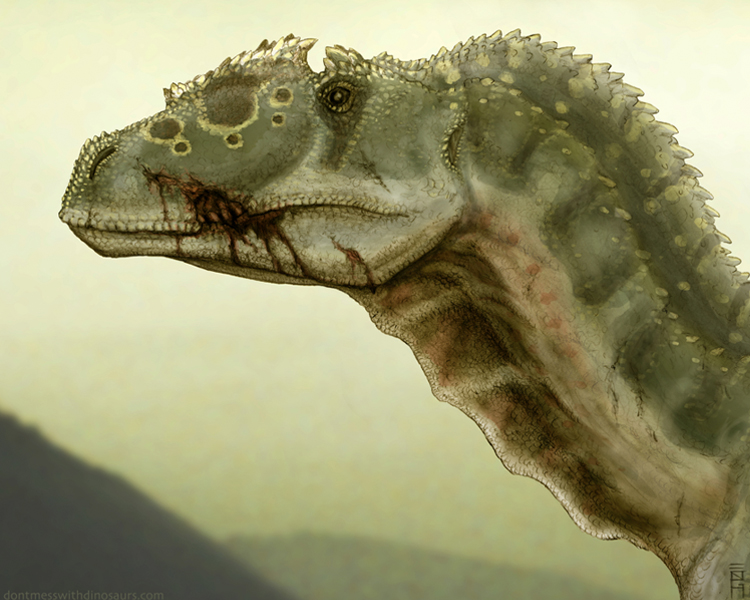
There's a lot of healthy speculation in your work, which is wonderful to see. In particular, I'd like you to go into more detail about the development of your 'Daspletosaurus attacks' painting [above]. The ceratopsians are fairly conventional looking, but the Daspletosaurus certainly isn't, which is why it's one of my favourites! What was your inspiration behind portraying the animal's integument in such an unconventional way (with particular reference to the 'plucked' leg)?

Andrea Cau's blog, Theropoda, was a big catalyst for that painting. There was a particularly great post where he explained how it probably was physiologically possible for large theropods to be feathered without overheating. So I went ahead with that idea. It was quite funny that Yutyrannus was found shortly afterwards - I really thought I'd overdone it in the painting! The legs are really a silly idea to be honest. I wanted to make it look like a giant chicken - I've always thought chickens looked like dinosaurs - and explored the possibility of feathers being lost and leaving naked skin. So it just looks like a plucked chicken leg...I think this is pretty unlikely as the bumps on a plucked leg are related to feathers anyway as far as I know! I left an open nostril to also evoke its bird like nature, like a vulture or condor, but I understand this is incorrect. Also the face is heavily scarred and has a layer of tough, keratinous skin around the mouth (a proto-beak if you will) which seemed interesting. I was much more conservative with Chasmosaurus as I know both less about them and felt a little outside my comfort zone just plopping filaments on them - maybe next time!

So much palaeoart now is digital that your 'traditional' acrylic paintings are actually quite refreshing. Would you ever consider 'going digital' even for just one piece of work? (Obligatory question.)

Yes, in fact I have tried it in the past. However I find it difficult to get used to and a lot of the connection with the work is lost for me by using a screen. I'm also just not as good at it! I would like to say though that I really love a lot of the digital art that is being produced by other artists.

Bactrosaurus johnsoni

 How would you say your palaeoart has developed from a purely artistic perspective in recent years - have you consciously aimed for a definitive style, one that incorporates elements of certain artistic movements? Many of your pieces, and I'm thinking especially of the Rainforest Tyrannosaur, have a 'feel' that is completely unique in palaeoart.

This is a really interesting question to me! I strive to improve with every painting that I do, artistically and scientifically. I don't think I have aimed for a particular style, and certainly not consciously if I have done so. My earliest work was just having a go at painting dinosaurs really, which I think quickly developed because I love adding detail to the paintings - the more the better! In particular the 'Rainforest Tyrannosaur' has a lot of that obsession with detail, trying to put in as much as I could to the painting.

That was partially inspired by a visit to rainforest (in Ecuador) as part of my university studies, which made me want to depict the wonder of being in a special, unusual place. In fact, that trip was probably the main reason I've been painting dinosaurs - it felt like I was in a prehistoric environment (even though modern tropical rainforests are more recent than dinosaurs) and became very inspired. I certainly didn't take painting dinosaurs and wildlife seriously before 2007 or so. I would say I'm trying to aim for more realistic painting where possible but my lack of expertise with the medium has resulted in a more stylised appearance than I would like.

I would also like to mention James Gurney's blog, Gurney Journey, which is really fascinating for me as an artist. The way he links art and science together when describing artistic techniques is really great, and I try to learn as much as I can from that. I am also a big fan of Renaissance and Romantic art periods as these works have a great deal of atmosphere while coming from a realist background, which must have influenced my work in some way.

Emus!
Finally, how do you think that palaeoart should continue to evolve?


A difficult question - I think in as many directions as possible! Obviously a greater regard for scientific accuracy, which seems to be happening, is great to see. The recent trends in more speculative reconstructions are really good as well, as we are able to acknowledge that we can't be 100% certain about the appearance of prehistoric animals anyway. An increase in variety is wonderful too, in subject and in style, although again this actually seems to be happening.

The key thing I think, regardless of art style, is that it's ultimately about reconstructing animals and ecosystems, not depicting monstrous creatures. And finally, so many people are producing art now that lots of previously obscure subjects are getting their due - although obviously I am not helping by painting tyrannosaurs all the time! 

*****

I'd like to thank Alexander for his time - and remember, you can see larger versions of many of the above, plus an awful lot more besides (including beautiful extant animals and environments), on his deviantArt page. Also, all art is © Alexander Lovegrove and is used with permission - don't go stealing it now, especially not for any dodgy exhibits. We'll find out, you know - our spies lurk behind strategically altered giant-format 1980s dinosaur books on park benches all over the world.

I don't think Alexander should worry about his art being stylised - it's a strength, not a weakness. But have you got something you're itching to say about Alexander's work, and/or what he had to say? Either scream it at bewildered passers by the next time you leave the house, or drop us a comment below.