Showing posts with label raptors. Show all posts

Tuesday, February 3, 2015

Feathered Raptors Forever

The new Indiana Raptor Center website is open for business.


I've written about Indiana Raptor Center several times over the years. They are a local (to me) hospital that rescues and rehabilitates orphaned and injured birds of prey, as well as performing educational programs to teach the public about the importance of raptors in the environment and conservation in general. Since last summer, I have been working on their new website along with my wife Jennie, who was instrumental in rethinking the site architecture and researching other sites in the wildlife rescue world. Now it's complete, and I'd like to invite you to check it out.

The center was in dire need of a new site, for many reasons. The new design is focused on two prime objectives: 1) make the site work well on mobile devices; and 2) make it really easy and obvious how to donate. InRC does work that is clearly in the public interest, but they receive no public money. On their old site, fundraising was almost an afterthought. I won't go on too long about the process of creating the site, since I talk about it a bit at the InRC blog.

The amount of work InRC does astounds me - as does their ability to weather the almost daily heartbreak that comes with the job. They're a totally volunteer organization. Since I know for a fact there's a considerable overlap between LITC readers and lovers of living dinosaurs, I hope you'll visit the site, share a link with our fellow bird lovers, and pitch a few dollars to them if you are able and inclined.

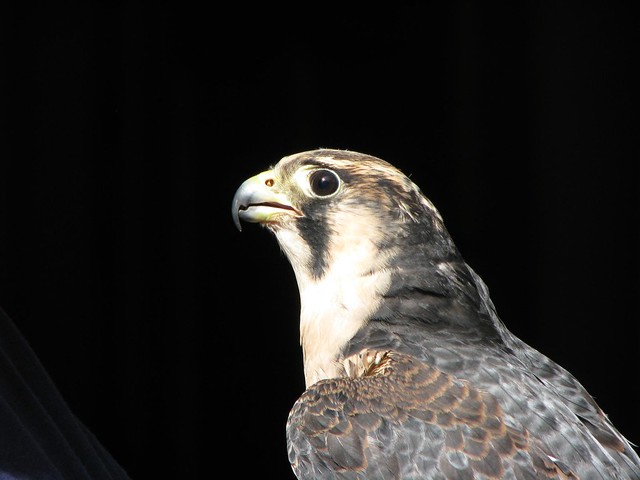
Taiga the Peregrine Falcon
Taiga, a recently departed peregrine falcon who served as an education ambassador for years.

Tuesday, August 13, 2013

Raptor Rendezvous 2013


My local rescue and rehab center for birds of prey, Indiana Raptor Center in Nashville, Indiana, is preparing for its big annual fundraiser, Raptor Rendezvous. If you're a resident of Indiana or surrounding states, I can't recommend it highly enough. Raptor rehabbers from around the Midwest come out, bringing a wide variety of birds. This year, I've also designed a 2014 calendar for InRC, which will be available at the event. The July illustration features, appropriately enough, the Bald Eagles above. They're Piper and Ben, two of InRC's residents.

I recently shared this preview image along with another one at my Tumblr. I also have all of the information about the Raptor Rendezvous there. In brief: it's on September 7, in the beautiful confines of Brown County State Park in Nashville, IN. The event will begin with a dinner, followed by an evening program starring a variety of birds. Did I mention the birds? It will be packed with birds, with special front-row seating area for photographers. The rehabbers are pretty cool, as far as humans go. They tell some good tales. Mostly about birds. If you're on Facebook, check out the event page, as well.

If you're unable to attend but would like to purchase a calendar, I can make that happen if you shoot me an email. If you can't afford to do either, I'd greatly appreciate tweets, Facebook shares, and reblogs of my Tumblr post.

Previous posts about Indiana Raptor Center:
Raptor Sunday
Great Horned Owls in Flight
Indiana Raptor Center Update
Raptor Rendezvous 2012

To see my photos of the birds of Indiana Raptor Center, check out my flickr collection. My Natural Indiana collection features a few sets of Brown County State Park photos.

Thursday, October 25, 2012

Raptor Rendezvous 2012

Shawnee

That there is Shawnee, a young example of the extant theropod species Haliaeetus leucocephalus, the bald eagle. I met him recently at Indiana Raptor Center, a group I've been working with for a year now (and have written about a few times). This weekend is their big fundraising event, the Raptor Rendezvous. If you're a local-to-me reader (as in, if you live in southern Indiana or thereabouts, it would be well worth your time to drive to Nashville, Indiana for one or both days of the event. I'll also have some artwork in the auction and photographs for sale, and you can say "hello" if you recognize me. I'll be the exhausted grad student.

Shawnee is not ready for primetime yet, but you will get to see a ton of great birds up close, including this charmer, a Tyto alba named Oberon.

Oberon the Barn Owl

Here's the raptor center's press release, which has all of the pertinent information.
Indiana Raptor Center (InRC), located in Nashville IN, is presenting the second annual Raptor Rendezvous Festival in Brown County on October 27 and 28. Events include a rendezvous tent on Saturday, Oct. 27, 9 am – 5 pm, located in the Nashville Village Green at Main and Jefferson Streets, complete with re-enactment falconers and live birds, an education display about InRC, and a trading post full of handmade goods, InRC merchandise, small collectible antiques and vintage curiosities, the sale of which supports InRC.

On October 28 the cap-off event of the weekend is a 4 hour extravaganza at the Brown County State Park Abe Martin Lodge, 1 pm – 5 pm. Included will be a silent auction, beverages and concessions and a bird of prey display including approximately 20 bird of prey species from FIVE Indiana and Illinois rehabilitation and education centers.

Special guest from Illinois Raptor Center will be Jack Nuzzo presenting a golden eagle, and a few others seldom seen in Brown County. Charly Taylor from WildCare in Bloomington, Kathy Hershey from Utopia Wildlife in Columbus, Brittany Davis of Eagle Creek in Indianapolis, and the crew from InRC will present area favorites like the bald eagle, barn owl, and some exotic raptor species from other parts of the world.

Admission to all events is free, donations are accepted, and cameras are welcome. This true Raptor Rendezvous will be the largest bird of prey program ever offered in the state of Indiana, larger even than our event last year! All proceeds from the weekend will be used to support the birds of the Indiana Raptor Center, including the provision of food, veterinary care, and shelter maintenance for both full-time residents and our rehabilitation patients.

Truly a wonderful, family event full of fun and information, and a few new surprises!
Read more about my adventures with InRC here, here, here, here, and here. And feel free to join their facebook group, too.

Wednesday, July 25, 2012

Raptor Conservation

Indiana is currently experiencing a growing trend in shootings of raptors. This is a serious federal offense, carrying huge fines, but nonetheless my friends at Indiana Raptor Center are admitting more and more birds of prey suffering from gunshot wounds. They're usually fatal. Updates on the Facebook group for the center invariably gain many hopeful comments, only to be dashed with news that euthanization was necessary.

I'm hard at work on a poster which will be part of a multi-organizational public push to stop this awful trend. There's one telling bit of copy that haunts me as I work. I can't get it out of my head:
"70% of all raptors die withing the first year of their life. Rehabilitation centers report collisions, shootings, electrocution, and pesticide exposure as common causes for admissions."
Today on Twitter, I had a brief conversation with Sharon Wegner-Larson about conservation efforts, and the cynicism of appealing to peoples' self-interest in these matters. It is cold and calculating, but it's also necessary. In fact, it's been a strong through-line in much of my work over the last few months. This poster, inspired by a similar one used a few years ago in the State of Wisconsin, has that strategy in mind, making the point that while raptors may claim a few chickens, they more than pay their way by keeping potentially costly rodent populations down. If you can't hit the heart, aim for the wallet. It's often a larger target.


Illustration of Microraptor and Sinornithosaurus by Emily Willoughby, used with her permission. Click to big it up.

So, when I look at evocative pieces of paleontography like the above Liaoning scene by Emily Willoughby [blog], I have to wonder: even if the asteroid hadn't done the trick, who's to say that previous generations wouldn't have wiped out surviving non-avian dinosaurs by the time our current generations arrived on the planet? Our endless appetite for fictional dinosaur carnage doesn't speak well of their chances, certainly. Maybe it's for the best that so many are gone: it allows us to keep them alive in idealized worlds of our own choosing, safe from our baser instincts. Perhaps these fantasies of lost worlds can help us appreciate our own, and protect the avian dinosaurs with whom we still share the planet.

Thursday, April 5, 2012

Bittersweet news on two injured raptors

On Tuesday, I shared the story of a male turkey vulture with a broken wing whose retrieval I took part in. I talked to Laura from Indiana Raptor Center yesterday, and I'm sorry to say that he had to be euthanized. Unfortunately, the amount of dead tissue in the bone was too great. However, he will have a worthy second life, as he is to be mounted and presented to a local nature center for use in their interpretive programs. He lives in my memory, too. After years of watching these birds as they soared on thermals or congregated around a carcass, I was able to see one up close, to touch it, to watch as it greedily accepted a meal of raw beef. I hope I'm not too sentimental in supposing that I saw some avian form of joy in him as he ripped off pieces of meat, flinging it back and forth and spraying us with the gatorade it had been dipped in. Birdspeed, momentary friend!

Turkey Vulture rescue
Patti cradling the turkey vulture as she places him in a box for a nap.

But I save a bit of news that, while not entirely happy, has a little more sweet than bitter, I think. On Monday, I also got to see a Bald Eagle in the center's flight barn. I had previously been in the barn with Great Horned Owls. This was a totally different experience. Eagles are a LOT louder than owls, and this bird watched me more intently than the owls did. When the center received the eagle, he was in terrible shape, emaciated, with an enlarged heart and liver. Patti and Laura's skills have brought him back to flight-readiness, and though he doesn't have many days ahead of him because of the condition of his liver, he will get to live them in the sunlight, on the shore of whatever nearby lake he chooses. You can't ask for much more than that.

Bald Eagle
A soon-to-be-released bald eagle in the flight barn.

To have an eagle fly less than four feet away from me and feel the wind off of his wings was a thrill.

Tuesday, April 3, 2012

Indiana Raptor Center update

I've written here before about my occasional work with the Indiana Raptor Center, helping spread the word about conservation and rehabbing injured birds of prey so we can keep this proud branch of the dinosaur family going strong. There's been a bit of activity lately, so I figured I'd round it all up in this post.

Vulture Rescue Squad!
Turkey Vulture roundup
There's a vulture in there, honest!


This week, I visited the center to talk shop and hammer out some details about a couple of design projects, detailed below. As soon as I pulled in the driveway, they had a surprise for me: my first rescue trip. A nearby landowner had reported a turkey vulture with a broken wing. Center founders Patti Reynolds and Laura Edmonds weren't sure if it was a good ID; wild turkeys are sometimes confused for vultures. But we had to go check it out.

We bounced up and down the hills and dales of Brown County, and after several minutes were at the location. We found that the ID was good: it was a small Turkey Vulture, with an obvious wing injury. Volunteer and master taxidermist Marcus donned some heavy gloves, Patti grabbed a towel, and I took a large net, with my camera hanging from my neck. Forming one point of an enclosing triangle, it was my job to keep the vulture out of the road. Patti and Marcus approached from their points, and within five minutes of us pulling up, Marcus lunged, pinned the bird, and scooped him up. Patti wrapped him in her towel.

Turkey Vulture rescue

Luckily for the bird, he had managed to scrounge some nutrition. Luckily for us, it hadn't been too recently. The vulture tried to defensively vomit, but since he had an empty tank, we kept clean. After a chat with the homeowner about the bird's possibilities for rehab, we delivered him to the Raptor Center's facilities where Laura was ready to do an evaluation.

Turkey Vulture rescue

Turkey Vulture rescue

He had a pretty bad break right at his wrist joint (seeing vulture pus is marked off my bucket list), which Laura cleaned and wrapped. After hydrating him and feeding him raw beef dipped in gatorade, she gave gave him a shot of painkiller and returned him to his box for a much-needed nap. Next, he'll visit their veterinarian who will determine the chances for recovery, and his ultimate fate will be decided. If the wing can be healed, he'll eventually be released. If not, he'll have to be euthanized. Fingers crossed for a good prognosis.

Turkey Vulture rescue

UPDATE: Sadly, the bone was too far gone and the bird had to be euthanized. He is going to be mounted for a local nature center's educational programs. But I'll always remember him like so: a creature joyful to be fed fresh meat, whipping it back and forth in his beak and spraying us with gatorade. To a second life as a teacher of curious minds.

Conserving a Jurassic Legacy
I'm always excited to work in a new production medium, and when Laura recently asked me to think about a design for a patch depicting a Mesozoic dinosaur with an extant bird of prey, I was stoked to work on it. I recently submitted this design of Velociraptor and a Red-tailed Hawk, which everyone at the Raptor Center gave the thumbs up to... next step is production. I'll be talking to a manufacturer to find out if I need to tweak anything to make sure the small detail is preserved once it jumps from screen to thread. I cannot wait to get the embroidered final product. I'll snap some photos for sure.

Certified Dinosaur Rehabber Patch

Red-Tailed Hawk Conservation
We've had a rash of protected bird shootings in Indiana over the last several months. Luckily for our birds, Patti and Laura know that a method to combat this has been tried and proven in other states: simply, put birds in front of school children and get the population of outdoorsmen to pay attention. I'll be helping with both efforts, but first up I'll be doing a poster aimed at the latter group. I'm really excited that we've received permission to use one of William Zimmerman's Red-Tailed Hawk paintings! My task: to drive home the point that while a hawk will occasionally nab a chicken or two, your friendly neighborhood raptors save you thousands of dollars in the long run by eating up the rodents that covet your grain stores. I'll share this here as well.

Birds are dinosaurs, blah blah blah...

Tuesday, September 15, 2009

Raptors Don't Grow On Trees

A few years ago, Phil Manning at the University of Manchester used a robotic simulation of the dromaeosaur sickle claw to determine how it may have been used - he wanted to test the assumption, popularized by Jurassic Park, that it was a disemboweling tool, perfect for slashing through the bellies of prey dinosaurs. The robo-claw wasn't actually able to slash through the flesh of a pig's carcass; rather, it punctured it. This led to the conclusion that raptors most likely used the claws to maintain a grip on their larger prey while ripping them up with their teeth, leading to a pretty awful, painful death by bleeding.

Manning is continuing to explore the use of dromaeosaurs' claws, and a recent study of the claws of their hands, published in the newest, dino-centric issue of the Anatomical Record, suggests that they could have supported their weight when climbing. In particular, the paper discusses the manual (hand) claws of Velociraptor mongoliensis, whose inner curve had an arc of 127 degrees, which falls between the upper limits of perching bird claws and the lower limits of trunk-climbing bird's claws. Manning also refers back to a 1969 study of Deinonychus antirrhopus, another small dromaeosaur; their pedal (foot) claws had an arc of 160 degrees, which is in line with the upper range of today's trunk-climbing birds, like woodpeckers or the nuthatches which frequent my suet block. Further studies will be devoted to Deinonychus foot claws, of which we have more good specimens than those of Velociraptor.

So the dromaeosaurs, at least the smaller ones, may very well have used their claws to climb trees as well as hang on to their dinners. Lacking any proper paleoart depicting this fascinating new idea, here's an incredibly crappy, dashed-off, proportionally inaccurate one from yours truly.
Raptor in a Tree
Image by me, via flickr