Friday, October 30, 2009

Raúl Martín

Just got the new issue of Nat Geo, and I was happy to find that Raúl Martín has a nice two page spread in the feature on ancient crocodiles. It depicts the giant cretaceous crocodile Deinosuchus lunging for the tyrannosaur Albertosaurus. The image was not made available online, but Martín has covered similar territory for the magazine before. Here is a piece he did several years ago; this time setting is Africa and the players are the giant croc Sarcosuchus and the spinosaurid Suchomimus. Though I must say that this illustration definitely distorts the scales of the two by placing Suchomimus so far in the background - the new one places Albertosaurus the same distance from the viewer as Deinosuchus.

The crocodile article is, in true Nat Geo style, a tie-in to an upcoming special on their cable channel. Here's a preview.

Just because I'm feeling frisky, here's another take on Suchomimus v. Sarcosuchus by the always entertaining Luis Rey.
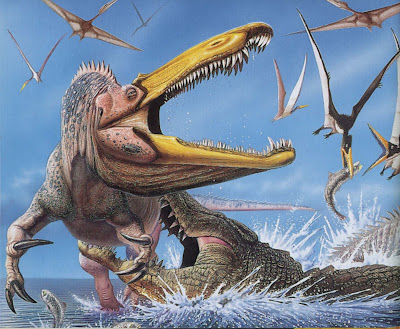
There probably isn't any better way to depict a giant crocodile than by letting it prey on a giant, snaggle-toothed theropod.

Thursday, October 29, 2009

Klosterman's "Eating the Dinosaur"

What else would you expect to be on this cover?


I think I'd like my triceratops prepared like a pig in old cartoons, you know: on a platter with an apple in its mouth. I guess maybe it would have to be a watermelon or pumpkin in this case. An apple would look pretty goofy (because it's so small and a triceratops is so big, you know).

For you plastic dino lovers, I found a couple of alternate concepts for this cover here...

Wednesday, October 28, 2009

The Fugliest of the Dinosaur Statues

This hungry SOB has got to be one of the ugliest dinosaur reconstructions I've seen. We won't even start with the anatomical inaccuracies. Gross disregard of tyrannosaur anatomy.

Most realistic dinosaur ever!
Photo by Vintageroadside, via Flickr

Apparently, you can get a closer look at Stewart's Petrified Wood in Holbrook, AZ. I definitely intend on it myself.

Three Genera... or One?

You may remember when the pachycephalosaur Dracorex hogwartsia was revealed to the public. The reason it garnered the amount of publicity it did was that its specific name (that would be the "hogwartsia") was inspired by a certain series of novels which in turn inspire hysteria in children. It was considered striking enough to grace the cover of the December 2007 issue of Nat Geo, featuring the John Updike article Big Bad Bizarre Dinosaurs.

Not to burst any muggle-bubbles, but according to Jack Horner and Mark Goodwin in Extreme Cranial Ontogeny in the Upper Cretaceous Dinosaur Pachycephalosaurus, Dracorex and the slightly larger Stygimoloch aren't unique genera at all: they are juvenile specimens of the iconic "bone-head" Pachycephalosaurus. Horner and Goodwin took a close look at the available specimens and determined that they clearly share characteristics of juveniles. Their bones were still growing, and their domes weren't fully fused.

Though we may lament the loss of two such colorful dinosaur names, this does bring the pachycephalosaur family more in line with the ontological (a fancy word for growin' up) development of other dinosaurs, such as the ceratopsians and crested duck-bills, as well as birds like the modern cassowary. In all of these, juveniles begin with much different head ornamentation before developing ostentatious adult characteristics fairly quickly during puberty.

Southern Cassowary (Casuarius casuarius)
Cassowary, by rogersmithpix via flickr

Tuesday, October 27, 2009

Oh Shoot Me, New York Daily News

I've decided on a whim to start a new recurring feature here at LITC: Oh Shoot Me. OSM will highlight the most awfulest prehistory reportage the mainstream media has to offer.

First up, the New York Daily News with their article New fossil found in England makes pliosaur biggest predator among the dinosaurs. It opens thusly:
T-rex was a wimp. The recent discovery of a fossilized skull in England crowns the new king of predatory dinosaurs: a 53-foot “sea monster” called a pliosaur.
Want another gem? Cool, okay!
Experts believe that the skull - which measures over 6-feet - contains the largest dinosaur jaw ever found in England, or the world, and that it means pliosaurs were powerful enough to rip a small car in half.
Seriously? We've confused people enough by calling a pliosaur a dinosaur. We're going to muddy it further by saying it could rip a small car in twain? If vehicular destruction is going to be our preferred measure of a prehistoric beast's bite strength, couldn't we pick a small submersible or motorboat?

Though the mistake is called out by one of the post's commenters, this is the comment I'll take away from it, courtesy one ezekiel14: "Gosh, even in prehistoric times did John Kerry get eaten alive by Karl Rove." Not sure where ezekiel14 got a stale political jab out of the article, but large props to him for it.

I've featured some numb-skull reporting in the past, but I think I'll present it in this format in the future. I'd like to hope it will be a rare occasion, but that's not very realistic, is it?

More on the Australian Dino Class of 2009

The Australian Age of Dinosaurs website is hosting a few videos from a recent prime time documentary about the discovery of the dinosaurs Australovenator, Diamantinasaurus, and Wintonotitan. It aired on the program "Sunday Night" in September. Strangely enough, the program uses clips of the utahraptors from Walking with Dinosaurs, uncredited, though they do credit another WWD clip used to depict the environment of early Cretaceous Queensland. The animated reconstruction of Australovenator is colored similarly to the WWD utahraptors, so maybe the editor got confused. The presenter must have been similarly confused; he refers to Australovenator as a "raptor," whereas it was actually a member of one branch of the allosaur family. I am glad to hear that Australian TV uses didgeridoos as audio shorthand for Australian-ness the way we do in the States.

And next time you're in Romania, be sure to make time to drop by the Moldova Mall. They've got a little exhibit set up featuring these three dinosaurs. I wish the marketing director for my mall would get an itch to do this sort of thing. It would probably mean displacing a pushy cell phone or facial cream salesperson's kiosk, but that's a fair sacrifice, isn't it?


Image courtesy Australian Age of Dinosaurs

Sunday, October 25, 2009

Carnival

Carnival fun has a strong attraction for people of Latin blood in America as well as in Europe (LOC)

We'll just say this is a dinosaur. Because it's cool.

Friday, October 23, 2009

Jurassic Sea Life

Yesterday I noticed a new member in one of the Flickr groups I follow. He's a fellow named Leif Beckmann, from Germany, and he has posted some photos of his resin models. They are wonderful. Here is his model of the Jurassic ammonite Kosmoceras castor. Obviously, this is not a dinosaur, but it was a contemporary, so it counts.
Ammonite Kosmoceras (Spinikosmoceras) castor (REINECKE 1818)
By callovium_shale, via flickr

He is also working on a trilobite, and is currently posting photos of the work in progress. I find each stage of its assembly beautiful in its own way.

Thursday, October 22, 2009

Hello, Fruitadens


Paleontologist Luis Chiappe with F. haagarorum model, copyright AP

This week we were introduced to Fruitadens haagarorum, North America's smallest known dinosaur, a Jurassic ornithischian from the Fruita Paleontological Locality.

Fruitadens is a heterodontosaur, which are among the most basal members of the proud ornithischian family, which would also produce such classics as the duckbills, the ceratopsians, and the stegosaurs. It was likely an omnivore, an opportunistic feeder who would have eaten a variety of plants and critters. The fossils have been sitting around at the Natural History Museum of Los Angeles County for thirty-some years, but were just recently identified and named.

I'd like to go on record as thinking that this little dude would look real cute with raccoon-like coloration. Seems fitting, doesn't it? Get on it, paleoartists.

Wednesday, October 21, 2009

The Dinosaurs, from PBS


This is a very strange, hallucinogenic scene from the PBS documentary series "The Dinosaurs!" I love how the T. Rex is just chilling there on the sand dune with her chicks when the trike just up and charges. Then it tumbles down the dune and after a perfunctory slash at the T. rex's belly, submits to playing the role of dinner. I'm sure your average cheetah would love to have an antelope lie down in front of it and invite it to take a bite.

This series was from the early nineties, right before the nature of dinosaur animation was changed forever by the good folks at Industrial Light and Magic. It took a few seconds, but suddenly it came flooding back to my mind from the hoary halls of memory. I remember watching this. May have been my introduction to Bob Bakker. I'm surprised by how little information about the series I've found on the web.

Here's an entire episode from the end of the series, dealing with the K-T extinction. It's an hour long, so please, feel free to kick back with a box of Little Debbies and increase my time on site average!