Sexy rexy's got nothing on the nicotine-craving Brachiosaurus. My doodles always have at least one wonky limb.
Wednesday, January 23, 2013
Sketchbook: The Challenges of the Smoking Brachiosaurus
Sexy rexy's got nothing on the nicotine-craving Brachiosaurus. My doodles always have at least one wonky limb.
Labels:
allosaurus,
brachiosaurus,
jurassic,
paleoart,
sketchbook
Monday, January 21, 2013
Vintage Dinosaur Art: An Odyssey In Time: The Dinosaurs of North America
Taking a break from De Oerwereld, we return this week to an artist who's probably been a little under-appreciated. Eleanor 'Ely' Kish produced her most important work in the 1970s and early 1980s, and a great deal of it is gathered together in Dale Russell's hefty An Odyssey In Time: The Dinosaurs of North America. It's a beautiful book, and one that is truly brought to life (as Russell acknowledges) by Kish's stunning paintings, even if time has not been kind to the way that many of the animals have been restored.
Now don't get me wrong - I wish to make it very clear that I consider Kish's work to be truly masterful. This particularly applies to the reconstructed palaeoenvironments that the animals inhabit; not only did Kish take the task of including the correct flora very seriously, the worlds depicted in her work are frequently breathtaking in scale and detail. In short, they are utterly believable. Kish also paid keen attention to composition and technique, such that - as with all the best palaeoartists - her work stands proudly as art for its own sake, even without considering the palaeontological element.
All of that said, show someone a '70s or early '80s Kish dinosaur these days and the first thing they'll say is "Holy crap, that's skinny!". Kish's restorations represent one of the most extreme faces of what's come to be known as 'shrink-wrapping' in palaeoart - that is, the animals are little more than skeletons with dust sheets thrown over them. Indeed, the above piece - depicting an Apatosaurus pair crossing a mud flat - was even used by Darren Naish in his All Yesterdays presentation to exemplify the 'shrink-wrapping' style. It's easy, here, to appreciate the beauty of the landscape, and the skillful creation of moonlit reflections in the shallow waters of this peaceful delta - but, to modern eyes, the emaciated sauropods are jarring and horrific. 'Zombie dinosaurs', indeed.
Of course, it's always important to remember the era in which works were produced. Such ultra-skinny dinosaurs may well have been an over-reaction to the lumpen, lardy 'evolutionary failures' that had dominated palaeoart for decades; in Kish's case, it might also have been down to the scientific advice she was being given at the time (although I've only heard that one on rumour!). Whatever the case, it's perhaps most important to note the rigorous approach to restoration that Kish employed - an approach that contrasted with even the best of the 'classic' palaeoartists (although Burian did try, using what limited resources he had available to him). The skins of her dinosaurs might adhere too closely to their skeletons, but at least the skeletons themselves adhere closely to their real counterparts.
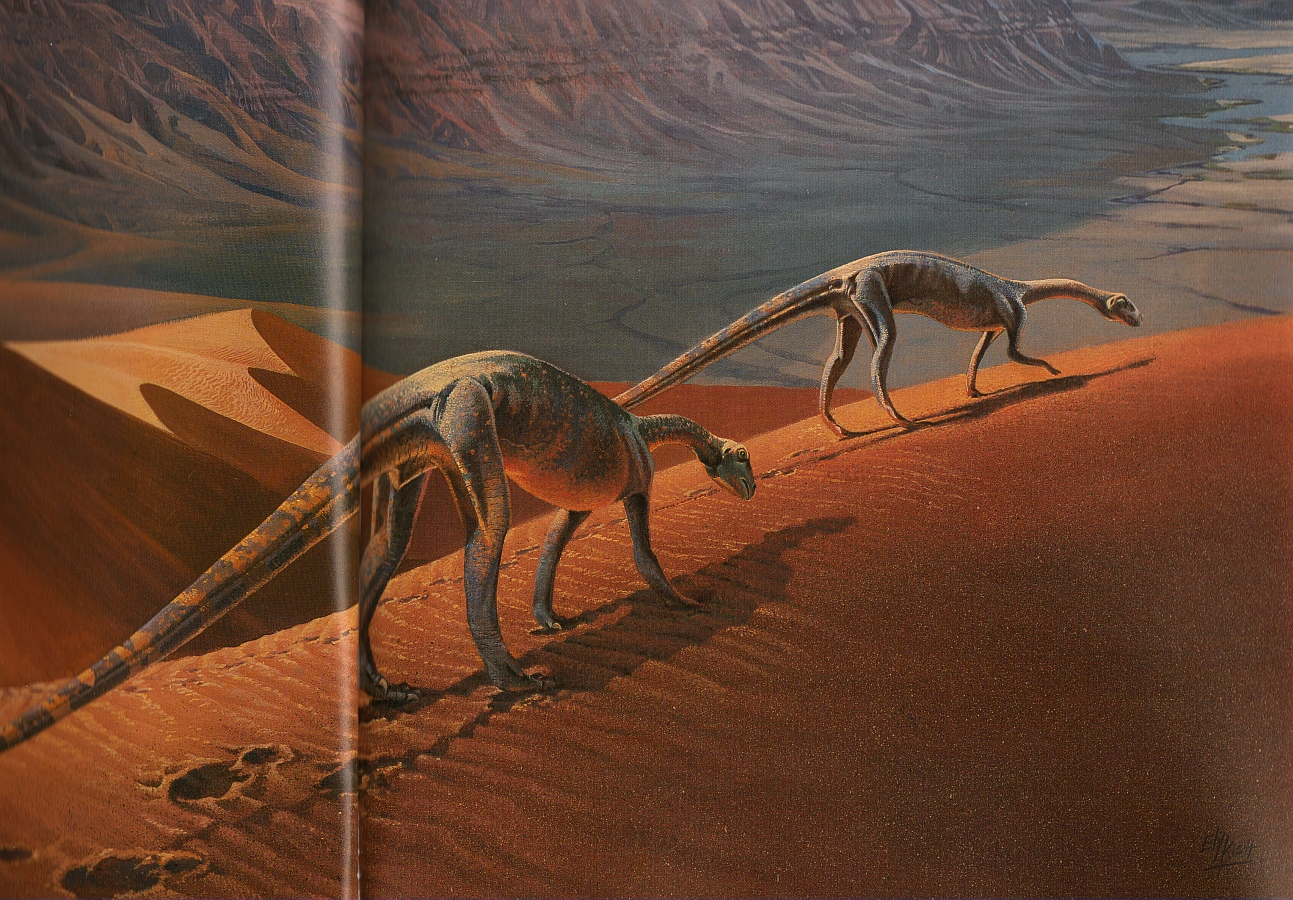
Naturally, there are cases in which one can justifiably portray a skeletal dinosaur - and I'm not only saying that as a cheap joke with regard to the Diplodo-corpses above. Scroll up a little, and you will notice that Kish's Massospondylus are tragic, doomed wanderers in a vast desertscape that is utterly barren, save for the faintest glimmer of water in the distance. The scene invites us to imagine these two desperate, starving dinosaurs wandering for days over the dunes in search of a water source. They might even then be too skinny (they do need room for their internal organs), but at least their painfully thin appearance makes sense to a contemporary viewer. Those corpses aren't bad either...
On other occasions, Kish's work has aged better than it might have scientifically because the animals are not the focus. Show the above painting to someone who isn't palaeontologically inclined, and they'll probably only notice the astonishing realism and beauty of the shoreline at first, in spite of the sauropods ("Pleurocoelus") milling around casually in the background. Kish broke new ground in making dinosaurs a component of a wider environment and ecosystem in her art.
The history of hadrosaurs in palaeoart isn't explored all that often (now there's an idea...), but their depiction has gone from tubby tripods, to more slimline bipeds/quadrupeds, to more fleshy and bulky quadrupeds and occasionally outright porkers. As one might expect, Kish's Corythosaurus represent the second stage in that evolution; they are so thin as to be near-unrecognisable next to today's much more massive-looking restorations, but represent a leap forward from the embarrassing, web-handed 'duckbills' of the previous generation. Dale Russell's influence on this beautiful bayou can be felt with the Troodon stage left, which bears more than a passing resemblance to a certain well-known model. The sharp-eyed will also spot a fragment of long-dead tyrannosaur hanging out in the bottom left.
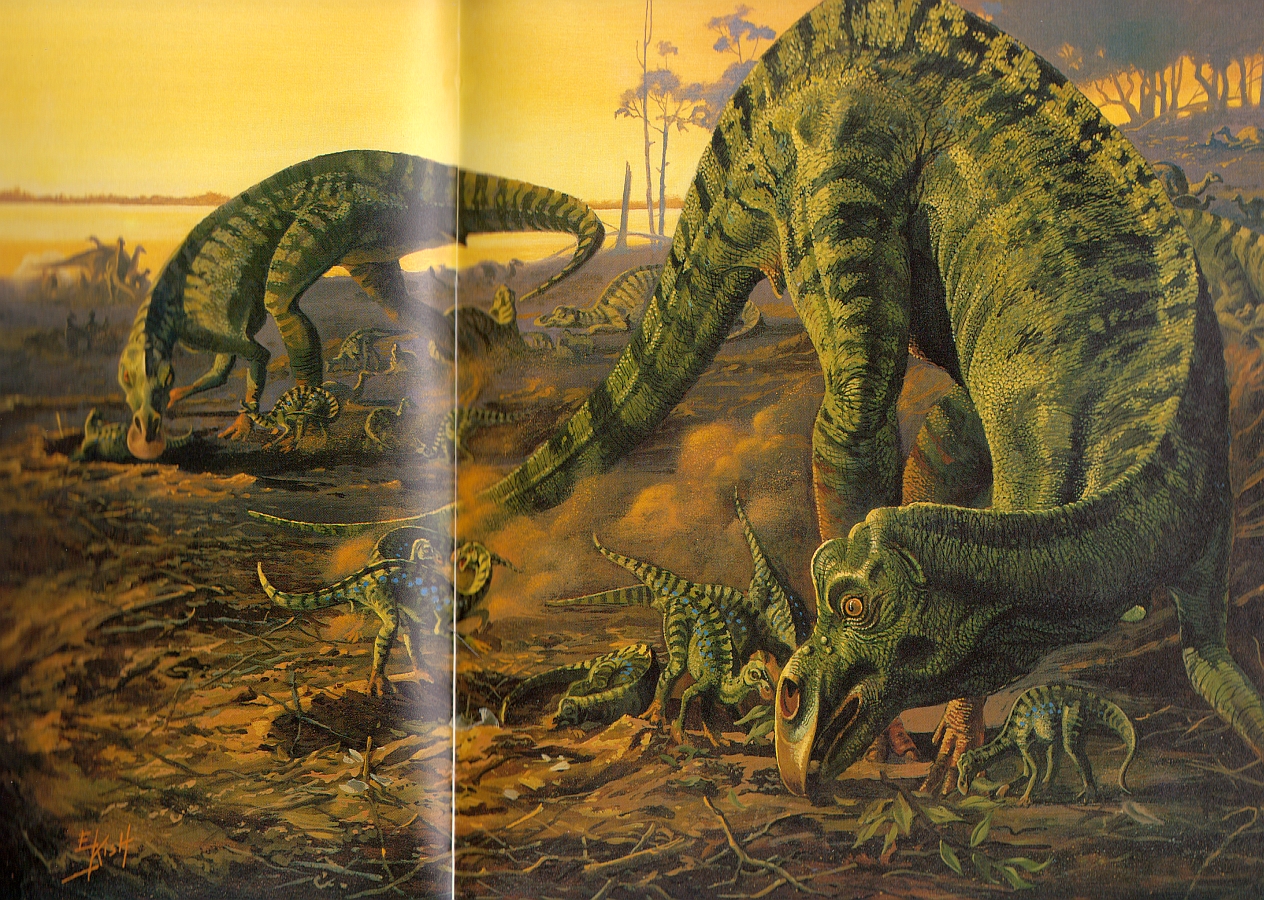
Speaking of hadrosaurs, someone - like me - who grew up with the palaeoart of the 1990s would be hard-pressed to recognise these creatures as Maiasaura, such is the extent of the shrink-wrapping. One especially peculiar, but inevitable result of shrink-wrapping that Kish does not hide is that the pubic bones protrude to the extent that the animals could seemingly use them as crude stabbing weapons. Still, the painting makes wonderful use of light and shade, as does...
...Kish's depiction of two Dryptosaurus engaging in a mating ritual. These two might just be the nadir of the corpsetastic, Tim Burton, heroin chic approach to dinosaur restoration, but the scene behind them is a mind-kersploder. It's almost possible to feel the warmth of the setting sun, and to hear the cries of the flocking birds as they fly to their evening roost. The composition here, too, is uncommonly superb for a work of palaeoart. In spite of how unsettling I might find the wiry tyrannosauroids in the foreground (is anyone else reminded of the Jurassic Park Coelophysis toy?), this is one of my favourite pieces in the book, simply for its dazzling display of artistic skill.
Some dinosaurs, of course, are just too chunky to shrink-wrap, and Tyrannosaurus is surely one of them. Sure, you can choose to display every facet of its skull through the skin in ghoulish detail, but there's no getting away from its absurdly massive, beer keg chest and enormous hips and thighs. Here, again, we see Kish's skill in composition (and Niroot is quite envious of the well-executed palm tree). This is also one of the few Kish pieces to feature dinosaurs in 'action' poses - never mind the fact that T. rex is busy reducing Edmontosaurus to delicious, filleted meaty strips. They'd be finger lickin' good, if only it could lick its fingers.
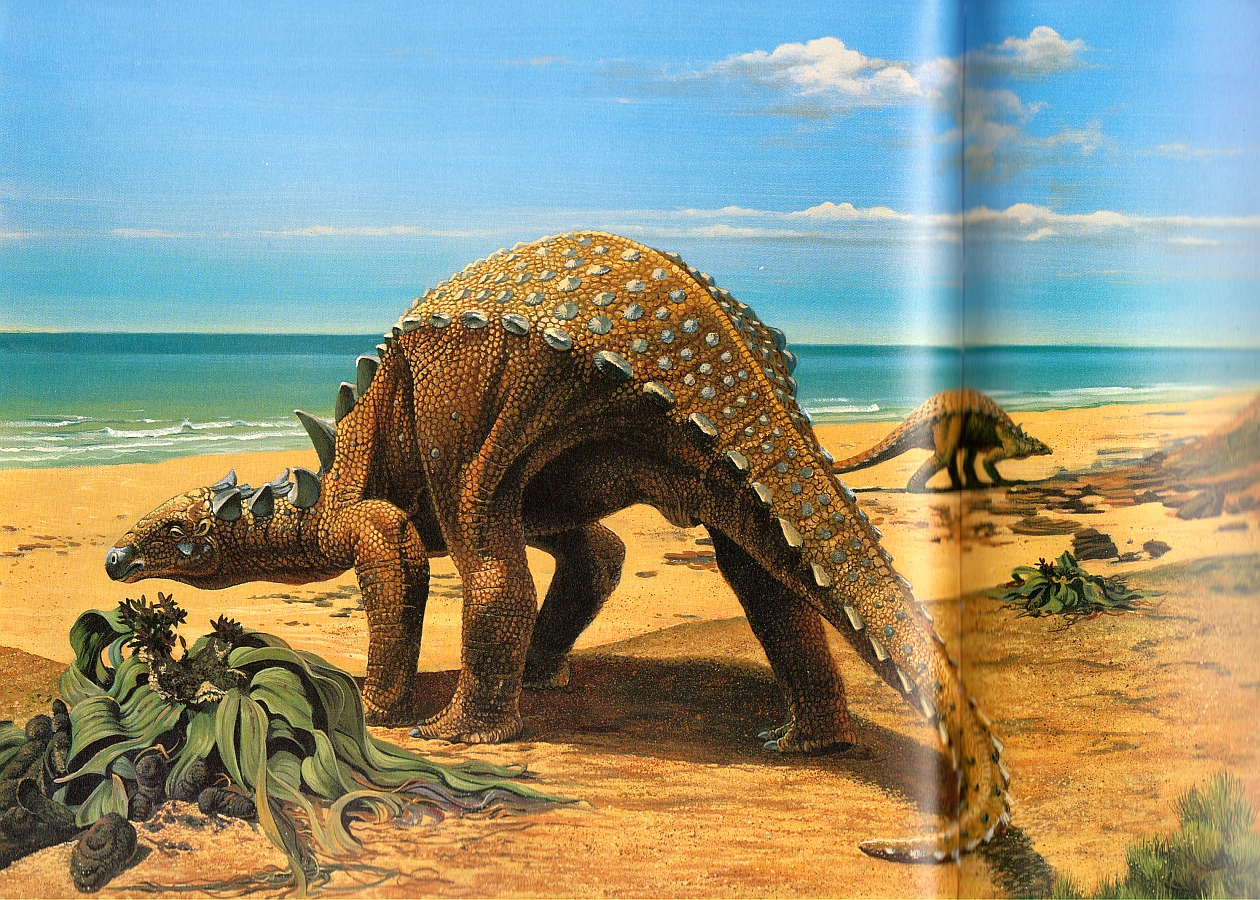
The same principle can also be applied to ankylosaurs - the spiny walking coffee tables of the Mesozoic are simply too wide to be restored in a truly anorexic fashion. While the browsing Sauropelta are quite fetching in themselves, I again regret not being able to present the entire picture here, which is far more expansive and lovingly created than this detail suggests. I guess the only course of action is for you all to find a copy of the book...
Eleanor Kish, then. Come to ogle the super-skinny dinosaurs, but stay for the masterful artistry. We've covered Kish on three occasions before, and I may well return to An Odyssey In Time somewhere down the line - not only to feature more glorious Kish artwork, but because it also features that perennial favourite, the 'Dinosauroid' (nothing to do with Kish, I might add). As for next week...there'll be something completely different!
Now don't get me wrong - I wish to make it very clear that I consider Kish's work to be truly masterful. This particularly applies to the reconstructed palaeoenvironments that the animals inhabit; not only did Kish take the task of including the correct flora very seriously, the worlds depicted in her work are frequently breathtaking in scale and detail. In short, they are utterly believable. Kish also paid keen attention to composition and technique, such that - as with all the best palaeoartists - her work stands proudly as art for its own sake, even without considering the palaeontological element.
All of that said, show someone a '70s or early '80s Kish dinosaur these days and the first thing they'll say is "Holy crap, that's skinny!". Kish's restorations represent one of the most extreme faces of what's come to be known as 'shrink-wrapping' in palaeoart - that is, the animals are little more than skeletons with dust sheets thrown over them. Indeed, the above piece - depicting an Apatosaurus pair crossing a mud flat - was even used by Darren Naish in his All Yesterdays presentation to exemplify the 'shrink-wrapping' style. It's easy, here, to appreciate the beauty of the landscape, and the skillful creation of moonlit reflections in the shallow waters of this peaceful delta - but, to modern eyes, the emaciated sauropods are jarring and horrific. 'Zombie dinosaurs', indeed.
Of course, it's always important to remember the era in which works were produced. Such ultra-skinny dinosaurs may well have been an over-reaction to the lumpen, lardy 'evolutionary failures' that had dominated palaeoart for decades; in Kish's case, it might also have been down to the scientific advice she was being given at the time (although I've only heard that one on rumour!). Whatever the case, it's perhaps most important to note the rigorous approach to restoration that Kish employed - an approach that contrasted with even the best of the 'classic' palaeoartists (although Burian did try, using what limited resources he had available to him). The skins of her dinosaurs might adhere too closely to their skeletons, but at least the skeletons themselves adhere closely to their real counterparts.
Naturally, there are cases in which one can justifiably portray a skeletal dinosaur - and I'm not only saying that as a cheap joke with regard to the Diplodo-corpses above. Scroll up a little, and you will notice that Kish's Massospondylus are tragic, doomed wanderers in a vast desertscape that is utterly barren, save for the faintest glimmer of water in the distance. The scene invites us to imagine these two desperate, starving dinosaurs wandering for days over the dunes in search of a water source. They might even then be too skinny (they do need room for their internal organs), but at least their painfully thin appearance makes sense to a contemporary viewer. Those corpses aren't bad either...
On other occasions, Kish's work has aged better than it might have scientifically because the animals are not the focus. Show the above painting to someone who isn't palaeontologically inclined, and they'll probably only notice the astonishing realism and beauty of the shoreline at first, in spite of the sauropods ("Pleurocoelus") milling around casually in the background. Kish broke new ground in making dinosaurs a component of a wider environment and ecosystem in her art.
The history of hadrosaurs in palaeoart isn't explored all that often (now there's an idea...), but their depiction has gone from tubby tripods, to more slimline bipeds/quadrupeds, to more fleshy and bulky quadrupeds and occasionally outright porkers. As one might expect, Kish's Corythosaurus represent the second stage in that evolution; they are so thin as to be near-unrecognisable next to today's much more massive-looking restorations, but represent a leap forward from the embarrassing, web-handed 'duckbills' of the previous generation. Dale Russell's influence on this beautiful bayou can be felt with the Troodon stage left, which bears more than a passing resemblance to a certain well-known model. The sharp-eyed will also spot a fragment of long-dead tyrannosaur hanging out in the bottom left.
Speaking of hadrosaurs, someone - like me - who grew up with the palaeoart of the 1990s would be hard-pressed to recognise these creatures as Maiasaura, such is the extent of the shrink-wrapping. One especially peculiar, but inevitable result of shrink-wrapping that Kish does not hide is that the pubic bones protrude to the extent that the animals could seemingly use them as crude stabbing weapons. Still, the painting makes wonderful use of light and shade, as does...
...Kish's depiction of two Dryptosaurus engaging in a mating ritual. These two might just be the nadir of the corpsetastic, Tim Burton, heroin chic approach to dinosaur restoration, but the scene behind them is a mind-kersploder. It's almost possible to feel the warmth of the setting sun, and to hear the cries of the flocking birds as they fly to their evening roost. The composition here, too, is uncommonly superb for a work of palaeoart. In spite of how unsettling I might find the wiry tyrannosauroids in the foreground (is anyone else reminded of the Jurassic Park Coelophysis toy?), this is one of my favourite pieces in the book, simply for its dazzling display of artistic skill.
Some dinosaurs, of course, are just too chunky to shrink-wrap, and Tyrannosaurus is surely one of them. Sure, you can choose to display every facet of its skull through the skin in ghoulish detail, but there's no getting away from its absurdly massive, beer keg chest and enormous hips and thighs. Here, again, we see Kish's skill in composition (and Niroot is quite envious of the well-executed palm tree). This is also one of the few Kish pieces to feature dinosaurs in 'action' poses - never mind the fact that T. rex is busy reducing Edmontosaurus to delicious, filleted meaty strips. They'd be finger lickin' good, if only it could lick its fingers.
The same principle can also be applied to ankylosaurs - the spiny walking coffee tables of the Mesozoic are simply too wide to be restored in a truly anorexic fashion. While the browsing Sauropelta are quite fetching in themselves, I again regret not being able to present the entire picture here, which is far more expansive and lovingly created than this detail suggests. I guess the only course of action is for you all to find a copy of the book...
Eleanor Kish, then. Come to ogle the super-skinny dinosaurs, but stay for the masterful artistry. We've covered Kish on three occasions before, and I may well return to An Odyssey In Time somewhere down the line - not only to feature more glorious Kish artwork, but because it also features that perennial favourite, the 'Dinosauroid' (nothing to do with Kish, I might add). As for next week...there'll be something completely different!
Friday, January 18, 2013
Return to the Valley of Dinosaurigami
It's been well over a year since I put together a post of origami dinosaurs, which is entirely too long. This time, I'm focusing on one artist. All of the pieces below have been designed and folded by paper artist Tran Trung Hieu, who shares work on Flickr as well as the Vietnam Origami Group.
I'll kick this post off with a gorgeous Therizinosaurus. Love the feathery-fin detail on those majestic forelimbs.
Here's one I'd not seen tried before: ribbon-tailed Epidexipteryx.
Another refreshing oddball, the alvarezsaur Mononykus.
And yet another I'd not seen tried before, and a beauty it is. The mighty Balaur bondoc, in mid-pounce.
Back to more popular forms with a royal red Spinosaurus.
Comprised of over 90 pieces of paper, a skeletal Sarcosuchus.
Finally, looking quite handsome in white against a black backdrop and hailing from the forests of the antarctic, a fetching Cryolophosaurus.

Amazing work, Tran! Please be sure to show your appreciation at his Flickr photostream. There are many more treasures to find there, but since he hasn't organized them into sets, it will take a little work to find them. But it's well worth it.
Earlier posts in this occasional series:
Dinosaurigami
More Dinosaurigami
Further Adventures in Dinosaurigami
Deeper Into Dinosaurigami
We'll have fun, fun, fun, until daddy takes the dinosaurigami away
I'll kick this post off with a gorgeous Therizinosaurus. Love the feathery-fin detail on those majestic forelimbs.
Here's one I'd not seen tried before: ribbon-tailed Epidexipteryx.
Another refreshing oddball, the alvarezsaur Mononykus.
And yet another I'd not seen tried before, and a beauty it is. The mighty Balaur bondoc, in mid-pounce.
Back to more popular forms with a royal red Spinosaurus.
Comprised of over 90 pieces of paper, a skeletal Sarcosuchus.
Finally, looking quite handsome in white against a black backdrop and hailing from the forests of the antarctic, a fetching Cryolophosaurus.
Amazing work, Tran! Please be sure to show your appreciation at his Flickr photostream. There are many more treasures to find there, but since he hasn't organized them into sets, it will take a little work to find them. But it's well worth it.
Earlier posts in this occasional series:
Dinosaurigami
More Dinosaurigami
Further Adventures in Dinosaurigami
Deeper Into Dinosaurigami
We'll have fun, fun, fun, until daddy takes the dinosaurigami away
Thursday, January 17, 2013
Mesozoic Miscellany 57
High time for another round-up, I reckon! Saddle up, pard'ners.
First up: the plate-backs have arrived at ART Evolved! January's gallery is devoted to stegosaurs, and a fetching group it is.
John Conway's log is essential reading, both for the artwork he shares and his insights. He recently wrote a piece on Gregory S. Paul, lamenting the paleoart titan's obsession with taxonomic acts. He writes:
It's always fun when The Onion writes dinosaur pieces, as in October's New Evidence Suggests Dinosaurs Died in Cretaceous Period Hospice.
Mark Witton's evocative illustration of a Pachyrhinosaurus family braving the Cretaceous arctic. © Mark Witton, of course.
Mark Witton made a splash with his speculative, musk ox-inspired Pachyrhinosaurus illustration recently, and he writes a characteristically insightful piece on why it's not such a nutty idea, existing ceratopsid skin impressions be damned.
Mark Wildman wrote about the joys of finding shark teeth in the doldrums of winter at Saurian.
At Symbiartic, Kalliopi Monoyios begins a series of posts on University of Chicago superstar paleontologist Neil Shubin's new book The Universe Within.
Kalliopi and her Symbiartic comrade Glendon Mellow have started a Google Plus community devoted to Science Art. It's been the shot in the arm I needed for G+ to make sense for me. Come on over.
Matt Wedel explores the sauropod nervous system at SV-POW, in a post hilariously titled Oblivious Sauropods Being Eaten.
Speaking of sauropods, Matt Martyniuk, author of A Field Guide to Mesozoic Birds, responds to a recent Andrea Cau post about the All Yesterdays-flavored work of Emiliano Troco with his own double-dewlap bearing sauropod.
Finally, I'd like to share one sneak peek into a project I'm working on. I'm writing and illustrating a children's book! It's a paleo book. Of course it is. I've been sharing bits of it on various social media outlets, so it's high time I shared some here. I humbly present an artistic Ankylosaurus.
It's a work-in-progress, but it will give you an idea of what to expect. More details as 2013 rolls on!
First up: the plate-backs have arrived at ART Evolved! January's gallery is devoted to stegosaurs, and a fetching group it is.
John Conway's log is essential reading, both for the artwork he shares and his insights. He recently wrote a piece on Gregory S. Paul, lamenting the paleoart titan's obsession with taxonomic acts. He writes:
Why is one of the greatest dinosaur artists of all time spending so much time on this? Considering he hasn’t a hope in hell of convincing the majority of people working on dinosaur taxonomy that his approach is right, continuing to fight this fight feels like a criminal waste of time and effort.For more of Conway's thoughts, click on over.
It's always fun when The Onion writes dinosaur pieces, as in October's New Evidence Suggests Dinosaurs Died in Cretaceous Period Hospice.
Mark Witton's evocative illustration of a Pachyrhinosaurus family braving the Cretaceous arctic. © Mark Witton, of course.
Mark Witton made a splash with his speculative, musk ox-inspired Pachyrhinosaurus illustration recently, and he writes a characteristically insightful piece on why it's not such a nutty idea, existing ceratopsid skin impressions be damned.
Mark Wildman wrote about the joys of finding shark teeth in the doldrums of winter at Saurian.
At Symbiartic, Kalliopi Monoyios begins a series of posts on University of Chicago superstar paleontologist Neil Shubin's new book The Universe Within.
Kalliopi and her Symbiartic comrade Glendon Mellow have started a Google Plus community devoted to Science Art. It's been the shot in the arm I needed for G+ to make sense for me. Come on over.
Matt Wedel explores the sauropod nervous system at SV-POW, in a post hilariously titled Oblivious Sauropods Being Eaten.
Speaking of sauropods, Matt Martyniuk, author of A Field Guide to Mesozoic Birds, responds to a recent Andrea Cau post about the All Yesterdays-flavored work of Emiliano Troco with his own double-dewlap bearing sauropod.
Finally, I'd like to share one sneak peek into a project I'm working on. I'm writing and illustrating a children's book! It's a paleo book. Of course it is. I've been sharing bits of it on various social media outlets, so it's high time I shared some here. I humbly present an artistic Ankylosaurus.
Wednesday, January 16, 2013
Sketchbook: A Tubby Hadrosaur
Would you be up for me sharing doodles here? I'm sure many of your sketchbooks are like mine, with dinosaurs of all sorts sneaking around notes, rants, moments of genius, and other serious business. So I have plenty of the little buggers to share. I'll try to make it a thing (and of course, my fellow LITC bloggers are invited to do sketchbook posts of their own).
I'll kick off what I hope to be a long series with a tubby hadrosaur of some sort I drew after reading a chapter of the excellent A Smile in the Mind (designers, read it). Kind of looks like a mix of Gryposaurus and Lambeosaurus. With a strange, perhaps pathological hindlimb.
I have no idea why I was drawing my hand, but the two end up interacting in a fun way, as if I'm pretending to hold a handful of whatever seedy things hadrosaurs like to eat. I also shared this at my tumblr blog The Gallant Cannibal, where I share things that spark my curiosity as well as promote posts we write here. It's kind of become a supplement to LITC, so you may be interested in following me there, too.
I'll kick off what I hope to be a long series with a tubby hadrosaur of some sort I drew after reading a chapter of the excellent A Smile in the Mind (designers, read it). Kind of looks like a mix of Gryposaurus and Lambeosaurus. With a strange, perhaps pathological hindlimb.
I have no idea why I was drawing my hand, but the two end up interacting in a fun way, as if I'm pretending to hold a handful of whatever seedy things hadrosaurs like to eat. I also shared this at my tumblr blog The Gallant Cannibal, where I share things that spark my curiosity as well as promote posts we write here. It's kind of become a supplement to LITC, so you may be interested in following me there, too.
Tuesday, January 15, 2013
Vintage Dinosaur Art: De Oerwereld van de Dinosauriërs - Part 2
That's right - it's time for another look at the best palaeoart of the 1980s, as presented in De Oerwereld van de Dinosauriërs, also known as Dinosaurs: a Global View. I'm sure all of you - literally all of you, every last individual reading this blog- eagerly lapped up the last installment, but I'll link you back to it as a formality. Onwards!
As usual, I've been forced to cut certain images up into chunks due to the small size of my scanner, so please take note that this is merely the right half of Hallett's stunning depiction of Dicraeosaurus. Out of all the artists working in the 1980s, it is perhaps Hallett's work that has best stood the test of time scientifically; with a few minor tweaks, many of his 1980s paintings would pass muster today. Of course, they are also artistic achievements to match the classic palaeoart greats, as evidenced upon closer examination of this image. One is so impressed by the majesty of these huge creatures, it's easy to miss such details as the 'waterlines' on their hides, and the beautifully rendered sky.
In the background, it's possible to see Hallett's experiments with sauropod posture (notice the individual on the left). It's a wonderful depiction of sauropods happily going about their business, and quite possibly my favourite spread in the entire book.
As I noted last time, Henderson's work serves as an effective contrast to Hallett's in the context of this book. Whereas Hallett's is more immediate and features the animals in sharp focus, Henderson often obscures them in shadow, vegetation, or both. One of his greatest strengths is in using light effectively to both draw the viewer into a scene, and invoke a strong emotional response. Here, the bunny-handed allosaurs may rudely stick out to the 21st-century dinosaur enthusiast, but it doesn't matter. We are invited to imagine this Diplodocus' story, and what might happen between it and the skulking predators. Unlike Hallett and others, Henderson rarely depicts a fight in mid-swing - rather, he is concerned with the before and after.
Of course, when all is said and done, what you really want is BLOOD - never mind all that artsy-fartsy nonsense. Proving that sauropods are perfectly capable of defending themselves, here we see Shunosaurus performing uninvited, impromptu dentistry on an allosaur (most likely Yangchuanosaurus). However, if you are quite sick of violent palaeoart, then you are invited to inspect the carefully considered anatomy of the animals and their beautifully detailed footprints. Everyone loves a footprint.
Again, as previously noted (whaddaya mean, I've run out of things to say?), Henderson's art frequently exhibits a melancholy that is vanishingly rare, if not unique in palaeoart. Here it is evoked by the jagged forms of the rotting trees in the foreground, the furious, stormy sky, and the fact that the sauropods kinda have sad faces. Don't they, though? I mean, it's enough to make you want to hug one of their massive scaly legs, or perhaps offer them a mug of hot chocolate with marshmallows and cream. They're Patagosaurus, by the way, an animal that resembled the more famous Cetiosaurus.
Even if you think you haven't seen Mark Hallett's Crossing the Flat before, you definitely have. It's a bona fide palaeoart classic; naturally, it is reproduced in the book as a double-page spread. As such, I can only present a detail here (the calf and the mother's neck - Mamenchisaurus was absurd), although I have featured the whole thing once before. It's the sort of painting that, should people ever ask you why you find dinosaurs so bloody fascinating, you can press their noses against and say simply "THIS".
The latest biomechanical work has revealed that Plateosaurus almost certainly wasn't ever a quadruped, but, again, that hardly tarnishes one's appreciation of this lovely scene. Although only the left half is shown here, it hopefully gives a suitable flavour of this typically Hendersonian work - a marvelously tranquil portrayal of a wandering herd. Once again, the viewer is placed in a realistically detached position, and in this case is even being addressed by a glancing plateosaur (or so it appears), which as in all of Henderson's work greatly enhances the feeling of wandering, alone, in the Mesozoic. You might not last that long, but at least you'd see something as glorious and moving as this before being shredded into little pieces by a mob of voracious Coelophysis.
I didn't feature any Sibbick last time. Admittedly, Sibbick's work is very much in the minority in this book, but nevertheless this should redress the balance. This particular piece - a ceratosaur shouting some obscene insults at some trumped-up brachiosaur - has featured in a number of different publications, among them The Ultimate Dinosaur Book, a favourite from my childhood. Many have questioned what, exactly, the horned one is hoping to achieve in facing such a vastly bigger adversary; indeed, the UDB noted that it was 'unlikely' that a puny ceratosaur would ever pick on an adult brachiosaur. However, one doesn't have to interpret the scene in this way - it could be that the ceratosaur has been disturbed by the brachiosaur's heffalumpian tramplings, and is giving the big lug a piece of its mind before reluctantly moving on. And if that doesn't convince you, just look at that pterosaur's face. Oh my, what a face.
Next week: something different! De Oerwereld van de Dinosauriërs will return, but variety is the nutmeg of existence, and all that. Perhaps some more Ely Kish, perhaps an obscure 1980s pop-up book...we'll see.
As usual, I've been forced to cut certain images up into chunks due to the small size of my scanner, so please take note that this is merely the right half of Hallett's stunning depiction of Dicraeosaurus. Out of all the artists working in the 1980s, it is perhaps Hallett's work that has best stood the test of time scientifically; with a few minor tweaks, many of his 1980s paintings would pass muster today. Of course, they are also artistic achievements to match the classic palaeoart greats, as evidenced upon closer examination of this image. One is so impressed by the majesty of these huge creatures, it's easy to miss such details as the 'waterlines' on their hides, and the beautifully rendered sky.
In the background, it's possible to see Hallett's experiments with sauropod posture (notice the individual on the left). It's a wonderful depiction of sauropods happily going about their business, and quite possibly my favourite spread in the entire book.
As I noted last time, Henderson's work serves as an effective contrast to Hallett's in the context of this book. Whereas Hallett's is more immediate and features the animals in sharp focus, Henderson often obscures them in shadow, vegetation, or both. One of his greatest strengths is in using light effectively to both draw the viewer into a scene, and invoke a strong emotional response. Here, the bunny-handed allosaurs may rudely stick out to the 21st-century dinosaur enthusiast, but it doesn't matter. We are invited to imagine this Diplodocus' story, and what might happen between it and the skulking predators. Unlike Hallett and others, Henderson rarely depicts a fight in mid-swing - rather, he is concerned with the before and after.
Of course, when all is said and done, what you really want is BLOOD - never mind all that artsy-fartsy nonsense. Proving that sauropods are perfectly capable of defending themselves, here we see Shunosaurus performing uninvited, impromptu dentistry on an allosaur (most likely Yangchuanosaurus). However, if you are quite sick of violent palaeoart, then you are invited to inspect the carefully considered anatomy of the animals and their beautifully detailed footprints. Everyone loves a footprint.
Again, as previously noted (whaddaya mean, I've run out of things to say?), Henderson's art frequently exhibits a melancholy that is vanishingly rare, if not unique in palaeoart. Here it is evoked by the jagged forms of the rotting trees in the foreground, the furious, stormy sky, and the fact that the sauropods kinda have sad faces. Don't they, though? I mean, it's enough to make you want to hug one of their massive scaly legs, or perhaps offer them a mug of hot chocolate with marshmallows and cream. They're Patagosaurus, by the way, an animal that resembled the more famous Cetiosaurus.
Even if you think you haven't seen Mark Hallett's Crossing the Flat before, you definitely have. It's a bona fide palaeoart classic; naturally, it is reproduced in the book as a double-page spread. As such, I can only present a detail here (the calf and the mother's neck - Mamenchisaurus was absurd), although I have featured the whole thing once before. It's the sort of painting that, should people ever ask you why you find dinosaurs so bloody fascinating, you can press their noses against and say simply "THIS".
The latest biomechanical work has revealed that Plateosaurus almost certainly wasn't ever a quadruped, but, again, that hardly tarnishes one's appreciation of this lovely scene. Although only the left half is shown here, it hopefully gives a suitable flavour of this typically Hendersonian work - a marvelously tranquil portrayal of a wandering herd. Once again, the viewer is placed in a realistically detached position, and in this case is even being addressed by a glancing plateosaur (or so it appears), which as in all of Henderson's work greatly enhances the feeling of wandering, alone, in the Mesozoic. You might not last that long, but at least you'd see something as glorious and moving as this before being shredded into little pieces by a mob of voracious Coelophysis.
I didn't feature any Sibbick last time. Admittedly, Sibbick's work is very much in the minority in this book, but nevertheless this should redress the balance. This particular piece - a ceratosaur shouting some obscene insults at some trumped-up brachiosaur - has featured in a number of different publications, among them The Ultimate Dinosaur Book, a favourite from my childhood. Many have questioned what, exactly, the horned one is hoping to achieve in facing such a vastly bigger adversary; indeed, the UDB noted that it was 'unlikely' that a puny ceratosaur would ever pick on an adult brachiosaur. However, one doesn't have to interpret the scene in this way - it could be that the ceratosaur has been disturbed by the brachiosaur's heffalumpian tramplings, and is giving the big lug a piece of its mind before reluctantly moving on. And if that doesn't convince you, just look at that pterosaur's face. Oh my, what a face.
Next week: something different! De Oerwereld van de Dinosauriërs will return, but variety is the nutmeg of existence, and all that. Perhaps some more Ely Kish, perhaps an obscure 1980s pop-up book...we'll see.
Repost: Tyrant of the Salvage Yards
Today, as I struggle to get into the groove of another hectic semester, I'd like to repost a piece from June of 2011 about sculptor Andrew Chase's wonderful scrap-metal Tyrannosaurus rex sculpture. It never quite got the notice I hoped it would, but maybe with another year and a half of experience under my belt, I can spread the word a little wider.
I'm not the first person to recognize the intimate relationship between art and paleontology. One of the great benefits of writing this blog has been meeting artists who inspire me with their craftsmanship, imagination, and dedication to the inherent beauty in biological forms. Even better than that is learning of the surging culture of young paleoartists hashing out their form on-line. Their ability and discipline is humbling and has spurred me on to make a career of visual science communication. So, when artist Andrew Chase emailed me about his sculpture of Tyrannosaurus rex, my mind was primed to be blown.

Here was an artist who recognized the integrity of the tyrant lizard's form. This is something I admire in the greatest paleoart, and it's the reason I harp on scientific accuracy (concerning which, I admit, I still have much to learn). The greater understanding paleontologists have given us - how dinosaurs moved, breathed and inhabited their lost worlds - has resulted in more resonant art.
I asked Andrew what drew him, as an artist, to this particular animal. "Tyrannosaurus has a purity of form that I find beautiful," he answered. "In my opinion, the T. rex is basically a mouth delivery device, everything else is subordinate to that. No goofy crests, sails, horns/protrusions for sexual display, for this baby it's all about the head. What's the tail for? To balance the head. Legs? Moving the head to the food. Brain? Overrated, keep it small and you can make the jaws bigger. Arms? Not necessary, lose 'em (well almost) and increase the size of the head. I think that singular dedication of purpose is maladaptive but really, really cool."
I told Andrew I was especially impressed that he had consulted with the University of Utah's Dr. Mark Loewen when conceiving his sculpture, and I knew that many readers would appreciate it, as well. He said, "I don't know why anybody doing this sort of project wouldn't consult with an expert. I'd be insane not to. There's literally no downside. I've made six animal sculptures so far and I've found that the closer I adhere to the animal's real physiology, the better the outcome. When I make a strong effort to be accurate, the pieces are better balanced, pose more easily, and are generally superior in every way to the one sculpture where I just eyeballed it."
Andrew's T. rex is six feet long, stands two feet at the hip, and weighs about forty pounds. It is fully articulated, as are his other animal sculptures, and he says that it's "made primarily out of recycled transmission parts, conduit, plumbing pipe and unidentifiable widgets found in industrial salvage yards."
The genesis of the sculpture was Andrew's yet-unpublished children's book, Timmy, a lonely robot tale - written and created before Wall-E - in which he says that "the Tyrannosaurus is a metal shredder, compactor and waste disposal unit. Everything and everyone will eventually pass through him. Because of this, the poor T. rex suffers the plight of undertakers everywhere and leads a somewhat lonely existence, even though he's witty, urbane, and would never intentionally eat a functioning machine."
Please head over to Andrew Chase's website to check out more of his art, including some stunning work from Timmy.
* * * * *
I'm not the first person to recognize the intimate relationship between art and paleontology. One of the great benefits of writing this blog has been meeting artists who inspire me with their craftsmanship, imagination, and dedication to the inherent beauty in biological forms. Even better than that is learning of the surging culture of young paleoartists hashing out their form on-line. Their ability and discipline is humbling and has spurred me on to make a career of visual science communication. So, when artist Andrew Chase emailed me about his sculpture of Tyrannosaurus rex, my mind was primed to be blown.

Here was an artist who recognized the integrity of the tyrant lizard's form. This is something I admire in the greatest paleoart, and it's the reason I harp on scientific accuracy (concerning which, I admit, I still have much to learn). The greater understanding paleontologists have given us - how dinosaurs moved, breathed and inhabited their lost worlds - has resulted in more resonant art.
I asked Andrew what drew him, as an artist, to this particular animal. "Tyrannosaurus has a purity of form that I find beautiful," he answered. "In my opinion, the T. rex is basically a mouth delivery device, everything else is subordinate to that. No goofy crests, sails, horns/protrusions for sexual display, for this baby it's all about the head. What's the tail for? To balance the head. Legs? Moving the head to the food. Brain? Overrated, keep it small and you can make the jaws bigger. Arms? Not necessary, lose 'em (well almost) and increase the size of the head. I think that singular dedication of purpose is maladaptive but really, really cool."
I told Andrew I was especially impressed that he had consulted with the University of Utah's Dr. Mark Loewen when conceiving his sculpture, and I knew that many readers would appreciate it, as well. He said, "I don't know why anybody doing this sort of project wouldn't consult with an expert. I'd be insane not to. There's literally no downside. I've made six animal sculptures so far and I've found that the closer I adhere to the animal's real physiology, the better the outcome. When I make a strong effort to be accurate, the pieces are better balanced, pose more easily, and are generally superior in every way to the one sculpture where I just eyeballed it."
Andrew's T. rex is six feet long, stands two feet at the hip, and weighs about forty pounds. It is fully articulated, as are his other animal sculptures, and he says that it's "made primarily out of recycled transmission parts, conduit, plumbing pipe and unidentifiable widgets found in industrial salvage yards."
The genesis of the sculpture was Andrew's yet-unpublished children's book, Timmy, a lonely robot tale - written and created before Wall-E - in which he says that "the Tyrannosaurus is a metal shredder, compactor and waste disposal unit. Everything and everyone will eventually pass through him. Because of this, the poor T. rex suffers the plight of undertakers everywhere and leads a somewhat lonely existence, even though he's witty, urbane, and would never intentionally eat a functioning machine."
Please head over to Andrew Chase's website to check out more of his art, including some stunning work from Timmy.
Labels:
andrew chase,
paleoart,
repost,
sculpture,
tyrannosaurus rex
Wednesday, January 9, 2013
Artist Interview: Alexander Lovegrove
There are a huge number of palaeoartists clamouring for attention on deviantArt these days, so it requires a unique take on affairs to truly stand out - especially with Yet Another Tyrannosaurus. Alexander Lovegrove (an ecology PhD student from the UK) first caught my attention with the piece pictured above - a depiction of that very dinosaur in a rainforest setting It might be a little fanciful, but the highly individual style and meticulous detailing make it stand out from the pack. In fact, I immediately thought of Henri Rousseau's jungle scenes, even if Alexander's style and professed influences are somewhat different. The potentially bland and conventional lateral view of the creature is subverted by having the animal's off-centre head facing the viewer, its piercing, predatory gaze proving irresistible to the eye.
Ever since then, it's been fascinating to see what Alexander (right) will produce next, and there have been a steady stream of new pieces on his deviantArt page. He may make some mistakes along the way (who doesn't?), but his bold technique and speculative touches, coupled with his funneling of his ecological interests into his art, have definitely made him a palaeoartist worth keeping an eye on. I wanted to know a little more about what goes into his art, as well as just plain show it off - and wouldn't you know, some fool gave me a platform to do so. Hurrah! Anyway, on with the interview...
![]() |
| Zhuchengtyrannus (left) and Tarbosaurus (right). This piece actually consists of two paintings combined. |
How long have you been
interested in dinosaurs? Was it something that stemmed from your
interests in natural history and ecology more broadly, or did it
develop alongside?
I've been interested in dinosaurs as
long as I can remember, and just haven't grown out of it. I've also
always been interested in the natural world (I am currently an
ecology PhD student), so I guess that is part of it too. As I've
grown older I have come to appreciate the connections between the
world of dinosaurs and modern ecosystems. It's amazing to think that
there were whole ecosystems, habitats and biomes that are lost in
time.
Yeah, Doug Henderson is definitely up
there! Above all he is a wonderful artist. I think Doug
Henderson's work stands out a great deal now due to his mastery of
painting natural environments and his skill at composition. I would
love to emulate those ideas, but I am just an amateur really. The
first paleoart I really started to recognise and enjoy was Greg
Paul's, like many other artists of my generation. However, it wasn't
his skeletal or pencil illustrations that really captured my
imagination but a series of watercolours which I think appeared in
the Dinosaurs magazine series when I was a kid. It always seemed
like colour was important to me when depicting dinosaurs, they needed
to be vibrant! Other big inspirations and influences were Michael
Skrepnick and Mark Hallett, whose work I really admire. And then more
recently there are so many others - simply too numerous to list! I
am also a great admirer of the ultra-realism of John Gurche, although
he hasn't depicted that many dinosaurs.
They are not
palaeoartists, but John Howe and Alan Lee were really big early
influences - I started out painting Tolkein-y things!
![]() |
| 'Winter Kill' |
Yeah, I really do like tyrannosaurs a
lot more than other dinosaurs - my favourite of all being
Albertosaurus. Something about them really fascinates me, in
particular their ancestry and relationship to the bird lineage
(although I've ended up painting the most derived examples). Their
shape seems very elegant to me too, and there's been an explosion of
diversity recently that I think I want to capture in my paintings.
Although funnily enough some of the paintings were happenstance and I
didn't mean to paint them so much. I am trying to broaden my range
now though!
From the way your work has
evolved over the past few years, I would guess that you've been doing
your homework in terms of dinosaur anatomy (none of your theropods
have the dreaded 'bunny hands' these days). What have you been
reading, and how helpful have you found the community feedback on
deviantArt?
Ah yes, anatomy. I still consider this
a weak point really, especially concerning muscles and outer
integument. I don't measure out proportions and my painting style is
quite loose ( I sometimes obscure the underlying sketch and have to
hastily paint from scratch!). I must pay much greater attention in
future though, as the subject simply demands it. You wouldn't expect
a decent painting of a lion or tiger to have flaws in proportion or
anatomy, and if they did it would really stand out.
Much of my knowledge has come from
various blogs really, but I would single out Tet Zoo, Skeletal Drawing and Theropoda (Google translated) as being particularly useful (I
would add SVPOW if I ever depicted enough sauropods). I wish I had
more time to learn and properly appreciate the anatomical side of
things - in particular when painting a dinosaur that I haven't
attempted before. It can be difficult to research effectively,
especially as museum mounts are not always accurate. I do try to get
scientific papers, but these are often very difficult to access. I
like to avoid lateral views where possible (although my work is still
full of them) so skeletal diagrams can be difficult to interpret.
Another thing that I have been trying to pay attention to is to
depict the environment the dinosaurs live in more accurately, but
this can be even harder to find information on, other than for a few
well-known localities.
deviantArt has been particularly
helpful though, with not only feedback but a network of artists to
talk to, compare work and learn from. I have found the comments and
general encouragement really great, in fact it's probably what kept
me painting a few times. I would say though that deviantArt is
heavily biased towards younger people. I haven't really opened up to
the critique process much on there, mainly because I like to critique
my own paintings so much - I can always improve. I may try that in
the future though.
Andrea Cau's blog, Theropoda, was a big
catalyst for that painting. There was a particularly great post
where he explained how it probably was physiologically possible for
large theropods to be feathered without overheating. So I went ahead
with that idea. It was quite funny that Yutyrannus was found shortly
afterwards - I really thought I'd overdone it in the painting! The
legs are really a silly idea to be honest. I wanted to make it look
like a giant chicken - I've always thought chickens looked like
dinosaurs - and explored the possibility of feathers being lost and
leaving naked skin. So it just looks like a plucked chicken leg...I
think this is pretty unlikely as the bumps on a plucked leg are
related to feathers anyway as far as I know! I left an open nostril
to also evoke its bird like nature, like a vulture or condor, but I
understand this is incorrect. Also the face is heavily scarred and
has a layer of tough, keratinous skin around the mouth (a proto-beak
if you will) which seemed interesting. I was much more conservative
with Chasmosaurus as I know both less about them and felt a little
outside my comfort zone just plopping filaments on them - maybe next
time!
So much palaeoart now is digital
that your 'traditional' acrylic paintings are actually quite
refreshing. Would you ever consider 'going digital' even for just one
piece of work? (Obligatory question.)
Yes, in fact I have tried it in the
past. However I find it difficult to get used to and a lot of the
connection with the work is lost for me by using a screen. I'm also
just not as good at it! I would like to say though that I really
love a lot of the digital art that is being produced by other
artists.
![]() |
| Bactrosaurus johnsoni |
How would you say your palaeoart
has developed from a purely artistic perspective in recent years -
have you consciously aimed for a definitive style, one that
incorporates elements of certain artistic movements? Many of your
pieces, and I'm thinking especially of the Rainforest Tyrannosaur,
have a 'feel' that is completely unique in palaeoart.
This is a really interesting question
to me! I strive to improve with every painting that I do,
artistically and scientifically. I don't think I have aimed for a
particular style, and certainly not consciously if I have done so.
My earliest work was just having a go at painting dinosaurs really,
which I think quickly developed because I love adding detail to the
paintings - the more the better! In particular the 'Rainforest
Tyrannosaur' has a lot of that obsession with detail, trying to put
in as much as I could to the painting.
That was partially inspired
by a visit to rainforest (in Ecuador) as part of my university
studies, which made me want to depict the wonder of being in a
special, unusual place. In fact, that trip was probably the main
reason I've been painting dinosaurs - it felt like I was in a
prehistoric environment (even though modern tropical rainforests are
more recent than dinosaurs) and became very inspired. I certainly
didn't take painting dinosaurs and wildlife seriously before 2007 or
so. I would say I'm trying to aim for more realistic painting where
possible but my lack of expertise with the medium has resulted in a
more stylised appearance than I would like.
I would also like to mention James
Gurney's blog, Gurney Journey, which is really fascinating for me as
an artist. The way he links art and science together when describing
artistic techniques is really great, and I try to learn as much as I
can from that. I am also a big fan of Renaissance and Romantic art
periods as these works have a great deal of atmosphere while coming
from a realist background, which must have influenced my work in some
way.
![]() |
| Emus! |
Finally, how do you think that
palaeoart should continue to evolve?
A difficult question - I think in as
many directions as possible! Obviously a greater regard for
scientific accuracy, which seems to be happening, is great to see.
The recent trends in more speculative reconstructions are really good
as well, as we are able to acknowledge that we can't be 100% certain
about the appearance of prehistoric animals anyway. An increase in
variety is wonderful too, in subject and in style, although again
this actually seems to be happening.
The key thing I think,
regardless of art style, is that it's ultimately about reconstructing
animals and ecosystems, not depicting monstrous creatures. And
finally, so many people are producing art now that lots of previously
obscure subjects are getting their due - although obviously I am not
helping by painting tyrannosaurs all the time!
*****
I'd like to thank Alexander for his time - and remember, you can see larger versions of many of the above, plus an awful lot more besides (including beautiful extant animals and environments), on his deviantArt page. Also, all art is © Alexander Lovegrove and is used with permission - don't go stealing it now, especially not for any dodgy exhibits. We'll find out, you know - our spies lurk behind strategically altered giant-format 1980s dinosaur books on park benches all over the world.
I don't think Alexander should worry about his art being stylised - it's a strength, not a weakness. But have you got something you're itching to say about Alexander's work, and/or what he had to say? Either scream it at bewildered passers by the next time you leave the house, or drop us a comment below.
Monday, January 7, 2013
All Yesterdays: The LITC Contest!
All Yesterdays continues to take the paleo-blogosphere by storm, with contests popping up left and right. We here at Love in the Time of Chasmosaurs are always eager to hop on a bandwagon, so we're holding our own All Yesterdays inspired contest...but with a twist.
What kind of twist, you say? What could we possibly want that the other contests don't?
We've all gone on record here as wanting more stylistic diversity in our paleoart, and here's our chance to put our money where our mouth is. (Figuratively. There's no actual money.) So for this contest, we want you to give us that All Yesterdays inspired speculation, but in new and exciting styles.
So what, precisely, are we looking for?
The first place winner will recieve a copy of Dinosaur Art, as supplied by Marc.
The second place winner will recieve a vintage book of dinosaur art, hand selected by David himself.
The third place winner will receive a signed sketch from myself, depicting any prehistoric creature he or she so desires.
All art we receive will be displayed here, at Love in the Time of Chasmosaurs. Niroot, Myself, David, and Marc will all be participating, of course, but for obvious reasons we will be ineligible to win.
Happy creating, folks! We're looking forward to seeing what you come up with!
What kind of twist, you say? What could we possibly want that the other contests don't?
We've all gone on record here as wanting more stylistic diversity in our paleoart, and here's our chance to put our money where our mouth is. (Figuratively. There's no actual money.) So for this contest, we want you to give us that All Yesterdays inspired speculation, but in new and exciting styles.
So what, precisely, are we looking for?
- A distinct sense of style. Give us a break from the detail oriented realism that's so common. Experiment a bit. Cubism? Art Nouveau? Impressionism? Gesture drawing? It's up to you.
- Interesting speculation. At the same time, we're looking for interesting and unusual subject matter. Dust bathing proto birds? Symbiotic pterosaurs? Odd soft tissue? We'd like to see all of it. Hit us with your craziest stuff.
- Accuracy. Your only guideline is that the animal must at least adhere to current knowledge. No naked raptors and tail dragging sauropods, please.
- Feel free to send along an artists statement explaining your influences or ideas!
- All art is due March 1st, 2013. Send all art to chasmosaurs@gmail.com.
The first place winner will recieve a copy of Dinosaur Art, as supplied by Marc.
The second place winner will recieve a vintage book of dinosaur art, hand selected by David himself.
The third place winner will receive a signed sketch from myself, depicting any prehistoric creature he or she so desires.
All art we receive will be displayed here, at Love in the Time of Chasmosaurs. Niroot, Myself, David, and Marc will all be participating, of course, but for obvious reasons we will be ineligible to win.
Happy creating, folks! We're looking forward to seeing what you come up with!
The All Yesterdays Art Contest
Heads up, artists: Irregular Books, publisher of All Yesterdays, is holding a contest for artists who are willing to take daring leaps into prehistory. I have an idea of my own, and am working out how I want to achieve it. Contest details in the graphic below:

Note that the deadline is February 28, 2013 instead of 2012! Don't go to any crazy time-travelling lengths to submit your work. Though if you do have a time machine, not much need to speculate, is there?

Note that the deadline is February 28, 2013 instead of 2012! Don't go to any crazy time-travelling lengths to submit your work. Though if you do have a time machine, not much need to speculate, is there?
Subscribe to:
Posts (Atom)