Monday, September 16, 2013

Citipati in Quarks & Co. television spot

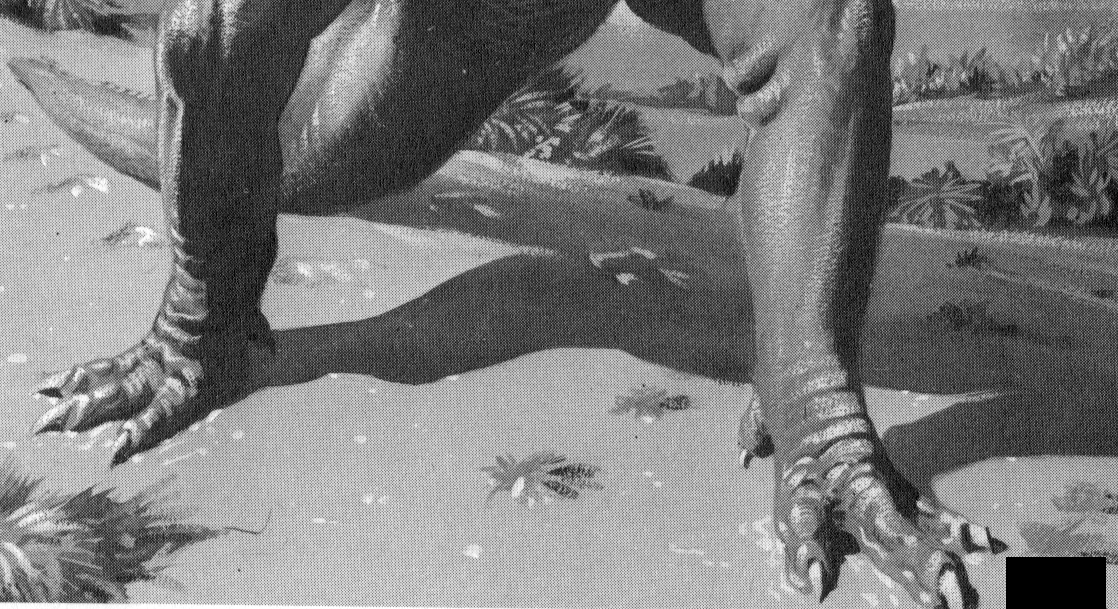
A few readers are perhaps already familiar with this Citipati illustration which I did about two years ago. It has even been featured on this blog once before.


Back in January this year, I was contacted by a writer from the German television broadcaster, WDR, requesting permission to use this illustration for their science documentary strand, Quarks & Co. The programme in question, I was informed, concerns a certain Jack Horner's proposal to create a 'chicken dinosaur', to which I think no LITC reader requires any explanation.

I wasn't sure whether or not the use was going ahead and soon forgot about it altogether. It transpired that it did indeed take place and that the programme itself had actually aired in late February and early March. The short animated sequence in which the illustration appeared can be seen here.

Thankfully the image still reads well even though it has been flipped for the purpose. They also referred to it as an Oviraptor, rather than Citipati -- but oh, well. The pleasantest surprise is that they even constructed a skeleton to match.


As a side note, I would of course have given it feathered fingers and a much thicker tail base were I drawing this now, and would also have resolutely avoided the running posture.

This was a post of not inconsiderable substance for me. Oh, my! Unfortunately, my next one will be a return to my usual vacuous form. I am so sorry.

N

Thursday, September 12, 2013

EXCLUSIVE: Jurassic Park 5 poster leaked

With the recent reveal that the fourth Jurassic Park movie will be titled Jurassic World, the hype machine is ramping up in hot anticipation of the 2015 blockbuster. But we at LITC have been leaked another huge bit of news about the Jurassic Park franchise: this is a new trilogy. Directors have been lined up, scripts are d-o-n-e done, and work on the marketing has even begun. Here's the exclusive leaked poster for the follow up to Jurassic World: Jurassic Holler.

Jurassic Holler

Hoo boy! Looks like we're in for some good ol' fashioned homespun finger-lickin' chicken-fried dinosaur-on-hillbilly action! The confidential Hollywood informant who contacted me has not yet revealed the title of the final film in the new trilogy, but I'm hoping for Jurassic Avenue, if only for the possibility of a dinosaur dance montage to this hot jam, with slightly altered lyrics.

Wednesday, September 11, 2013

I really love your tyrant feet

Back at the start of the month, the distastefully talented author, artist, blogger, and nomen oblitum enthusiast Matt Martyniuk posed an interesting question on his Dino Goss blog - namely, does anyone actually have any evidence that non-avian dinosaurs possessed birdlike scutes on their feet? Well, it turns out that, in the form of Concavenator, they do, although that does limit said scutes to tetanuran theropods, and artists frequently depict animals far more distantly related to birds (even ornithischians) with them. As Matt pondered,
"I'm not sure when this meme began, and if it's related to the Dinosaur Renaissance when the link between birds and dinosaurs was re-established...Of course, like many paleo-memes that developed during the 1980s, the main idea seems to be using this as a flourish to make otherwise scaly dinosaurs seem more bird-like."
Those who know me - even those who regularly read this blog - might be aware that I have a 'thing' for theropod feet, particularly those belonging to Manospondylus gigas. With that in mind, I thought it might be interesting, given Matt's musings, to take a look at sexy rexy feet through the decades.

One other thing - I've also decided to turn this into a (very easy) COMPETITION! Hurrah! The first person to leave a comment naming all of the artists will get a rubbish dinosaur book from my out-of-control stockpile. I'll also throw in a card featuring artwork by Niroot, which I will ask him very nicely to sign.


Right, then. For starters, here's the Real Deal - sort of. These belong to a cast of 'Stan' mounted in the Oxford University Museum of Natural History, and they're really quite enormous. Check out the arctometatarsalian condition, whereby the middle metatarsal is 'pinched' between the other two.


Here's an early entry by a highly respected palaeoartist of the classic era. No sign of tarsal scutes here, but check out the rather large, apparently reversed first toe (hallux), jutting out like a spur.


This artist (signature censored, because I'm in denial) has illustrated T. rex with rather more slender, shapely toes and what appear to be weight-bearing plantar pads, in spite of also giving it a bizarre, splayed stance. The left foot in particular appears very birdlike, and the hallux is rather more stumpy.


On the other hand, this artist - working at around the same time, ish - has made the feet considerably chunkier, with soft tissue spreading much wider than the width of the bones and, by extension, the claws. No scutes here - just rounded, non-overlapping scales, like a lizard - although the artist has thought to highlight tendons.


This artist was well known for his excellently observed lizardlike scaly skin textures. The soft tissues on this tyrannosaur's feet are far more snug to the bone, with hardly any sign of fleshy pads to cushion the animal's weight.


Entering the 1970s, and there are still no scutes to be seen on this oddly rectangular-footed individual.


Finally, in the early 1970s, with the Dinosaur Renaissance underway, tarsal scutes appear on the tyrant's feet. Note also that this individual appears to be very energetic indeed - going for a jog, in fact, in stark contrast to its palaeoart predecessors.


While scutes may have started to become de rigueur back in the mid-'70s, it didn't necessarily always mean that the rest of the restoration was particularly birdlike. This model, for example, is highly crocodilian, with all manner of armour scutes covering the body - just check out that tail. The tarsal scutes, therefore, may well be unintentionally birdlike.


The same can't be said for this work; not only has clear attention been paid to the arrangement of the scutes, the general soft tissue profile of the feet (complete with skin stretching between the toes) has clearly been modelled on modern birds (see these, for example). One can obviously see appropriately huge plantar pads taking the strain and spreading as the animal walks forward; there are echoes of illustration #3, but the ankle is far slimmer.


By the time the '80s rolled around, one might have expected that all the big names would had adopted the birdlike style of illustration #8 - however, this wasn't the case. Of course, much about this illustration - from the incongruously wide stance, to the rather shapeless 'tree trunk' legs - has a distinctly retro air. However, the differences in approach are still striking; there is a complete lack of birdlike scutes and plantar pads, and the ankle joint is far less obvious.


And finally, to bring us bang up to date...a fine pair that should look quite familiar. Thoroughly modern, and yet  perhaps closer in appearance to illustration #2 than illustration #8 (without the strange stance, of course).

So there you have it - my worrisome theropod foot fetish laid bare. Is this my barrel-scrapingest post yet? Not by half (have you seen some of the desperate rubbish I've come out with before?). Remember, if you can name all the artists, there's a book in it for you. Get cracking! Oh, and don't forget to buy a copy of Matt Martyniuk's superb Field Guide to Mesozoic Birds and other Winged Dinosaurs, if you haven't already - it's worth it for the beautiful artwork, with an uncommonly realistic portrayal of feathered dinosaurs, alone.

Tuesday, September 10, 2013

'Triceratops isn't going anywhere'

I did have a legitimate inspiration for this latest piece of silliness.


I have a distinct recollection of the 'Triceratops didn't exist' issue re-surfacing very recently, chiefly on Twitter, but now that I try to go back to look for it in order to lessen the vacuity of this post, I am unable to find any mention of the thing. Perhaps I dreamt it after all. The drawing did seem to have been happily met with when I shared it, however.

That matter aside, perhaps it is entertaining enough to be left to the viewer's own interpretation, regardless of context. It also happens to fit in with the series of spleen-venting saurians I began a little while back, or Dinosaurs Attack: Classy Edition, as Marc has it. So there we are.

N


Wednesday, September 4, 2013

Vintage Dinosaur Art: Let me tell you about...Dinosaurs

Dinosaur books aimed at children haven't changed much over the last few decades, even as dinosaur science has gained a terrifying, unstoppable momentum, like a Dalek rolling down a mountain. Let me tell you about...Dinosaurs is from 1983 (with this edition arriving in 1985), but you'll find its haphazard mix of slightly iffy anatomy and flagrant copying in a great many books that occupy a small niche in kids' bookshops around the world today. What's more, many such modern books are completely bloody uncredited, and so is LmtyaD. It's especially annoying as it would appear that a number of illustrators worked on LmtyaD, and some were, shall we say, rather more accomplished than the others.


The illustrations on the cover, for example, are actually pretty good from a purely artistic perspective; the shading and texturing, in particular, are rather impressive. Of course, the animals themselves are pretty bizarre - just check out zombie-hands Droopy the T. rex, and the Triceratops with legs that don't seem to have any muscles...or joints. The Apatosaurus, meanwhile, is the typical hump-backed Discount Value Pack Sauropod. It's a decent indicator of what's to come.


I'm rather fond of the work of one particular artist in LmtyaD; Niroot, too, has expressed a liking, and you definitely should listen to him, 'cos he's a professional artist and everything. The artist - let's chauvinistically presume they're male and name them Jambo van de Apenheul - makes excellent use of a deceptively diverse earthy colour palette and achieves some quite lovely, subtle patterning and texturing. Of course, he also draws Barney-like tyrannosaurs with tiny heads, which are a little distracting, but one can't help but feel that van de Apenheul could have made a very decent dinosaur artist, if only he'd had the right guidance.


Van de Apenheul is clearly also behind this illustration of Melanorosaurus, here mislabelled as Melanosaurus (which was actually a lizard, or so says Wikipedia - and who am I to question Wikipedia?). The slightly later Fabrosaurus, another one of those genera based on teeth that palaeontologists just love to spend all of their spare time sorting out, is shown to demonstrate how greatly even early dinosaurs could contrast in size. Unlike Melanorosaurus, poor Fabrosaurus is even dwarfed by its own name. The basal sauropodomorph is considerably less chunky and advanced-looking when shown in art these days, but hey, at least it's out there on the land. Quite unlike...


....this unfortunate brachiosaur, who seems to have wandered out to sea by accident. That's what having a tiny brain will do for you.


Back on the beach, and this depiction of Ornitholestes illustrates the pitfalls of combining copies of different artists' versions of the same animal. The animal in the background appears to be based on Giovanni Caselli's bird-nabber (itself a riff on Charles R Knight's original), while the individual in the middleground is based on Bernard Robinson's work. Consequently, they look like different species, with the Caselli-like creature sporting (more accurately) a smaller head and a reduced 'thumb' on its hand, while the Robinson-esque animal has more obvious lizardly 'lips' and a rather derisory expression on its face.


About halfway through the book, the artwork takes something of a turn for the worse - certainly in terms of depicting believable-looking creatures. Although T. rex isn't described as the bumbling silent movie comedian of some early '80s books, the artwork doesn't do the 'King of the Tyrant Lizards' too many favours; the above image could be a poster for Attack of the Killer Granny Smiths from Outer Space. Still, perspective is tricky when you have limited access to 3D references, and at least its head is the right sort of shape, and doesn't resemble a rubbery Halloween mask.


Oh boy. Hey, is anyone else reminded of one of those full-body dinosaur costumes, in which the wearer's polyester-wrapped legs are distractingly visible? Well, if the toothy front end isn't being waggled in your face, of course.


In a similar vein...ah, I love retro ankylosaurs, and this Euoplocephalus (formerly known as Ankylosaurus...wait, what!?) is simply a magnificent example; a sceptical-looking armadillo with barely-there legs and a tail terminating in an oven mitt. Meanwhile, Palaeoscincus (i.e. Edmontonia) is particularly cross, having lost the majority of its tail - which I'm quite sure has absolutely nothing to do with the fact that the tail was hidden behind another animal in Caselli's illustration.


Just as bizarre is this tottering Compsognathus, which resembles the bastard offspring of a hen and Dale Russell's 'Dinosauroid' (the tail was shortened during adolescence, you see) - rather fitting, given that a hen is mentioned in the text. The style is somewhat Caselli-esque here, too, with the thoroughly disgruntled face resembling that on Caselli's Compsognathus "corallestris". Thankfully, the flipper hands were left in the '70s, where they belong.


And finally...the anonymous author is having no truck with your reprehensibly unscientific questions. Every fossil find, from a 75% complete skeleton of Spinosaurus with preserved gut contents and eggs containing dainty spinosaur embryos, down to a tiny ammonite that's fallen from a Dorset cliff into someone's ice cream cone, is exciting to somebody.

Pffft. Cop-out. Bernard Robinson-esque Allosaurus is not impressed.

Many thanks to Adam S Smith for letting me borrow this book, a childhood favourite of his (although he nevertheless brought the disparity in illustration quality to my attention). Adam's a palaeontologist with a particular affinity for plesiosaurs and other marine reptiles. Check out his Plesiosaur Directory website and, of course, the Dinosaur Toy Blog.

Tuesday, August 27, 2013

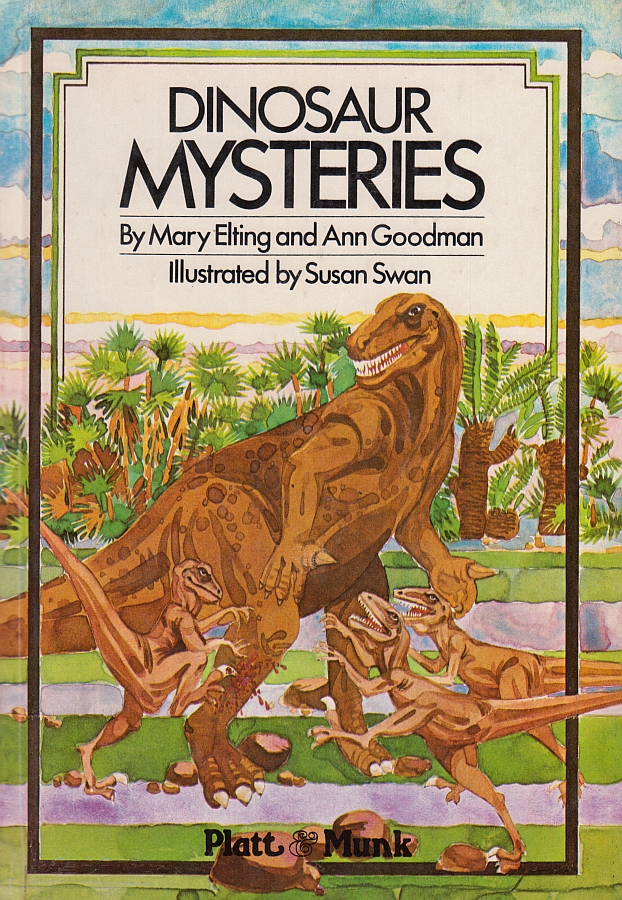
Vintage Dinosaur Art: Dinosaur Mysteries

Following the outlandish (but highly artistically accomplished) work in Dinosaurs and more Dinosaurs, we're back on more familiar ground this week, with a Dino Renaissance-flavoured title from 1980. Don't be fooled, however; the weirdness doesn't end here.

I should also take a moment to again thank Dave Hone, who let me borrow this book in addition to DamD. The impassioned talk given to me in the pub was surely worth it. [Also, stop press: David's gone and blogged about the artist before. Don't mind the repeats, please.]


So, let's not beat around the bush here - those Deinonychus have clearly picked on the wrong Iguanodon, seeing as it boasts a suspiciously carnivorous-looking maw stuck all the way up there by the title. No such chimeras appear elsewhere in the book, so why this Godzilla-like beast is featured on the cover is a bit of a mystery. Perhaps the artist, Susan Swan, had finished the top half of the illustration close to deadline, before receiving the dreaded phone call from the publisher. "Nah, forget T. rex, it's so 1970s. We want some of those scary swarming guys with the giant claws. And a dinosaur giving a thumbs-up."


The cover exemplifies the distinctive, rather unusual art style employed in the book, mostly consisting of simple, bright colours and flat washes, giving a minimal, almost naive look. A departure from this style comes in the inside cover pages, which feature the beautifully complex, shaded illustration shown above. It's reminiscent of some of William Stout's work, and is packed with easily-missed incidental details - not least the dragonflies, which are something of a motif in this book.


Far more typical is this illustration, in which a Tyrannosaurus menaces a weirdly gangly Parasaurolophus. Although rather older than T. rex, the trombone-headed one has nevertheless ended up on The King™'s menu (uh-huh) many times in art over the years - perhaps because it's more interesting to look at than boring old Edmontosaurus. Noteworthy in this painting are the lovely butterflies and white Pteranodon. White Pteranodon! Makes a change from brown, I guess.


Dinosaur Mysteries is thoroughly modern in outlook, with the text presenting dinosaurs as fleet-footed, successful animals, rather than glacially slow reptilian flesh heaps. Accordingly, the illustrations, for all their simplicity, showcase lean animals striding magnificently about with their tails held well clear of the terrain; note the horizontal T. rex in the image above, and recall that other artists were painting toddling tyrannofatties well into the 1980s. Of course, it didn't mean that Swan was shy of paying homage to the old greats - the Rexy and Triceratops up front clearly owe a lot to Charles 'Chazza' Knight.


Furthermore, there are some slightly silly memes that, like creationists on deviantArt and tiresome misogynists everywhere else, simply refuse to go away. Here we have Swan's entry into the glorious 'tyrannosaur being smacked in the face' canon; Swan manages one up on other artists by really selling the impact with a delicious (and, given the style, slightly incongruous) blood splatter.

But never mind that - I know you're all really looking at the flowers, for beneath the tough facade of every dinosaur geek is a keen botanist struggling to get out.Yes, those are some quite beautiful flowers. I'm glad you noticed.


Perhaps the most prominent examples of Dino Renaissance thinking to feature in the illustrations are the sauropods. Even if they were finally tramping about on the land, knocking over trees and making a mess of everything, the sauropods of the 1980s were often still rather slothful beasts, hauling their limp tails behind them. But not here! I really rather like the composition of this scene, with the foreground sauropod's curving shape serving to frame its fellows.

I had thought that the pink butterflies didn't really make any sense, but it turns out they did have lepidopterans back then, at least. So, hey, fabulous pink butterflies all around!


I know what you're thinking, but the truth is that, no, this isn't Psittacosaurus. It's Protoceratops. You know, the one with the enormous neck frill and cheek bones like one of Madonna's more famous undergarments. How Swan ended up painting this strange and rather shy no-necked creature is another mystery. I like to think that she only had access to old restorations of juveniles, and extrapolated from there.

The background reminds me of Charlie Chalk. I know, I'm old.


In addition to providing the most unlikely Protoceratops ever seen in palaeoart, Swan also gives us some fantastically '80s quadrupedal spinosaurs. These pin-headed lummoxes are a far cry from the modern day butchery-on-legs; truly, they just don't paint 'em like this any more (right?). I'm fond of the sun and surrounding sky in this one - an evocative atmosphere is created with just a very few, broad, carefully placed brushstrokes.


Remember Saltopus? Occasionally popping up in dinosaur books back in the day, you don't see very much of this rather obscure and poorly known animal in space year 2013. Here, Salty stands in for Syntarsus in demonstrating the crazy notion of feathered dinosaurs. That's not very scary!

There aren't very many illustrations of fuzzy Saltopus in existence, although I believe John McLoughlin (see below) also produced one. Indeed, a number of illustrations in this book appear to, er, be in debt to McLoughlin.


Other totally radical ideas on dinosaur soft tissues are featured in Dinosaur Mysteries, providing a fantastic (and quite rare) glimpse at some of the less likely ideas doing the rounds at the time. Here, we have a McLoughlin-inspired Torosaurus, its frill completely held down by flesh and rendered immobile; both Darren Naish and Trish (who is in no need of a surname) have blogged on McLoughlin's work before, so go and have a read if you haven't already.


Oh boy. Handily, and very, very unusually, this illustration is actually acknowledged as being "after G. Irons" - that'll be Gregory Irons, then. The original is featured over at TetZoo.


And finally..."It's a what? A WHAT? Look, this line's bad, I think I got it. I'm off for a beer." For the sake of fairness and in the interest of maintaining my outstanding reputation as an entirely scrupulous and reliable gent, I should point out that the text refers, correctly, to Pachycephalosaurus. It doesn't, alas, stop the caption being hilarious. If any readers have their own examples of amusingly botched dinosaur labels in old books (a long shot, I realise), do share them; I'd love to compile them. As for this one - why, it's the biggest mystery of all!

Monday, August 26, 2013

Mesozoic Miscellany 63

In the News

Important new multituberculate: It's Rugosodon. Check out Nat Geo, The Dragon's Tales, and Paleoexhibit.

The Disney D23 convention revealed more about Pixar's The Good Dinosaur. More at Entertainment Weekly and i09.

Around the Dinoblogosphere

Our Marc reviewed the beautiful new Papo figure of an animal which is definitely a dinosaur, Dimetrodon, at the Dinosaur Toy Blog.

At Saurian, Mark Wildman wrote an excellent post about the "duelling dinosaurs" auction.

Redbubble featured a big bushel of dinosaur designs on their blog, including the work of some familiar illustrators.

Naish wrote about lovely azhdarchids at TetZoo. Of the Richard Orr illustration for Dixie Doug's Prehistoric Reptiles: "Richard Orr’s painting... always makes me think of one of Hieronymus Bosch’s scenes of Hell. Truly, it’s a horrific, terrifying scene..."

More zoo photos from Heinrich at Dinosaurpalaeo, focusing on Australian birds.

Scott Hartman sat down to chew the fat with Dave Hone for an Archosaur Musings interview.

Matt Martyniuk delved into the history of the term T. rex in pop culture at Dinogoss.

Reading Jurassic Park in 2013 is weird as hell, reports Trish Arnold.

Ian Garofalo wrote about Maleevosaurus at Mesozoic Mullings.

Paleoart Pick

James Gurney has released a video instuction series called How I Paint Dinosaurs. Check it out!


Outrageously Off-Topic Indulgence

Lego master Chris McVeigh has been making really cool constructions of drawings of popular characters. Here's Cookie Monster.

C is for Cookie

Check out more by clicking through to Flickr or at his Tumblr.

Monday, August 19, 2013

Vintage Dinosaur Art: Dinosaurs and more Dinosaurs - Part 2

Onwards with the second part of our exploration of this frequently unsettling book. Do take a look at part 1 and David's 2010 post on the artist (George Solonevich) for more background.


Dinosaurs and more Dinosaurs might boast a significant number of relatively obscure beasts when compared with similar books, but that doesn't mean it shies away from the staples. Here, for example, we have an Iguanodon, easily identified by its approving hand gestures. There's something particularly peculiar about the head on this beast - it seems to have borrowed the head of a theropod from a more sober book (in DaMD, it would have dozens of moray-like teeth and/or a snaking tongue). The oddly humanoid proportions of the forelimbs are, of course, entirely in keeping with contemporary depictions of the animal. All in all, this one isn't too 'out there'; it's not like it's scaling a tree trunk, flicking out a lizardy tongue and brandishing a feathered tail, for example.


Yeah, you saw that one coming, I know.  In any case, Hypsilophodon is hardly known for bringing the crazy; the poor little creature is normally depicted scurrying around (or running hastily away from) much larger, more awesomebro species. Sure, there was the infamous 'tree kangaroo' Neave Parker depiction, but even then it was just standing around, looking suitably placid and harmless. Leave it to Solonevich to make even this most innocuous of animals into a creeping, crawling nightbeast with many-jointed limbs, a feathered (or is that beaver-like?) tail and Venom's tongue. By comparison, the gangly, vertical Ornithomimus on the right looks very conventional indeed, and there is something quite beautiful about its lovingly 'sculpted' legs.


Speaking of the conventional versus the very unconventional, the majority of the book's ankylosaurs follow the era's rather dull tendency to produce squat, short-tailed, no-necked armadillo-turtles. This more unusual depiction, then, is surely to be welcomed, even if it looks still more outlandish. The bony nodules are superbly painted - it's almost possible to get a tangible sense of how rough this animal's hide is - but I'm sure you're nevertheless wondering what on Earth this thing is supposed to be. Well, it's Pinacosaurus (here identified as Syrmosaurus). Hey, at least it's got a nice long tail, right?


Now here's a fun exercise in pointless hypothetical alterna-history - what if, just as Waterhouse Hawkins was sculpting the mighty Crystal Palace monstrosities, someone had tripped over a hadrosaur skull weathering out of a hillside somewhere? What would have happened had Hawkins hurriedly incorporated it into his dino designs? I like to think that the result would have looked something like the above. I'm particularly fond of the melty feet and hugely thick neck and tail. Magnificent stuff.


While the above Anatosaurus (aka Anatotitan, aka Edmontosaurus) is furnished with the full-mega-portly-body treatment, only the head of Pachycephalosaurus is shown. There's a good reason for this, of course; Pachycephalosaurus isn't known from very much else, so any full-body reconstruction would be subject to a great amount of speculation, and might end up looking a bit freaky some decades down the line.

I love its angry little face. Bless.


If you want marginocephalians in all their glory, you'll have to consult the ceratopsian pages. The above animal has a masterfully textured toad body. Somehow, it's ended up with the (not all that bad, for the time) head of a Styracosaurus. I'm sure it's a mask.


Of course, bring in the ceratopsians, and you also have to present their perpetual foes. Opposite Styracosaurus we have the frightful Gorgosaurus, a cross between a hen, a snake and a Cornish pasty. The character that Solonevich brings to this hunchbacked killer pastry is fantastic; note also the way in which the viewer's eye is expertly drawn to that hideous, bristling maw. Nevertheless, there's only one animal we could possibly end on...


Disappointingly, Solonevich's Tyrannosaurus isn't particularly unusual for the time; there are definite shades of both Neave Parker and, especially, Zdenek Burian. This Rexy is a dead ringer for Burian's monochrome Gorgosaurus, in particular, right down to the gleaming, greasy skin textures. What the prey is intended to represent isn't mentioned. Dave Hone noted that its head looks remarkably like those on contemporary reconstructions of small pterosaurs like Rhamphorynchus; the combination of this mismatched head, extremely thin skin-flap neck and leggy bipedal body is a bit of a mystery. We can only assume that, as with so many of the other illustrations in this book, Solonevich just thought it looked pretty damn...interesting. And it certainly does.

Wednesday, August 14, 2013

The Life and Times of a Tyrannosaurus Rex


Youtuber Ana McMullen has uploaded a lecture by Dr. Thomas Holtz, "The Life and Times of a Tyrannosaurus Rex," delivered at Durham Museum. Enjoy!


Tuesday, August 13, 2013

Raptor Rendezvous 2013


My local rescue and rehab center for birds of prey, Indiana Raptor Center in Nashville, Indiana, is preparing for its big annual fundraiser, Raptor Rendezvous. If you're a resident of Indiana or surrounding states, I can't recommend it highly enough. Raptor rehabbers from around the Midwest come out, bringing a wide variety of birds. This year, I've also designed a 2014 calendar for InRC, which will be available at the event. The July illustration features, appropriately enough, the Bald Eagles above. They're Piper and Ben, two of InRC's residents.

I recently shared this preview image along with another one at my Tumblr. I also have all of the information about the Raptor Rendezvous there. In brief: it's on September 7, in the beautiful confines of Brown County State Park in Nashville, IN. The event will begin with a dinner, followed by an evening program starring a variety of birds. Did I mention the birds? It will be packed with birds, with special front-row seating area for photographers. The rehabbers are pretty cool, as far as humans go. They tell some good tales. Mostly about birds. If you're on Facebook, check out the event page, as well.

If you're unable to attend but would like to purchase a calendar, I can make that happen if you shoot me an email. If you can't afford to do either, I'd greatly appreciate tweets, Facebook shares, and reblogs of my Tumblr post.

Previous posts about Indiana Raptor Center:
Raptor Sunday
Great Horned Owls in Flight
Indiana Raptor Center Update
Raptor Rendezvous 2012

To see my photos of the birds of Indiana Raptor Center, check out my flickr collection. My Natural Indiana collection features a few sets of Brown County State Park photos.