Been a while since the last roundup, so there's plenty of meat to chew on. There's been a lot of growth in the dino blogosphere lately, and while I'm thrilled about it, I also wish it wasn't happening just as I was getting super-busy with school!
Anyhow, first up, check out Brian Engh's test animation of a Cryolophosaurus as part of the "Dinosaurs Reanimated" project.
I love it. Good stuff, Brian. Everyone, follow the Dinosaurs Reanimated production blog and subscribe to the Youtube Channel. And read more at Don't Mess With Dinosaurs, too.
In the ultimate example of turning lemons into lemonade, a contentious topic on the Dinosaur Mailing List has spurred the creation of a new mailing list dedicated to the history of paleontology. It's only hours old, so if you want to get in on the ground floor, now's the time. This is good timing for me, as I'm planning a project about paleontology history for my independent study in typography this semester (it's still taking shape, but trust me, it shall be shared here). The list is hosted at Google groups, a venue I'm new to, so
Tony Martin is retiring the Great Cretaceous Walk blog for now, as he's concentrating on his new blog focusing on more recent ichnology as he prepares for the IU Press publication of his new book, Life Traces of the Georgia Coast. I love GCW and will miss it, but it's hard to shed tears, as Tony's still writing terrific stuff, and hints at a possible book about his travels in Australia.
Project Dryptosaurus has a new website, so be sure to pop in and bring a nifty housewarming gift...
Archaeopteryx 150: Raptormaniacs, Dinosaur Tracking, and Pick & Scalpel all raise a glass to Archie.
Bird knees. They don't bend backward. Scott Hartman sets SciAm straight.
Victoria Arbour writes about... picking the nose of a Euplocephalus. Examining a broken skull fossil, Arbour, with Tetsuo Miyashita and Phil Currie, verified what Larry Witmer and Ryan Ridgely observed to be a "crazy straw" nasal passage in a couple different ankylosaurs in 2008. The Witmer Lab blog Pick & Scalpel has posted on this research as well. Wouldn't it be nice to see both the heat exchange and resonating hypotheses explored in a future documentary? I mean, it's not exactly hordes of tyrannosaurs mobbing duckbills, but why not let some thyreophorans step into the limelight?
To wrap things up, because I'm getting mighty sleepy, a new PLoS One paper sinks Anatotitan, AKA my Twitter, Flickr, and DeviantArt handle, into Edmontosaurus. Well, phooey. But still, one of the great taxon names of all time, and I'll keep wearing it proudly.

Sunday, October 2, 2011

Saturday, October 1, 2011
A funny thing happened when I tried to review Terra Nova
I tried, but I just don't have the energy to do it. I think my post-viewing tweet summed it up. Sorry I'm not more livid about it. I think it's kind of alright, and I'll happily give it a season or so to sort itself out.
One thing of note in the "what in the heck do non-geeks think about dinosaurs" file comes from The AV Club. From previously noted dinosaur fan Todd VanDerWerff: "It’s not the most graceful pilot in the world, lurching about like a, well, dinosaur." China can pump out as many meticulously preserved, elegant examples of feathered dinosaurs as they please: at the end of the day, the word "dinosaur" will still mean the hulking, volcano fume sucking, antediluvian morons the world thought they were sixty years ago. So, what damage can Terra Nova really do? Bring it on, Braga!
One thing of note in the "what in the heck do non-geeks think about dinosaurs" file comes from The AV Club. From previously noted dinosaur fan Todd VanDerWerff: "It’s not the most graceful pilot in the world, lurching about like a, well, dinosaur." China can pump out as many meticulously preserved, elegant examples of feathered dinosaurs as they please: at the end of the day, the word "dinosaur" will still mean the hulking, volcano fume sucking, antediluvian morons the world thought they were sixty years ago. So, what damage can Terra Nova really do? Bring it on, Braga!
Thursday, September 29, 2011
Meet Matt Carrano
If you saw Dinosaur Revolution, you saw a bit of Matt Carrano, curator of dinosaurs at the Smithsonian Institution. But you didn't see enough, did you? Well, thanks to the generous organization for which he works, now you can. Pull up a chair and settle in for this interview, or if you're in public on a mobile device, why not pull some bystanders away from whatever their doing and show them something cooler and more important?
Wednesday, September 28, 2011
Planet Dinosaur, episode three - review
This week's Planet Dinosaur looked at the killer theropods of the Late Cretaceous. (I'm sure they're getting to non-theropods in time.) In the North, Daspletosaurus was the tyrannosaurs' representative while in the South, Majungasaurus held up the abelisaur end. There was also a brief sojurn into the Land of the Giant Troodon, but we'll come to that in a minute.

Daspletosaurus and Centrosaurus. Copyright the BBC.
Firstly, though, we must address the most important issue here: was Daspletosaurus spelled consistently in John Hurt's script? The poor guy seemed to be pronouncing it in two different ways; much of the time it was correct, but then equally as often he seemed to be saying "Desplatosaurus". Or do my ears deceive me?
We were informed from the off that Daspletosaurus co-existed with Gorgosaurus although, sadly, we never got to see the latter. (Also, the skeletal diagram for Gorgosaurus depicted, strangely, a juvenile animal.) Daspletosaurus was portrayed as gregarious, but not a pack hunter a la Currie - rather, it displayed the more reptilian behaviour of attacking in a mob without any tactics or co-ordination. Which was a Good Thing. Once again, the programme pointed to healed bite marks and puncture wounds on tyrannosaur skulls as evidence for intraspecific competition, which was welcome, but did feel like a bit of a retread.
For the most part, the creatures in this episode looked rather good, and the animation was decent with a few moments of stiffness (including a tyrannosaur that looked like it was skating). There were a few nice touches, such as a Chasmosaurus scratching itself against a tree, that lent the action a more naturalistic feel. Nevertheless, the animals still look completely rubbish when they fight - while no scrap was quite as slapdash-looking as the herky-jerky carcharodontosaur battle in the first episode, there is still something quite...wrong about the way Planet Dinosaur's beasts do battle. This is particularly true of larger animals, as they appear to lack the necessary mass.
The series was also guilty of presenting speculation as fact this week, notably when it portrayed an Alaskan giant Troodon population ganging up on juvenile Edmontosaurus. While it was pointed out that there is evidence of Troodon (or at the very least, troodont) bite marks on Edmontosaurus remains, we were presented with no evidence for Troodon being a co-ordinated pack hunter. It's plausible, perhaps, but still speculative - and it's a little disappointing that the show didn't point this out, given how good it has been on that front so far. Equally disappointing was the rather under-feathered appearance of the Troodon. It seems extremely unlikely, given the advanced feathers seen on other troodonts, that Troodon itself would have reverted to only having an extremely short, hairlike covering of protofeathers. This seems especially baffling given that, disregarding a few cock-ups with feather attachment points and the like, the show's dromaeosaurs all have wings.
The segment featuring Majungasaurus was enjoyable, if only for the adorable baby Majungasaurus that fed alongside their attentative mother (again, speculative, but in this case, I'm going to let it go. It's cute). Naturally, in addition to looking at the biomechanics of its bite, the show took delight in presenting the animal's cannibalistic side - following a (rubbish) fight with a burly male over a carcass, the mother Majungasaurus promptly devoured her opponent. It would've been better if the fight sequence itself was better animated - and the behaviour of the animals during the fight a little more convincing - but said cannibalism was still a cool fact to introduce to the public. Especially kids. I bet they loved it.
The final section in this episode was pretty cool, too, as a herd of Centrosaurus met a watery death in a flooded river while migrating en masse. Granted, some of the animals' behaviour was again a little odd (why weren't they resisting the Daspletosaurus more?), but this moody, stormy scene made for a good finale.
Overall, Planet Dinosaur continues to be a mixture of virtuous science, better-than-average CG restorations and slightly clunky animation. It's difficult to decide how pedantic one should be when writing these reviews. For me, the most important aspect of this series is the science that it's introducing to the general public. Most of this stuff won't be new to dinosaur enthusiasts, but episodes like last week's are likely to astound the public at large (who are also less likely to notice that the feathers are incorrect, or particularly remember how the feathers were arranged anyway). Hopefully, next week will see a break away from theropods - much as I like them - and John Hurt correctly pronouncing those tricksy dinosaur names.
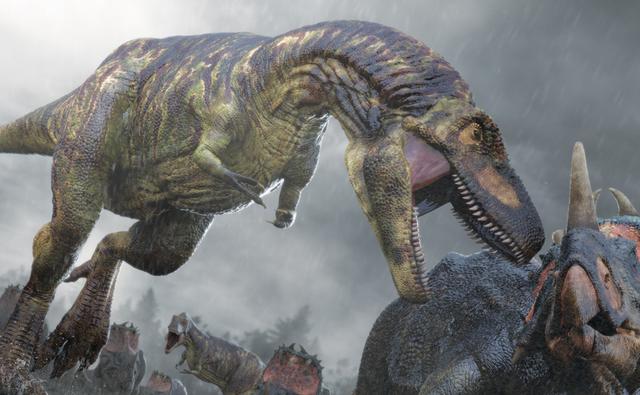
Daspletosaurus and Centrosaurus. Copyright the BBC.
Firstly, though, we must address the most important issue here: was Daspletosaurus spelled consistently in John Hurt's script? The poor guy seemed to be pronouncing it in two different ways; much of the time it was correct, but then equally as often he seemed to be saying "Desplatosaurus". Or do my ears deceive me?
We were informed from the off that Daspletosaurus co-existed with Gorgosaurus although, sadly, we never got to see the latter. (Also, the skeletal diagram for Gorgosaurus depicted, strangely, a juvenile animal.) Daspletosaurus was portrayed as gregarious, but not a pack hunter a la Currie - rather, it displayed the more reptilian behaviour of attacking in a mob without any tactics or co-ordination. Which was a Good Thing. Once again, the programme pointed to healed bite marks and puncture wounds on tyrannosaur skulls as evidence for intraspecific competition, which was welcome, but did feel like a bit of a retread.
For the most part, the creatures in this episode looked rather good, and the animation was decent with a few moments of stiffness (including a tyrannosaur that looked like it was skating). There were a few nice touches, such as a Chasmosaurus scratching itself against a tree, that lent the action a more naturalistic feel. Nevertheless, the animals still look completely rubbish when they fight - while no scrap was quite as slapdash-looking as the herky-jerky carcharodontosaur battle in the first episode, there is still something quite...wrong about the way Planet Dinosaur's beasts do battle. This is particularly true of larger animals, as they appear to lack the necessary mass.
The series was also guilty of presenting speculation as fact this week, notably when it portrayed an Alaskan giant Troodon population ganging up on juvenile Edmontosaurus. While it was pointed out that there is evidence of Troodon (or at the very least, troodont) bite marks on Edmontosaurus remains, we were presented with no evidence for Troodon being a co-ordinated pack hunter. It's plausible, perhaps, but still speculative - and it's a little disappointing that the show didn't point this out, given how good it has been on that front so far. Equally disappointing was the rather under-feathered appearance of the Troodon. It seems extremely unlikely, given the advanced feathers seen on other troodonts, that Troodon itself would have reverted to only having an extremely short, hairlike covering of protofeathers. This seems especially baffling given that, disregarding a few cock-ups with feather attachment points and the like, the show's dromaeosaurs all have wings.
The segment featuring Majungasaurus was enjoyable, if only for the adorable baby Majungasaurus that fed alongside their attentative mother (again, speculative, but in this case, I'm going to let it go. It's cute). Naturally, in addition to looking at the biomechanics of its bite, the show took delight in presenting the animal's cannibalistic side - following a (rubbish) fight with a burly male over a carcass, the mother Majungasaurus promptly devoured her opponent. It would've been better if the fight sequence itself was better animated - and the behaviour of the animals during the fight a little more convincing - but said cannibalism was still a cool fact to introduce to the public. Especially kids. I bet they loved it.
The final section in this episode was pretty cool, too, as a herd of Centrosaurus met a watery death in a flooded river while migrating en masse. Granted, some of the animals' behaviour was again a little odd (why weren't they resisting the Daspletosaurus more?), but this moody, stormy scene made for a good finale.
Overall, Planet Dinosaur continues to be a mixture of virtuous science, better-than-average CG restorations and slightly clunky animation. It's difficult to decide how pedantic one should be when writing these reviews. For me, the most important aspect of this series is the science that it's introducing to the general public. Most of this stuff won't be new to dinosaur enthusiasts, but episodes like last week's are likely to astound the public at large (who are also less likely to notice that the feathers are incorrect, or particularly remember how the feathers were arranged anyway). Hopefully, next week will see a break away from theropods - much as I like them - and John Hurt correctly pronouncing those tricksy dinosaur names.
Tuesday, September 27, 2011
Terrible '90s Dromaeosaur Face-Off: Round 3
After David's rather highbrow post yesterday, dealing with fancy art history and all that jazz, it's time for me to drag standards back down again - from the painterly sublime to the sketchbook ridiculous. Yes, it's time for the third round of the Terrible '90s Dromaeosaur Face-Off™!
First of all, however, I must announce that last week's winner (again, by only a single vote!) was Deinonychus from The Humongous Book of Dinosaurs/Dinosaurs! magazine. Described as "pruney skinned" (David), a "mutant '80s allosaur" (Hadiaz) and possessing a left foot that represents no less than "evolution perfection" (Henrique Niza), may we have a round of applause for our wrinkly brown friend, please.

In the blue corner, this week sees the triumphant return of Know the World of Dinosaurs to the competition. With the book's Velociraptor having already won one round, it'll be interesting to see how its Deinonychus fares. Although similar in many ways, the Deinonychus is notably leaner and its head longer and shallower. Which means they probably arranged their page incorrectly.

In the red corner we have an old Vintage Dinosaur Art favourite - the Velociraptor from those strange Dinosaurier trading cards David unearthed. "Hilariously wrong" it may be, but is it a worthy contender against the anatomical train wreck put forward by Know the World of Dinosaurs? That decision is down to you, oh readers! What japes we have.

Remember, I'm after your suggestions for future nominees as well as your votes. My aim is to have four initial rounds, followed by two semi-finals and a stupendously exciting floppy-handed lizardy-skinned all-out brawl of a finale!
First of all, however, I must announce that last week's winner (again, by only a single vote!) was Deinonychus from The Humongous Book of Dinosaurs/Dinosaurs! magazine. Described as "pruney skinned" (David), a "mutant '80s allosaur" (Hadiaz) and possessing a left foot that represents no less than "evolution perfection" (Henrique Niza), may we have a round of applause for our wrinkly brown friend, please.
In the blue corner, this week sees the triumphant return of Know the World of Dinosaurs to the competition. With the book's Velociraptor having already won one round, it'll be interesting to see how its Deinonychus fares. Although similar in many ways, the Deinonychus is notably leaner and its head longer and shallower. Which means they probably arranged their page incorrectly.

In the red corner we have an old Vintage Dinosaur Art favourite - the Velociraptor from those strange Dinosaurier trading cards David unearthed. "Hilariously wrong" it may be, but is it a worthy contender against the anatomical train wreck put forward by Know the World of Dinosaurs? That decision is down to you, oh readers! What japes we have.
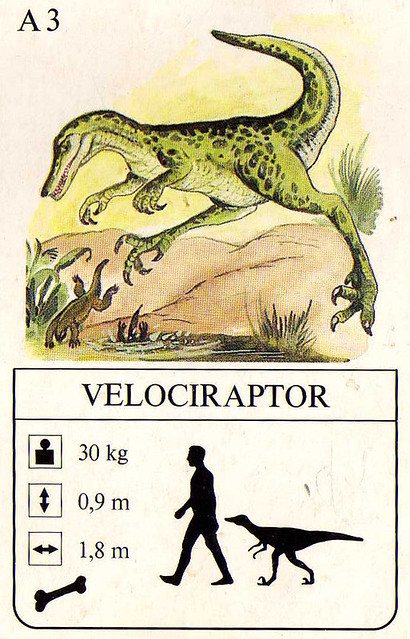
Remember, I'm after your suggestions for future nominees as well as your votes. My aim is to have four initial rounds, followed by two semi-finals and a stupendously exciting floppy-handed lizardy-skinned all-out brawl of a finale!
Monday, September 26, 2011
Vintage Dinosaur Art: J.M.W. Turner
Apologies if this is out of left field, but whenever my current studies intersect with paleontology, I can't stop myself from sharing it. In my recent research into the foundations of the Arts and Crafts movement, a multi-faceted philosophy spurred by distaste for the excessive ornamentation of Victorian design and the early industrial revolution's devaluing of traditional craftsmanship, I inevitably met the figure of John Ruskin, an art critic whose writings were instrumental in the development of the views of William Morris, considered the most important figure in the movement.
One of Ruskin's major works was a multi-volume tome called Modern Painters, a book which has oddly enough received a bit of attention in the art and science blogosphere recently (see here and here). Ruskin is one of those figures I find particularly challenging to deal with: on one hand, he had a major influence and is still studied today. On the other, he was one of those 19th Century intellects who held firm against Darwin's revolution of thought, agonizing over humanity's demotion to the realm of "lesser animals."
Modern Painters is largely a defense of the painter J.M.W. Turner, and here is where we come to Ruskin's writing on the saurian beasts that so captured the imagination of England in the Victorian era. In a paper published by Prose Studies in 2008, Ruskin's Rewriting of Darwin, Andrew Leng proposes that Modern Painters V, published in 1860, is in fact the very first serious response to The Origin of Species, mirroring its "tree of life" motif. In the book's conclusion, which Leng calls "a paleontological apocalypse which dramatizes the triumph of the protean dragon," Ruskin brings all of his verbal weapons to bear as he bemoans the further defilement of the human spirit (and, by extention, the arts): first by the dehumanizing industrial revolution, now by Darwinian evolution. "Ruskin’s remorseless campaign against Darwin’s presiding emblem," Leng writes, "indicates his realization that The Origin had appropriated the almost universal symbol of the sacred tree of life, thereby investing the theory of natural selection with talismanic authority."
The dinosaurs whose existence was just now being revealed by the infant science of paleontology were seen by many as symbols of British power. Ruskin, however, saw this as a terrible irony; these dinosaurs were the great dragons of ancient times, symbols of avarice. In Turner's 1806 painting "The Goddess of Discord Choosing the Apple of Contention in the Garden of the Hesperides," the artist depicts the dragon guarding the titular garden in a way that, to Ruskin's eye, is nothing less than a premonition of Hawkins' Crystal Palace Iguanodon.
Here's Turner's original, from Wikipedia. You can hardly make out the beast at the pinnacle in the center of the image.

Luckily, Ruskin commissioned a detail engraving for his book.

Ruskin writes,
One of Ruskin's major works was a multi-volume tome called Modern Painters, a book which has oddly enough received a bit of attention in the art and science blogosphere recently (see here and here). Ruskin is one of those figures I find particularly challenging to deal with: on one hand, he had a major influence and is still studied today. On the other, he was one of those 19th Century intellects who held firm against Darwin's revolution of thought, agonizing over humanity's demotion to the realm of "lesser animals."
Modern Painters is largely a defense of the painter J.M.W. Turner, and here is where we come to Ruskin's writing on the saurian beasts that so captured the imagination of England in the Victorian era. In a paper published by Prose Studies in 2008, Ruskin's Rewriting of Darwin, Andrew Leng proposes that Modern Painters V, published in 1860, is in fact the very first serious response to The Origin of Species, mirroring its "tree of life" motif. In the book's conclusion, which Leng calls "a paleontological apocalypse which dramatizes the triumph of the protean dragon," Ruskin brings all of his verbal weapons to bear as he bemoans the further defilement of the human spirit (and, by extention, the arts): first by the dehumanizing industrial revolution, now by Darwinian evolution. "Ruskin’s remorseless campaign against Darwin’s presiding emblem," Leng writes, "indicates his realization that The Origin had appropriated the almost universal symbol of the sacred tree of life, thereby investing the theory of natural selection with talismanic authority."
The dinosaurs whose existence was just now being revealed by the infant science of paleontology were seen by many as symbols of British power. Ruskin, however, saw this as a terrible irony; these dinosaurs were the great dragons of ancient times, symbols of avarice. In Turner's 1806 painting "The Goddess of Discord Choosing the Apple of Contention in the Garden of the Hesperides," the artist depicts the dragon guarding the titular garden in a way that, to Ruskin's eye, is nothing less than a premonition of Hawkins' Crystal Palace Iguanodon.
Here's Turner's original, from Wikipedia. You can hardly make out the beast at the pinnacle in the center of the image.

Luckily, Ruskin commissioned a detail engraving for his book.

Ruskin writes,
"There is something very wonderful, it seems to me, in this anticipation, by Turner, of the grandest reaches of recent inquiry into the form of the dragons of the old earth. I do not know at what period the first hints were given of the existence of their remains; but certainly no definite statements of their probable forms were given either by Buckland, Owen, or Conybeare before 1815; yet this saurian of Turner's is very nearly an exact counterpart of the model of the Iguanodon, now the guardian of the Hesperian Gardens of the Crystal Palace, wings only excepted, which are, here, almost accurately, those of a pterodactyle. The instinctive grasp which the healthy imagination takes of possible truth, even in its wildest flights, was never more marvellously demonstrated."Having established Turner has a modern master; Ruskin was now imbuing him with the power of prophecy. I'm not sure that "healthy" human imagination has an "instinctive grasp" on any truths. If it does, however, Ruskin would be better served by another example. The Crystal Palace Iguanodon was doomed for obsolence less than thirty years after it was unveiled, when Louis Dollo's studies of the bounty of new fossils discovered atBernissart overturned scientific understanding of the animal.
Friday, September 23, 2011
Weishampel Opens the Hadrosaur Symposium
If you hear the dulcet tones of honking Parasauropholi this week, it's likely coming from Drumheller, Alberta, where the Royal Tyrrell Museum has been hosting the 2011 Hadrosaur Symposium. Most of us aren't able to be there, but in the spirit of the shiny digital future, the Tyrrell is making presentations available via their Youtube channel. The first upload is David Weishampel's opening talk, giving historical context to the presentations to follow. Great stuff to see presented in this manner, so if you've got a spare 25 minutes, settle in and press "play." Embedded below for your convenience.
The Tyrrell is also sharing the symposium's content via Facebook and Flickr. Hopefully, more presentations will make their way online, and thanks to Dr. Tom Holtz again for helping to spread the word about nifty dinosaur happenings online.
The Tyrrell is also sharing the symposium's content via Facebook and Flickr. Hopefully, more presentations will make their way online, and thanks to Dr. Tom Holtz again for helping to spread the word about nifty dinosaur happenings online.
Wednesday, September 21, 2011
Planet Dinosaur, episode two - review
Entitled 'Feathered Dragons', this week's episode of Planet Dinosaur focussed on the glut of feathered nonavian dinosaurs discovered in China since 1996. And it was, I must say, a treat, in spite of a few minor niggles.

(Above: Microraptor and lizard prey. Copyright the BBC.)
Cheekily mentioning a 'dinosaur revolution' in China, smooth-talkin' narrator John Hurt introduced us first to Epidexipteryx, hunting for insect larvae and being hunted in turn by Sinraptor (which is probably fine if the former lived in the Late Jurassic). Nothing really to complain about here - there might have been a few impossible forearm rotations, but it was very difficult to tell, so I'm giving them the benefit of the doubt. Besides, it was a marvellous idea to introduce this animal to a wide audience in a CG dinosaur show - after all, who when thinking of a 'dinosaur' ever pictures a tiny creature with primitive feathers and a bizarre, aye-aye-esque elongated finger? If there was ever a perfect dinosaur to destroy people's preconceptions, it was Epidexipteryx.
Moving on, we were introduced to a perhaps under-feathered Saurornithoides having its nest raided by what was, in this case, a commendably non-specific "oviraptorid". The animal depicted resembled "Ingenia", the oviraptorosaur with a preoccupied name. Once again, the show played to its main strengths, presenting ample fossil evidence for oviraptorosaurs enjoying an omnivorous diet and displaying photographs of fossils, a few of which I hadn't seen before. This is really what sets Planet Dinosaur apart from every other CG dinosaur show out there, and is why the likes of Brian Switek and Darren Naish (for it is he) have been singing its praises. Over at Brian's Dinosaur Tracking blog, Heinrich Mallison has claimed that there was "no filter" between palaeontologists and those working on the show. For once, I can really believe that.
The next animal on the list was Gigantoraptor. Again, we were both told and shown exactly which bones from this beast have been discovered, which was fantastic. We were also told that, in spite of its size, it "seems certain that Gigantoraptor had feathers" based on phylogenetic bracketing. Hallelujah for that. Granted, things weren't perfect here - for example, the feathers on both Gigantoraptor and the unspecified oviraptorosaur were attached in the wrong places, and referring to Gigantoraptor as 'the largest feathered animal of all time' was dubious given the existence of Therizinosaurus. But I enjoyed the scenes featuring an animal that was akin, in the words of whoever wrote Hurt's script, to "a mouse the size of a cow".
It should probably also be noted that the Gigantoraptor scene drew direct comparison with Dinosaur Revolution, in that it featured the animals displaying to each other. David's already defended Dinosaur Revolution on the grounds that it was never originally intended to be a serious documentary show, whereas Planet Dinosaur always was conceived as such. As such, it is perhaps understandable that Planet Dinosaur should adopt a more plausible birdlike approach when portraying giant oviraptorosaurs displaying to one another. But it's still worth noting.
Unfortunately, the most dubious moments occurred in the final section of the show, featuring Microraptor and Sinornithosaurus. That's not to say that these weren't some of the best feathered dromaeosaurs yet shown on television, because they almost certainly were. Hopefully, following this, any show that dares depict a ridiculous 'gorilla suit' feathered theropod will become a laughing stock.
However - and I'll admit this is pedantry to an extent - it often appeared that the Microraptor was a little more...supple than it should have been. That is to say, it splayed its legs out to such an extent that they probably should have been a-poppin' out of their sockets. Sinornithosaurus was generally fine - in fact, it was one of the best looking CG dromaeosaurs I've ever seen - but the highly contentious 'venomous fangs' idea reared its head. And was presented as pretty much certified fact. (I'll leave any commenters to fight over that one.)
All controversies aside, I'll have words with any dinosaur geek who was unimpressed with this episode. Yes, the feathers weren't always perfect, and perhaps one or two controversial ideas were presented as fact, although not without fossil evidence. This is still the way forward for CG dinosaurs ont' telly. The animation was better this week too, as while it was occasionally still a little stiff and unnatural, the involvement of (mostly) small animals meant that the unconvincing portrayal of elephantine heft was not an issue. Here's hoping this is a series that will get better and better!
Any suggestions that I've been overly nice due to a guilt complex/alcohol will be mostly ignored.

(Above: Microraptor and lizard prey. Copyright the BBC.)
Cheekily mentioning a 'dinosaur revolution' in China, smooth-talkin' narrator John Hurt introduced us first to Epidexipteryx, hunting for insect larvae and being hunted in turn by Sinraptor (which is probably fine if the former lived in the Late Jurassic). Nothing really to complain about here - there might have been a few impossible forearm rotations, but it was very difficult to tell, so I'm giving them the benefit of the doubt. Besides, it was a marvellous idea to introduce this animal to a wide audience in a CG dinosaur show - after all, who when thinking of a 'dinosaur' ever pictures a tiny creature with primitive feathers and a bizarre, aye-aye-esque elongated finger? If there was ever a perfect dinosaur to destroy people's preconceptions, it was Epidexipteryx.
Moving on, we were introduced to a perhaps under-feathered Saurornithoides having its nest raided by what was, in this case, a commendably non-specific "oviraptorid". The animal depicted resembled "Ingenia", the oviraptorosaur with a preoccupied name. Once again, the show played to its main strengths, presenting ample fossil evidence for oviraptorosaurs enjoying an omnivorous diet and displaying photographs of fossils, a few of which I hadn't seen before. This is really what sets Planet Dinosaur apart from every other CG dinosaur show out there, and is why the likes of Brian Switek and Darren Naish (for it is he) have been singing its praises. Over at Brian's Dinosaur Tracking blog, Heinrich Mallison has claimed that there was "no filter" between palaeontologists and those working on the show. For once, I can really believe that.
The next animal on the list was Gigantoraptor. Again, we were both told and shown exactly which bones from this beast have been discovered, which was fantastic. We were also told that, in spite of its size, it "seems certain that Gigantoraptor had feathers" based on phylogenetic bracketing. Hallelujah for that. Granted, things weren't perfect here - for example, the feathers on both Gigantoraptor and the unspecified oviraptorosaur were attached in the wrong places, and referring to Gigantoraptor as 'the largest feathered animal of all time' was dubious given the existence of Therizinosaurus. But I enjoyed the scenes featuring an animal that was akin, in the words of whoever wrote Hurt's script, to "a mouse the size of a cow".
It should probably also be noted that the Gigantoraptor scene drew direct comparison with Dinosaur Revolution, in that it featured the animals displaying to each other. David's already defended Dinosaur Revolution on the grounds that it was never originally intended to be a serious documentary show, whereas Planet Dinosaur always was conceived as such. As such, it is perhaps understandable that Planet Dinosaur should adopt a more plausible birdlike approach when portraying giant oviraptorosaurs displaying to one another. But it's still worth noting.
Unfortunately, the most dubious moments occurred in the final section of the show, featuring Microraptor and Sinornithosaurus. That's not to say that these weren't some of the best feathered dromaeosaurs yet shown on television, because they almost certainly were. Hopefully, following this, any show that dares depict a ridiculous 'gorilla suit' feathered theropod will become a laughing stock.
However - and I'll admit this is pedantry to an extent - it often appeared that the Microraptor was a little more...supple than it should have been. That is to say, it splayed its legs out to such an extent that they probably should have been a-poppin' out of their sockets. Sinornithosaurus was generally fine - in fact, it was one of the best looking CG dromaeosaurs I've ever seen - but the highly contentious 'venomous fangs' idea reared its head. And was presented as pretty much certified fact. (I'll leave any commenters to fight over that one.)
All controversies aside, I'll have words with any dinosaur geek who was unimpressed with this episode. Yes, the feathers weren't always perfect, and perhaps one or two controversial ideas were presented as fact, although not without fossil evidence. This is still the way forward for CG dinosaurs ont' telly. The animation was better this week too, as while it was occasionally still a little stiff and unnatural, the involvement of (mostly) small animals meant that the unconvincing portrayal of elephantine heft was not an issue. Here's hoping this is a series that will get better and better!
Any suggestions that I've been overly nice due to a guilt complex/alcohol will be mostly ignored.
Dr. Noonian Soong, Dinosaur Lover

As devotees of my Twitter feed can attest (and a raucous legion they are), I'm a hopeless fan of Star Trek: The Next Generation. After not seeing it since its original run, which I had fond memories of, I am currently revisiting the entire series on Netflix, and just finished the really terrific third season. When I began the third episode of season 4, I had vague memories of it, being the episode in which Data, the android officer on the U.S.S Enterprise, meets his long-lost creator, a cyberneticist named Dr. Noonian Soong. What I didn't remember was that Dr. Soong is apparently a dinosaur enthusiast, as well. His lab is crammed with paleo goodies. Just take a look.

Here, Dr. Soong grabs a plastic dinosaur out of the jaws of what I assume is a cast of a tyrannosaur skull. He proceeds to arrange it with his other figures in the large diorama in the foreground of the image at the top of the post.

Behind Data's evil brother, Lore, you can see a Triceratops model, which I think is one of those balsa wood skeleton kits.

In this later shot, which shows the bookshelves to have been reshuffled, you see the Triceratops again, as well as a couple of skulls. A mammal of some sort and what appears to be a Dimetrodon on the lower right.

At the end of the episode, Data generously bequeaths two of Soong's dinosaurs to two young brothers.
In his review of the episode for the AV Club, Zack Handlen remarks, "They still have toy dinosaurs in the future that look about the same as the toy dinosaurs I had growing up. This pleases me." It is pretty odd that even in the idealized future of Star Trek, in which you'd imagine that even corporations would be held to a high moral standard - and therefore above cynically cranking out obsolete dinosaur figures for a quick buck - some toy company is still producing man-in-suit theropods. There are alternative explanations, of course: maybe these are part of a collection passed down through generations of Soongs. Or maybe... just maybe... Paleontological research between now and the 2300s will completely overturn the current thinking, and we'll be back with upright tyrannosaurs, swamp-bound sauropods, and other quaint depictions we so smugly scoff at now. Kind of horrifying, isn't it?
What kind of paleontology is being done in the 24th century? It's not all star travel, after all; in the episode before this, Captain Picard briefly considers taking a post which would have him take charge of a deep sea research station. What new localities have opened up? What does the new technology reveal that we can't see? How has the phylogeny been rearranged? Most pressingly, what stops paleophiles of the future from whiling away their lives exploring simulated Mesozoic worlds created on Holodecks?*
It's not the most notable intersection of dinosaurs and Star Trek - that honor would have to go to the Voth, a hadrosaurian dinosauroid encountered by the crew of the Voyager in that series. I haven't committed myself to diving into that particular pool, but if I do, I'll be sure to write up a nice chunk o' blogginess about it.
*For the Philistines and Star Wars fans among us, a holodeck is a sort of immersive virtual reality technology introduced in The Next Generation.
Tuesday, September 20, 2011
Scooters and Dinosaurs
Flicker User Aurore&Aube is back at it with Lego builds. This time, the black Triceratops we're already familiar with squares off against a couple on a red scooter, and then the couple is chased by the blue T. rex.


You know, I would absolutely watch a movie about a couple of kids on a time traveling scooter having dinosaur adventures. I hope I still have my ol' screenwriting chops...
You know, I would absolutely watch a movie about a couple of kids on a time traveling scooter having dinosaur adventures. I hope I still have my ol' screenwriting chops...
Subscribe to:
Posts (Atom)