Showing posts with label Planet Dinosaur. Show all posts

Wednesday, October 19, 2011

Planet Dinosaur, episode six - review

Planet Dinosaur drew to a close tonight with an episode entitled 'DINOGEDDON'. Well no, not really - it was 'The Great Survivors'. Nevertheless, the series ended, inevitably, with the extinction of the nonavian dinosaurs, but we were allowed a little therizinosaur and terrifying pterosaur fun along the way.


Above: "What the hell just happened?" © BBC


The episode began with a look at the dwarf dinosaurs of Hațeg Island, including the titanosaur Magyarosaurus and some unnamed deinonychosaur, but sadly not Balaur (now THAT would've been a cool animal to feature). While the terrifyingly authoritative voice of John Hurt explained island dwarfism, the main stars of this segment were not dinosaurs, but pterosaurs - specifically, the honkin' great Hatzegopteryx, which is the disputed holder of the title of 'biggest pterosaur'. The show might not have been absolutely accurate in its depiction of the animal (not that I would know - there have been mutterings from the experts), but it did a wonderful job making them look like something from your worst nightmare.

I mean, can you imagine? "Hey kids, look at that magnificent soaring beast! I think it's coming in to land...HOLY SHIT RUN FOR YOUR LIFE!" Once again, the giant pterosaurs were depicted picking off juvenile titanosaurs, this time in increasingly grizzly fashions that even topped the previous episode. Low camera angles helped emphasise the intimidating height of the pterosaurs as their creepy, triangular heads came snapping in, gulping down little sauropods whole. To make them extra disturbing, the animators gave their necks marionette-style, herky-jerky movements as they stalked forward. Put these in the next Jurassic Park movie, please - they'd be exactly one hundred times scarier than ridiculous cartoon Pteranodon with teeth.

Returning to the world of, you know, dinosaurs, the episode had a look at the therizinosaurs and Nothronychus in particular. In keeping with the theme of dinosaurs' often extraordinary evolutionary adaptations, much was made of how the therizinosaurs represented an offshoot of a quintessentially carnivorous dinosaur clade turned herbivorous. The therizinosaurs looked good for the most part (fear not - there was protofuzz), as did their primitive tyrannosaur antagonists. There was even time for an enjoyable sojurn into the merry world of mass death by botulism, as once more commendably supported by fossil evidence.

Just as Carcharodontosaurus was recycled in the previous episode, so Gigantoraptor made a comeback here, flapping its arms about and looking ridiculous while battling Alectrosaurus (which was actually one of the better of the usually poorly animated dino-on-dino scraps). The main point of this section was to present the extraordinary brooding oviraptorosaur fossils, and every good dinosaur nerd will have recognised the Citipati specimen 'Big Mama' in the lineup. The programme introduced a little schmaltz (if you'll pardon the Americanism) with a pair of beak-nuzzling lovey-dovey Gigantoraptor, but made up for it by duly burying the male alive under an enormous collapsing sand dune. The repeated use of the term 'oviraptorid' and the incorrect feather placement did niggle, but it was entertaining overall, and did introduce the audience to some of the most amazing fossils to come out of Mongolia.

Finally, then, we came to DINOGEDDON. Sixty-five million years ago, blah blah, asteroid, dust cloud, starvation. The end of the Cretaceous as depicted in Planet Dinosaur didn't quite have the same gravitas as in Walking With Dinosaurs (although maybe I'm a sucker for baby T. rex puppets), and if anything just felt a bit...unnecessary. Unlike Walking With Dinosaurs, the show was not at all in chronological order and did not need wrapping up in the same way - and did we really need to be told all about how the nonavian dinosaurs were wiped out by an asteroid yet again? Some of the graphics shown were helpful - especially when it came to demonstrating how clades besides the Dinosauria were hugely impacted by the extinction event - but there was an odd separation of 'dinosaurs' and 'birds'. Dinosaurs - 100% gone. Birds - 95% gone. Hey, wait a minute...

Ultimately, what bothered me about the end of the show was that it was not made clear that the pterosaurs and plesiosaurs shown during a montage of footage while John Hurt spoke of the evolutionary success of the 'dinosaurs' weren't dinosaurs. Granted, the show never referred to them as 'dinosaurs', but this sequence certainly implied that they were, and the last thing anyone needs is for that confusion to be perpetuated - never mind the idea that birds are so special that they transcend being dinosaurs. I like birds, I really do, but look at them - they're dinosaurs, one and all.

At the very end of the show, Hurt spoke of the 'end of Planet Dinosaur'. Of course, the truth is it didn't end. Today dinosaurs are represented by over 9,000 species of birds, outnumbering mammal species two to one. Walking With Dinosaurs, to its credit, pointed this out, so it's a shame that Planet Dinosaur, given its excellent adherence to scientific evidence, didn't do the same.

Still, that won't impact too greatly on what was otherwise an excellent series. The animation could be ropey at times, but the makers of this series tried really hard - moreso than anyone before them - to present a show that was both educational and a spectacle. It was a real breath of fresh air to see the fossils, and an absolute joy to think that many people were being introduced to them all for the first time. Bravo Planet Dinosaur.

Wednesday, October 12, 2011

Planet Dinosaur, episode five - review

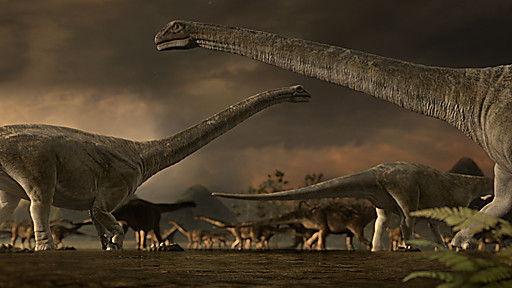
At long last, Planet Dinosaur brought us sauropods this week - in an episode entitled 'New Giants'. In particular, the episode featured the mighty titanosaurs of South America and Africa, Argentinosaurus and Paralititan, and the huge carcharodontosaurs that lived alongside them.


Above: titanosaurs on parade. Copyright the BBC.

A few dubious facts and figures were bandied about in this episode. Tedious as hyperbole-laden 'my dinosaur's the biggest!' contests tend to be, Argentinosaurus might not have been the heaviest sauropod, and Mapusaurus might have rivalled Tyrannosaurus in size, but was not definitely bigger, as described in the episode. (Admittedly, they may have been talking about Giganotosaurus instead, but that animal was not named.)

Unfortunately, the sauropods continued the tradition of looking a little hollow - especially when it came to their heads - and certain details about them were wrong, but overall the convincing impression was given of just how massive they were. Furthermore, the show did a good job of emphasising just how ridiculously quickly sauropods had to pile on the pounds as they grew up (if only they'd had access to packets of biscuits and the internet), and presenting sauropod breeding strategy as essentially being 'birth fast, most die young' (they were r-strategists, in other words). No sentimental scenes of mummy Argentinosaurus cooing over her hatchlings here, either - most of the poor, abandoned little sods ended up as cutesy-faced morsels for giant pterosaurs (Mark Witton-style) and the abelisaur Skorpiovenator.

Still, all did not go the predators' way. While the interesting theory of 'sauropod grazing' behaviour for charcharodontosaurs was presented, that didn't mean the big old dears were content to sit idly by while their allosauroid neighbours tore chunks from them. In one particularly gruesome scene, an Argentinosaurus killed a Mapusaurus by, well, stepping on it. Squish. I could almost hear the cheering coming from SV-POW.

Once again, the show did an absolutely tip-top job of showing off some wonderful fossil finds. In particular, I was bowled over by the fact that sauropod trackways in South America had been found to contain the bones of numerous other animals. I know I keep saying this in these reviews, but the importance of showing the fossils to the general public cannot be over-emphasised. In fact, having spoken to a few people outside of the wacky world of the dino-blog-o-sphere about Planet Dinosaur, this is definitely the aspect of the show that is most drawing in the general public. From a geek's perspective, this engaging with people using the actual science can only be good thing (and I'm sure my scientist friends will agree). The important thing about this show is that it is clear the makers are often trying really hard to make a highly entertaining, yet educational show, rather than just make something that's "RAR! DINOSAURS IN YOUR FACE!".

Also, that time-lapse segment was a pretty nice idea, don'tcha think? Reminded me of that bit in Life in which a whale carcass is stripped bare by freaky starfish and crustaceans. But with dinosaurs. Excellent. It made up for all those repetitive shots of twitching eyeballs (could they even do that? I didn't think they could, but now I'm not sure).

And, yes, the recycling of Sarcosuchus and Carcharodontosaurus did feel a little cheap. At least we got to see a little more of the former this time, and the scene in which the two partake in a tug-of-war contest using a subadult Paralititan was rather amusing. How awful. (Although it did get away in the end.)

Overall, a few irksome details aside, I enjoyed this episode. It feels churlish to expect every little thing to be perfect in these shows, and this series continues to do a good job of not over-sentimentalising its subject matter and presenting a suitable amount of scientific evidence. Roll on next week.

Wednesday, October 5, 2011

Planet Dinosaur, episode four - review

This week, Planet Dinosaur served up some plesiosaurs. Now, this creates a problem for me - while I have just enough knowledge of dinosaurs to occasionally convince people that I know what I'm talking about, my knowledge of plesiosaurs amounts to exactly the square root of bugger all cubed. I interviewed Adam Smith once and tended to just sit there dumbfoundedly, nodding and making sure my dictaphone was working. Fortunately a few dinosaurs from the Morrison formation were also included - so don't mind me for focussing on those.


Above: Allosaurus and Camptosaurus from Planet Dinosaur. Copyright the BBC.

Entitled 'Fight for Life', the theme of this episode was predator-prey relationships in the Late Jurassic. The terrestrial star of the show was good old Allosaurus, which (a few too-hollow fenestrae aside) was rendered very well; unlike in Walking With Dinosaurs, the animal's horns were correctly positioned, while its enlarged thumb claw was present and correct. Nice colour scheme, too. Pleasingly, the show drew on research from recent years when talking about Allosaurus' bite, noting that it likely used its head as a sort of 'hatchet' when attacking its prey.

Allosaurus was depicted hunting Stegosaurus and Camptosaurus, which were themselves portrayed as living together for mutual benefit (plausible). Stegosaurus was one of the more poorly rendered dinosaurs in the show, lacking throat ossicles and having 'old-fashioned' hands. Camptosaurus was mostly fine, although it did display a side-to-side chewing motion similar to a mammal, which was something that no dinosaur could do.

Still, it was a thrill to see Allosaurus tracking its prey, and the "incredible" evidence for Stegosaurus-Allosaurus interactions was duly shown to us. We even got a brief glimpse of Saurophaganax, scaring Allosaurus away from its kill. Even if you're of the opinion that Saurophaganax should be lumped into Allosaurus, it was great to see a non-Allosaurus fragilis Morrison predator get a look in.

To the plesiosaurs, then. Ah. Erm. Um. Well. Yes. Naturally, the show lavished attention on 'Predator X', the gigantic pliosaur that has yet to be named (it's a shame that there are only three plesiosaur researchers in the world*). And hey, both it and Kimmerosaurus looked pretty decent. To me. As in, there were no major howlers like swan necks and overly floppy flippers. There were, similar to the Allosaurus, recessed areas of the head that shouldn't have been, but based on my very very limited knowledge of plesiosaurs they looked acceptable.

And blimey, those above-water shots looked stunning, didn't they? Yes they did.

The best parts of these scenes, as is so often the case with this show, were when we were shown various fossils that provided evidence for plesiosaur feeding behaviour and predator-prey relationships. Being not normally so concerned with marine reptiles, most of it was brand new and therefore fascinating to me; it made it easier to appreciate what a good job the show is doing when it comes to educating non-enthusiasts about dinosaurs. In the future, if any documentaries about prehistoric animals don't provide the fossil evidence, they are going to receive howls of derision and a shower of rotten fruit for sure.

Overall, a good episode; while it's unfortunate that the fact that plesiosaurs were not dinosaurs was not explained, enough people hopefully know this by now. Hopefully. The restorations were also pretty good, the Stegosaurus aside. Keep an eye on Adam Smith's Plesiosaur Bites blog, as he may well be reviewing it soon.

*Not literally true.

UPDATE: Adam has now uploaded part 1 of his review of the show's plesiosaurs.

Wednesday, September 28, 2011

Planet Dinosaur, episode three - review

This week's Planet Dinosaur looked at the killer theropods of the Late Cretaceous. (I'm sure they're getting to non-theropods in time.) In the North, Daspletosaurus was the tyrannosaurs' representative while in the South, Majungasaurus held up the abelisaur end. There was also a brief sojurn into the Land of the Giant Troodon, but we'll come to that in a minute.


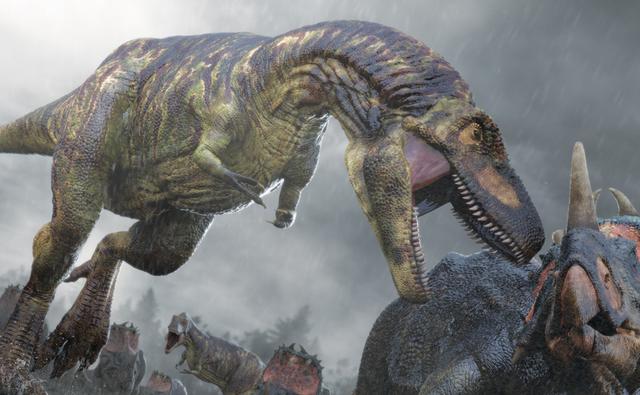
Daspletosaurus and Centrosaurus. Copyright the BBC.

Firstly, though, we must address the most important issue here: was Daspletosaurus spelled consistently in John Hurt's script? The poor guy seemed to be pronouncing it in two different ways; much of the time it was correct, but then equally as often he seemed to be saying "Desplatosaurus". Or do my ears deceive me?

We were informed from the off that Daspletosaurus co-existed with Gorgosaurus although, sadly, we never got to see the latter. (Also, the skeletal diagram for Gorgosaurus depicted, strangely, a juvenile animal.) Daspletosaurus was portrayed as gregarious, but not a pack hunter a la Currie - rather, it displayed the more reptilian behaviour of attacking in a mob without any tactics or co-ordination. Which was a Good Thing. Once again, the programme pointed to healed bite marks and puncture wounds on tyrannosaur skulls as evidence for intraspecific competition, which was welcome, but did feel like a bit of a retread.

For the most part, the creatures in this episode looked rather good, and the animation was decent with a few moments of stiffness (including a tyrannosaur that looked like it was skating). There were a few nice touches, such as a Chasmosaurus scratching itself against a tree, that lent the action a more naturalistic feel. Nevertheless, the animals still look completely rubbish when they fight - while no scrap was quite as slapdash-looking as the herky-jerky carcharodontosaur battle in the first episode, there is still something quite...wrong about the way Planet Dinosaur's beasts do battle. This is particularly true of larger animals, as they appear to lack the necessary mass.

The series was also guilty of presenting speculation as fact this week, notably when it portrayed an Alaskan giant Troodon population ganging up on juvenile Edmontosaurus. While it was pointed out that there is evidence of Troodon (or at the very least, troodont) bite marks on Edmontosaurus remains, we were presented with no evidence for Troodon being a co-ordinated pack hunter. It's plausible, perhaps, but still speculative - and it's a little disappointing that the show didn't point this out, given how good it has been on that front so far. Equally disappointing was the rather under-feathered appearance of the Troodon. It seems extremely unlikely, given the advanced feathers seen on other troodonts, that Troodon itself would have reverted to only having an extremely short, hairlike covering of protofeathers. This seems especially baffling given that, disregarding a few cock-ups with feather attachment points and the like, the show's dromaeosaurs all have wings.

The segment featuring Majungasaurus was enjoyable, if only for the adorable baby Majungasaurus that fed alongside their attentative mother (again, speculative, but in this case, I'm going to let it go. It's cute). Naturally, in addition to looking at the biomechanics of its bite, the show took delight in presenting the animal's cannibalistic side - following a (rubbish) fight with a burly male over a carcass, the mother Majungasaurus promptly devoured her opponent. It would've been better if the fight sequence itself was better animated - and the behaviour of the animals during the fight a little more convincing - but said cannibalism was still a cool fact to introduce to the public. Especially kids. I bet they loved it.

The final section in this episode was pretty cool, too, as a herd of Centrosaurus met a watery death in a flooded river while migrating en masse. Granted, some of the animals' behaviour was again a little odd (why weren't they resisting the Daspletosaurus more?), but this moody, stormy scene made for a good finale.

Overall, Planet Dinosaur continues to be a mixture of virtuous science, better-than-average CG restorations and slightly clunky animation. It's difficult to decide how pedantic one should be when writing these reviews. For me, the most important aspect of this series is the science that it's introducing to the general public. Most of this stuff won't be new to dinosaur enthusiasts, but episodes like last week's are likely to astound the public at large (who are also less likely to notice that the feathers are incorrect, or particularly remember how the feathers were arranged anyway). Hopefully, next week will see a break away from theropods - much as I like them - and John Hurt correctly pronouncing those tricksy dinosaur names.

Wednesday, September 21, 2011

Planet Dinosaur, episode two - review

Entitled 'Feathered Dragons', this week's episode of Planet Dinosaur focussed on the glut of feathered nonavian dinosaurs discovered in China since 1996. And it was, I must say, a treat, in spite of a few minor niggles.


(Above: Microraptor and lizard prey. Copyright the BBC.)

Cheekily mentioning a 'dinosaur revolution' in China, smooth-talkin' narrator John Hurt introduced us first to Epidexipteryx, hunting for insect larvae and being hunted in turn by Sinraptor (which is probably fine if the former lived in the Late Jurassic). Nothing really to complain about here - there might have been a few impossible forearm rotations, but it was very difficult to tell, so I'm giving them the benefit of the doubt. Besides, it was a marvellous idea to introduce this animal to a wide audience in a CG dinosaur show - after all, who when thinking of a 'dinosaur' ever pictures a tiny creature with primitive feathers and a bizarre, aye-aye-esque elongated finger? If there was ever a perfect dinosaur to destroy people's preconceptions, it was Epidexipteryx.

Moving on, we were introduced to a perhaps under-feathered Saurornithoides having its nest raided by what was, in this case, a commendably non-specific "oviraptorid". The animal depicted resembled "Ingenia", the oviraptorosaur with a preoccupied name. Once again, the show played to its main strengths, presenting ample fossil evidence for oviraptorosaurs enjoying an omnivorous diet and displaying photographs of fossils, a few of which I hadn't seen before. This is really what sets Planet Dinosaur apart from every other CG dinosaur show out there, and is why the likes of Brian Switek and Darren Naish (for it is he) have been singing its praises. Over at Brian's Dinosaur Tracking blog, Heinrich Mallison has claimed that there was "no filter" between palaeontologists and those working on the show. For once, I can really believe that.

The next animal on the list was Gigantoraptor. Again, we were both told and shown exactly which bones from this beast have been discovered, which was fantastic. We were also told that, in spite of its size, it "seems certain that Gigantoraptor had feathers" based on phylogenetic bracketing. Hallelujah for that. Granted, things weren't perfect here - for example, the feathers on both Gigantoraptor and the unspecified oviraptorosaur were attached in the wrong places, and referring to Gigantoraptor as 'the largest feathered animal of all time' was dubious given the existence of Therizinosaurus. But I enjoyed the scenes featuring an animal that was akin, in the words of whoever wrote Hurt's script, to "a mouse the size of a cow".

It should probably also be noted that the Gigantoraptor scene drew direct comparison with Dinosaur Revolution, in that it featured the animals displaying to each other. David's already defended Dinosaur Revolution on the grounds that it was never originally intended to be a serious documentary show, whereas Planet Dinosaur always was conceived as such. As such, it is perhaps understandable that Planet Dinosaur should adopt a more plausible birdlike approach when portraying giant oviraptorosaurs displaying to one another. But it's still worth noting.

Unfortunately, the most dubious moments occurred in the final section of the show, featuring Microraptor and Sinornithosaurus. That's not to say that these weren't some of the best feathered dromaeosaurs yet shown on television, because they almost certainly were. Hopefully, following this, any show that dares depict a ridiculous 'gorilla suit' feathered theropod will become a laughing stock.

However - and I'll admit this is pedantry to an extent - it often appeared that the Microraptor was a little more...supple than it should have been. That is to say, it splayed its legs out to such an extent that they probably should have been a-poppin' out of their sockets. Sinornithosaurus was generally fine - in fact, it was one of the best looking CG dromaeosaurs I've ever seen - but the highly contentious 'venomous fangs' idea reared its head. And was presented as pretty much certified fact. (I'll leave any commenters to fight over that one.)

All controversies aside, I'll have words with any dinosaur geek who was unimpressed with this episode. Yes, the feathers weren't always perfect, and perhaps one or two controversial ideas were presented as fact, although not without fossil evidence. This is still the way forward for CG dinosaurs ont' telly. The animation was better this week too, as while it was occasionally still a little stiff and unnatural, the involvement of (mostly) small animals meant that the unconvincing portrayal of elephantine heft was not an issue. Here's hoping this is a series that will get better and better!

Any suggestions that I've been overly nice due to a guilt complex/alcohol will be mostly ignored.

Wednesday, September 14, 2011

Planet Dinosaur, episode one - review

After almost comical hype (including featuring as an item in the Six O'Clock News), the Beeb's latest dino-fest is finally here. Planet Dinosaur is the other great CG dinosaur documentary event of the year, alongside Dinosaur Revolution (which David has already written about), although it is more in the Walking With Dinosaurs mould. It looks expensive. It features John Hurt's dulcet tones. And it's somewhat flawed. Looks like we're going to have to wait a bit longer for that dream CG dinosaur show.


(Above: the Planet Dinosaur Spinosaurus. Copyright the BBC, used with the assumption that it'll probably be alright, guv.)

Of course, there was much to commend here. For one thing, most of the speculation about the behaviour of the animals was backed up with fossil evidence, whether it was spinosaurs attacking pterosaurs or intraspecific competition in large theropods (although the assertion that such fighting was "likely territorial" was a spurious one). The animals looked pretty good for the most part, with the head of the show's star Spinosaurus being the closest that any CG documentary has yet come to the real thing, while Rugops had appropriately ridiculous, atrophied and largely immobile forelimbs.

That's the thing though - the forelimbs. Oh, theropod forelimbs, why must you trip people up so? For the most part in Planet Dinosaur they just look suspicously...human, but the pedantic dino-nerd is at least kept sated by the fact that the animals aren't adopting the classically erroneous bunny-hands posture. But then - gah! - the Spinosaurus does just that while attacking a sawfish. Shame.

At a more fundamental level, there's the animation. Say what you like about Jurassic Park 3 and that fight sequence, but at least you were left in no doubt there that the creatures smacking each other about were big. Here, while we're repeatedly told that Spinosaurus and its adversary Carcharodontosaurus were bloody enormous, the animation gives little impression of this. There's just no weight shifting, no sense of all that tonnage being smacked around. In fact all of the animals in Planet Dinosaur look unconvincing in this respect.

Still, at least the animals' behaviours were pretty convincing and, as I said before, frequently backed up with fossil evidence (although namedropping some of the palaeontologists involved in the research would've been nice). When Carcharodontosaurus was depicted hunting ornithopods in a forest, it didn't run out in full view, roaring and firing pistols into the air, unlike so many dino documentaries. When it tackled its prey, the show didn't skimp on the cruelty as the quarry hobbled away, bleeding copiously. Equally, Spinosaurus was depicted partaking in pleasingly plausible heron or grizzly-like fishing behaviour rather than tossing fully-grown Rugops about (as in certain other shows I won't care to mention).

Rugops did feature, however, and was described as having "weak jaws" and therefore being a "natural-born scavenger". Groan...

Oh, and that ornithopod? Well, that was Ouranosaurus, who must be too old for this shit. And I mean that literally, as Ouranosaurus lived millions of years before any of the other animals in the show. Well, bugger.

There we have it then - a mixed bag, with apologies for the cliché. Some good points - like including actual science in a dinosaur show! - and quite a few bad ones. I'm still looking forward to future episodes, which promise us properly winged dromaeosaurs if nothing else. If you've seen the show and think I've been too harsh (which I probably have), then do drop a comment.

Thursday, September 1, 2011

The Planet Dinosaur launch trailer is here

So it is. Looking good too.


Highlights in the trailer: maniraptors with proper plumage! A Spinosaurus with a suitable head*! It's a little hard to critique the finer details when they're flashing past in a trailer montage (and yes, the use of the word 'pterodactyl' and a stock raptor sound effect is very lame), but it's looking like an improvement over many CG docus from the last decade or so. Here's hoping!

*Or not quite, as I've just seen these stills, which show that the mandible is a little off (not to mention certain other aspects of the anatomy, notably the forelimbs). Could be worse...I'm still happy about the feathered dinosaurs.