Monday, October 10, 2011

Vintage Dinosaur Art: Dinosaurs: A Pop-Up Book

Can a dinosaur book ever just be...adorable? Not in a twee, cute-and-cuddly-characters sort of way, but simply through being wonderfully designed and a clear labour of love? Well, I think that, at the very least, this one can.


Firstly, just look at the word 'DINOSAURS' on the cover - it's so evocative of a certain era in dinosaur pop culture (and reminds me of the poster for When Dinosaurs Ruled the Earth every time I look at it). The book dates from 1977, and as such features dinosaurs that are decidedly old-fashioned (although still beautifully painted by Dot and Sy Barlowe). Open up the cover, and you're greeted with this:


A pop-up Tyrannosaurus skeleton! And, given the difficulties of creating such a complex object in pop-up paper form, not a bad one. You can certainly see that the artist did their research - check out the carefully detailed Centrosaurus in the background, too. I suspect that that one (if not everything here) was based on a museum mount.


On the above page, pulling the tab on the left causes a baby Protoceratops (I presume) to break out of its egg. Alright, so this is adorable in a slightly twee, cutesy way. But I love it - it's a fantastic idea! It's also a wonderful way of teaching very young children about dinosaur life.


When I first looked through this book, what immediately struck me was the scarcity of theropods. Normally the stars of the show ('cos kids love scary predators with big teeth), they have here been sidelined in favour of their herbivorous bretheren, and it's actually quite refreshing - it lends the book a genteel, relaxed air, which is aided by the high quality of the illustrations. The fact that none of the animals are depicted tearing each other limb-from-limb probably also helps. There are a fair number of clichés (check out the volcanoes in the above picture) but the book finds a number of interesting, inventive ways to introduce kids to new dinosaurs. For example, flipping over the Monoclonius above reveals the closely-related Styracosaurus (below). It's a good way of making clear the similarities between them, without having to spell it out in the text.


It's unfortunate that a rather lizardy-headed Diplodocus is anachronistically on the same spread as the centrosaurs, but there we go. To emphasise its length, the whole animal must be folded out from the page. It may be rather oddly shaped, but at least it's firmly on dry land.


...Which is more than can be said for this Brachiosaurus, bobbing about in the river. Pulling the tab leads to the animal rising up to the surface. Swamp-dwelling sauropods stuck around a long time after their sell-by date. Still, having the tab action reveal more of the animal is a decent trick, and keeps things interesting. I also like the use of additional wildlife to set the scene (notice the small turtle on the rock).


One of the most impressive pop-up pieces in the book is this Stegosaurus (below). Every plate along the animal's back has been individually inserted, which prevents it from looking a little too two-dimensional, and once more it's beautifully painted (if old-fashioned as ever).


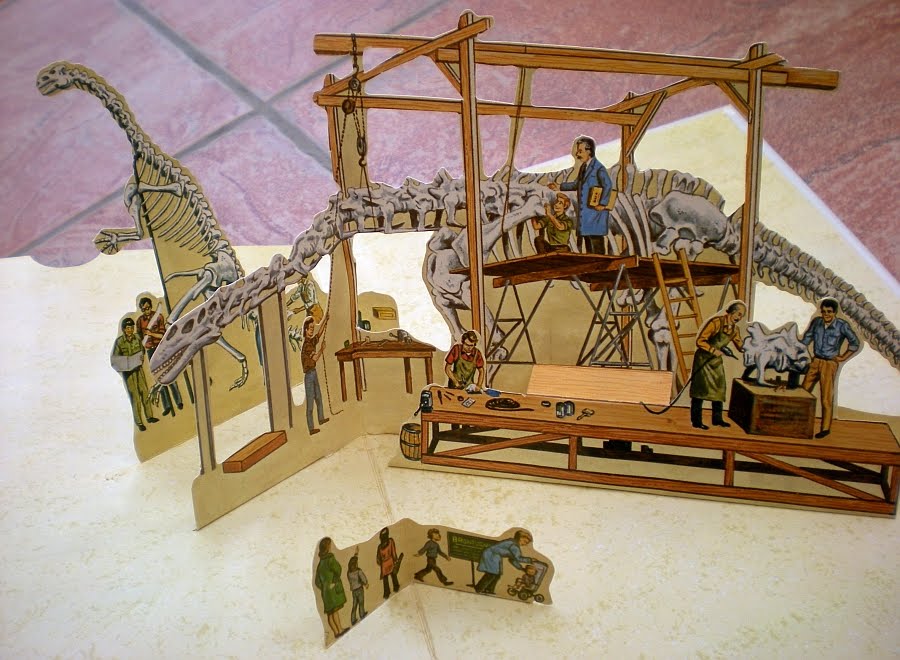
The book finishes back where it began - in the museum. This has got to be my favourite pop-up in the book - a 3D museum scene with skeletons, museum workers, curious guests and even a tiny sign reading "BRONTOSAURUS". In addition to showing off the sheer size of the dinosaurs when compared with people, the 'Bronto' skeleton is, again, remarkably well drawn.


In a word - charming. Many thanks to Niroot for letting me borrow it.

Friday, October 7, 2011

Mesozoic Miscellany 46

Serving up a generous slice of what's hot in the dinosaur blogosphere, it's another edition of Mesozoic Miscellany. Tally ho!

If you're in Alaska, or can get there, tonight is the opening of "Dinosaurs and Robots," an art show from friends of LITC Raven Amos and Scott Elyard. Some really cool stuff from both of them, including paleoart that looks like none other you've ever seen. Click their names for more info and to take a look at what they've been working on.

The Paleo Tourist writes about one of his favorite fossils, Microraptor gui, including recollections of his time as a docent for the Field Museum hosting of the AMNH's Dinosaurs: Ancient Fossils, New Discoveries exhibition in 2007.

At Sauropod Vertebra Picture of the Week (affectionately known as SV-POW!), Matt Wedel shares his experience this week at the Los Angeles County Museum to examine a special alligator skull fossil. He also has praise for the museum's recent renovation, calling it "frankly phenomenal: spacious, well-lit, loads of actual material on display, skeletons you can walk all the way around, informative but unobtrusive signage, tasteful integration with existing architecture." Cannot wait to see it with my own eyes!

Another newly renovated site I can't wait to see with my own eyes: the visitor center housing the famous quarry wall at Dinosaur National Monument, which Brian Switek calls America's "real Jurassic Park" in his splendid recounting of opening day at Dinosaur Tracking. Dan Chure, who has been telling the story of the monument's visitor's center over the last few years, also writes about the day at the visitor center's blog. I was at DNM about 20 years ago, when on vacation with my dad, one of the experiences that helped make me the hopless dinophile I am. I read Jurassic Park three times during the trip and fell in love with the Rockies and the desert. Congratulations to everyone who worked on this renovation.

I'd also like to visit Triassic Park. Bill Parker writes about a trip to Argentina at Chinleana.

At Paleo Illustrata, Stu writes about one of his treasured books, Mantells' Petrifications and their Meanings, sharing many of its fine illustrations.

Albertonykus reviews the third episode of Dinosaur Revolution, which I sadly have yet to see. It's favorable review, and it sounds like a lot of good stuff to chew on for maniraptor fans.

Also regarding episode three of Dinosaur Revolution, Mike Habib writes about the portrayal of the pterodactlyoid Anhanguera in the program.

Here at LITC, my main man Marc Vincent has been writing terrific reviews of Planet Dinosaur, now airing on BBC. If you haven't checked them out, you really should.

Recently added SciAm blogger David Bressan writes about the history of the kangaroo-dinosaur analogy and the iconic status of T. rex at History of Geology, and does me the very great honor of a citation to one of my posts from last year. Great read, and thanks for the link, David!

I could write a long paragraph about one of Heinrich Mallison's recent posts at Dinosaurpalaeo, but two words will certainly suffice: Plateosaurus butt.

At the new Project Dryptosaurus site, Gary shares a hilarious vocal version of the Jurassic Park theme. One thing: I couldn't help but think of a much smaller scale, potty-mouthed version that's gone around the web. You know the one.

Mark Wildman is teasing us with a detail of a pterosaur fossil. Can't wait to see the full post about it.

72 pages after Jim Lawson began sharing his unpublished tyrant lizard tale, Paleo: Loner is done.

Dave Hone does us the immense favor of collecting all of the links to his long list of interviews with paleontography luminaries at Archosaur Musings. His latest: master Doug Henderson.

Arkansas has produced some exciting dinosaur tracks, and ReBecca Hunt-Foster has the skinny at Dinochick Blogs.

Finally, here's a very nice Gallimimus digital illustration from Paul Heaston. He writes, "I feel like the ornithomimids are being ignored in the dino-media and paleoart these days. They're cool! I gave this guy a confetti streamer tail because I wanted to."
gallimimus digital painting

You know, he has a point (though it must be noted that in the Archosaur Musings link above, Hone shares one of Doug Henderson's beauties which features Struthiomimus). The "bird mimics" don't seem to get an overwhelming amount of love right now. You know what I'd like to see? An ornithomimid triumphant over a tyrannosaur. They deserve some good PR, don't they?

Great Horned Owls in Flight

Another bit from Raptor Sunday:


As a commenter wrote on Flickr, I'm sure Sandy meant to do that! Owls can become pretty strongly attached to humans, and I'm sure it was just Sandy's way of making us feel less jealous about her ability to fly. This video was taken in the Indiana Raptor Center's flight barn, where their Great Horned Owls are becoming accustomed to flying, and where their progress can be monitored. Next year, they'll be adding on to it substantially, in addition to other renovations on their property in Nashville, Indiana.

Wednesday, October 5, 2011

Planet Dinosaur, episode four - review

This week, Planet Dinosaur served up some plesiosaurs. Now, this creates a problem for me - while I have just enough knowledge of dinosaurs to occasionally convince people that I know what I'm talking about, my knowledge of plesiosaurs amounts to exactly the square root of bugger all cubed. I interviewed Adam Smith once and tended to just sit there dumbfoundedly, nodding and making sure my dictaphone was working. Fortunately a few dinosaurs from the Morrison formation were also included - so don't mind me for focussing on those.


Above: Allosaurus and Camptosaurus from Planet Dinosaur. Copyright the BBC.

Entitled 'Fight for Life', the theme of this episode was predator-prey relationships in the Late Jurassic. The terrestrial star of the show was good old Allosaurus, which (a few too-hollow fenestrae aside) was rendered very well; unlike in Walking With Dinosaurs, the animal's horns were correctly positioned, while its enlarged thumb claw was present and correct. Nice colour scheme, too. Pleasingly, the show drew on research from recent years when talking about Allosaurus' bite, noting that it likely used its head as a sort of 'hatchet' when attacking its prey.

Allosaurus was depicted hunting Stegosaurus and Camptosaurus, which were themselves portrayed as living together for mutual benefit (plausible). Stegosaurus was one of the more poorly rendered dinosaurs in the show, lacking throat ossicles and having 'old-fashioned' hands. Camptosaurus was mostly fine, although it did display a side-to-side chewing motion similar to a mammal, which was something that no dinosaur could do.

Still, it was a thrill to see Allosaurus tracking its prey, and the "incredible" evidence for Stegosaurus-Allosaurus interactions was duly shown to us. We even got a brief glimpse of Saurophaganax, scaring Allosaurus away from its kill. Even if you're of the opinion that Saurophaganax should be lumped into Allosaurus, it was great to see a non-Allosaurus fragilis Morrison predator get a look in.

To the plesiosaurs, then. Ah. Erm. Um. Well. Yes. Naturally, the show lavished attention on 'Predator X', the gigantic pliosaur that has yet to be named (it's a shame that there are only three plesiosaur researchers in the world*). And hey, both it and Kimmerosaurus looked pretty decent. To me. As in, there were no major howlers like swan necks and overly floppy flippers. There were, similar to the Allosaurus, recessed areas of the head that shouldn't have been, but based on my very very limited knowledge of plesiosaurs they looked acceptable.

And blimey, those above-water shots looked stunning, didn't they? Yes they did.

The best parts of these scenes, as is so often the case with this show, were when we were shown various fossils that provided evidence for plesiosaur feeding behaviour and predator-prey relationships. Being not normally so concerned with marine reptiles, most of it was brand new and therefore fascinating to me; it made it easier to appreciate what a good job the show is doing when it comes to educating non-enthusiasts about dinosaurs. In the future, if any documentaries about prehistoric animals don't provide the fossil evidence, they are going to receive howls of derision and a shower of rotten fruit for sure.

Overall, a good episode; while it's unfortunate that the fact that plesiosaurs were not dinosaurs was not explained, enough people hopefully know this by now. Hopefully. The restorations were also pretty good, the Stegosaurus aside. Keep an eye on Adam Smith's Plesiosaur Bites blog, as he may well be reviewing it soon.

*Not literally true.

UPDATE: Adam has now uploaded part 1 of his review of the show's plesiosaurs.

More reflections on Raptor Sunday

Talking with Patti and Laura at the Indiana Raptor Center this week, I couldn't help but reflect on how dinosaur paleontology and bird conservation relate to each other as outreach efforts. I've spent a lot of time over the last couple of months pondering my role as a graphic designer and what I want to do with this fancy degree I'm working for. As I explore ideas for my thesis project, I feel that the core of it must be my dedication to environmental conservation and my desire to communicate the reason it's so vital: the deep, unbreakable tie we have with our fellow earthlings, human, animal, and otherwise. That's where paleontology's relevance is, too. Just read Scott Sampson if you need convincing. It's not the slight hobby of collectors, merely hoping to fill drawers in museums. It's an important way to reveal life's history. I don't think I've hit on any ground-breaking insights, but I've always found that writing helps me distill my thoughts and help direct them into action. When it's relevant, I hope you won't object to me sharing these posts here.

As a schoolboy, I remember learning about Indiana’s prehistory. Being a northerner, I mainly heard stories of the native cultures who hunted and fished before the arrival of European settlers. I heard stories of farmers discovering the bones of Mammoths when digging ponds. I heard of glaciers, the creation of Lake Michigan, the shaping of the land around us, the layers of till that created the farmlands my family drove across when driving southbound through the state. Ever since, I can't help but look into the prehistory of a place before I travel there.

One thing I learned quickly: Indiana is not dinosaur country. No, those bragging rights belonged to Western states where I heard of rocks that every year gave us new dinosaurs to study. It would take years before I matured enough to get over this slight. But eventually I learned to consider the prehistoric tales told by my home state just as fascinating as those coming from Montana, Utah, and other Western states. I especially appreciated the Carboniferous ecosystems evident in the south of the state, where ancient coal forests were mined for electricity and the remains of tropical seas provided world-famous limestone for sculpture and architecture.

Of course, by the time I had a deeper understanding and appreciation of non-dinosaur paleontology, the slight had been mitigated greatly by the realization that even though the great bulk of dinosaurs had perished many millions of years ago, a slim branch of their family tree survived the end-Mesozoic extinction and flourished: birds, of course. When I was dreaming of fantastic Mesozoic tableaus populated by great monstrous tyrants and outlandishly ornamented behemoths, I was simultaneously watching their distant kin at the feeders hanging in my family’s backyard Magnolia tree. I was collecting their feathers, gazing at their exotic relations in magazines and field guides, and learning of the diverse roles they played in their ecosystems. Two seemingly independent interests that had been traveling their separate ways intersected and reinforced each other.

Patrick the American Kestrel
Patrick the American Kestrel, one of the Indiana Raptor Center's residents That's Jennie and me reflected in his eye!.

So these birds - songbirds, shorebirds and raptors, woodpeckers, blackbirds and thrushes - are Indiana’s dinosaurs. And they deserve no less appreciation, no smaller measure of wonder than what we give to the beasts of the Mesozoic who live only in the mists of the dream time, where we can freely imbue them with as much monstrous character as we like. Likewise, looking into the keen eyes of a kestrel to see its peculiar intelligence and observing its finely honed behaviors, we can start to see the mundane beauty of the animal kingdom that must have been the true way the dinosaurs lived. Hadrosaurs are sometimes called the “cows of the Cretaceous.” Ceratopsians are compared to buffalo and rhinoceros. Sauropods to elephants. But these rough and inaccurate comparisons only serve as masks for creatures that we’ll never know.

In birds, however, some strand of the theropod’s nature persists. I believe that the power of that realization can be a potent force for education that brings people face-to-face with the long and surprising journeys evolution has taken over our shared planet’s billions of years orbiting the Sun, and that's what I want to be at the core of my identity as a designer. Thesis ideas, start dropping into my lap any time now...

Tuesday, October 4, 2011

Terrible '90s Dromaeosaur Face-Off: Round 4

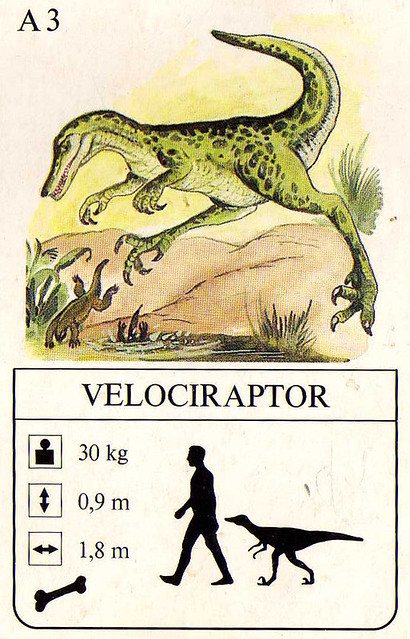
It's finally time for the last round before the semi-finals. Last week's runaway rinner was Velociraptor from the Dinosaurier trading cards - described as a "Croco-raptor" (Ryan de Luca), "hideous mutant alligator man" (Tomozaurus) and "bipedal crocodile with ostrich legs" (Henrique Niza). Shine on, you crazy diamond!


Both of this week's entries come courtesy of Vrahno, who was able to provide a double helping of spectacularly bad dromaeosaurs in a single comment. It should be a tough one!

In the blue corner - Velociraptor from Spotter's Guide to Dinosaurs and Other Prehistoric Animals:


And in the red corner - Velociraptor from 100 Things You Should Know About Dinosaurs:


Which one wins? And on what criteria? You decide! The winner will appear in the second semi-final in two weeks' time. Best of luck.

Extant Theropod Appreciation #9: Raptor Sunday

Patrick the American Kestrel
Patrick, an American Kestrel and stealer of hearts.

This past Sunday, Jennie and I visited the Indiana Raptor Center in Nashville, a small tourist town about a half hour from Bloomington and the IU campus. Situated on a ridge in Indiana woodland, backing up to a ravine, the Raptor Center is home to dozens of species, both local and exotic. The center's president and executive director, Patti Reynolds, along with education director and master falconer Laura Edmunds, showed us around the facilities and introduced us to some of the resident raptors. I think we made friends of both the feathered and non-feathered kind, and I hope that the sentiment is mutual.

Barred Owls
Barred owl with something yummy.

I occasionally get bushwhacked by the beauty of an avian critter and do posts in the Extant Theropod Appreciation series. This week will certainly be in that vein as I share some of my feelings about the visit. I have never really interacted with raptors in this way, save for the odd presentation in grade school or nature centers. This was a whole different ball of wax: learning the animal's names and stories, seeing the relationship they had with their keepers and rehabilitators, dodging them as they flew inches above my head (an experience I commend Jennie for enduring). You look into the eyes of an owl or a falcon, and even though I'm as skeptical and non-spiritual as they come, you can understand how mythologies spring from these animals. You can understand why we might project human qualities onto them, and either aspire to the nobler ones or personify our fears.

Oliver the Peregrine
Oliver the Peregrine Falcon, with a quail for lunch.

Mowgli the Great Horned Owl
Mowgli, a female Great Horned Owl.

To me, though, you must set those poetic and mythic associations aside and focus on the inherent value of an animal. An owl is not wisdom. A bald eagle is not righteousness. They are instead integral parts of their habitats. There is a reason they live where they do: they are living components in ecosystems. Those ecosystems in turn have evolved to become the environments which first sustained our ancestors, and to alter that system is to impact our own lives in ways we can't always predict. The Indiana Raptor Center and related organizations don't just rehabilitate the broken and needy, they help us understand how we can correct broken environments and see just how needy we are.

Ben the Bald Eagle
Thunderin' Ben the Bald Eagle, making that distinctive Bald Eagle cry.

If you have a local raptor rescue center, I'd encourage you to see if tours are available and, if you're looking for some way to contribute, donate time, talent, or money. This was such a huge honor for me, and if you've also had little experience with these animals up close, you owe it to yourself to look them in the eyes, examine their plumage, and see them in flight up close. Thanks to Patti and Laura for being such obliging hosts (extra thanks to Laura for keeping me on my toes - when we first arrived, she said "So, you're here to see the... pickling operation?" and I, gullible dope that I am, fell for it, wondering if I'd come to the wrong address. Even after this, she pulled five or six more fast ones on me before I became more alert). I'll have one or two more posts about this visit, but you can also check out photos and a video in my Flickr set.

Monday, October 3, 2011

Vintage Dinosaur Art: Ladybird Dinosaurs

If you've never owned a Ladybird book, then you didn't have a childhood. I'm serious - your childhood memories were probably implanted, and you are in fact the product of a sinister government/corporate experiment a la Deus Ex. Ladybird published a huge range of hardback, conveniently kiddy-sized books, both fictional and factual - everything from simplified versions of Robinson Crusoe to simplified accounts of prehistoric animals. Which'll be what this here book is all about.


Dating from 1988, Dinosaurs features some thoroughly outdated, yet still very beautiful artwork by B H Robinson. The internet reveals his first name to be Bernard. An accomplished animal illustrator, Robinson's work has a very distinctive look and feel, even if he sometimes resorts to ripping off established palaeoartists. His dinosaurs (as with the Tyrannosaurus and Triceratops above) are very reptilian, rather old-fashioned, but wonderfully and impeccably detailed.


Like many dinosaur books aimed at kids, this book skips merrily through time in (mostly) chronological order, detailing quite a few animals besides dinosaurs. The above Permian scene stood out to me simply because, well, the Edaphosaurus. The Edaphosaurus! I know the animal was a pin-head, but this illustration may be taking it a little too far.


Robinson's sauropods are still of the swamp-dwelling variety, with wrinkly skin and a taste for mushy aquatic plants (it's the only thing these pathetic evolutionary failures are equipped to eat, you see). Diplodocus is very recognisable - slender, with a long neck and whip-like tail. Apatosaurus is...less so. This is, it's safe to say, one of the lesser of Robinson's illustrations.


Robinson's theropods are the tail-dragging, cold-blooded lumps of old, and he obviously takes inspiration from lizards when rendering them. His Allosaurus, while as beautifully painted as ever, has a head that owes more to Varanus than the real thing. The Stegosaurus is just predictably old-fashioned, with its sprawled forelimbs, highly arched back and lizardy feet. Still, it should be noted that as cold-blooded animals (that never existed) they do sorta make sense, particularly when it comes to their being somewhat under-muscled. I'll come back to that.


Here's a good example of Robinson ripping off established (if dead) artists. In particular, the Hypsilophodon stage left obviously owes an awful lot to Neave Parker's peculiarly perching interpretation of the animal. The Iguanodon, meanwhile, looks rather similar to a fibreglass model that I've seen in every British attraction featuring life-size fibreglass dinosaurs that I've been to. It seems that for so long this WAS Iguanodon - a tripod with a lizard head and arms notably less robust than they really were. Can't really blame Robinson for going along with the meme, I suppose. (Look, Nessie!)


And now for something completely different: weird ankylosaurs. The Polacanthus pretty much resembles how the animal was commonly depicted for decades, including by the likes of John Sibbick (whose own painting of the animal was ripped off repeatedly). It does at least have straight legs, unlike the freaky no-neck Ankylosaurus, which also has spikes on its tail club. ("Over 4.5m long" - not half! Well, that is about half, actually.) In spite of how strange the Ankylosaurus may look, the award for derpiest animal in this book surely goes to...


...Tyrannosaurus! Poor dear, what have they done to you? The skin texture is beautiful as ever, but the animal itself looks horrendous. Styracosaurus looks embarrassed to be in the same scene (although of course it shouldn't be anyway). Returning to my point about under-muscled dinosaurs - this trait is particularly noticable when it comes to Robinson's tyrannosaurs. Robinson has obviously 'fixed' the animal to appear more reptilian, cold-blooded and, subsequently, weedy. Still, this is not to deride him too much, because, hey...


...His Archaeopteryx is actually pretty good! Check it out - no glue-on mini-hands! As someone accustomed to drawing birds, Robinson naturally delivers a feathered maniraptoran with decent plumage and anatomy that makes sense. Truly, his tyrannosaur-related sins are forgiven.

And that's your lot for now. As always, let me know of your thoughts, especially if you are familiar with this illustrator and his work.

Sunday, October 2, 2011

Mesozoic Miscellany 45

Been a while since the last roundup, so there's plenty of meat to chew on. There's been a lot of growth in the dino blogosphere lately, and while I'm thrilled about it, I also wish it wasn't happening just as I was getting super-busy with school!

Anyhow, first up, check out Brian Engh's test animation of a Cryolophosaurus as part of the "Dinosaurs Reanimated" project.


I love it. Good stuff, Brian. Everyone, follow the Dinosaurs Reanimated production blog and subscribe to the Youtube Channel. And read more at Don't Mess With Dinosaurs, too.

In the ultimate example of turning lemons into lemonade, a contentious topic on the Dinosaur Mailing List has spurred the creation of a new mailing list dedicated to the history of paleontology. It's only hours old, so if you want to get in on the ground floor, now's the time. This is good timing for me, as I'm planning a project about paleontology history for my independent study in typography this semester (it's still taking shape, but trust me, it shall be shared here). The list is hosted at Google groups, a venue I'm new to, so

Tony Martin is retiring the Great Cretaceous Walk blog for now, as he's concentrating on his new blog focusing on more recent ichnology as he prepares for the IU Press publication of his new book, Life Traces of the Georgia Coast. I love GCW and will miss it, but it's hard to shed tears, as Tony's still writing terrific stuff, and hints at a possible book about his travels in Australia.

Project Dryptosaurus has a new website, so be sure to pop in and bring a nifty housewarming gift...

Archaeopteryx 150: Raptormaniacs, Dinosaur Tracking, and Pick & Scalpel all raise a glass to Archie.

Bird knees. They don't bend backward. Scott Hartman sets SciAm straight.

Victoria Arbour writes about... picking the nose of a Euplocephalus. Examining a broken skull fossil, Arbour, with Tetsuo Miyashita and Phil Currie, verified what Larry Witmer and Ryan Ridgely observed to be a "crazy straw" nasal passage in a couple different ankylosaurs in 2008. The Witmer Lab blog Pick & Scalpel has posted on this research as well. Wouldn't it be nice to see both the heat exchange and resonating hypotheses explored in a future documentary? I mean, it's not exactly hordes of tyrannosaurs mobbing duckbills, but why not let some thyreophorans step into the limelight?

To wrap things up, because I'm getting mighty sleepy, a new PLoS One paper sinks Anatotitan, AKA my Twitter, Flickr, and DeviantArt handle, into Edmontosaurus. Well, phooey. But still, one of the great taxon names of all time, and I'll keep wearing it proudly.

Saturday, October 1, 2011

A funny thing happened when I tried to review Terra Nova

I tried, but I just don't have the energy to do it. I think my post-viewing tweet summed it up. Sorry I'm not more livid about it. I think it's kind of alright, and I'll happily give it a season or so to sort itself out.

One thing of note in the "what in the heck do non-geeks think about dinosaurs" file comes from The AV Club. From previously noted dinosaur fan Todd VanDerWerff: "It’s not the most graceful pilot in the world, lurching about like a, well, dinosaur." China can pump out as many meticulously preserved, elegant examples of feathered dinosaurs as they please: at the end of the day, the word "dinosaur" will still mean the hulking, volcano fume sucking, antediluvian morons the world thought they were sixty years ago. So, what damage can Terra Nova really do? Bring it on, Braga!