The month kicked off with Brussatte et al's response to the Ornithoscelida paper from this spring. What this team has found? Basically, we don't know what dinosaur phylogeny in the broadest scale looks like. It's equally plausible that any of our current models are correct. At the base of the tree, we're dealing with a bunch of similar, hard-to-distinguish Triassic critters, and we need more of them to resolve the issue of what the tree looks like up in the limbs and branches. Read more at Live Science.
The newest look of Anchiornis, illustrated by Rebecca Gelernter and distributed with press materials by the University of Bristol.Anchiornis has been revised yet again, this time with details of its totally weird feathers. It sported totally weird V-shaped plumaceous feathers and its totally weird wing surfaces were made of multiple rows of feathers whose barbs were not tightly zipped together the way those of modern birds are. Read more from the Inverse, Phys Org, and Live Science.
New research describes the post-apocalyptic world of the early Paleogene. Read more at Gizmodo.
Also looking at that post-Mesozoic world, a new paper demonstrates a shift from nocturnal to diurnal lifestyles among Post-K/Pg mammals. Read more from UCL.
Do you lek it like that? Seems some Jurassic theropods did. Read more from Brian Switek at Laelaps.
Around the Dinoblogosphere
Andy Farke speaks out for Grand Staircase-Escalante National Monument at the SVP blog.
Hopefully, you've had a chance to read Asher's insightful interview with Mark Witton from a couple days ago. Be sure to also read his recent piece for the Atlantic, which used the publication of Dinosaur Art II and Taschen's Paleoart to examine the history, present, and future of paleoart.
Which taxa were crowned the top ten open access fossils of 2017? Let's just say the fish lobby really stepped up. Read the list at PLoS.
At the Celestial Troodon blog, Midiaou Diallo shares his thoughts about the recent Sinosauropteryx paper.
Venturing out of the Mesozoic, Zach Miller has a wonderful post on borophagine dogs, specifically Aelurodon, as he was able to procure a nice cast of the holotype fossil in the SVP silent auction this year.
Victoria Arbour traveled to spain for the Dinosaurios 2.0 conference, and writes about her experiences at Pseudoplocephalus.
Are you aware of the "birds are not dinosaurs" crowd, but perhaps not completely clear on their arguments? Well, Darren Naish has written a post at TetZoo that will be a huge help to you. One thing I didn't realize about the BANDits is that "they’ve – I think unwittingly – moulded themselves into a distinct social group, even going so far as wearing special badges at conferences." Wow.
One thing I missed and probably would have included in the guide is Mark Hallett's 2018 calendar. Thanks to Matt Wedel for calling attention to it at SV-POW!
The LITC AV Club
PBS's Eons covers feathered dinosaurs in its latest episode. But why oh why did they use Damned Dromaeosaurs for some of the art?
The Saurian team previews their latest patch. Can't wait to play it! I'll need a new PC, but I'm patient, and they're continually working to improve gameplay.
Brian Engh showed just how much TLC goes into each of his pieces in a recent video condensing an hour of his process down to about a minute.
Help Annalisa Berta and Susan Turner, writers of the upcoming book Bone Hunters: A History of Women in Vertebrate Paleontology, head to SVP 2018 to conduct video interviews related to the project. Donate at GoFundMe.
This month inspired by a post on Facebook about how tyrannosaurs might best down an ankylosaur, I'm featuring Thai artist Nattawut Wongta's recent piece depicting T. rex victorious over an Ankylosaurus. Love the look in the tyrant's eye. Check out more of Wongta's work at DeviantArt.
Tyrannosaurus and Ankylosaurus illustration by Nattawut Wongta, used here with the artist's permission.
If you've ever watched the dipping and rising trajectory of a woodpecker flying between trees, you've witnessed "bounding flight." New research reveals that a small enantornithine from the Jehol Biota, Junornis, did the same. Read more from Dave Hone in the Guardian and Fernanda Castano at Letters from Gondwana.
In further Jehol Biota news, Sinosauropteryx is the subject of newly published research seeking to resolve its coloration in life. Fian Smithwick et al describe the little bugger as the resident of a fairly open habitat, sporting countershaded coloration a dapper bandit mask (see Bob Nicholl's restoration). It also confirms that the banded tail present in this little comsognathid's fossil remains is the result of the preservation of melanin, and not any other artifact of preservation. This research also broadens our knowledge of the Jehol environment, previously known to have been chiefly enclosed forest.
"Only three good specimens are known for Ankylosaurus," Victoria Arbour writes. So she and Jordan Mallon went about a comprehensive review of what we've learned since Carpenter's comprehensive 2004 paper. What's especially cool is that this reappraisal was spurred by her consultations with the Saurian team. Read about Arbour and Mallon's conclusions at Pseudoplocephalus and from Brian Switek at Laelaps.
New research on a site in the Kaiparowits plateau offers a ton of insight into hadrosaur nesting behavior. Read more from Pete Bucholz at Earth Archives and Duane Nash at Antediluvian Salad.
The Bearded Lady Project is hitting the road. Follow the project's website to see if a screening and portrait exhibition is coming your way.
The powerhouse paleoart team of Scott Elyard and Raven Amos ran the IAmSciArt Twitter account for a week during October. Head to their first tweet and scroll through for a treasure trove of paleoart insight.
Hello all you #sciart fans in Twitterland! This is @alaskanime sending out the first of many tweets! Welcome to this week's curated posts!
And that's not all in the realm of rotating curator accounts on Twitter: Liz Martin-Silverstone guested at BioTweeps, too. As you might expect, she covered pterosaurs, but also dug into many other facets of a career in palaeontology. Start here.
Good morning (well at least it's morning for me)! I'm Liz, or @gimpasaura, and I'll be your Biotweep this week. My plan for this week: pic.twitter.com/ZK2SitOo1e
Dinosaur Art II is now available! The first Dinosaur Art volume was a big hit among readers, offering a look at some of the most influential paleoartists of the last forty years. The sequel focuses on contemporary artists, including Andrey Atuchin, Emily Willoughby, Sergey Krasovskiy, Velizar Simeonovski, Mark Witton, Julio Lacerda Jason Brougham, Vitali Klatt, Peter Schouten, and Tom Bjorklund. Also, Witton wrote an article about the book, as well as a defense of palaeoart as a scientific practice, at Boing Boing.
If you're a fan of more abstract and stylized paleoillustration, you'll want to check out Lonely Planet's Dinosaur Atlas, illustrated in vivid vector awesomeness by James Gilleard. Check out more of his beautiful work from the book at Behance.
Another of my favorites is "In Our Time," and host Melvyn Bragg recently talked feathered dinosaurs with Michael Benton, Maria McNamara, and Steve Brusatte.
Dawndinos is a five year research project studying the ways locomotion played a role in the success of the earliest dinosaurs. Paleoart titan Bob Nicholls was commissioned to create an original illustration for the team, and delivered a doozy: Archosaurian Dawn, in which a Marasuchus flock scavenges fallen Aetosauroides carcasses as a Gracilisuchus passes by in the foreground.
Archosaurian Dawn by Bob Nicholls, posted here with his permission.
The Society of Vertebrate Paleontology 2017 meeting was held in late August in Calgary. There have been a few posts from attendees, though not as many as I'd hoped. Check out recaps from Liz Martin-Silverstone and Albertonykus. Alex Hastings presented a poster on dinosaurs in comics and writes about his extensive research. Over at the RMDRC Paleo Lab blog, Anthony Maltese writes about the creation of the Protosphyraena skeletal mount he unveiled at SVP.
Californians can finally relax: they have an official state dinosaur. It's the hadrosaur Augustynolophus [insert hilarious vegetarian joke here]. Read more from Smithsonian and the LA Times.
It's the case of the upside-down ankylosaurs! New research studies the phenomenon of armored dinosaurs being discovered on their backs. Read more at Live Science.
Morturneria seymourensis, an aristonectine plesiosaur that swam the Antarctic seas of the Late Cretaceous, was first discovered more than 30 years ago, but new research has revealed it to be an oddball in the family: a filter feeder, with teeth that interlocked to trap and strain krill and other small food from the water. Read more from Sci-News and Earth Archives.
If you were a bit thrown by the term "allokotosauria" when Shringasaurus was revealed last month, have no fear. Zach Miller has a new post at Waxing Palaeontological about this clade's history and current roster of beasts.
How do paleontologists in the field decide how to conduct their search for fossils? How do they determine the significance of what they find? Adrian Currie writes about the secret epistemology of field work at Extinct.
At Antediluvian Salad, Duane Nash muses about groundcover in the Mesozoic, especially as depicted in paleoart, and winds up thinking a lot about biocrusts. Definitely worth a read if you're into palaeoart that delves into the more subtle details of an environment.
Public paleoart projects are always worth a look. The Everything Dinosaur blog features a new project to honor Gideon Mantell with a life-size sculpture of an iguanodontid in the town of his birth: Lewes, in East Sussex, England.
Amargasaurus tote bag designed by Levi Hastings, image used here with his permission.
I've long been a fan of Levi Hasting's abstract dinosaur watercolors and screenprints, and have featured his work here often. His new Amargasaurus tote bag is splendid. Perfect for carrying around a collection of dino toys. Pick it up in his Etsy shop.
Have you seen the incredible models and puppets created by TRX Dinosaurs? Here's a pic from their Instagram feed, which also includes some fun videos. Head to the TRX Dinosaurs website, where you can order your own poseable, life-size sculpture of Velociraptor or Deinonychus, or order a custom puppet! They're pricey, but the attention to detail and fidelity to contemporary paleontological knowledge certainly make them worth every cent.
The LITC AV Club
Designer and illustrator Ian Stewart heroically animated the artwork of Ray Troll to make a music video for the Ratfish Wranglers' "Ages of Rock."
Hey. There's a video game called Anatomically Incorrect Dinosaurs. Sounds right up our alley, doesn't it? And doesn't this trailer make sense? Like, total sense?
Crowdfunding Spotlight
Last minute campaign alert! This one closes on September 30, so be quick about it. Especially if you're a fan of Victorian art and design giant William Morris (he of the Arts and Crafts movement fame). Especially if you're a fan of his famous "Strawberry Thief" pattern - because now, it's got dinosaurs in it. Pledge at Kickstarter for your pocket square, necktie, or scarf!
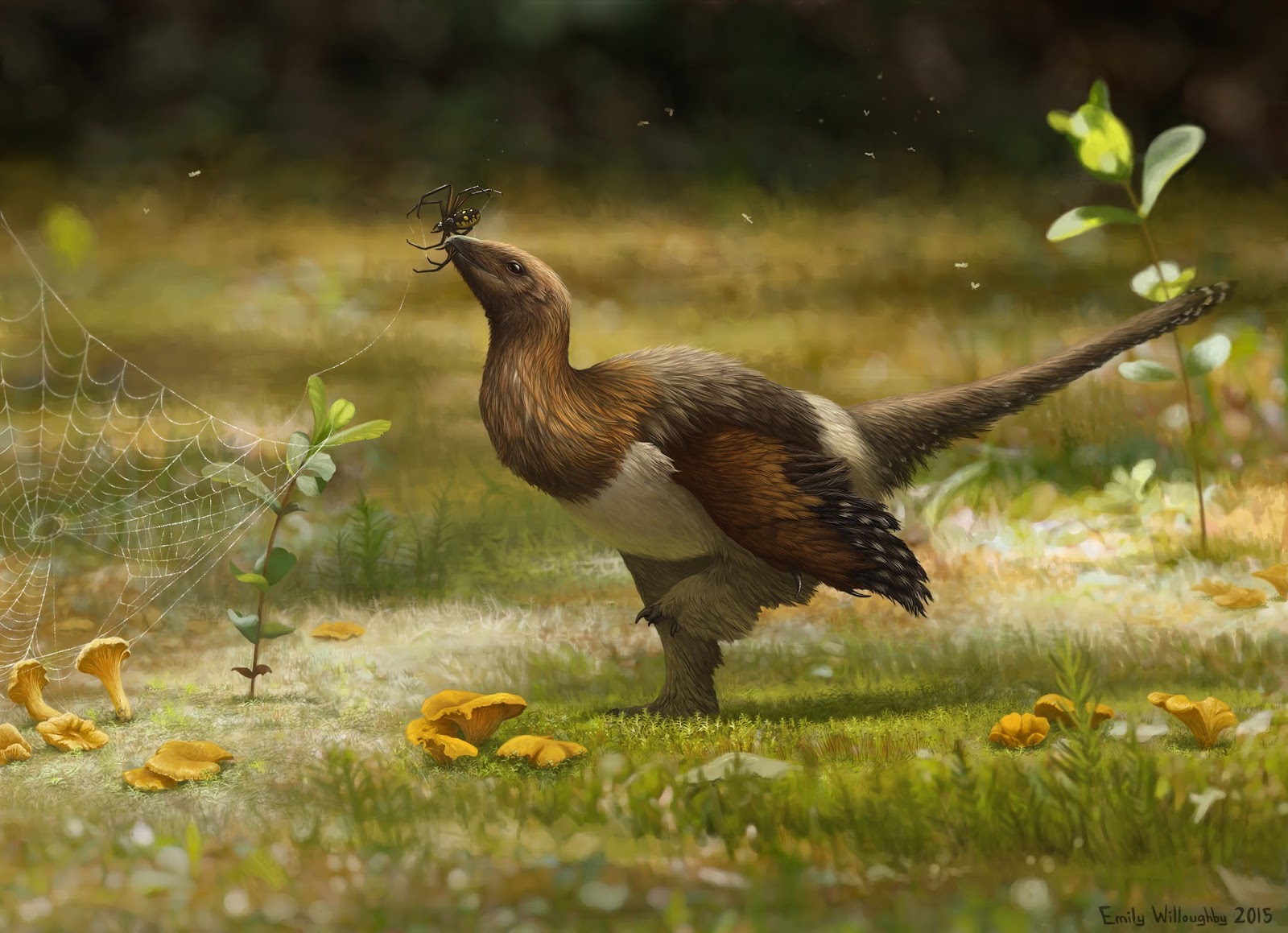
Meet Serikornis, a small troodontid whose feathers are utterly lacking in barbules. Read more at Theropoda and NatGeo. And check out the amazing Emily Willoughby illustration, featured at the end of this post as our Moment of Paleoart Zen.
New research into the famous quad-flippered plesiosaurs looks at how they might have propelled themselves through the water. Coauthor Darren Naish writes all about it at TetZoo. And do check out the video about the research down in the LITC AV Club section of this post.
Lemmysuchus obtusidens is a new teleosaurid on the scene, made to crush shells. And yes, it's named for Lemmy Koopa. Er, I mean Kilmeister. Read more from Sci News, the Telegraph, and WaPo.
Around the Dinoblogosphere
At Waxing Paleontological, Zach follows up last year's Hopeful Dinosaurs article in the wake of new research that puts Pisanosaurus in the silesaurid bucket.
Head over to the New York Times, where Asher Elbein has written a great piece on the ongoing saga of the tangled dromaeosaurs of The Utahraptor Project.
You probably like dinosaurs. Otherwise, why are you here? If you like the world-famous LEGO brand of construction bricks too, boy howdy do you want to see Gareth Monger's latest Pteroformer post.
Lisa Buckley's back with another post from the field, in which she discovers her first Cretaceous bird tracks.
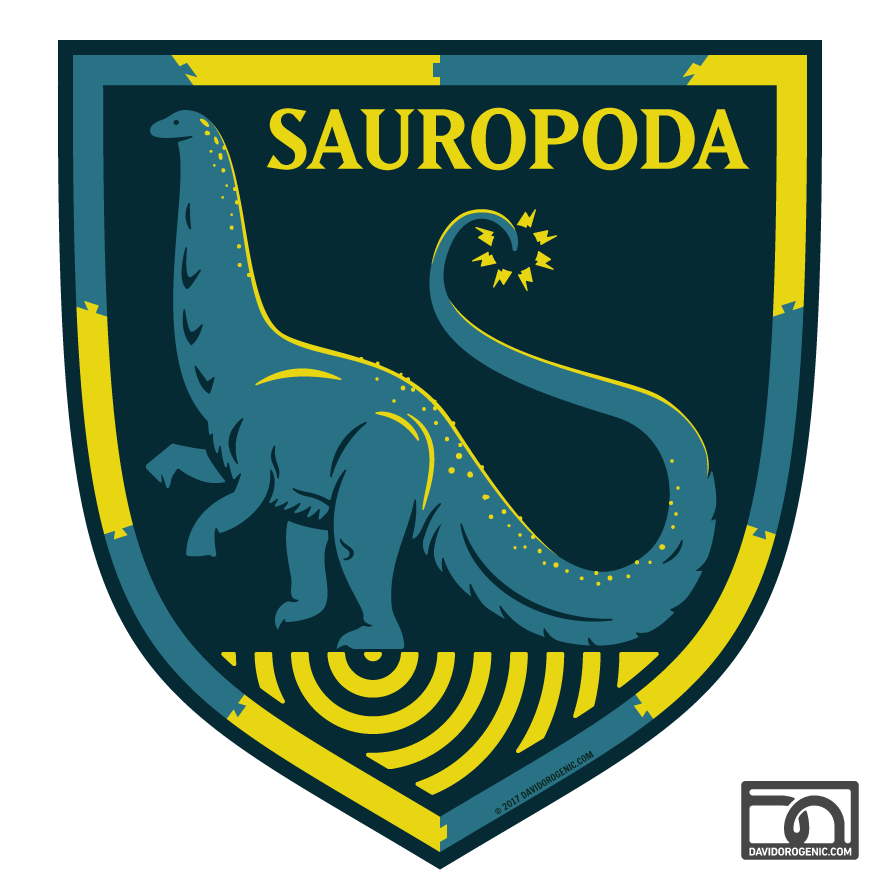
Hey, I got back into the dinosaur heraldry game a little while ago! Here's my Sauropoda family crest design, featuring a Brontosaurus rampant. I have some ideas for others but haven't had the time to really figure them out. But the 'pod lovers are covered. Available on tees, mugs, stickers, and more at my Redbubble Shop.
The LITC AV Club
Draw a coelocanth with Brian Engh!
Listen to Memo Kosemen and Joschua Knüppe talk paleoart!
Luke Muscutt talks about the awesome new plesiosaur locomotion research!
July! That really was a month, wasn't it? A mellow month after the sturm und drang of June, but still plenty of fun to be had, so let's start having it.
In the News
Razanandrongobe sakalavae is a new, giant notosuchian from Jurassic Madagascar. Learn more about this fearsome beast from Jon Tennant at PLOS.
Straight out of the nineties: fossils that have been in the Royal Tyrrell Museum since 1993 and 1996 have received new attention, found to be a new species of troodontid. Read about Albertavenator curriei at Live Science.
The earliest neornithine bird, Vegavis iaai, was recently the subject of osteohistological research, offering confirmation that it was a diving, foot-propelled bird. Read more from Fernanda Castano at Letters from Gondwana.
Paul Pursglove writes about Wukongopterus lii, now on display in the Dinosaurs of China exhibition at Wollaton Hall, at the Pterosaur database blog.
At the RMDRC blog, Anthony Maltese shares the story of finding a tyrannosaur's ass. Glamorous field work alert!
One of the most enduring questions about theropods -especially non-maniraptorans - is how they used those often small forelimbs. "T. rex trying," anyone? Duane Nash takes a critical look at some of our prevailing assumptions and comes up with some pretty satisfying counterpoints.
Rebecca Groom of Palaeoplushies fame unveiled her painstakingly crafted Yutyrannus huali art doll, and it can be yours.
The LITC AV Club
Who's ready for an hour of Dave Hone talking about tyrannosaurs? He offers a fantastic overview of the family. Pull up a seat!
As if that wasn't generous enough, there's a great Q&A portion that the Royal Institution has made available to the masses.
Not enough tyrant action for you yet? No? Well have some more: Dr. Thomas Carr talks about Daspletosaurus horneri.
Saurian is finally here! At the time of this writing, the team is simply awaiting for Steam to approve it. Here's the release trailer for the game.
Finally, Mark Witton has announced his next book, and it's a doozy. Check out his preview video!
Crowdfunding Spotlight
Diane Ramic's paleofauna coloring books are pretty wonderful, with an engaging aesthetic that allows colorers plenty of freedom to invent color schemes for the animals. Her second coloring book is being funded via Kickstarter. The campaign lasts until August 6, so hurry up and pledge.
A Moment of Paleoart Zen
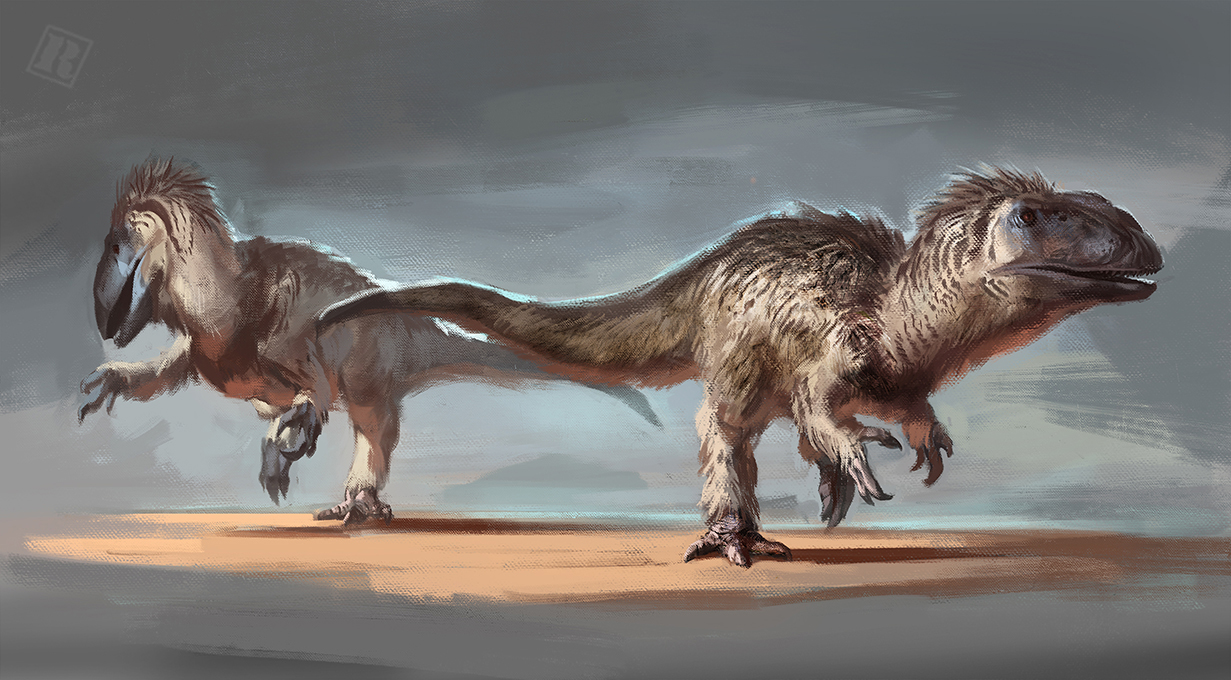
So, this has been a tyrannosaur-heavy post. Why stop now? Here's Raph Lomotan's gorgeous Yutyrannus pair.
It's kind of been an annoying month for those of us who don't think science exists to serve our personal preferences as to what prehistoric animals looked like (ahem). And if you're not into childish sensationalism in your science journalism, it's been doubly annoying. So... I made this.
I think I remember that line correctly...
In the News
Let's start with something light and non-controversial, shall we? Thank goodness for amber, that perennial benefactor of the prehistorically-inclined. The latest gift? A beautiful little enantornithe. Read more from Asher Elbein, writing for Audubon.
New research at the Cleveland-Lloyd Dinosaur Quarry, the site of a massive Jurassic bonebed dominated by Allosaurus remains, suggests a gradual deposition of carcasses over years of seasonal flooding, rather than a single catastrophic event. Read more from Brian Switek. Randall Irmis writes about iffy coverageof the research at the Natural History Museum of Utah blog.
Finally, the story that inspired a thousand online arguments. Nothing like a new paper on tyrannosaur integument to get the people talking. There has been a ton of conversation over the paper itself as well as about the typically awful hot takes from sciencey websites and blogs. Read more from Meig Dickson at Earth Archives. Mark Witton's post is particularly insightful, and I for one will not fuss too much when I concede that my recent Science March sign has been rendered - probably - obsolete.
Around the Dinoblogosphere
At Prehistoric Beast of the Week, Chris has begun reviewing dinosaur figures by Safari, starting with a snazzy Coelophysis. Love the racing stripe.
Give a listen to WICN's Inquiry podcast, which recently featured Anthony J. Martin talking about paleontology, especially ichnology and his book Dinosaurs Without Bones.
Victoria Arbour visited the "coal age Galapagos," a fossil exposure in Nova Scotia, and found some beautiful stuff. Check it out at Pseudoplocephalus.
The LITC AV Club
PBS Digital Studios has begun a new paleontology video series titled Eons, hosted by Hank Green. Here's episode one, dedicated to trilobites. Subscribe at Youtube to see what they cook up next!
The Empty Wallets Club
The contents page of Taschen's Paleoart.
In August, the publishing company Taschen will release Zoë Lescaze's Paleoart, a scholarly look at the history of artistic depicions of ancient life. You know, paleoart.
The collection provides an in-depth look at this neglected niche of art history and shows how the artists charged with imagining extinct creatures often projected their own aesthetic whims onto prehistory, rendering the primordial past with dashes of Romanticism, Impressionism, Japonisme, Fauvism, and Art Nouveau, among other influences.
It looks gorgeous, but it does cost a pretty penny.
Not the roller coaster that March was, but April's been another nifty month in matters paleontological, and that's no foolin'!
In the News
Edmontosaurus lovers, heads up. The cranium of E. regalisis the subject of a new paper in PLoS One. Brian Switek has been writing a cool series called "The Dead Zoo" for Omni, and he profiled the mighty duckbill, taking into account all of this new information we've been getting about it over the last decade.
Herman's back with a book review attack, upping one that rocks, dissing one that lacks. Hit it!
At Tyrannosauroidea Central, Thomas Carr writed about the implications of the recent publication of Daspletosaurus horneri: ontogeny and the anagenesis hypothesis.
The Royal Tyrrell Museum's speaker series continues, with a presentation on the halisaurine mosasaurs by Dr. Takuya Konishi of the University of Cincinnati.
Brian Engh revisits Aquilops in his newest paleoart video.
Crowdfunding Spotlight
Following up her portrait series on the diversity of the paleontology community, Thea Boodhoo is working on organizing a workshop on diversity at this August's SVP meeting in Calgary. They need funds to make the workshop a great experience for all attendees. Head to GoFundMe to help out.
After her successful set of prehistoric enamel pins funded a couple months ago, Jessy Smith is back with a set of Mesozic megafauna. Pledge at Kickstarter.
Well. That was a month, eh? Before we dive into this wild lunar cycle of paleontological action, I'll put out one more call: if you are a paleoartist and you haven't taken the 2017 Survey of Paleoartists, do it! It's easy and won't take too long.
In the News
Ornithoscelida. This is the name given new clade consisting of ornithischia and theropoda, according to a new phylogenetic study by Matthew Baron with Paul Barrett and David Norman. This new model proposes that the sauropodomorphs and theropods aren't quite as closely related as we've thought, with saurischia redefined to be sauropodomorpha + hererrasauridae. Many interesting implications here. Let's see how is pans out over time. Read more from Darren Naish at TetZoo, Ed Yong at the Atlantic, and Pete Bucholz at Earth Archives.
Anchiornis plus lasers! New research using the technique of laser-stimulated fluorescence has "fleshed out" the little-dinobird-that-could, confirming some hypotheses about soft tissue anatomy in paravians and throwing in some surprises, to boot (no pun intended, but the foot integument has stoked conversation online). Read more from Scott Hartman at Skeletal Drawing, Andrea Cau at Theropoda, and NatGeo.
Want more dinobird soft tissue, eh? A newly described, remarkable specimen of Confuciusornis has been found to preserve soft tissue features of the ankle and foot. "Microscopic analyses of these tissues indicate that they include tendons or ligaments, fibrocartilages and articular cartilages, with microstructure evident at the cellular level. Further chemical analyses reveal that even some of the original molecular residues of these soft tissues may remain, such as fragments of amino acids from collagen, particularly in the fibrocartilage." The authors conclude that Confuciusornis represents a transitional state between the leg posture of ancestral theropods and modern birds. Read the Nature Communications paper and the release from Bristol University.
Daspletosaurus isn't left out of the March integument madness. A new species of the tyrant, D. horneri, has been described by Thomas Carr, based on fossils that have been long awaiting description. Another new tyrannosaur, big whoop, right? Well, this one has major implications for restorations of these Cretaceous poster children. Carr and team studied an extremely well preserved specimen, determining that the face was covered by large scales like those of modern crocodiles, and had no lips. Furthermore, the face was supplied with a powerful web of nerves, making it highly sensitive. Read more from Phys Org, Science, and Eurekalert. Already lots of critiques popping up, but of course we'll have to see what pops up in further publications.
The Burmese amber strikes back. This time, mid-Cretaceous amber containing platycnemid damselflies shows evidence of courtship behavior. The insects possessed the enlarged tibiae of their modern relatives. It's a pretty stunning find, and thankfully the private collector who purchased the amber provided it to scientists so it could be published. Read more at Phys Org and Cosmos.
In the discovered-but-not-described bin, another titanic Mesozoic penguin from New Zealand. This new one is about as large as the largest ancient penguins and was found a few meters above the discovery site of Waimanu manneringi, most ancient of the proud lineage. Read more at Laelaps from Brian Switek.
New research has compared the lower jaws of a whole bunch of therizinosaurs to better understand the feeding adaptations of the various species. Read more about it from Albertonykus at Raptormaniacs.
A late Jurassic turtle has been found to have the ability to retract its neck into its shell. Read more on Platychelys from Jon Tennant at PLOS Paleo Community.
Finally, this one seemed to get buried in the press in February, so I'm including it this month, thanks to Ashley Hall calling attention to it. An absolutely gorgeous new fossil of Eoconfuciusornis from the Yixian Formation, preserving soft tissue of the ovaries and wing.
On Discover's "Dead Things" blog, Gemma Tarlach is profiling up-and-coming paleontologists. The first profile in the series is all about Sanaa El-Sayed and one heck of a big catfish.
Did you hear about all of the new coelurosaurian Monopoly pieces? A penguin, a rubber duck, and a so-so Tyrannosaurus rex. Read more at Everything Dinosaur.
Jordan Mallon shared his most-overlooked paper with Dave Hone in an installment of the "Buried Treasure" series. Read more about "Taphonomy and habitat preference of North American pachycephalosaurids" over at Archosaur Musings.
At Mary Anning's Revenge, Meaghan and Amy shared a couple of their recent paleo talks. Check out the vids, do it.
One of my favorite podcasts is In Defense of Plants, so I was extra excited to see that Dr. Caroline Strömberg stopped by to talk paleobotany. She discusses her specialty in researching phytoliths, silica particles produced by certain plants, and gives a wonderful overview of the science.
At New Views on Old Bones, Paul Barrett has been writing about an expedition to Lake Kariba in Zimbabwe, in search of Early Jurassic fossils. Check out parts one, two, and the recently published finale.
Duane writes about "the longest tenured and most successful marine tetrapod family of all time," the plesiosaurs, at Antediluvian Salad.
Some good posts on female paleontologists for Women's History Month: Learn about American paleontologist Mignon Talbot at the Tetanurae Guy and read about Mary Anning from Fernanda Castano.
The Empty Wallets Club
Comic artist Abby Howard (Junior Scientist Power Hour) announced her new book, Dinosaur Empire!, due to be released in August by Amulet Books. It looks amazing - a trip through the entire Mesozoic, with fauna that clearly is based on contemporary science. Check out her announcement comic, and then preorder it!
Dinosaur Art, the 2012 paleoart book edited by Steve White and published by Titan Books, was such a big deal that we dedicated a whole week to it. The book got a lot of press, but I think it's fair to say that LITC provided the most in-depth analysis you'll find, as each contributor to the blog provided a review, and we published an interview with White. So LITC is pretty excited that its sequel is coming this October! This time, we'll be treated to the work of Willoughby, Witton, Lacerda, Atuchin, and more.
Raven Amos has added another terrific design to her NeatoShop storefront, taking direct aim at the myopic, small-minded, backwards-thinking, and utterly annoying "science ruined dinosaurs" crowd. Science made dinosaurs awesome!
Illustrator Patrick Murphy has released his first book, an introduction to dinosaurs for kids 9 and up. Order it here!
The LITC AV Club
Wound up with more videos than usual, so why not give them their own special section?
Here's short n' sweet PBS News Hour feature on Julius Csotonyi's paleaort. Thanks to Michael Ryan of the Cleveland Museum of Natural History (and Palaeoblog) for giving big ups to paleoart.
Larry Witmer talks about a sweet, sweet Triceratops brain endocast.
The Royal Tyrrell Museum's speaker series recently featured Peter Larson, who spoke on his research tracking theropod diversity and disparity in the late Cretaceous.
Filmmaker Lexi Marsh is challenging "a lost legacy" with The Bearded Lady Project. Her 20 minute short film, focusing on Dr. Ellen Currano, debuted early this month at the University of Wyoming at Laramie. Read Carolyn Gramling's great interview with Marsh at Science. Check out the trailer above, too.
I am a fan of Joschua Knüppe's naturalistic paleoartwork, and when I saw his latest pterosaur illustration for Pteros, I immediately asked for permission to feature it here. Gegepterus changi is a ctenochasmatid pterosaur hailing from the Early Cretaceous Yixian Formation.
Gegepterus changi, illustrated by Joschua Knüppe, and shared here with the artist's permission.
Though I typically post these on the first, I'm running February's roundup a day early to make room for the launch of the 2017 Survey of Paleoartists tomorrow. Come back tomorrow to read about, and take, the survey!
In the News
Early in February, The Society of Vertebrate Paleontology spoke out against the Trump regime's hotly-debated immigration ban from nine majority-Muslim countries. Check out the full statement here.
Isaberrysaurus mollensis is a newly described primitive neornithischian from the Early Jurassic Los Molles Formation. Discovered with a belly full of cycad seeds, it was initially thought to occupy a more basal spot in ornithischia on account of its rather stegosaurian noggin. Read more from Franz Anthony at Earth Archives.
It barely missed the cut last month, so I'll include it this time. Saccorhytus coronarius is the newly discovered, 540 million year old contender for earliest deuterostome. As NPR's All Things Considered put it, S. coronarius was "basically a giant gaping mouth with spikes and some extra holes — probably for oozing waste." Sounds like I've got my Halloween costume figured out. Read more from Smithsonian, Phys Org, and CNN.
At Laelaps, Brian Switek introduces us to Keilhauia nui, a Jurassic ichthyosaur discovered in Svalbard, Norway and notable among its kin for the fact that its hips were preserved with it. Now we just need to enlist Weird Al to parody Shakira to make this story blow up.
Bulbasaurus phylloxyron illustration by Matt Celeskey, distributed with press materials for the PeerJ publication.
LITC's Asher Elbein has been a busy guy. First: his terrific piece for Audubon on how modern paleontology is harnessing the power of lasers to study fossils: in this case, research published in December on the early Cretaceous bird Confuciusornis, indicating it was capable of flight and adapted for arboreality. After that appetizer, dive into his new piece for the Bitter Southerner, in which he writes about the largely obscured history of the continent of Appalachia. Though many of the Mesozoic fossils of the eastern US are scrappy, Asher writes, "...put enough scraps together, and you can catch a glimpse of something more: the shape of a body, the shape of a forest, the shape of a land lost beneath fathomless time."
Popular Mechanics ran a brief article on the Paleobiology Database Navigator, a tool that allows users to explore fossil localities by geological timeframe, taxa, or location. It's pretty great, check it out if you haven't already.
Thea Boodhoo tells the story of her involvement with the Institute for the Study of Mongolian Dinosaurs and lays out the background of the institute's mission to raise up a new generation of Mongolian paleontologists.
Learn about the fossils of Big Bend National Park from the Mary Anning's Revenge crew. It's like... maybe public lands are super-important and worth preserving? Is that a crazy, fringe idea these days?
At Archosaur Musings, Dave Hone has launched a new series in which paleontologists discuss favorite or unsung scientific papers. He kicks it off with Mike Taylor, who writes about the process of publishing his paper with Matt Wedel on sauropod neck length.
"Scientist-led palaeoart should be the best there is," says Mark Witton, "carefully-executed, evidence-led syntheses of research conclusions in compelling artworks." So it's incredibly frustrating when paleoart commissioned by a scientist and created under their guidance fails in fundamental ways. Read Mark's full commentary at his blog.
There's a new paleontology-infused podcast in town: Common Descent.
Darren Naish shares a write-up of his talk at last autumn's Popularising Palaeontology event at King's College London. Head to Tet Zoo to read about his talk on paleoart memes. You can check out more about the workshop, including videos of the talks, at the Popularising Palaeontology website.
Did you know about Peru's Talara tar pits? Brian Switek waxes rhapsodic about their beautiful, jet-black bounty, as well as discussing some other tar pit sites that don't get the attention La Brea receives. In another post championing an unsung fossil, he gives some overdue love toTorvosaurus' smaller cousin Marshosaurus, a mid-sized Morrison predator only known from some bits of jaw and hip.
At Musings of a Clumsy Palaeontologist, Liz Martin-Silverstone is celebrating 150 years of Canadian paleontology, a rich history that kicked off with the discovery of a Dimetrodon on Prince Edward Island in 1845. Read her first post in the series here.
The Empty Wallets Club
Some juicy new books and art to pick up this month! I figure they're deserving of their very own section here. We'll see if there's enough every month to keep it around.
Some great stuff has been coming out from the 252MYA crew. Just a few recent pieces: Greer Strother's Hatzegopteryx poster. Franz Anthony's Ediacaran Biota tee. Julio Lacerda's Age of Fishes poster. I'll also note that 252MYA's licensing arm is now live, so there's literally no reason any media needs to resort to atrocious CG abominations instead of good paleoart.
Brian Engh is selling his paleoart book to Patreon supporters who pledge at the $20 per month level or higher, and if you commit to keeping that pledge level for at least two months, he'll draw a custom illustration of your choosing on the inside cover! And while you're here, dim the lights and check out Brian's second video dedicated to the dinosaur trackmakers of Copper Ridge. He also touches on gnarly injuries, the vital role of predators, the importance of public lands. Details on his book promotion at the end of the video.
It's not in the 252mya shop at the moment, but Gabriel Ugueto has added to his growing selection of Mesozoic fauna posters. Now available at Redbubble: Wessex dinosaurs and pterosaurs and one dedicated to the fauna of the Las Hoyas Formation of Spain. Dude's got a selfie next to the word "prolific" in the Merriam-Webster's.
Sharon Wegner-Larson released another great fossil-based design this month: Triceratops Rocks. Minerals, ginkgo leaves, and one of the coolest skulls of all time, what's not to love?
Emily Willoughby, Jonathan Kane, and Mike Keesey's new book God's Word or Human Reason?: An Inside Perspective on Creationismis now available. A limited number of signed hardcover copies are available from Emily for $40 through Paypal, too. The book, as you may guess from the subtitle, lays out evidence for evolution from a group of authors who were at one time creationists. Also, I had the distinct honor of designing the cover!
More from Mike Keesey, why not? I love his comic Paleocene. Set in the devastated post K-T world, the opening chapter of the comic (he completed page 20 recently) has set the stage for a story about a clan of stem-primates as they struggle for survival. It even involves issues of class. I love the writing, the color, the atmosphere... it's just great. To support him in this and other endeavors, sign on to be a patron at his Patreon page.
A Moment of Paleoart Zen
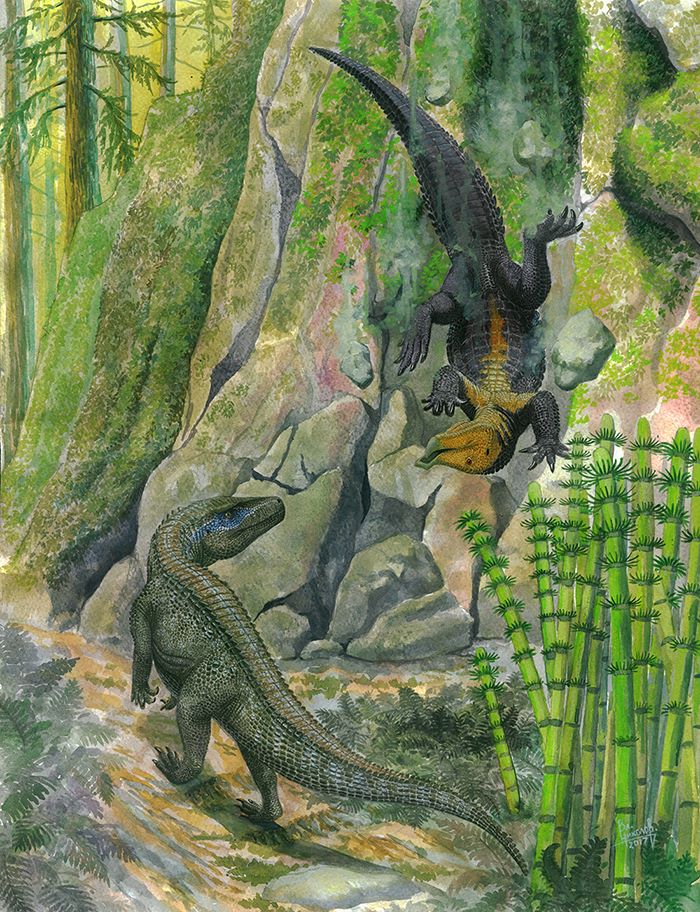
I felt like going non-dinosaurian this time around, and this terrific new illustration by Vladimir Nikolov fit the bill perfectly. At Facebook, he offers this description:
An unfortunate individual of the aetosaurian species Stagonolepis robertsoni is falling to its death, while a nearby passing Ornithosuchus woodwardi is suddenly offered a free lunch. In nature, in great many occasions, someone's loss and pain is someone else's gain. The scene takes place during the Late Triassic in what is now Scotland.
That's a wrap for February. As ever, your comments and shares on social media are greatly appreciated. And seriously, come back tomorrow for the launch of the 2017 Survey of Paleoartists!


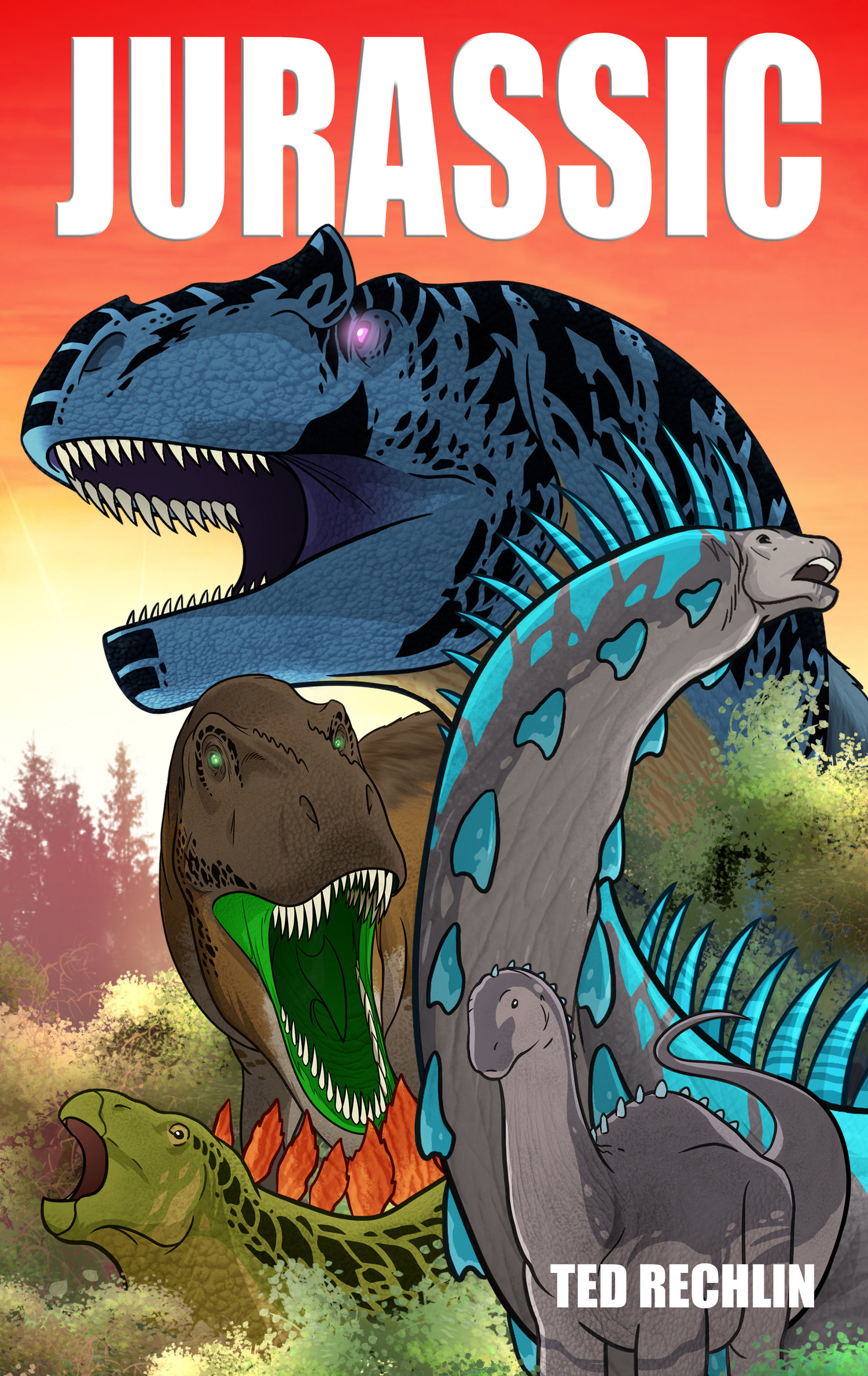
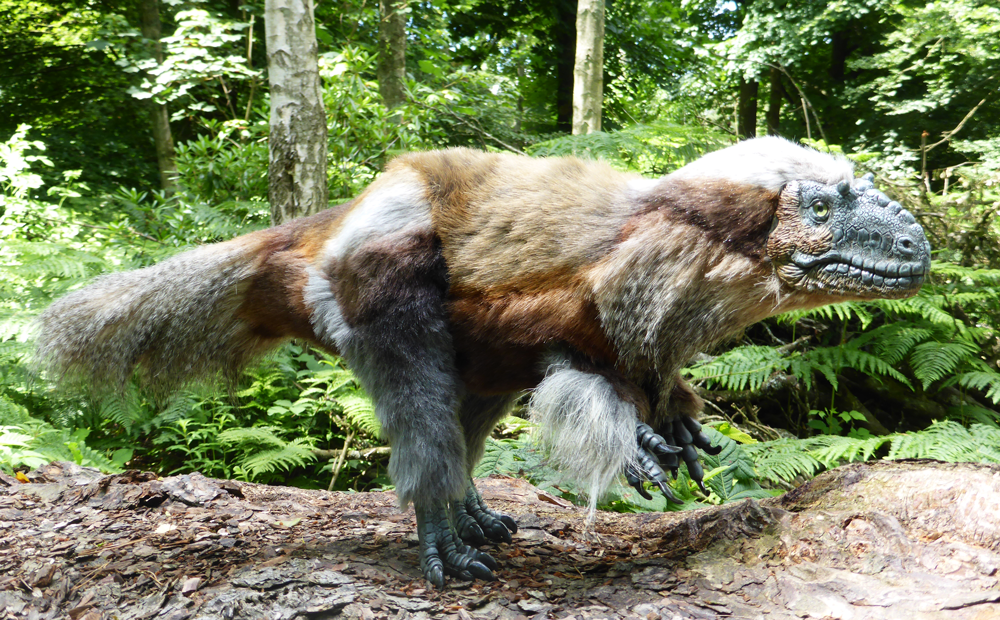
 Diane Ramic's paleofauna coloring books are pretty wonderful, with an engaging aesthetic that allows colorers plenty of freedom to invent color schemes for the animals.