Monday, January 9, 2012

Vintage Dinosaur Art: Iguanodon by Rourke

A large share of my to-scan stack is taken up by titles from the Rourke Publishing series of storybooks featuring prehistoric animals. Today, we'll look at their 1984 Iguanodon title, written by Rupert Oliver with illustrations by Bernard Long, a British illustrator who unfortunately lacks much of a web presence. But his national heritage is fitting, as this title takes place in Early Cretaceous England, which we know from the geological feature called the Wealden Supergroup.

Iguanodon cover

First, I am delighted to report the return of the tongue-lolling Iguanodon, which appeared in a recent VDA post by Marc. Here, it accompanies text explaining that the Iguanodon could smell an approaching storm, so I suppose that it's meant to be a scent organ.
Iguanodon in a storm

When megalosaurs attack, out comes Iguanodon's tongue again.
Megalosaurus 
chase

Ditto for when, in a scene perhaps inspired by Fellowship of the Ring, the Iguanodon escapes the megalosaurs thanks to a flash flood. If only Long had the cheek to shape the surging water into enraged ornithopods.

Dinosaur flash flood

In other news, those megalosaurs are of the hunchback persuasion.

Megalosaurus chase

With that bit of meme-spotting out of the way, we can proceed to the work in general. While the illustrations may not be up to the level of anatomical accuracy of Greg Paul or Doug Henderson, to pick two eighties dinosaur artists out of a hat, they're excellent quality for a children's storybook. And writer Rupert Oliver and the folks at Rourke deserve a mighty tip of the hat for considering the setting in which their prehistoric characters would live. The text describes "a vast green carpet of cycads, horsetails, and rushes," and Long mixes these in with conifers rather than simply slapping green-plant like things and anachronisitic grasses in the background.
Iguanodon

The fauna are appropriate, for the most part, including ubiquitous rhamphorynchids buzzing about in the skies (reminiscent of the great flocks of crows now making themselves a noisy part of my town's milieu) and beasts like the nodosaurid Polacanthus.

Exhausted Iguanodon

Its presence here is fitting, as the first fossils of the genus come from the Wealden strata of the Isle of Wight. If written today, this title would be more appropriately called Mantellisaurus, which is the currently accepted name for the former I. atherfieldensis since 2007, when Greg Paul renamed the animal as part of a larger trend of bringing some sense to the traditional wastebasket-taxon status of Iguanodon.

Out of place in the early Cretaceous is Megalosaurus, which will probably always be part of a matched set with Iguanodon thanks to their status as founding members of the dinosauria. Problem is, it's a middle Jurassic beast. The book could be updated to include any of a number of scrappy theropods from the Wealden, perhaps Eotyrannus (I should note that a field guide to the Wealden was recently released, reviewed last month by Darren Naish).

Rourke titles close with brief sections on the scientific background of the story, describing the history of the relevant taxon's fossil discoveries and its place on the dinosaur family tree. Here, Ouranosaurus gets a rare cameo.

Ouranosaurus

Overall, a respectable effort that sets its self apart from the glut of slapped-together dinosaur titles of the eighties. Plus, it gives us this majestic sight: the Iguanodon conga line.

Iguanodon conga line

Superb.

Previous Rourke books featured here:
Triceratops (John Francis)
Pteranodon (Doreen Edwards)
Allosaurus (Doreen Edwards)

Saturday, January 7, 2012

The inherent humor of great size differences

I haven't really publicized it yet, but my lady-wife Jennie and I have started an Etsy shop called Terrier Mountain (see, our house is on a hill, and we have 1.5 terriers). We have some linocut and letterpress stuff up right now, and I'm in the process of figuring out a good way to produce high-quality prints of my illustrations. I've had great results with a high-end Epson printer using their line of pigment-based archival quality inks, but it's a school printer and thus not available to me for my "commercial" work. As soon as I figure out a good direction, I'll be adding a bunch of digital illustrations, and maybe photographs, to the shop.

Among this work is a set of cartoony illustrations I conceived as the sort of thing I'd want to hang in a nursery. Although I didn't put this much thought into the project when I started drawing, it sort of makes sense: beyond the simple style and bright colors, they call on that essential component of kids' dinosaur obsessions: they were freakin' big. Here are the first three.

First, we visit the late Cretaceous of Mongolia, where a curious Shuvuuia seems to have awakened a grumpy Protoceratops by jumping up on his back.

Shuvuuia and Protoceratops

Then on to late Jurassic Africa and the Tendaguru formation, where a young Giraffatitan is being buzzed by a lil' rhamphorynchid.

Rhamphorynchus and Giraffatitan

Finally, a pair from the Tithonian: Allosaurus and Anurognathus. This was the first one I did (accounting for the different proportions, which will be normalized for the final product), and my friend Gatis made an observation that it was funny because of the unimpressed expression on the allosaur's face. Because of that, I changed my Giraffatitan so it wasn't smiling. I think he was right about it.

Allosaurus and Anurognathus

I have some ideas for the next one. But today I had an idea: I've been lucky enough that I've had a few people turn my silly ideas in to illustrations, so I figure it's time to start paying people back. In the comments below, feel free to suggest pairs you'd like to see me do in this style. As you can see, I'm trying to represent a diverse group of animals, and I'm trying to keep them at least roughly contemporaneous. Pairs from the same formation get precedence. I can't promise I'll do every suggestion as my semester starts up this week, but I'll do what I can! Have at it!

Friday, January 6, 2012

Mesozoic Miscellany 49

This week, we mourn the death of Dan Varner, a regular fixture of the dinosaur mailing list and a fine paleoartist whose work for Mike Everhart's Oceans of Kansas is some of the best work on Mesozoic sea life I've ever seen. Read Tributes from Nobu Tamura, Matt Van Rooijen, Jaime Headden, David Maas, ART Evolved. ART Evolved has also announced that in May, their gallery will be a tribute to Dan. Everhart's Oceans of Kansas website has hosted a Varner gallery for while, which has been updated to include a touching tribute by his friend Bruce Schumacher. Condolences to all of his friends and family.

One thing I love about this brave new on-line world, as should be clear to long-time LITC readers, is the proliferation of all stripes of paleontology-inspired artwork. French artist Alain Bénéteau (dustdevil at DeviantArt) is one of many artists who are generously sharing a great diversity of work. He produces restorations of ancient ecosystems, ink drawings, and comics, all worthy of your attention.

This year, Indiana University Press, as part of their continuing Life of the Past Series, will release Sébastien Steyer's Earth Before the Dinosaurs, illustrated by Alain.

See more of Alain's work at his site, Paleospot, and follow him under that same name on Twitter.Here's the latest in his "Archie Tales" series, which applies a bit of Chuck Jones logic to paleontology, funny little just-so stories that give alternate explanations for strange fossils like Mononykus. Click to make it big enough to read.


Gary of Project Drypto has begun a new blog, Jersey Boy Hunts Dinosaurs. Today, he writes about the odd 1998 Jurassic Park PC game Trespasser. Ah, the joys of trying to stack boxes with Minnie Driver's stiff mannequin arms...

You may recall that Dave Hone and Darren Naish recently teamed up on a paper which looked at the possibility of mutual sexual selection in pterosaurs and dinosaurs. This week, both have addressed the topic on their respective blogs with Hone writing about theropod sociality at Archosaur Musings and Naish writing about the research in general at Tetrapod Zoology.

Obviously confusing me with someone more esteemed than myself, Heinrich Mallison kindly linked to LITC in a recent post at Dinosaurpalaeo, in which he shares some architectural archosaurs decorating, oddly enough, the Berlin Aquarium. He reckons that their use hearkens back to a time when the affinities of dinosaurs were less understood than they are today. Regardless, they're pretty amazing works of art.

Speaking of amazing works of art, you must see Jenn Hall's Auroraceratops, illustrated for Dr. Peter Dodson.

Andy Farke reviewed the new fossil species described in PLoS One in 2011, and shares a wishlist for 2012.

You may recall a recentish bit of research which analyzed the scleral rings of a number of dinosaurs to infer which times of the day they may have been most active. At Green Tea and Velociraptors, Jon Tennant digs into the ongoing debate about the work.

At the blog Raptormaniacs, Albertonykus has posted the results of a poll regarding the favorite new maniraptor of 2010, which went to, little surprise, Balaur. Head over and vote for the best of 2011.

If you're as big of a geek about historical paleontology photos, be sure to stop by the Prep Lounge to see pictures from the '30s when the Works Progress Administration put people to work prepping fossils in Texas.

The recent description of Spinops, based on fossils that had been collecting dust at the British Natural History Museum for years, inspired a satirical Gawker article. Mark Wildman muses on the sometimes long gap between a fossil's excavation and preparation at Saurian. Hylaeosaurus is closing in on almost two centuries, he notes.

The Dinosaur Toy Blog previews new toys the Bullyland company has in store for 2012, including a hilarious, pop-eyed Spinosaurus.

Finally, Brian Switek reviews a book about paleoart icon Charles R. Knight at Dinosaur Tracking. Charles R. Knight: The Artist Who Saw Through Time is both a coffee-table book of Knight art and a biography. It includes humanizing insight into the man, causing me to wonder how well he'd get by in today's web culture. "Knight refused to have collaborators and rejected almost all criticism. He wanted to hear only scientific corrections from Osborn, and he frequently argued with Osborn about critiques others made of his paintings."

Thursday, January 5, 2012

Bird Day!

Today is January 5, and I apologize for not providing advance notice that it is Bird Day. Honestly, I had no idea until my buddy and fellow bird enthusiast Keith Collins shared a link on Facebook. So I'm making up for it by posting here, as well as sharing amazing bird photographs on Twitter via the #BirdDay hashtag. Follow along and I'll keep the pix coming for as long as I'm at my computer today.

Here's a recent illustration of me very own, of one of my favorite extant avian theropods, the Short-Eared Owl.

Short-Eared Owl

The Short-Eared Owl is one of the few owls that hunts in fields. Steve Gifford, one of my favorite bird photographers and a fellow Hoosier, has taken some absolutely stunning photos of them at abandoned strip mines, where they congeregate to hunt around dusk.

Short-eared Owl by Steve Gifford
Photograph by Steve Gifford, via Flickr.

Maybe you're new to this blog, and you're thinking "why in the heck is he posting about birds on a dinosaur blog? What's next, a lemon curd recipe?" Well, no. I'm not going to be posting about lemon curd (unless there's a lemon curd manufacturer who uses a dinosaur as a mascot or something like that). The reason I post about birds here is because birds are the dinosaurs who were lucky / resourceful / adaptable enough survive the end-Cretaceous extinction event. They are the standard-bearers for the proud archosaurian lineage that ruled the planet for hundreds of millions of years.

I've said this before here, and so has Marc. The bird-dinosaur link is one of those things I've begun to take for granted, among other bits of paleontological knowledge, such as "marine reptiles and pterosaurs weren't dinosaurs" and "Stegosaurus and Tyrannosaurus were separated my as much time as Tyrannosaurus and humans." But this is because I spend so much of my time on-line reading paleontology blogs and perusing paleoart, all made by fellow enthusiasts who make up the tiny percentage of folks who pay attention to this science and retain the knowledge of it. In truth, we can't afford to take any of this for granted.

That last bit sounds a bit dramatic, but I think it's true. The most important aspect of dinosaur paleontology, with the most potential for public education, is arguably the bird-dinosaur link. I recently had a conversation with a fellow student, a really sharp and with it person, about my still-incomplete (sadly) printing project dealing with the fossil record of feathers. I touched on the evidence for the theropod origin of birds, and she said with a nod something like "I've heard about that. Like pterodactyls, right?" This is an isolated incident, but I know for a fact that she's closer to the general knowledge level about paleontology than I am. Next time I see her, I'll try to figure out if she retained any of our conversation. Or if I should just cry into my pillow.

Anyhow. Go hug a bird, or at least look at it admiringly. Donate some money to a bird cause of some sort, for instance the Indiana Raptor Center. Read a bit about dinosaur to bird evolution (here's a great, brief summary from DinoBuzz). Make excruciating use of "making a flap" and "ruffling feathers" in your conversations today. Or come up with your own ways to celebrate birds. I've got more photos to tweet!

Tweet! Get it?

Monday, January 2, 2012

Vintage Dinosaur Art: The Reign of the Dinosaurs

This New Horizons title from 1992 caught my eye on eBay - I will confess - because the cover illustration is very, very strange. That is one terrifying-looking tyrannosaur - bordering on surreal, actually. Expecting more weirdness inside, I snapped it up only to find that, in fact, it contains a great deal of stunning artwork. Why the publishers chose to stick such a bad piece on the cover (clearly by a jobbing illustrator - spot the Sibbick reference) given what's presented inside the book is anyone's guess.


Alongside some well-worn art from the likes of Burian, Zallinger and Parker (pretty much all of which has been featured here before), this book features stunning work from, in particular, Mark Hallett and Eleanor Kish. A couple of the pieces included - a cryptically-camouflaged Hypacrosaurus by Kish and a rather dead Triceratops being picked over by mammals from Hallett - have already been looked at by David. However, there's a lot here that's new to LITC.

There is one thing I need to get out of the way, however, before we begin with the good stuff.


Wah-waaaaaah. Oh, the 1980s (or, ahem, early '90s)...

Never mind, though - here comes an amazing artwork from Mark Hallett (with apologies for the big ol' page fold - this is a small book).


When I first stumbled upon this in this book I couldn't quite believe my eyes. This is from the 1980s!?! Holy crap! The only possible explanation for such excellence is that Hallett is in possession of a TARDIS. The theropod in the centre of this scene (Rapator - a possible allosauroid known from very fragmentary remains) has correctly-orientated forelimbs, the brachiosaurs have accurate hands and feet, and most astonishingly of all the little theropod in the foreground (Kakuru, again known from very fragmentary remains) appears to have a protofeather coat. Just stunning. I can't quite believe that this painting didn't feature in more dinosaur books in the early '90s.

More recognisable is this piece from 1986, entitled Crossing the Flat. It depicts everyone's favourite disproportionately long-necked sauropod Mamenchisaurus. Not a lot to say about this one - it's beautiful, though.


Eleanor Kish, for her part, also contributes a number of pieces that are very beautifully painted, even if they haven't aged as well as Hallett's.


Her reconstructions are excellent for the 1980s, and apparently she went as far as to create models of the animals' skeletons, reconstructing them in 3D before moving on to the painting at hand. Even if this Saurolophus looks a little dated now (and the swan-necked plesiosaur merrily paddling along in the background is particularly unfortunate), Kish is superb at believably placing her animals in environments in such a way that they look like part of the ecosystem, rather than obviously being the centre of attention. The book quotes Dale Russell as saying that Kish creates "images of landscapes [palaeontologists] can never see".


This Daspletosaurus (shown scaring off a champsosaur) does have a notably peculiar head - it's a bit of a shrink-wrapped skull with huge eyes. Still, I wouldn't mind having this painting on my wall - just drink in that lush scenery.


Finally, here's a particularly bleak scene from Kish entitled Chasmosaurus, with the titular ceratopsian's corpse being picked over by two small maniraptoran theropods (it's difficult to tell whether they are dromaeosaurs or troodonts, although they are probably the former). Apart from being naked (of course), the theropods do look very, very skinny, although one could argue that, given the context of the scene, perhaps they are starving. The weird, pointy protuberance of the pubic bones seems to be something common to Kish's dinosaurs. Still, this is a highly evocative and desolate scene. In the book it's included in the chapter on the K/Pg extinction event. Of course the painting could not be set at that time, but rather about ten million years before, given that Chasmosaurus is known from the Dinosaur Park Formation.

Wednesday, December 28, 2011

My first LITC year: a retrospective & look forward

Dear cherished readers,

The first year in which I've participated in the Love in the Time of Chasmosaurs jamboree is nearly at an end. As such, I've decided that a short, not-at-all-disgustingly-self-indulgent retrospective is in order.

(You might think it'd have made more sense to do it on the first anniversary of my joining the blog. And you'd probably be right, but now just feels like the right time, damnit.)

Writing for David's blog has been lots of fun, obviously, and I am very grateful for the opportunity. If nothing else, it's given me something to do now that I've left university and my social life has all but vapourised.

When I look back on 2011, it will be with fond memories of such world-shaping events as the Terrible '90s Dromaeosaur Face-Off, the ultimate example of abuse of hindsight. It's only a matter of time before the competition's winner, 'Zombienychus', becomes the star of his own TV documentary series, motion picture, and toy range (I plan on pitching the latter to Schleich). My graduation ceremony pales in comparison...


The chance to nitpick the fine efforts of CG artists, programme writers and John Hurt ("Des-platter-saurus!") for a wide(ish) audience of internet geeks was one that I truly relished - and I don't think I did too bad a job, with only a few cock-ups (including what was, in retrospect, a completely inexplicable disliking of the term 'oviraptorid'). One of the show's writers and directors even dropped in for the first review, which was a very humbling moment for me (people read my nonsense?!?). In the end I very much enjoyed Planet Dinosaur, and am hoping for a second series - its focus on the Actual Evidence was more refreshing than an ice-cold power shower to the face.

I'll also take credit, if you don't mind, for making Niroot Puttapipat such a blog staple that we should probably introduce a tag for posts that mention him. In case you missed it, his latest saurian work was a rather brilliant festive Parasaurolophus illustration. Also, I got a birthday present that was hand-painted by him and therefore better than yours. Neener-neener-ner-ner.

Most of all, thanks to all of you, the readers, for sticking by, even through posts about toys, crap robots, more toys, more crap robots, my undergraduate thesis, "perversely bizarre" books, and the Netherlands. Hopefully I've provided some decent between-meal blogging snacks to David's main courses.

Here's to 2012, then. What will the new year bring? Well, a few weeks back we received an e-mail from a chap by the name of Jay Epperhart. Quoth Jay:
"So occasionally you will make a quip along the line of 'can you believe they ['80s and '90s authors/artists] thought dromaeosaurid theropods had non-feathered pronated hands *snicker*" and I'm like 'wait, what?!' since that it what my 10-year-old self memorized."
Jay cordially suggested that one of us cough up an article all about how dinosaur reconstructions have changed since the '90s. David suggested that I should handle it. Which I will, as soon as I can think of something to pad out the article that isn't related to theropod feathers and forelimb posture.Your ideas are welcome for that one...

There will also be plenty more Vintage Dinosaur Art from me, of course. My scouring of eBay and charity shops for crummy old books is ongoing.

'Til then, thanks very much once again for all the support and comments since May, and I'll see you in 2012. Here's a photo of me looking confused on a Dutch woman's bicycle for your amusement.


Tuesday, December 27, 2011

How to Name a Dinosaur (SciAm Guest Blog repost)

A year ago, I wrote a guest post for the Scientific American guest blog, called "How to Name a Dinosaur." Still kind of tickles me that I have my name associated with SciAm, even if it's such a minor way. So, here it is again.

You had no reason to expect a good weekend as you began a long-dreaded yard project. Come Monday morning’s office discussions of sporting events and parties, you would be nursing an aching back. But with a single strike of your shovel, your yard gave you a story to top any tale of drunken debauchery recounted over cubicle partitions: waiting less than 20 inches under the sod was a fossilized femur that hadn’t seen the sun in 120 million years.

Since plausibility has already been pretty well throttled, let’s say that in the kind of radically simplified form of paleontology children’s books employ, scientists from a local museum immediately recognize the bone as belonging to a dinosaur that is brand new to science. In a savvy move thought up by the museum’s public relations office, you will be given the honor of naming the beast. It’s a heavy burden, and you recognize quickly that it’s going to require careful deliberation. You don’t want your dinosaur to be laughed off of the paleontological stage, after all.

The name a dinosaur is given is subjected to the same scrutiny as the description of its skeletal remains. It’s a minefield, and there are many ways the unwary can go astray. A shaky grasp of latin might result in incorrect pluralization or an awkward suffix. Noble dedications to local culture and language can be misspelled. Worse yet, it might just sound silly. Avoid all of these, and your name still might be brushed off because you were too conservative.

As a first step, you might narrow down your choices depending on the kind of dinosaur you're naming. No matter what kind you've got on your hands, there is likely an informal signifier in the form of a suffix to its generic name. For an ostrich-mimic, you might choose -mimus. A herbivore with a beaked, horned, frilled skull receives a -ceratops. For a dromaeosaur, -raptor works nicely. To get across the tenacity of a predatory theropod, -venator sounds really cool. A relative of Baryonyx or Spinosaurus might pay tribute to the crocodiles its snout resembles with -suchus. Sauropods work well with -titan. To play it safe, choose the truly classic dinosaurian suffix, -saurus.

Generous fellow that I am, I’ll provide further guidance in the form of three broad categories which apply to most dinosaur names. Individual examples can bleed between them, of course. Since we’re about to turn the corner into 2011, I’ll also use the opportunity to employ some of my favorite dinosaur names of 2010 as examples. One note before I start: for brevity’s sake, I'm only giving advice for the generic half of the Linnaean binomial, in other words, the Tyrannosaurus but not the rex. You're on your own when deciding on a specific name. If you're stuck, name it for your mom, and you'll do alright.

Stick with Tradition

The 19th century scientists who founded the discipline of paleontology as we know it often stuck to simple anatomical descriptions of the fossilized creatures they examined. Gideon Mantell kept it basic with his Iguanodon, “iguana tooth.” Since he only had teeth to go on, we can’t fault him for lack of imagination. 1838’s Poekilopleuron simply means “varied ribs.” Joseph Leidy, the founder of American paleontology, chose Hadrosaurus as the name of the world’s first mountable dinosaur skeleton. It means “bulky lizard,” which is accurate, if not terribly evocative. 2010 saw the introduction of a few anatomically-named dinosaurs, such as the abelisaur Austrocheirus, the “southern claw.” Pneumatoraptor, from Hungary, was named for the tiny air pockets infusing its scapulocoracoid.

Considering the classical training of the early paleontologists, many of them had a firm grasp of mythology. Edward Drinker Cope’s Laelaps was named for a tenacious dog of Greek mythology - unfortunately, a mite had already been given the name, and it’s now the “tearing lizard,” Dryptosaurus. One of my favorite mythologically themed dinosaur names of recent years is the brachiosaur Abydosaurus, whose skull was found with four cervical vertebrae near the Green River at Dinosaur National Monument. Its name refers to the town of Abydos in ancient Egypt, where the god Osiris’ own head and neck were buried in the Nile. Instead of providing insight into the anatomy of the great beast it was given to, the name tells a story about its discovery millions of years after it walked.

A third subset of traditional names is to pay tribute to another researcher, fossil hunter, or someone else who was instrumental in the discovery of the dinosaur or the field in general. This is normally done in the specific name, but entire genera are occasionally dedicated to one person, as in the ornithischians Othnelia and Drinker, honoring the prolific rivals of the Bone Wars. Just this month, a North American troodontid named Geminiraptor saurezorum was announced, and both halves of the binomial are dedicated to a pair of scientist sisters named Suarez. If you’re familiar with matters astrological, you might correctly guess that they’re twins.

Go Native

If you want to be cutting edge, jump on to the growing trend of paying tribute to local places, culture, and history. It’s a heartening trend, as paleontologists often rely on locals for support of their work, and it counteracts the old stereotype of paleontologists ripping fossils from the ground for the enrichment of far-off institutions. And it engages cultures in ways that sticking stubbornly to Latin and Greek can’t. While the names of new dinosaurs coming out of China may confound the tongue of someone from Helsinki, Buenos Aires, or Des Moines, Chinese kids probably appreciate having dinosaurs of their own, such as Mei long, the “sleeping dragon.” On the other hand, local tributes can result in clunkers like this year’s dynamic duo Koreanosaurus or Koreaceratops, which recieved a fair amount of web snark.

This year has seen plenty of good newcomers in this category, though. A few of them paid tribute to the cultures who first inhabited the American West. Two of these derive from the Navajo language. Seitaad is named for a mythological beast that swallowed its prey in sand dunes, which also alludes to the manner of the small sauropodomorph's death. Bistahieversor’s name is derived from a Navajo description of local geography. The Zuni people have their own dinosaur as well, a duckbill named Jeyawati, which means “grinding tooth” in their language.

One of the most inspired members of this class of dinosaur names comes from Romania. When I first read about it, it sounded like some beast out of Tolkein’s Middle-Earth. But the island-dwelling theropod Balaur bondoc refers to actual mythology with a decidedly local flavor. It’s standard for descriptions of dinosaurs to include sections on the etymology of their names, but Balaur’s is exceptional, exploring the twisting roots of the word’s various meanings that approach the evolutionary tree of life for richness and complexity. Lead author Zoltan Csiki writes that Balaur’s name is “motivated both by the classical association between dinosaurs (especially theropods) and dragon-like creatures, as well as by the fact that balaur is a mythological creature with links to both reptiles (snakes) and birds (wings)...” Who knew that reading the description of a dinosaur could also be a lesson in Romanian mythology?

Make a Splash

It’s part of a paleontologist’s job to focus on the deep past, but some also think forward to the public impact of their discoveries. Lately, University of Chicago’s Paul Sereno has seemed especially focused on the public-relations side of paleontology; in 2009, he unveiled the controversial Raptorex, which might be mistaken for the name of a Pokemon character, as well as a slew of Mesozoic crocodilians with nicknames like BoarCroc, DogCroc, RatCroc, and the unfortunate PancakeCroc.

This year, even a mild-mannered iguanodont received an impactful name in Iguanacolossus. But 2010 will truly be remembered as the Year of Ceratopsians, and some of the catchiest new names come from the beak-and-horns set, including Medusaceratops, Kosmoceratops, and Mojoceratops.
One of my favorite dinosaur names of this year or any other is Diabloceratops, which describes the fierce twin horns protruding from the back of its frill and is just plain fun to say. If he was writing Jurassic Park today, I imagine that Michael Crichton would be strongly tempted to include a Diabloceratops paddock on the island.

A Final Word of Advice

Go bold. Shoot for a word that will make some emotional impact. A dinosaur’s name is often the first impression it will present to the public. Though the standard pantheon of the most popular dinosaurs - you know, the ones even my grandmother can name - has been in place for a century, it’s always susceptible to invasion by a charismatic newcomer, as was proven by Velociraptor’s leap into the public consciousness in the 1990’s. If a novelist, comic artist, or screenwriter latches onto the name of your dinosaur, it could very well be fast-tracked for celebrity.

Above all, remember that the name you choose for your backyard discovery will say as much about you as it does about the bones in the museum.


Illustration copyright Matt Van Rooijen, used with his permission.

Monday, December 26, 2011

Vintage Dinosaur Art: Nebula to Man

In all of my poring through Google Books, Project Gutenberg, Open Library, Biodiversity Library, and any other source for nifty historical texts relating to dinosaurs, my favorite find yet may well be Nebula to Man, Henry R. Knipe's poetic recounting of the history of life on Earth according to the best scientific knowledge at the turn of the 20th century. As to why he chose to write in this form, Knipe explains,
To attempt a work of this kind in rhyme is, I know, a bold experiment. But, however severely scientific in some of its aspects, the story of Geology is truly the most enchanting story in the world; and rhyme may well be regarded as an appropriate form in which to present it. Indeed it is a fit theme for presentation in a much higher form than this, and we may well hope that some day it will be taken in hand by some great poetic genius.
Accompanying this poetry are a series of black and white and color illustrations by a variety of talented artists, and like last week's feature about Eva Hülsmann's illustrations, they are refreshingly original.

There is not a wealth of information about Henry Knipe online. In a Cambridge University obituary, Knipe is said to have worked for the British Museum, overseeing artistic reconstructions of extinct animals. To illustrate Nebula to Man, Knipe employed Ernest Bucknall, John Charlton, Joseph Smit, Lancelot Speed, Charles Whymper, Edward A. Wilson, and Alice B. Woodward. I'll share illustrations from those who were included in the Mesozoic chapter.

I'll start with Dutch zoological illustrator Joseph Smit, who provides a bunch of dinosaurs for Knipe, including a "Brontosaurus" pair which are presented in a fairly conventional way for the time: tails dragging, bound to the water's edge.

Nebula to Man

Smit's Iguanodon reflects the new thinking about the iconic ornithopod since the discoveries in Bernissart a couple of decades before this publication. While drawn from a different angle, it bears a debt to an earlier one by Alice B. Woodward.

Nebula to Man

Knipe would have been remiss not to include Archaeopteryx in the book, and Smit was the man tasked with the reconstruction. He pairs it with Compsognathus, the small German theropod used by Huxley to illustrate the similarities between birds and dinosaurs. This one is pretty tubby. His urvogel wears a vulture-like fringe around a bear head and neck, and for the second week in a row we have an awkwardly rendered wing with feathers extending from the wrist rather than digit II.

Nebula to Man

Smit's Ceratosaurus is leaving something behind for Tony Martin, as well as keeping the little furry things in check. The influence of Marsh's skeletal reconstruction is evident.

Nebula to Man

Smit's finest contribution is this new take on a pair of early American dinosaurs: "Laelaps" or Dryptosaurus and Hadrosaurus. His lively theropod is influenced by the Charles R. Knight classic, and I love the way it's throwing itself into this assault against a much larger foe. Kind of like my in-laws' chihuahua Carlos, who has never liked me and never hesitates to give me a piece of his mind.
Nebula to Man

Lancelot Speed provided a number of color landscapes to the book, but only one for the Mesozoic era. It's a moody Triassic marsh, in which the sauropodomorph Anchisaurus nabs a tasty, if uncharacteristically meaty, snack while the phytosaur Belodon glowers from the shadows.

Nebula to Man

My favorites are from Alice B. Woodward, already an established book illustrator. Her father worked for the Natural History Museum, and may have been her connection to Knipe. Her Pteranodons are remarkable, especially considering when they were done. A little bit man-in-suity, but still a treat. It looks like she's connected the crest to the rest of the body with muscle, as we've seen John McLoughlin do with Triceratops.

Nebula to Man

Here's her version of the nodosaur Polacanthus, which is pretty croccy.

Nebula to Man

Woodward provides the second set of sauropods in the book, in this illustration of Diplodocus and Ornitholestes, which draws on the same instincts that make her book illustrations so compelling. The little theropod is our stand in, amazed at the sight of the two sauropods passing by. This may well be the first life restoration of Ornitholestes, being about ten years before Knight's meme-starting version. The only earlier representation I've seen is the skeletal in Osborn's description. Please do correct me if I've missed another.

Nebula to Man

Finally, I'll share some illustrations by Charles Whymper, who isn't notable enough for Wikipedia but did some stunning work for Knipe's epic nonetheless. First, one of the most bizarre depictions of Megalosaurus this side of Hawkins. It's positiveley sauropodomorphish.

Nebula to Man

He contributed two fine pterosaur plates; the first includes Scaphognathus crassirostris in the lower left, in a variation of the classic pose. Dig that hairy soaring Rhamphorynchus, too.

Nebula to Man

As if that's not enough, Whymper also has a color plate in Nebula to Man, depicting a Dimorphodon swooping in on a Teleosaurus hunting "duckbills." As far as I know, this would have been a completely speculative inclusion a century ago. Since then, monotremes dating back to the Cretaceous have been found, but this is still an anachronistic scene. Still, beautiful stuff.

Nebula to Man

Regarding the text itself, it probably deserves a post of its own, and maybe it will be lucky enough to get one. I'll end this post with his closing, which is ironically placed right after a section extolling the virtues of the British Empire.
All, all is change, not e'en the studded sky
Has held its jewels from all eternity.
And these, not formed for ever from the past,
Will cease, in time, their lustrous lights to cast:
And other orbs, as bright, will fill their place,
And with new light illumine endless space.
So must our earth, part of a common fate,
Sink in its turn, cold and inanimate;
And to its sun, burnt out, once joined again
Be borne through space, and at Fate's call remain.
And must the spirit of the life here spent
Sink with the scene of its development?
Is all the work around, by Nature wrought,
A passing show, destined to end in naught?
But here to things unknown we vainly press,
And man, bowed down, feels all his littleness.
Yet seeing mystery is in things that be,
He ploughs his way in hope, and reverently.
And though old myths and legends must decay,
And like old forms of life slow pass away ;
Hope still will stand, unnumbered with the dead,
To breathe of worlds, whence pain and death have fled,
Where peace prevails, and Life is perfected.

The rest of the Mesozoic era scans from this title are in the Vintage Dinosaur Art group at Flickr. You can read Nebula to Man for yourself at Google Books or Open Library. The OL scan is much better, but I didn't come across it until I had already ripped these images and uploaded them. And a tip o' the cap must go to Mark Crowell, who has featured this title on his vintage dino book website.

Saturday, December 24, 2011

And a Brachiosaurus in a fir tree...

Niroot missed the deadline for Brian Switek's nifty roundup of dinosaurs on Christmas trees, so I'm posting it here. This is his wonderful Sideshow brachiosaur hatchling, nestled cozily in its egg and surely dreaming of the Mesozoic version of dancing sugarplums.


Why did he miss sending this to Brian? He was busy preparing to BLOW OUR FREAKING MINDS.

Friday, December 23, 2011

Five Unbeatable Last Minute Dinosaur Gift Ideas

It's getting late to be thinking about what you're going to tuck under the tree, cram into a big sock, or otherwise present to that dinosaur lover in your life (given that you do the whole Christmas thing, naturally). Never one to plan ahead myself, I feel your pain. And I respond with an appropriately tardy list of saurian gift ideas. You are welcome.

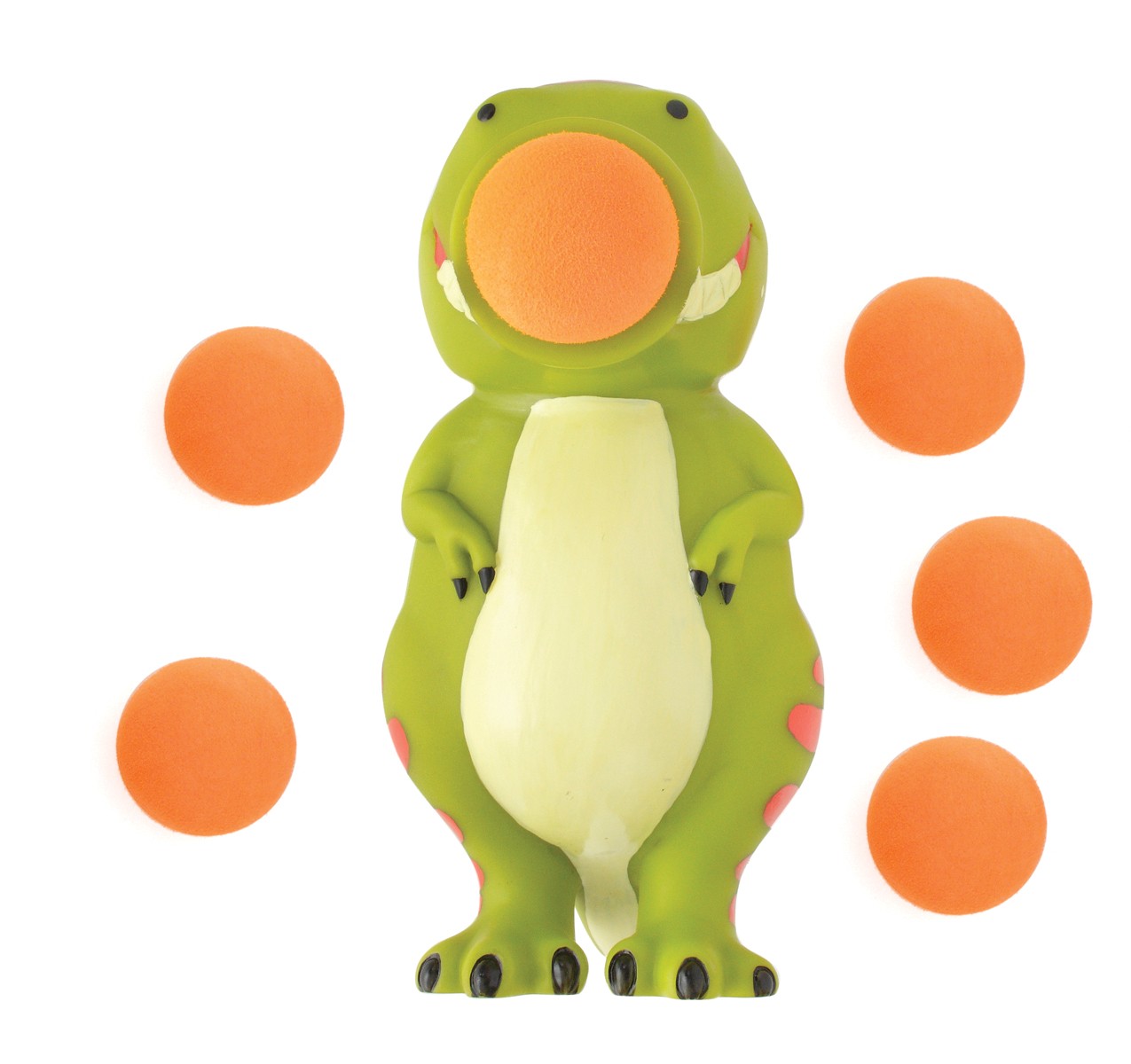
The Hog Wild Dino Popper

"This Dino Popper will have your kids roaring with delight!" exclaims Neatoshop. "Simply load the soft foam ball into the dinosaur's snout and squeeze the Dino Popper's belly - the harder you squeeze the further it shoots!" It goes for $10 at Amazon, and a reviewer writes that it's "very fun for a group get together." So, you'll have to buy a bunch of them unless you just intend on annoying people by shooting them with little foam balls. Which makes this cheap little toy a bit pricier in practice.

Cruncher Interactive Pet Dinosaur

Well, you don't purchase one of these for anatomical accuracy, do you? Though this putative Spinosaurus has a terribly squished-in face, and seems to adhere to the quadrupedal spino hypothesis, it does come with a fish, which is worth a couple or points, since that's what they likely snacked on. $60 at Amazon.

Stegron the Dinosaur Man
Amazing Spider-Man 166
Appropriately enough, the amazing Spiderman was once involved in a battle dubbed a "holiday holocaust" with the Lizard and his cohort Stegron the Dinosaur Man. There are many dinosaur dudes in the Marvel canon, but I picked this one. Arbitrarily. I might do a post about Devil Dinosaur, Reptil, and the rest one day, if I can wrap my head around the insane narrative contortions of the Marvel universe. In the meantime, you can get his action figure for a mere $12.89. Or maybe you can offer Luke Porter enough money that he'll make you his far superior custom minimate version.
Stegron
Luke Porter's Stegron. Photo via flickr.

Kota and Pals
Sort of a mesozoic version of that old chestnut Furby, these dudes are a real steal at only $8.00 from New Egg. They are also kind of terrifying. Here are the Parasaurolophus and pterosaur, for example.


But what the heck. Looks like the tykes love 'em.


Sideshow Dinosauria Maquettes
If you really need to buy someone's love, get them a Sideshow Maquette. For instance, mine. You could buy my love with a Sideshow maquette.


I know you have better ideas, so be sure to tell me what they are in the comments.