

Sunday, July 5, 2015
Vintage Dinosaur Art: The Lost World (Ladybird)
Ladybird books are a firm favourite of mine, since (like many other Brits) I have very fond memories of learning to read with them as a child - not just those bought for me at the time, but also hand-me-downs, which were all the more special. Their factual dinosaur book remains a favourite - laughably outdated these days, but still beautifully illustrated by LITC stalwart Bernard Robinson. Ladybird also published simplified versions of classic tales; as a child, I had their version of Robinson Crusoe. Until last week, I had no idea that these included The Lost World, and happily it's just as lavishly illustrated (by Martin Aitchison, this time) and entertaining as ever.


Thursday, June 25, 2015
The Finback and the Shark: A Process Blog
I recently took a trip up to Seymour, Texas, in order to report on an intermittent, ongoing fossil dig happening up on the famous Early Permian deposits on the Craddock Ranch. My main source (and, admittedly, the reason I pitched the story in the first place) was Robert Bakker, and over the course of the two day trip, I ended up spending quite a bit of time shooting the breeze with him about fossils, religion, and various other topics. I'll be placing an edited, condensed version of our interview here in the coming days, but right now I wanted to share something else--some pieces of art inspired by those conversations.
The overwhelming majority of fossils from the Craddock belong to Dimetrodon, which was remarkably common in the seasonal floodplains and channels of the period. I'd never drawn Dimetrodon before, and decided to look for a movement analogue in order to get a feel for the animal. I ended up settling on big monitor lizards and Argentinian Tegus as a stand in, and watched a bunch of videos on Youtube of big lizards cavorting around. Dimetrodon is, of course, a stem-mammal and not a squamate, but the body plans seem at least marginally similar.

I soon started doodling. The resulting sketches are my attempts to get to grips with Dimetrodon anatomy and some wild ideas about what they got up to on a day to day basis, including a very speculative hatchling (clockwise, 4th from top.) Other highlights include display pushups (5th from top) and a Dimetrodon taking a dip on a hot day (2nd from top.)
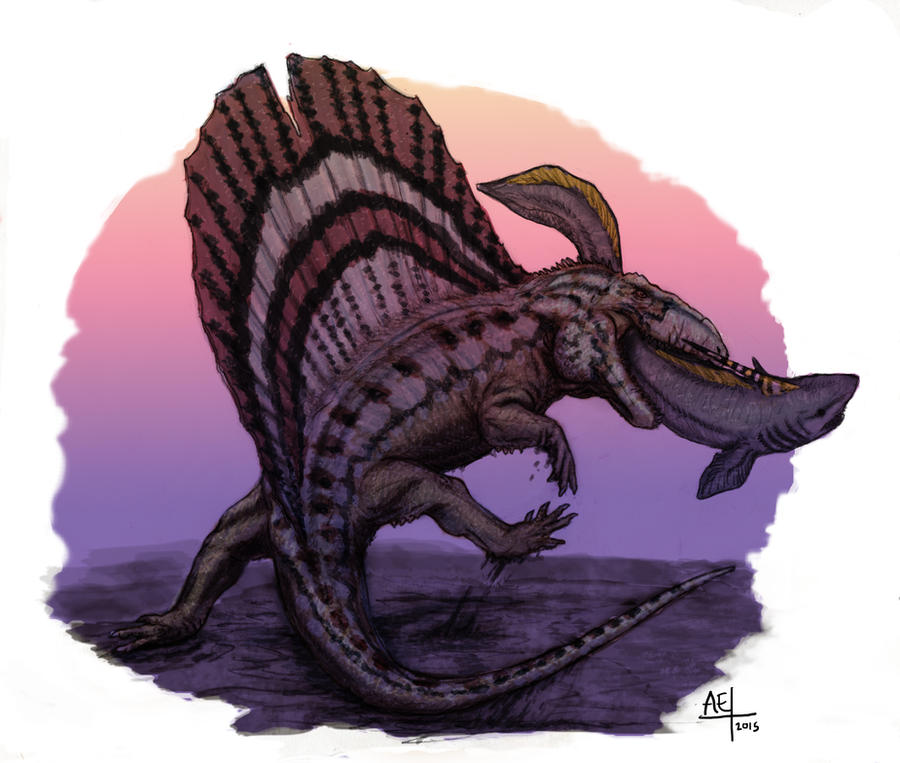
For the painting, I envisioned a big bull Dimetrodon attracted to a drying pond by the splashing of trapped sharks and amphibians. As a tip of the hat to my lizardy inspiration, I gave it the broad, flapping jowels of an Argentine Tegu, a sexually dimorphic trait, and a snout scarred by repeated tussles with other Xenacanthus sharks. This particular fellow has made a habit of killing sharks, and has gotten fairly good at it, but still gets tagged occasionally. In this frozen moment, he's shaking the shark hard enough that he's actually all but left the ground.
With the final pose settled on, more details were added with soft pencils.
Finally, I scanned the finished sketch into Adobe Photoshop and began cleaning it up and painting it. I eventually decided that I might as well go all the way and settled on a showy, Tegu-like color scheme. Dimetrodon was pretty clearly a somewhat flamboyant animal, and as a big predator of aquatic game may not have needed much in the way of camouflage. The final image, after much fussing, fuming, and some momentary, computer-freeze related terror, is below. I'm rather proud of it.
Dimetrodon, as it turns out, is quite fun to draw, and is a much more fascinating beast than is popularly credited. I can't wait to share the finished article in a few months.
The overwhelming majority of fossils from the Craddock belong to Dimetrodon, which was remarkably common in the seasonal floodplains and channels of the period. I'd never drawn Dimetrodon before, and decided to look for a movement analogue in order to get a feel for the animal. I ended up settling on big monitor lizards and Argentinian Tegus as a stand in, and watched a bunch of videos on Youtube of big lizards cavorting around. Dimetrodon is, of course, a stem-mammal and not a squamate, but the body plans seem at least marginally similar.

I soon started doodling. The resulting sketches are my attempts to get to grips with Dimetrodon anatomy and some wild ideas about what they got up to on a day to day basis, including a very speculative hatchling (clockwise, 4th from top.) Other highlights include display pushups (5th from top) and a Dimetrodon taking a dip on a hot day (2nd from top.)
 |
| Copyright 2015 Asher Elbein |
Out of all of these sketches, I liked the rearing Dimetrodon the most. Big lizards can be surprisingly fleet footed, especially when it comes to wheeling around, shaking prey, or threatening predators. For an example, see this Youtube video of a Tegu fighting off a much, much larger dog.
There remained the question of what would prompt the animal to wheel in such a aesthetically pleasing fashion. The answer lay, again, with Bakker--his studies of the Seymour deposits have led him to propose that Dimetrodon was a generalist that happily attacked amphibians and the sinuous, poison-spined Xenacanthus river sharks. As evidence for this, he points to the amount of chewed up shark remains in the deposit, as well as the fact that the massive populations of Dimetrodon in the area had to be eating something, and there simply weren't enough big herbivores in most of the rocks to go around. Also, the majority of the shed Dimetrodon teeth they find lie in aquatic, marshy or pond deposits, suggesting that Dimetrodon spent a good bit of time feeding there.
For the painting, I envisioned a big bull Dimetrodon attracted to a drying pond by the splashing of trapped sharks and amphibians. As a tip of the hat to my lizardy inspiration, I gave it the broad, flapping jowels of an Argentine Tegu, a sexually dimorphic trait, and a snout scarred by repeated tussles with other Xenacanthus sharks. This particular fellow has made a habit of killing sharks, and has gotten fairly good at it, but still gets tagged occasionally. In this frozen moment, he's shaking the shark hard enough that he's actually all but left the ground.
 |
| Copyright 2015 Asher Elbein |
 |
| Copyright 2015 Asher Elbein |
Finally, I scanned the finished sketch into Adobe Photoshop and began cleaning it up and painting it. I eventually decided that I might as well go all the way and settled on a showy, Tegu-like color scheme. Dimetrodon was pretty clearly a somewhat flamboyant animal, and as a big predator of aquatic game may not have needed much in the way of camouflage. The final image, after much fussing, fuming, and some momentary, computer-freeze related terror, is below. I'm rather proud of it.
 |
| Copyright 2015 Asher Elbein |
Dimetrodon, as it turns out, is quite fun to draw, and is a much more fascinating beast than is popularly credited. I can't wait to share the finished article in a few months.
Wednesday, June 24, 2015
King Craptor's "Jur-Ass-Kick World" Review
In the interest of providing another opinion on Jurassic World, which is something the world sorely needs, we at LITC are giving a guest post to one "King Craptor."
I liked that movie so much I gave it the title "Jur-Ass-Kick World"! The dinosaurs were mostly strong and it was very exciting to see the people die. I liked it that dinosaurs died to, like the brontosauruses that died, those were better dead than alive, and it was exciting to see how dead they were.
I liked the mean pterodactyls that attacked the people. Those pterodactyls were pretty scary. I liked the mean mossasaurus that ate the pterodactyl. I liked that the babysitter died. I don't like to admit when I'm wrong, but I sure was wrong about pterodactyls. I thought they sucked but they didn't suck. They were badass. VERY COOL.
Indomnus was the show stopper of course! I was excited every time that naughty freak showed up on the screen to wreck havoc. I was sad when mossasaurus killed it, but I know that the mean guys will make another Indomnus. Maybe a bunch of them! I liked the raptors best when they were chums with Indomnus, I don't know what kind of crazy juice they were drinking to be buddies with Starlord anyway, I had a hard time suspending my disbeliefs about that. THANKS HOLLYWOOD.
If I have to pick which people were my favorite people were the mean people with guns. I don't know why more people aren't mean, it's fun to watch. But I still get to see all those people get ripped up by dinosaurs and it is entertaining.
Jimmy Fallon tickles my funny bones, so that gyroscope scene was just extra gravy on the whole cake for old King Craptor. I still want him to be ripped to meat pieces by a gross killer dinosaur though.
So over all, I approve, go see the move already! It's the opposite of garbage! Double A+!!

I liked that movie so much I gave it the title "Jur-Ass-Kick World"! The dinosaurs were mostly strong and it was very exciting to see the people die. I liked it that dinosaurs died to, like the brontosauruses that died, those were better dead than alive, and it was exciting to see how dead they were.
I liked the mean pterodactyls that attacked the people. Those pterodactyls were pretty scary. I liked the mean mossasaurus that ate the pterodactyl. I liked that the babysitter died. I don't like to admit when I'm wrong, but I sure was wrong about pterodactyls. I thought they sucked but they didn't suck. They were badass. VERY COOL.
Indomnus was the show stopper of course! I was excited every time that naughty freak showed up on the screen to wreck havoc. I was sad when mossasaurus killed it, but I know that the mean guys will make another Indomnus. Maybe a bunch of them! I liked the raptors best when they were chums with Indomnus, I don't know what kind of crazy juice they were drinking to be buddies with Starlord anyway, I had a hard time suspending my disbeliefs about that. THANKS HOLLYWOOD.
If I have to pick which people were my favorite people were the mean people with guns. I don't know why more people aren't mean, it's fun to watch. But I still get to see all those people get ripped up by dinosaurs and it is entertaining.
Jimmy Fallon tickles my funny bones, so that gyroscope scene was just extra gravy on the whole cake for old King Craptor. I still want him to be ripped to meat pieces by a gross killer dinosaur though.
So over all, I approve, go see the move already! It's the opposite of garbage! Double A+!!
Tuesday, June 23, 2015
Asher's Jurassic World Review: More Teeth
This is the second of LITC's Jurassic World reviews. A prior take on this film can be read here.
Let's get this out of the way as quickly as possible: no, Jurassic World isn't very good. When judged by the metrics of ambition and imagination, it fails and keeps failing up until the final reel. And yet the depth of its failure is such that it somehow manages to come out the other side into an odd kind of success, as onscreen events take on a crazy momentum that leads to the kind of finale you almost certainly won't see coming.

Let's get this out of the way as quickly as possible: no, Jurassic World isn't very good. When judged by the metrics of ambition and imagination, it fails and keeps failing up until the final reel. And yet the depth of its failure is such that it somehow manages to come out the other side into an odd kind of success, as onscreen events take on a crazy momentum that leads to the kind of finale you almost certainly won't see coming.

Monday, June 22, 2015
Bloody hell, it's T. rex Autopsy
If you happened to dislike a certain highly profitable movie that was released recently (and I know a few people who would have good reason to), you may be consoled that there is an antidote at hand. Someone's only gone and made a TV show that involves the intricate dissection of an anatomically correct Tyrannosaurus carcass - a programme that combines the most up-to-date science with stunning practical effects work. It also features Steve Brusatte digging his way through gory theropod innards, which I will accept as fair penitence for that horrible coffee table book. It's National Geographic's T. rex Autopsy!
 |
| The life-size T. rex model. Photo from Nat Geo's official site, copyright Nat Geo Channels/Christopher Albert, and used on the assumption that they'll probably be cool with it... |
Sunday, June 14, 2015
Marc's Jurassic World review: not your father's de-extinction theme park
Aptly enough, Jurassic World feels like a theme park ride, and certainly not one of the sedate, trundle-along-in-a-gyrosphere variety. It's a high-tech, towering, gleaming steel roller coaster, with a breakneck pace that very rarely relents (only when they need to force a little character development in). It's certainly enormous fun, a spectacle worthy of being seen on the biggest screen possible. What it isn't is a Jurassic Park movie.
 |
| I've tried to keep it brief, but as a warning, this might get unusually wordy. |
Wednesday, June 10, 2015
Vintage Dinosaur Art: Prehistoric Animals (Hamlyn)
There can't be very many small, 'spotter's guide'-type dinosaur books that tuck a lovely surprise into their final few pages, after endless illustrations of animals standing around gawping in front of white backdrops - but, why look, here comes one now. Prehistoric Animals (first ed 1969, this ed 1974) is about as generic as they come, but offers up a pleasantly painterly few spreads towards the rear. It's just a shame that the artists aren't properly credited...


Tuesday, June 2, 2015
The Jurassic World Challenge
[Edited 6:41pm EST 6/2/15 for clarity and to incorporate some feedback; 12:27pm EST 6/6/15 to include links to our paleoart gift guide; 2:40pm EST 6/15 to add information about the Jurassic Foundation.]
It's June 2, and we're officially 10 days away from the release of Jurassic World in the US. The online paleontology community has long been afire with speculation, opining, ranting, and even a bit of giddy anticipation. This post is not about our respective attitudes about the film or the franchise, but about turning all of that energy around into something that can benefit our shared love of natural history. Whether we're happy with the way Jurassic World depicts its animals, tolerate it, or bemoan it, we all want the current scientific view of dinosaurs and other prehistoric animals to gain more traction among laypeople.
So here is an idea. It's pretty simple. I call it the Jurassic World Challenge. If you're buying a ticket for the movie, it's a fair bet that you also have that much money to give to the people who bring prehistory to life in the real world. Think of it as a matching fund, crowdsourced. See the movie, do some good. The official rules:
Of course, you don't have to pick one or the other. Buy some art, give some money to a research effort, enjoy the movie. I also put together a graphic to help spread the word, in before and after flavors. You are free to disseminate these far and wide! Take it and post it on your blog or other social media channels.


Below, I've put together a list of research and education funding efforts in need of our help, since these tend not to get much coverage. You may have local or regional museums and other institutions that you can support - just be sure, as Andy Farke notes in the comments below, to specify that you want to donate to research. It may even be worth it to team up with a group of friends and family to pool your money together. As for artists, most readers can probably think of a dozen off the top of their heads. You may check out the huge three-part gift guide I did last year, which focused on paleoart: parts one, two, and three. Also, browse our paleoart and Mesozoic Miscellany tags to find some of the many we've shared here over the years - almost all of them have work available for purchase!
Jurassic Foundation
Since I first posted this, I have been in touch with Matt Lamanna, current president of the Jurassic Foundation, about how people can donate to them. The Jurassic Foundation was founded in 1998 and its sole purpose is to fund dinosaur research. This is a great beneficiary. I was surprised to hear how little they've ever even had people inquire about donations! They don't have a way to do it online, but checks made out to the Jurassic Foundation can be sent to the following address:
Matthew Lamanna (current president)
Section of Vertebrate Paleontology
Carnegie Museum of Natural History
4400 Forbes Avenue
Pittsburgh, PA 15213-4080
U.S.A.
From Indiegogo:
Research Dinosaur Tracks in Northeast BC, Canada! (As featured recently in an interview with Lisa Buckley!)
The Ice-Blue Bones of Telluride: A Discovery Story
From GoFundMe:
Help MHP Paleo get a field vehicle
Mobile Fossil Teaching Sets
Support My Fossil Internship in Panama!
Looking into the Waters of the Past
Paleontology vs. The Dakar Rally 2016
Here are a couple hosted by Experiment, a science research crowdfunding platform.
Paleo-School - Students Experiencing their Childhood Dream
Using the Past to Understand Climate Change
A selection of campaigns from Donors Choose, a crowdfunding platform specifically for classrooms. These all came up by searching for "fossil", "geology", and "dinosaur."
Super Heroes Learning Through Our Senses
Help Kids Appreciate the Beauty and Wonder of Science!
Rocks Rock!
Rock Cycle and Fossil Activity Kits- Middle School Geology
Class Supplies for Success
The Jurassic World Challenge is not meant to be a test, or to shame anyone who does not take part. It is not meant to indict the producers of the movie for not funding science. It's just a way to encourage people to give back to the paleontological community that makes a movie like Jurassic World possible. So, if you're moved to comment on this post, rather than argue over Jurassic World's dinosaurs, add to the list above and suggest a good museum, education project, research funding campaign, or other paleontological cause to give money to. Or, of course, your favorite artist who runs an on-line shop! Let's put our Jurassic World money to good use!
It's June 2, and we're officially 10 days away from the release of Jurassic World in the US. The online paleontology community has long been afire with speculation, opining, ranting, and even a bit of giddy anticipation. This post is not about our respective attitudes about the film or the franchise, but about turning all of that energy around into something that can benefit our shared love of natural history. Whether we're happy with the way Jurassic World depicts its animals, tolerate it, or bemoan it, we all want the current scientific view of dinosaurs and other prehistoric animals to gain more traction among laypeople.
So here is an idea. It's pretty simple. I call it the Jurassic World Challenge. If you're buying a ticket for the movie, it's a fair bet that you also have that much money to give to the people who bring prehistory to life in the real world. Think of it as a matching fund, crowdsourced. See the movie, do some good. The official rules:
- Donate the equivalent of your Jurassic World ticket price to paleontological research
or - Spend the equivalent of your ticket price on the wares of an independent paleoartist
Of course, you don't have to pick one or the other. Buy some art, give some money to a research effort, enjoy the movie. I also put together a graphic to help spread the word, in before and after flavors. You are free to disseminate these far and wide! Take it and post it on your blog or other social media channels.
Below, I've put together a list of research and education funding efforts in need of our help, since these tend not to get much coverage. You may have local or regional museums and other institutions that you can support - just be sure, as Andy Farke notes in the comments below, to specify that you want to donate to research. It may even be worth it to team up with a group of friends and family to pool your money together. As for artists, most readers can probably think of a dozen off the top of their heads. You may check out the huge three-part gift guide I did last year, which focused on paleoart: parts one, two, and three. Also, browse our paleoart and Mesozoic Miscellany tags to find some of the many we've shared here over the years - almost all of them have work available for purchase!
Jurassic Foundation
Since I first posted this, I have been in touch with Matt Lamanna, current president of the Jurassic Foundation, about how people can donate to them. The Jurassic Foundation was founded in 1998 and its sole purpose is to fund dinosaur research. This is a great beneficiary. I was surprised to hear how little they've ever even had people inquire about donations! They don't have a way to do it online, but checks made out to the Jurassic Foundation can be sent to the following address:
Matthew Lamanna (current president)
Section of Vertebrate Paleontology
Carnegie Museum of Natural History
4400 Forbes Avenue
Pittsburgh, PA 15213-4080
U.S.A.
From Indiegogo:
Research Dinosaur Tracks in Northeast BC, Canada! (As featured recently in an interview with Lisa Buckley!)
The Ice-Blue Bones of Telluride: A Discovery Story
From GoFundMe:
Help MHP Paleo get a field vehicle
Mobile Fossil Teaching Sets
Support My Fossil Internship in Panama!
Looking into the Waters of the Past
Paleontology vs. The Dakar Rally 2016
Here are a couple hosted by Experiment, a science research crowdfunding platform.
Paleo-School - Students Experiencing their Childhood Dream
Using the Past to Understand Climate Change
A selection of campaigns from Donors Choose, a crowdfunding platform specifically for classrooms. These all came up by searching for "fossil", "geology", and "dinosaur."
Super Heroes Learning Through Our Senses
Help Kids Appreciate the Beauty and Wonder of Science!
Rocks Rock!
Rock Cycle and Fossil Activity Kits- Middle School Geology
Class Supplies for Success
The Jurassic World Challenge is not meant to be a test, or to shame anyone who does not take part. It is not meant to indict the producers of the movie for not funding science. It's just a way to encourage people to give back to the paleontological community that makes a movie like Jurassic World possible. So, if you're moved to comment on this post, rather than argue over Jurassic World's dinosaurs, add to the list above and suggest a good museum, education project, research funding campaign, or other paleontological cause to give money to. Or, of course, your favorite artist who runs an on-line shop! Let's put our Jurassic World money to good use!
Tuesday, May 26, 2015
Vintage Dinosaur Art: Prehistoric Life (Visual Books)
Over on his Theropoda blog, Andrea Cau has been watching the trailers for Jurassic World, noting that a lot of the dinosaurs actually look more retro than those in previous entries in the franchise - in fact, they resemble palaeoart of the 1940s-60s. Given the imminent release of said film, it's surely quite apt that the art in this week's post is exactly of that bent, and is looking extremely dated nowadays. Of course, the book concerned was published forty-two years ago.


Wednesday, May 20, 2015
Help Brian Switek Tell the Stories of Fossil Hunters in the Field
...at its core, fieldwork still relies on patience, luck, and a strong back to carry enough water to fight off lingering hangovers. - Brian Switek, from his "Have Allosaurus, Will Travel" Kickstarter campaign page.

Brian Switek prepares to enter Natural Trap Cave. Photo by Eric Scott.
Brian Switek is on a mission to tell a story. For years, he has carved out a niche as a journalist of life's history, and has written about every major palaeontology story in recent memory. More importantly, he's shed light on many that don't hit the front pages. He's told these stories via the various incarnations of his Laelaps blog, as a freelance reporter, and as the author of the popular Written in Stone and My Beloved Brontosaurus (as well as his new Prehistoric Predators, featuring the art of Julius Csotonyi, which I reviewed last week).
Next, he intends to tell the stories of the men and women who work for months in conditions most people wouldn't tolerate for a day to make the shiny museum exhibits and cavorting CGI saurians possible. He describes it as a need more than a want. To make this possible, he's raising funds via Kickstarter to allow him to spend the summer traveling between 10 important dig sites across western North America, spanning the last 250 millions years of Earth's history.
I love this idea. Pop-palaeontology often jettisons the uncertainty and debate that surround discoveries. Look no further than the NatGeo Spinosaurus blitz of last year, in which the publication of new fossil material was accompanied by a documentary, magazine cover story, and museum exhibition. These publicity efforts sell the public a story, one that tends to elide the "more research is needed" that is almost always part of a research paper's conclusions.
Brian is on the road now, but took a few minutes to do a brief interview about the project.
What do you think are the major misconceptions people have about the way field work and other research is undertaken?
Have a look at paleontology news items. Most of them are about the results of science - the naming of a new species, or a discovery about the way a particular animal lived. The passion of paleontology - the thing that keeps people trudging through deserts and spending countless hours in the lab - is often missing. That's symptomatic of science storytelling in general. The result is the focus rather than the process. And even though the first Jurassic Park film came out over 20 years ago, it partly fills that void. I regularly get asked whether paleontologists use ground-penetrating radar to find fossils (nope) and there's often an assumption that dinosaurs come out of the ground as lovely, articulated skeletons (that's rare).
The truth is that fieldwork roughly resembles how it was done a century ago. Making an important discovery starts with being dirty, sweaty, tired, and possibly hungover on long desert hikes where you feel like your brain is going to boil out of your ears. And when you find a fossil of note, it's often the beginning of commitment that involves years of digging, chipping, studying, and puzzling. It takes a special kind of madness to enjoy this kind of work, but it's that human story that I want to tell.
What media - writing or otherwise - do you think has done a good job of telling the story of palaeontology?
Some of the best works on the process of paleontology are books that look at the history of the discipline. Some that immediately come to mind are Paul Brinkman's The Second Jurassic Dinosaur Rush, David Rains Wallace's The Bonehunters' Revenge, and the harder-to-find biography of O.C. Marsh by Charles Schuchert and Clara MaeLeVene. Maybe it's because we're more distant from these researchers - and their dinosaur-sized personalities - so we feel more comfortable talking about their successes as well as their faults. Whatever the reason, these books are at the intersection of science and the personalities that drove it.
Do you have a favorite field site you've visited?
I don't know if I can choose! I've been lucky enough to work at a variety of sites around the west over the past four summers, and each has its own flavor. Quarries brimming with bone, such as Ghost Ranch, are nice, but there's nothing quite like the thrill of going prospecting to find a new site. So even though I can't pick a favorite, I'll say that I'm the most excited about the Cleveland-Lloyd Dinosaur Quarry. It's a rich Jurassic boneyard full of Allosaurus, and last summer I found a new dinosaur site outside the main quarry. I don't know what dinosaur it is or how much is in the rock, but in a few weeks I'll be going back to find out.
Best of luck to Brian in his efforts - I know firsthand how difficult crowdfunding can be. At the time of this posting, he has a week to raise about half of his funds, so please do consider pitching in and spreading the word on social media. Let's help him in this effort to sing the praises of palaeontology's usually unsung heroes.

Brian Switek is on a mission to tell a story. For years, he has carved out a niche as a journalist of life's history, and has written about every major palaeontology story in recent memory. More importantly, he's shed light on many that don't hit the front pages. He's told these stories via the various incarnations of his Laelaps blog, as a freelance reporter, and as the author of the popular Written in Stone and My Beloved Brontosaurus (as well as his new Prehistoric Predators, featuring the art of Julius Csotonyi, which I reviewed last week).
Next, he intends to tell the stories of the men and women who work for months in conditions most people wouldn't tolerate for a day to make the shiny museum exhibits and cavorting CGI saurians possible. He describes it as a need more than a want. To make this possible, he's raising funds via Kickstarter to allow him to spend the summer traveling between 10 important dig sites across western North America, spanning the last 250 millions years of Earth's history.
I love this idea. Pop-palaeontology often jettisons the uncertainty and debate that surround discoveries. Look no further than the NatGeo Spinosaurus blitz of last year, in which the publication of new fossil material was accompanied by a documentary, magazine cover story, and museum exhibition. These publicity efforts sell the public a story, one that tends to elide the "more research is needed" that is almost always part of a research paper's conclusions.
Brian is on the road now, but took a few minutes to do a brief interview about the project.
What do you think are the major misconceptions people have about the way field work and other research is undertaken?
Have a look at paleontology news items. Most of them are about the results of science - the naming of a new species, or a discovery about the way a particular animal lived. The passion of paleontology - the thing that keeps people trudging through deserts and spending countless hours in the lab - is often missing. That's symptomatic of science storytelling in general. The result is the focus rather than the process. And even though the first Jurassic Park film came out over 20 years ago, it partly fills that void. I regularly get asked whether paleontologists use ground-penetrating radar to find fossils (nope) and there's often an assumption that dinosaurs come out of the ground as lovely, articulated skeletons (that's rare).
The truth is that fieldwork roughly resembles how it was done a century ago. Making an important discovery starts with being dirty, sweaty, tired, and possibly hungover on long desert hikes where you feel like your brain is going to boil out of your ears. And when you find a fossil of note, it's often the beginning of commitment that involves years of digging, chipping, studying, and puzzling. It takes a special kind of madness to enjoy this kind of work, but it's that human story that I want to tell.
What media - writing or otherwise - do you think has done a good job of telling the story of palaeontology?
Some of the best works on the process of paleontology are books that look at the history of the discipline. Some that immediately come to mind are Paul Brinkman's The Second Jurassic Dinosaur Rush, David Rains Wallace's The Bonehunters' Revenge, and the harder-to-find biography of O.C. Marsh by Charles Schuchert and Clara MaeLeVene. Maybe it's because we're more distant from these researchers - and their dinosaur-sized personalities - so we feel more comfortable talking about their successes as well as their faults. Whatever the reason, these books are at the intersection of science and the personalities that drove it.
Do you have a favorite field site you've visited?
I don't know if I can choose! I've been lucky enough to work at a variety of sites around the west over the past four summers, and each has its own flavor. Quarries brimming with bone, such as Ghost Ranch, are nice, but there's nothing quite like the thrill of going prospecting to find a new site. So even though I can't pick a favorite, I'll say that I'm the most excited about the Cleveland-Lloyd Dinosaur Quarry. It's a rich Jurassic boneyard full of Allosaurus, and last summer I found a new dinosaur site outside the main quarry. I don't know what dinosaur it is or how much is in the rock, but in a few weeks I'll be going back to find out.
Best of luck to Brian in his efforts - I know firsthand how difficult crowdfunding can be. At the time of this posting, he has a week to raise about half of his funds, so please do consider pitching in and spreading the word on social media. Let's help him in this effort to sing the praises of palaeontology's usually unsung heroes.
Subscribe to:
Posts (Atom)