Monday, January 7, 2013

Vintage Dinosaur Art: De Oerwereld van de Dinosauriërs - Part 1

Many of you are sure to recognise this one - its original English title was Dinosaurs: a Global View. The Dutch title - De Oerwereld van de Dinosauriërs - translates to something like 'the primordial/primeval world of the dinosaurs', which might sound a little more hackneyed (and possibly cheesy), but in this case actually sets the tone perfectly. If any triumvirate of artists was truly capable of transporting the viewer back to the Mesozoic, it would have to be Hallett, Sibbick and Henderson. What a team!


Originally published in 1990, with this Dutch edition arriving in 1993, most (if not all) of the artwork in this book dates from the preceding decade. Given the amount of, shall we say, ill-informed art that came out of that decade, it's easy to forget the sheer quality of the work being produced by the top-flight palaeoartists of the time (especially if your peculiar hobby is reviewing old dinosaur books for a certain blog). One could pluck any one of the plates from this book and it would be worthy of hanging in a hall and charging an entry fee to see.

As I did previously with the likes of Life Before Man, I'll endeavour to cover a reasonable amount in a handful of blog entries, until such a point when everyone's bored, or I'm threatened by somebody's lawyer. The book's chapters are essentially ordered chronologically through the Mesozoic, but I hope you don't mind me theming my posts around different groups of animals. This week - theropods! (Oh, and if you were wondering, the second-hand section on the first floor of the branch of De Slegte in Apeldoorn is an absolute treasure trove. I'm going back there for another book...)


Mark Hallett's Staurikosaurus seems a good place to start - not only does it deal with a Triassic subject, but is an excellent showcase for Hallett's mastery of the many subtleties that make a restored animal appear lifelike. Intricate details such as the stretching and sagging skin around the animal's limbs, the soft tissues in and around the mouth, and the reflection of light on its scales add up to create a quite uncanny, not to mention very beautiful, portrait of this 'primitive' theropod. I remember a jobbing illustrator's knock-off of this piece appearing in Dinosaurs! magazine back in the day, but of course I didn't realise it was a copy until very recently. Seeing the original after all those years was a revelation.


Unfortunately, my rather small and rubbish scanner can't possibly do justice to a lot of these pieces, and I did deliberate over whether to leave this particular one out. However, in the end I simply couldn't resist sharing at least a small part of it. Therefore, may I present a detail from Doug Henderson's jaw-dropping Coelophysis scene. Henderson is most famous for developing a style in which prehistoric animals are mere components of a much wider, usually stunningly rendered landscape, and so it is here. Although this fragment doesn't show it, this scene is utterly dominated by a gigantic, fallen tree bridging the river, and overshadowed by the branches of another (standing) tree. In the context of the whole piece, the Coelophysis appear tiny and vulnerable parts of an ecosystem on a colossal scale, their swarming numbers melting into the central river. Simply a masterpiece, and one of many.


Back to Hallett, and here two Dilophosaurus struggle over an unfortunate Scutellosaurus. The animals here have a very different 'feel' to the Staurikosaurus - although equally lithe and sleek, their skin appears tougher and more leathery as the result of masterful texturing. It's a violent scene, the likes of which have become something of a palaeoart cliché now, but again displays a superb attention to small details - in terms of the animals' anatomy (check out those legs), their interaction with the surrounding environment, and the environment itself.


Henderson's work is often imbued with a melancholic quality that's very unusual for palaeoart. The monochrome helps, of course, but the composition here is also key. The skulking Ceratosaurus, its back turned to the viewer, displays an air of indifference in spite of the hulking carcass of the sauropod, which cleverly blends into the landscape. A gnarled tree with bare branches and a fallen log frame the animals in the centre. It's haunting - and how many artworks featuring Mesozoic dinosaurs can you say that about?


In addition the illustrations, the book contains a small number of photographs of models sculpted by Stephen Czerkas. The scaly skin of this Deinonychus has certainly aged it now, but its intricate detailing and lifelike quality still impress. Also of note is the arrangement of the hands, with the palms facing correctly inward and folded down (although not back against the arm, as in modern birds). It's remarkably prescient for the time.


I'm running out of superlatives with which to describe Henderson's work. Instead, you can just picture me gawping pathetically, a sliver of drool descending slowly from the left edge of my gaping cakehole. (I'd include a photograph, but I think we'd lose readership.) Regardless, this scene depicts Albertosaurus - not chasing or biting or being stabbed in the guts by anything, but simply taking a leisurely stroll through a stupendously beautiful Hendersonian forest. It's classic Henderson. Niroot remarked how much Henderson's work reminded him, in terms of composition in particular, of Oriental painting. Whether or not Henderson really was influenced by Oriental painting I don't know, but it's certainly lovely to think so.


Speaking of things that look lovely, here's something that really doesn't - Czerkas' Carnotaurus. However, that's only because the animal itself was such a pug-faced weirdo, and is not a comment on Czerkas' sterling sculpting skills. Certain very minor details (the hands) would not be regarded as accurate today, but overall it has aged remarkably well, and (again) has a definite likelike quality. The animal appears pleasingly bulky and fleshy, although not excessively so, and exudes a certain predatory menace.


Although it is seemingly quite rare for Henderson to produce anything as conventional as a scene of predation, he naturally manages to excel at them nonetheless. Here, the familiar tyrannosaur Tarbosaurus launches an attack against the hadrosaur Saurolophus. Against the greens and blues of the hadrosaurs and sunlit river, the vibrant red head of the theropod is a startling focal point. Water was another Henderson specialty, and here it is possible to get a sense of the deceptive power in the flow of the river, as the individual at the bottom right struggles gallantly upstream. In the context of this book, the often quite detached, one might say 'peaceful' and painterly quality of Henderson's work contrasts effectively with the more visceral and immediate quality of Hallett's, and they compliment each other perfectly.


And finally...this is perhaps the most unusual piece in the book and, surprise, it features Tyrannosaurus. If any readers could inform me as to the exact age of this one I'd be very grateful, as it seems to me to be a little anachronistic, and it wouldn't surprise me if it was one of his older pieces. It's gorgeously painted, of course, but the tyrannosaurs have a peculiarly crocodilian vibe and rather long tails, both of which remind me very much of 1970s palaeoart. There's also that Pteranodon, which is...odd.

As for those hornlets over the eyes - could the tyrannosaur in that movie trace that particular feature of its now instantly recognisable appearance back to this painting...?

There's more to come from De Oerwereld van de Dinosauriërs! Please do come back next week, on Monday, or maybe a bit later, depending on whether or not I pull my finger out.

Friday, January 4, 2013

Happy New Year


A little late in the proceedings, but not yet too late: a very happy New Year to all our readers from the Love in the Time of Chasmosaurs team; counter clockwise from right: David ('Anatotitan'), Asher (Dilophosaurus), Marc (Deinonychus) and me (Diplodocus).

I do recommend opening the image in a new tab for best viewing.

I would have liked to do more to this, but was obliged to call it finished, otherwise it might be March by the time I get to post it. It has already taken far longer than the rather lacklustre results would seem to warrant. I've taken a few liberties with the scale, of course (what Marc calls 'semi-authentic scale'). Nevertheless, I feel especially sheepish to be appearing so prominent, given that I'm the most ignorant and least qualified of the team. Perhaps I shall do another version someday which is more reflective of everyone's actual capacities...

Happy New Year!

Monday, December 31, 2012

Mesozoic Miscellany 56

The year 2012 was less than apocalyptic, never mind what the dimestore prophets predicted, but as with any arbitrary range of time, it saw plenty of changes. So it goes with the dinosaur blog world so I thought I'd collect some notable changes, which may have gone unnoticed in the blogroll, into the latest round of our occasional Mesozoic Miscellany series.

Filling a long-empty niche in the podcasting world is Palaeocast, covering all matters paleontological. From an in-depth discussion about the largest of the trilobites, Isotelus rex, to an overview of Mesozoic vertebrate evolution with Dave Hone, it's been a treat to finally have some concentrated doses of prehistory to listen to.

Some huge shake-ups have occurred among major players in the dinosaur blogging world recently. Brian Switek left his post at Smithsonian's ever-popular Dinosaur Tracking to join the new Phenomena blog network by National Geographic. Sticking with the name Laelaps, Switek will be no longer be separating dinosaurs from his other prehistoric coverage. Carl Zimmer, Ed Yong, and Virginia Hughes complete NatGeo's sci-com all-star team.

Dave Hone's hard work was also rewarded this year as he moved into new digs at the Guardian, Lost Worlds. He still maintains Archosaur Musings, so don't go neglecting it.

Public Library of Science has debuted a new team blog featuring Shaena Montanari, Sarah Werning, and Andy Farke. The Integrative Paleontologists covers paleontology in the digital age and offers terrific coverage of new research published in PLoS, building on the diverse research interests of its authors.

Mark Witton has begun posting on his own blog now. Much easier to follow than his Flickr account, and just in time for publication of his upcoming book from Princeton University Press, Pterosaurs.

A new paleo-blog from North Carolina Museum of Natural Sciences, Expedition Live!, also deserves a look, especially for therizinosaur lovers: Lindsay Zanno herself heads it up!

On the artistic side of things, some welcome additions to the blogging world included John Conway, Luis V. Rey, Julius Csotonyi, and Julio Lacerda.

Finally: Doug Henderson now has an Etsy shop! Seriously, there are no superlatives up to the task of describing Henderson's work. But you know that. Here, you can purchase his originals, including published work and sketches. Beyond supporting Henderson, which is a noble enough cause, your purchase may benefit a project he's developing, "to expand the illustration of Earth History beyond the realm of dinosaurs in a mudpie project of my own, one that needs funding and I hope sales of my original works may provide a little help."

Friday, December 28, 2012

The Extant Anatid and the Sauropodomorph

Daffy Duck has always been my favorite Looney Tunes character, so I was happy to learn that director Chuck Jones' first go at Daffy was 1939's Daffy Duck and the Dinosaur. It's a fitting start, since Daffy is Warner Brothers' most famous extant theropod (back off, Tweety-lovers, just back off). Set in the stone age - "millions and billions and trillions of years before you people were even born," a title card informs us - it's one of a long line of Warner Brothers cartoons in which a prey animal protagonist outwits a hapless hunter. In this case, it's Casper Caveman. Not only does it seem to presage The Flintstones (Casper has a pet sauropod named "Fido," and his home has a very Bedrock feel), Casper's first attempt at killing Daffy may well have been the inspiration for the famous "bullet time" effect in The Matrix.


Daffy Duck and the Cave Man might have been a more accurate title, but I think Jones knew that dinosaurs were a better draw.

Dinosaurs in Oxford

The Oxford University Museum of Natural History is one of the best in Britain, housed in a glorious, soaring Victorian neo-Gothic building. What's more, there are a number of skeletal mounts of dinosaurs ranging from Tyrannosaurus to Hypsilophodon, with many historically important British specimens also on show (by jingo). And entry is gratis. It's a must-visit if you're ever in the city, and Niroot and I just so happened to pop up there earlier in the month.


Although they are both grand Victorian museums built for the purpose, the OUMNH has a very different atmosphere to London's Natural History Museum. It's much smaller, of course (and has a different architectural style - Gothic as opposed to Romanesque Revival), but is also illuminated far more by natural light inside, giving a much more open, airy and less stately feel. It also doesn't receive the preposterously huge hordes of visitors that the NHM has to deal with, and as such allows visitors to get closer to its mounted skeletons.This, combined with the lighting conditions, makes it fantastic for photography.


The first thing every kid's eye is drawn to upon entering is a cast of BHI 3033, or 'Stan', the relatively small but big-noggined Tyrannosaurus rex. Of course, it's only 'relatively small' for an adult T. rex, which still means it's pretty bloody huge. The mount displays a fairly unusual 'rearing' posture, with the front end sloping upward, which makes it appear suitably imposing. Although standing on a wooden plinth, there's no glass in the way, so it's still possible to get up close to Stanny boy and take in that crazy tyrannosaur anatomy from all sorts of angles. I have a particular affinity for feet, apparently.


The head model is a little derptastic (they were probably better off displaying it separately, as they used to), and there's something off about that right forelimb (that one's for the nitpickers), but you can't go far wrong with a T. rex mount. The animal's just too awesome.

Directly in front of Staniel stands an Iguanodon bernissartensis cast in a classic Dollo-style 'kangaroo' pose. Much to the museum's credit, a nearby sign points out how this posture would be quite impossible for the living animal, even including a diagram with a dirty great arrow indicating where the tail has been broken.


Surrounding this enormous pair are the assorted remains, safely ensconced within glass cabinets, of British dinosaurs and others of particular historic interest. It's here you'll find Cetiosaurus, Eustreptospondylus and Megalosaurus, alongside the British "Camptosaurus" (Cumnoria) and more Iguanodon. It's a fascinating glimpse into the earliest days of palaeontology, and a wonderful opportunity to look at animals that are seldom seen in museums.


The Eustreptospondylus mount (a juvenile specimen) is accompanied by a model head, apparently fished out of the bins when Walking With Dinosaurs was completed.


The Cetiosaurus remains from Chipping Norton are helpfully labelled...


...While Megalosaurus jaw bits are assembled according to their positions in a (slightly speculative) restored skull. Just visible here is a reproduction of a restoration from 1854 (which the signage drily describes as a "slightly overweight quadruped"), which shows just how little they had to go on back then.


Cumnoria is yet another dinosaur with a tangled taxonomic history. In the museum it's labelled as "Camptosaurus" prestwichii, and (predictably) it was dumped into Iguanodon before that. The animal's lumping into Camptosaurus was accepted for decades, but recent studies have supported its generic separation.


Just around the way, there's a wonderful array of mounted skeletons and skulls from various Late Cretaceous North American dinosaurs, including Edmontosaurus, Triceratops, Pachycephalosaurus, a truly superb Struthiomimus, and Tyrannosaurus....er, again. Thanks to the lack of protective glass (for all but the T. rex skull cast), it's possible to poke one's camera lens into all sorts of improbable places (ooh er). If you enjoy inspecting every last minute little nodule on Pachycephalosaurus' preposterously adorned cranium, then you're in for a treat.


There's also this little fellow...why, it's Bambiraptor feinbergi! Or at least, that's how most of us know him - of course, the person who writes the signs at the OUMNH has taken it upon themselves to sink it into Velociraptor (nice 1990s-style illustration too). I believe it's known as 'doing a Paul'. It's a very minor nitpick, of course, but worth bringing up 'cos it's amusing, and also because I'm not aware of anyone else having proposed this lumping (but feel free to enlighten me if you have [And right away, someone did - see Alberta Claw's comment]).


Speaking of, er, maniraptors, Archaeopteryx gets the life restoration treatment too, and just for a change the model's actually very good, rather than being a hideous lizardy freak with miniature hands. There's also an excellent cast, of course. Compsognathus gets a similar deal, and the model's very lovely, although advances in palaeontology have dated it a little more. Nevertheless, it remains admirable for its high level of craftsmanship and stunning, intricate attention to detail.


On the other hand, it's pretty safe to say that Utahraptor didn't look like this. At all. Of course, this isn't entirely the model makers' fault - rumours abound that new(ish) material, yet to be published, indicates that this animal was a lot weirder than previously thought. Actually, I'd be very interested to learn where this model came from - it looks like it might be another Walking With Dinosaurs artefact (the 'raptors' in said show were also buck-ass nude), but the strangely allosaur-esque head and colour scheme don't seem like a good match. Any ideas?


I'd like to round things off - for the time being - on a pleasant note, so just take a good gander at this lovingly sculpted Iguanodon head (below and, if you squint a bit, above). It's a seriously impressive work of art and no mistake - the subtly rendered skin folds and bony nature of the face remind me a great deal of modern ungulates like horses and giraffes. Er, except for the beak. Entirely too rarely for palaeosculpture (if I may call it that), this has the appearance of a living animal rather than a monster or an inert, clinical restoration. Just excellent.


That'll be all for now, but there's far too much great stuff in the OUMNH to contain in a solitary post, no matter how photo-laden. We will return!

Thursday, December 27, 2012

The Changing View of T. rex

In an excellent little explainer video, Field Museum paleontologist Dr. Peter Makovicky explains how science has changed the way we see Tyrannosaurus rex over the last 112 years. Embedded here for your enjoyment.

The Changing View of T. rex from The Field Museum on Vimeo.

Monday, December 24, 2012

Vintage Dinosaur Art: Dinosaur Babies

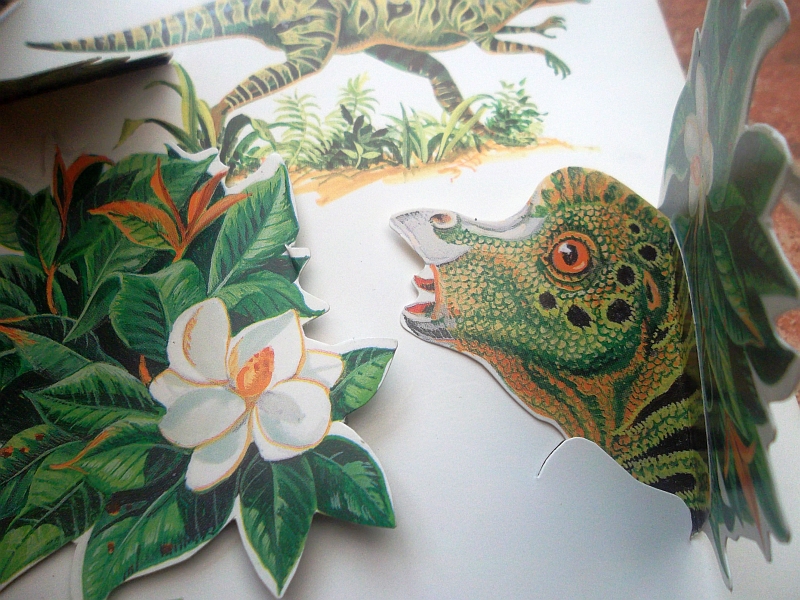
If any of the great artists of the Dinosaur Renaissance era deserve a much greater online presence than they currently have, then it's Eleanor (aka Ely) Kish. We've only featured her work on two occasions before, and this is the first book to grace LITC that is entirely illustrated by her. Happily, it's also a pop-up book - from the same National Geographic series as the recently-featured Creatures of Long Ago: Dinosaurs. As the title suggests, it's an insurmountable onslaught of cute.


Dinosaur Babies is quite unusual for Kish in that, by necessity of the format, it places the animals up front and centre, rather than featuring them as components of a more broadly realised prehistoric landscape. That doesn't stop the backgrounds being beautiful, of course, as amply demonstrated by the gorgeous desert scene on the cover.  Of course, the Pinacosaurus are lovely too - I'm particularly taken by the expression on the face of the individual on the right. It's not impressed...


A 1980s book about fresh-from-the-egg saurians was inevitably going to feature Protoceratops - after all, it took a nest with it wherever it went (even the Carnegie toy had one). True to form, the opening spread features a hatchling peering right out of the page at you. There's wonderful attention to detail - note the egg teeth - and the inclusion of a lizard, if quite common in these scenes, helps add a little faunal variety. The adult animals display Kish's typical anatomical rigour, with a modern-style posture advanced from the sprawling, lizardy portrayal of the animal that was still quite prevalent at the time. Kish's creations were sometimes prone to 'zombie dinosaur' syndrome - deathly thin with a pelvis that could take your eye out - but fortunately there's scant evidence of that here.


Maiasaura was another shoo-in for a book like this, for obvious reasons. In fact, a Maiasaura nesting site also appeared in Sibbick's pop-up effort, and there are a number of similarities - from the viewer taking on a nestling's perspective, to the adult chasing off a Troodon in the background. While the Sibbick scene, with its three-dimensional rendering of the mother's head, is the more striking overall, Kish's take is still delightful. The protruding arms are a nice touch.


My favourite scene in Dinosaur Babies is definitely this one, featuring cryptically camouflaged young Corythosaurus attempting to evade the eyes of prowling Albertosaurus. Cryptic camouflage remains a surprisingly underexplored theme in palaeoart (with recent notable examples popping up in All Yesterdays), and Kish has a particular talent for it. Of course, this is also an effective showcase for Kish's skill in creating highly detailed, believable and lush forested landscapes for her dinosaurs to dwell in. More than any other spread in the book, this one is bursting with tiny details and charming interactive features.


Pulling this tab, for example, will conceal two young hadrosaurs in the foliage as they cower from their toothy aggressor.


 The tyrannosaur's head, leering out over the top of the page, helps set the scene very effectively - the very motion of it popping up akin to what the hadrosaurlings would see as the predator scanned over the undergrowth. Lifting a flap to the right reveals a Corythosaurus staring up at the carnivore, looking utterly terrified to be suddenly exposed. Just brilliant stuff.


While the Corythosaurus scene remains superb, this baby Deinonychus tug-of-war hasn't aged so well - if it weren't for the feet, these creatures would be unrecognisable as dromaeosaurs (the purple colouring is also, in retrospect, rather unfortunate). They seem to have cheeks, not to mention what appears to be luscious lipstick. Oh dear. It's always good to see Deinonychus doing something other than reducing an implausibly large adversary to juicy meaty chunks - look, there's one scratching! - but this one is perhaps best skipped over. Except...


...this is a nifty feature - the terrified Gobiconodon are just getting an eyeful at first, but pulling a tab sends forth a probing claw. Again, Deinonychus predating animals smaller than itself is a pleasant change.


Ah, the good old paddlin' sauropod. The animal ("Pleurocoelus", one of those dodgy genera with complicated histories) appears to be an adult but, strangely, is described as a 'thousand pound baby' in the text. Never mind - the scene is rendered pleasantly enough and the sauropod is decent for the '80s (remember, some people were still illustrating toddling 'brontosaurs' at this time), while the pop-up element is put to good effect in creating the tangled plant life dragged along by the giant animal.


Pulling the tabs here results in one animal swimming across the lake, while another (in the cameo image) pops its head up to say hello. Unfortunately, its face rather resembles that of the highly phylotarded sauropods in the brilliant documentary Baby: Secret of the Lost Legend.


And finally, as previewed on Facebook, here it is - the adorable Styracosaurus tot, bounding out of the page toward the reader, with a mischievous glint in his eye! A beautiful illustration. This spread also sees an airing of the now-discarded 'ceratopsian wagon circle' meme (below), with a deft pull of the tab making the facing animals flick their heads into the air. Unfortunately, Daspletosaurus seems to have fallen foul of the Curse of the Dodgy Perspective, but seeing a herd of ceratopsians acting like frontiersmen is sweetly nostalgic in a way that only peculiarly prevalent stereotyped notions of dinosaur behaviour as depicted in art can be.


There'll be more Vintage Dinosaur Art in the new year, when I embark on the futile task of attempting to scan pages from the gigantic De Oerwereld van de Dinosauriërs (Czerkas & Czerkas) using my pathetic all-in-one printer. Keep it Chasmosaurs!

Thursday, December 20, 2012

All Yesterdays: Some Thoughts


We've been focusing a lot on All Yesterdays here of late, partially because we're all very artistically minded, and partially because it's just a gorgeous, thought provoking little book. I'm not going to review it here; you've seen enough by now to know that we're all pretty wild about it. Instead, I'm going to list some thoughts inspired by the book, and shamelessly tease you all with promise of a future, All Yesterdays style event.

Paleontological art has always been at its most valuable when it gives us a glimpse, not only into how extinct organisms looked, but also how they lived. Reading through All Yesterdays again prior to writing this, I was reminded of how my favorite pieces combined bits of soft tissue speculation with interesting and novel behaviors. Elasmosaurs waved their necks over the turbulent ocean, struggling to out-display their rivals. Heterodontosaurs wandered out of their burrow, adorned with spiky tails, eyes narrowed against the sun. Therezinosaurs sat like bristly, clawed mountains in the dim light, feeding placidly from the branches. All of these illustrations had an immense amount of character to them, and I think character is what's been missing from a lot of dinosaur art.

Leaellynasaura copyright John Conway
Animals aren't all the same. Not all herbivores are placid, and not all carnivores voracious. Some lions are tolerant, some cows insanely aggressive. There's huge individual variation among most species, whether of appearance or behavior, but most paleoart doesn't capture that. Every Tyrannosaurus becomes the same Tyrannosaurus, every Triceratops becomes the ideal spokesman for its species, every reconstruction rendered as a platonic ideal.

There's a huge opportunity sitting here for artists, and it's mostly been ignored. So much imagination already goes into paleoart; why not go even further, and create individualized creatures? Scars and bumps, behavioral quirks, even bits of expressive body language can go a long way toward characterizing an animal. There's something deeply immersive and realistic about this kind of reconstruction; it offers a harmonious blend of soft tissue speculation and behavioral imagination, and results in memorable art.

This kind of art doesn't have to be done in a photo-realistic manner, and I'd argue that it probably shouldn't. Excessive realism often ends up being  a trap; it constricts us into thinking of extinct organisms in the drabbest, most conservative terms. Like stuffed museum specimens standing in barren dioramas, the results often feel lifeless, choked by their own detail, petrified by repeated cliche. Zoological illustration has a long tradition of abstraction, gesture drawing, loose sketches and mixed media, all of which seek to capture the idea of movement or character in ways unrelated to the direct and detailed. A lot of paleontological illustration shies away from this, and I can't help but wonder if more experimental styles wouldn't help break us out of the the current, endless cycle of memes.


Giraffe style Barosaurus by Bakker, which begat...
...Giraffe style Barosaurus from Burian, which begat...
...whatever the hell this is.
This call for stylization shouldn't be mistaken for an excuse to get anatomy wrong; if anything, it's going to require better anatomical knowledge on the part of artists attempting it. It's important to know something very well before you attempt to capture it in the abstract. I'd be interested in seeing what artists choose to focus on when freed from the prison of trying to set down every wrinkle and fold of skin.

Over all, I found finishing All Yesterdays to be deeply frustrating, because it left me with an almost dizzying sense of possibility. I didn't want it to be over. I wanted more of a look into a world who's strangeness I'd taken for granted. So I did the only thing I could--I picked up a pencil...

Keep an eye out, dear readers. The LITC crew has a special announcement to make in the coming days, one that will make the more artistically inclined among you very, very happy! Stay tuned!

Wednesday, December 19, 2012

Vintage Dinosaur Art: Ivan Chermayeff

This will be a quick one today, featuring a poster rather than a book. In 1982, legendary graphic designer Ivan Chermayeff designed a poster for the American Museum of Natural History in New York, advertising free admission on Friday and Saturday nights.

 Poster design by Ivan Chermayeff; image courtesy the AIGA design archives.

You know you're a design bigwig if you're signing your work. A delightful bit of modernist design, playing on the upright forms of theropods that stalked museum halls before the dinosaur renaissance. Chermayeff likely got the gig thanks to the Mobil connection, as Mobil was one of the Chermayeff & Geismar design studio's big clients, and most enduring logo designs.

I do have a bunch of books to scan, and I know Marc always has something in the works, so I'm sure we'll be back on our usual Vintage Dinosaur Art schedule soon. This post also gives me the idea to look for more dinosaurs used in poster design, so I'll start rooting around and see what I can find.

Monday, December 17, 2012

Conway, Kosemen, and Naish Discuss All Yesterdays

C.M. Kosemen has uploaded videos from the Friday, December 7 launch event for All Yesterdays: Unique and Speculative Views of Dinosaurs and Other Prehistoric Animals to his Youtube channel.

First, Darren Naish introduces the book and the thinking behind it.


John Conway discusses his artistic process and rationale for his speculations.


And Kosemen chimes in as well, talking about "lenses of distortion."


Great to see what Marc, Niroot, and the rest of the rabble got to enjoy at the launch event.