Sunday, December 16, 2012

Obamadon is Not a Dinosaur


This illustration of Hell Creek fauna at the end of the Cretaceous is the work of Carl Buell [FB]. The big bad in the foreground chasing baby edmontosaurs is Palaeosaniwa. The little blue fellow is a polyglyphanodontian lizard called Obamadon. It is not a dinosaur.

The large fellows in the distance, who you might rightly guess to be Tyrannosaurus and Triceratops? Those are dinosaurs. Palaeosaniwa's breakfast? Those little green dumplings are dinosaurs. Obamadon, I'm sorry to report, is not. A page or two of web search results may lead you to believe it may be a dinosaur, but it is not a dinosaur.

Buell's artwork accompanies press about new research published in the Proceedings of the National Academy of Sciences studying the effect of the end-Cretaceous mass extinction on squamates - lizards and snakes - from Nick Longrich, Bhart-Anjan S. Bhullarb, and Jacques A. Gauthiera. They find that while the exact cause or causes of the extinction are still debated, a devastating and sudden loss in squamate diversity at the K-Pg boundary supports the Chicxulub impact hypothesis. While squamates have generally been seen as coming through the extinction relatively unscathed, Longrich and team found that less than a quarter of species persisted, and these were small and geographically widespread. Today's great diversity of squamate life took tens of millions of years to rise from the catastrophe. Longrich writes in his conclusion that "...the squamate fossil record provides a striking example of how mass extinction works as a form of creative destruction, and shows how the origins of the modern biota can be understood only in light of catastrophes occurring in deep time."

This paper erects a number of new squamate species, one of which is Obamadon. However, being a Cretaceous species does not grant our plucky little lizard membership in the esteemed ranks of the dinosaurs. Still a squamate, despite what headline writers, journalists slumming it in the science beat, and giddy political columnists might have you believe.

Distinguishing this extinct lizard from dinosaurs is just too much hassle when you've got a puff piece to crank out, or a witty analogy about the fiscal cliff and the K-Pg extinction to bestow upon your delighted readers.

Yes, Virginia, there is an Obamadon. But it's not a dinosaur.

Friday, December 14, 2012

The Paleoartistic Kaleidoscope of All Yesterdays


John Conway's Allosaurus and Camptosaurus, from the new book All Yesterdays.

This has been a wonderful year for Mesozoic publishing ventures. Paleontology enthusiasts are being treated to Dinosaur Art, the new edition of The Complete Dinosaur, the recently-published Field Guide of Mesozoic Birds by Matt Martyniuk, and of course, the collaboration between Darren Naish, John Conway, and C.M. Kosemen, All Yesterdays, featuring a meaty introduction from Naish and vital support from skeletal diagram master Scott Hartman. The team, web veterans all, have done a fine job of spreading the word, and reviews have sprung up across the web. It is available in ebook and print editions.

We've begun covering the book here, thanks to Marc and Niroot's attendance of last week's book launch event, and there is so much meat on this bone that we're not limiting ourselves to a single review. I'll kick things off by putting the book in context based on my personal experience. I plan on also writing from my perspective as an illustrator, though one who does not present my subjects in anything resembling a technical light. That will be a post for another day.

Reviews that have hit the web so far have been overwhelmingly positive, with notable pieces by Mark Witton, Emily Willoughby, Andrea Cau, Mike Taylor, and Brian Switek.

For readers unfamiliar with All Yesterdays, here's the skinny: in the face of the woeful lack of material the fossil record preserves, the intriguing glimpses into integument we've gained since the '80s, and the incredible diversity of soft tissue adornments and behaviors among extant animals, many of our artistic reconstructions of prehistoric animals may be far too conservative. Half of the book is dedicated to Conway and Kosemen's evidence-based speculations of Mesozoic fauna, with a second half devoted to showing what reconstructions of extant animals might look like if some future paleoartist took a too-conservative, skeleton-only approach.

Instead of being presented as a bold declaration of war on the establishment, Conway, Kosemen, and Naish see the book as rising out of a movement in paleontological illustration which has been building for a while (a point also made by Andrea Cau in his post linked above). This "All Yesterdays movement" (which I'll abbreviate AYM here) may not be the sole creation of these authors, but I think it's fair to say they they are its most important voices, if only for having the nerve to put the ideas to print (and e-print). To fully understand AYM, All Yesterdays is essential reading.

When I took part in the ScienceOnline 2011 panel discussion on science-art, I used Brian Engh's Sauroposeidon as an example of what has become the AYM. Sharing a work-in-progress of an illustration of the sauropod bearing a speculative display sac on its neck, with SV-POW blogger and sauropod expert Dr. Matt Wedel, Engh received this advice:
I think it rocks. But not nearly enough. Look up some pictures of prairie chickens, hooded seals, singing frogs, and everything else with inflatable display sacs. They don’t look like they just swallowed a stick of Mentos–they look like freeze-frames from half a millisecond after the the detonation of that bomb they swallowed. Real display sacs are so big and so colorful that no other animal could possibly mistake them for anything else. Therefore if you want to draw speculative display sacs they must be so big and colorful that none of the people who see the piece could possibly mistake them for anything else.
For Engh, this was a green light; he writes of having had a nagging feeling before consulting with Dr. Wedel.
When I look at illustrations of dinosaurs, even very technically good ones, I’m often left with the uneasy feeling that it just doesn’t ‘feel’ like a real animal. Its as if only two simple layers have been added to the still-recognizable skeleton – while living vertebrates often look nothing like their skeletons...
It's no secret that I am a devout admirer of Conway's work, and am thrilled to now have it in two different volumes - in print with Dinosaur Art, and the Kindle version of All Yesterdays. I'm also happy to have Kosemen's work; the two artists compliment each other by being as daring stylistically as they are in their anatomy. If only as a way to have this art available as a conversation piece, it would warrant a recommendation. It's the richness of the explanatory text which couches the restorations which makes it essential, for here the speculation is put into context, and there will likely be new information to even knowledgable readers; I was pleasantly surprised to learn about the shoulder joints and humeri of abelisaurs such as Carnotaurus, which allowed for much more range of motion than was possible in most large theropods. Both Conway and Kosemen take advantage of this to depict Carnotaurus in unique display postures. In other places, they write about the bizarre behaviors witnessed in extant animals, and the possibilities they may open up in dinosaurs, perhaps most outrageously in a pair of Morrison herbivores.

C.M. Kosemen's randy Stegosaurus and rather alarmed Haplocanthosaurus.

A more speculative approach to paleoart is a precarious enterprise, and All Yesterdays makes clear that speculation should be grounded in what has been observed in the natural world. As Naish writes in his introduction, "Science and speculation are happy bedfellows, so long as we remain grounded in our speculations, and so long as we state the core evidence we have in the first place." I see no reason to fear such speculation. Granted, it has the ability to drive us up the wall; just see the reaction to any given televised documentary. But one of the promising possibilities AYM presents is what could happen if other media truly embrace the approach. Imagine a documentary which does not present paleontological theory in narratives, as in Walking With Dinosaurs or its spin-offs. Instead, it could present a whole set of hypotheses and reconstructions, flipping the traditional script of talking heads serving the needs of narrative. Instead, narrative and reconstructions would demonstrate the living process of paleontological science, multiple hypotheses presented with their strengths and weaknesses in kaleidoscopic variety. Viewers would see science being done instead of stories which grant certain hypotheses, some tenuously supported in the paleontological community, the weight of fact.

I see AYM as an essentially modern phenomenon. Facilitating contact between illustrators, researchers, writers, and paleontologists around the world, the web has allowed a call-and-response culture in which one artist, blogger, or scientist can propose something and set off a chain of works and writings inspired by it; browsing work on the paleo-hotbed of deviantArt reveals a culture of constructive criticism and an iterative approach to reconstruction. An artist need not be isolated in his or her studio, referring only to literature and a limited number of advisors; conversations in cyberspace and the mutability of digital artistic processes allow for flexibility and fearlessness. All Yesterdays and the global constellation of artists who make up AYM have taken a bold step forward. It is a true paradigm shift. It will leave plenty of practitioners cold, as paradigm shifts must. But count me among those thrilled to live during this era of paleontological restoration, excited by the possibilities and eager for the conversation to continue.

Wednesday, December 12, 2012

Defending Velociraptor

Velociraptor maquette from the exhibition Les Géants du Jurassique. Photo by Dominique Pipet.

In my interview with Chris Masnaghetti this week, I shared his wonderful Velociraptor infographic. He bemoaned the animal's status in pop culture, calling it the "most misinterpreted dinosaur ever," putting heavy blame on Jurassic Park. Seems right to me: those scaly beasties have become the theropod equivalent of Brontosaurus: a placeholder for dinosaurkind in general, whether or not they represent current paleontological thinking. Combine a catchy name with innumerable pop culture references, and you've got a dinosaur ambassador to the public that more often than not serves to obscure the wonders of paleontology as it is actually practiced.

The web is vast, and while some of us are brave and persistent enough to try to kill all the "unsinkable rubber ducks" of paleontological myths that get repeated in comment thread arguments ad nauseum, we'll never root them all out. There will always be people who believe that Triceratops is doomed, that the invalid status of Brontosaurus is pure scientific bullying, and perhaps most pernicious of all, that feathers on Mesozoic non-avian dinosaurs are like, totes lame.

Example: this recent Tumblr post from someone who just finished a college course on dinosaur paleontology:
i think the most important thing i’ll take away from my dinosaur class (other than pterodactyls are not actually dinosaurs and my entire life has been a lie) is that velociraptors were covered in feathers. and dog-sized. but mostly
covered in feathers
can you imagine that shit in jurassic park??
What followed was an unattributed image of a feathered Velociraptor sculpture.

I reblogged the post, adding the comment, "Funny how no one maligns wolverines by saying they could just 'kick them away.' Small does not equal harmless!"

You've got to feel sorry for either the student for having a teacher who failed to impart a greater level of appreciation for paleontology; or for the teacher for having such a closed-minded student. Knee-jerk dismissal of feathered dinosaurs is nothing new. Nor is the widespread misunderstanding of all dinosaurs as little more than bloodthirsty Kaiju monsters. Both are rubber ducks we'll probably always be annoyed by.

My first point in writing this post, beyond ragging on another feather-hater, is that more strongly than ever, I think that what we really need is a big, stupid, pulpy piece of entertainment that makes feathered dinosaurs scary and cool. Televised documentaries won't do it. It doesn't have to be perfectly accurate, but if it can at least achieve a rough approximation of what dinosaurs could have looked like - combining the "All Yesterdays" approach with pulp fiction, perhaps - public opinion could well swing our way. Especially as the Dinosaur Train generation grows up.

Ferocity and general badassness will drive public popularity of dinosaurs, but my second point is that after writing my "wolverine" rebuttal, I realized I'd inadvertently fallen into a similar trap as the original poster. My defense of a more accurate Velociraptor relied on the animal being vicious. Viciousness is certainly a trait of some animals, but when it's focused on as a particular special or admirable trait, it reduces animals to mere robotic killing machines (see any sensationalized story about shark attacks). Velociraptor is super cool, even if in life it was as docile as Nummymuffincoocolbutter. I formally apologize for this grievous error. Now I'm going to find a wolverine to cuddle.

Tuesday, December 11, 2012

All Yesterdays: Appendix

Following on from Marc's reliably sterling report of the 'Live Spectacular' itself, this post is an appendix indeed in that it serves no real purpose whatever, but is merely my own brief, insubstantial reflection on the event. However, it does illustrate very well the level of vacuity which my contributions henceforth will consist of. You have fair warning.

Needless to say, I thoroughly enjoyed the talk given by Darren Naish, John Conway, and C. M. Kosemen; and the book signing which followed. I think Marc will agree that it was worth every travel hiccup we encountered during the journey there and back (of course they had to occur that evening). I must confess I was preparing to feel slightly intimidated, but I was very happy to have had all such feelings dispelled, even in the presence of all the authors and a number of other palaeo-luminaries such as Dave Hone, Mark Witton, Luis Rey and Robert Nicholls (does this constitute grotesque name-dropping?).

Marc queues for the book signing.

In conversation with Dave Hone. I think it is just as well my hair obscures my expression at this moment. 

My copy of All Yesterdays, with the authors' drawings and signatures.

For my own part not only as a geek but as an 'improper' palaeo artist (or 'palaeontographer' out of courtesy to Mr. Conway), even though I understood the premise of the talk prior to the event, I still found it highly illuminating. And even as I had no complacency regarding my own approaches to dinosaur restoration, I nevertheless came away with a great deal of food for thought. Perhaps I may share some of these in greater depth another time.

By the by, the hug which John Conway bestowed upon me, as seen in Marc's post, was specifically requested by fellow artist and blog reader, Tiffany Turrill. David Orr then supplemented the request with a demand. The things the Chasmosaurs team would do for our readers.

My sincerest thanks to the authors and everyone else involved for the event, and to David Orr too for sanctioning our attendance and report. And to make sure that the uselessness of this appendix is thorough, I close with a silly drawing inspired by the spirit of All Yesterdays: A Shantungosaurus adorned with a huge dewlap (reminiscent of Brahmin cattle) perched atop a precipitous rock to reach a tiny morsel of leaves.


Monday, December 10, 2012

Artist Interview: Christian Masnaghetti


As you may well have heard, the official launch of John Conway and C.M. Kosemen's All Yesterdays took place last week. Marc Vincent has already written about the launch event, and I'll be following up with a review of the book later this week (as soon as I wrap up a very hectic semester). Today, I'm sharing an interview with Argentine industrial designer and artist Christian Masnaghetti, AKA ChrisMasna on DeviantArt. He is a member of what may be called the "All Yesterdays movement" in paleoart. As you'll read, he's a big admirer of John Conway. I certainly see Conway's influence in some of Masnaghetti's work; I asked him about this as well as his process, development as an artist, and views on a couple hot-button issues in contemporary paleontological illustration.

* * * * *

Can you tell us about your artistic development? How did it coincide with an interest in paleontology?

Well, paleontology is, in part, the reason why I’m oriented to graphics. I have draws dinosaurs for as long as I can remember, copying them from books, TV, toys, etc. That trained my wrist and developed my artistic side during my childhood. While I’m 100% a digital artist now, pencils and watercolors were the tools I learned with. I bought my tablet in 2010, at the age of 20.

My interest in dinosaurs decreased during my last year of high school when I knew I was not going to study paleontology (economic reasons, I could not leave the home) and my first three years at the Uni. I decided to study Industrial Design in part because of my capacity to do decent drawings, but I almost stopped with dinosaurs during those years.

How has opening up your process to critique via DeviantArt worked out for you? Has it made specific contributions to your development?

In the (austral) summer of 2011, DeviantArt changed my life. I found a community of artists dedicated to palaeontography. I found people who shared my interest in dinosaurs. I took my tablet and started painting dinosaurs again. Now, finally, I could get a real feedback, and my paleo-education continued, supported now not only by books, but by DA friends and some blogs and forums, too.

I notice you've adopted the term "palaeontography," which has met with mixed reviews among the community. Care to share your thoughts on it?

I never liked the word paleoart, because art is the most subjective word of the dictionary. Representing ancient organisms according to scientific guidelines is much more than that. I can tell you I like Leonardo’s and but I dislike Picasso’s, but I can’t tell you that one piece of art is better than another, or that one piece is wrong. In art, the beauty is in the eyes of the beholder. With paleontological representations it is quite different. I can tell you that one piece is wrong, or worse than another, if the subject is reconstructed with grotesque errors. That’s why I started looking for another term to replace paleoart. So I ended up calling myself a paleoillustrator.

Some time later, I read on DeviantArt a statement from John Conway introducing the word palaeontography, and I felt that term needed to be spread. It’s a good name for our discipline. We are not just a bunch of guys who draw dinosaurs, we are a palaeontographers.


I can see some of Conway's influence in your work. Do you think that's a fair comparison?

Yes, Conway is one of the of those I follow (and envy). He developed a recognizable style, but I'm in my personal search yet.

Did your other experience with industrial design influence how you approach dinosaur art?

The career made me buy a tablet - my best decision ever - and made me learn 3D modelling. I made and used 3D models in some of my paintings (though the software I use is oriented to more mechanical, less organic work). And Industrial Design involves a bit of Graphic Design, in the communication to present a product to a client/buyer. I used that in my infographics.

Beyond the technical aspect of industrial design and the software skills, do any of the methods or techniques of industrial design translate to creating illustrations of living animals? Does the way you have to think in three dimensions give you any advantage when imagining an animal as it was in life?

No, not really. I guess I started thinking in three dimensions in my head prior to studying design.

What books or websites have you found most useful in your paleontology studies?

I'm reticent to name my books because they're getting old. Actually, part of my book collection is pretty 'vintage' (I feel very identified with some LITC posts). However, if I have to choose the most relevant book (collection) of my childhood, I'd say Dinosaurios, 104 magazines of pure awesomeness.

There are a lot of websitess, blogs, and forums which helped me: Wikipedia (obligatory), deviantArt, hellcreek.tk, The Bite Stuff, DinoGoss, Theropoda, Skeletal Drawing... and I'm sure I forget a few.

I've really enjoyed your dinosaur infographics. Can you tell us a bit about your process in developing these pieces?

Thanks! It's always nice to hear that, especially from another designer. I'm a fan of infographics. It's an attractive way to condense facts and make them easy to read and remember. It's surprising how rare dinosaur infographics are, so I decided to make them by myself.

I started making one around Velociraptor, in my opinion the most misinterpreted dinosaur ever (blame Jurassic Park and pop culture for that). The web needed it. Most of the comments/likes on DA (and the tumblrs, blogs, etc which shared it) are from people who does not belong to the dino-community, some of them didn't even know about feathered dinosaurs: mission accomplished!

I discovered things I didn't know thanks to the process, asking actual paleontologists for corrections/advice.

For my second infographic, I took Nima Sassani's research work and improved it visually, making a 3D Puertasaurus from his line art, and painting over it. You will see little references to my interests in the scale size, that's another way to mix actual and 'paleo' worlds. There is still a long list to do: Carnotaurus, then Tyrannosaurus, maybe Triceratops after that. Now I just need the time to do them!


Infographics are certainly are the sort of thing I'd like to see more institutions use to communicate the science of paleontology. Have you received any notice for these among museums or other centers of research?

Not yet. That would be great! I'm waiting.

I'd like to ask about a specific piece of art. Can you tell us about the process of creating your recent piece featuring dueling pachycephalosaurs on a mountainside? I love the way that it dramatically illustrates the hypothesis that they were primarily upland-inhabiting animals, as well as their inferred behavior, in a dramatic, elegant, and eye-catching way. How did it start, and how did it become the piece it is now?

Well, I spent some time watching in Youtube mountain-goats in battle for breeding rights, just for curiosity. Watching those living animals made me wonder if there was some parallel back in the Cretaceous, and minutes later I discovered myself doodling it on the border of my notepad. Although the habitat I propose here - thousands of meter high peaks - is unlikely, it is certainly an epic battlefield.

Like with almost every painting, I took a moment to imagine all the situation before start sketching. I try to see a scene in my head like a movie, and freeze a frame. Then it's time to put it down on paper/screen. That is always the most complicated part due to the corrections needed, every species implies research. But is the most interesting, too: for example, I wasn't aware (at least I didn't remember) of the insane width of Pachy's hips. You always discover something new doing this! Once you have the lineart done, it comes the fun part. Colouring is by far the more enjoyable thing of the whole process.

Regarding the color scheme, the first idea that come to my mind was the color of Pachycephalosaurus from Jurassic Park. JP has kick-ass designs, they are really well done IMO, and it was not going to be the first time I used them. But fan art is not a good idea when you want to become a serious paleontographer. While I was thinking of that, a wild Cubone appeared in my DA start screen, and that's the romantic story behind the color.

I'm not proud of something but I have to say it: for a millisecond I considered to equip their bodies with a dense layer of white fuzz...kinda hyper-conceptual thing, just to annoy some people.

Some great Renaissance artist said, "I don't finish my pictures, I abandon them." Another one said "You learn something new with every brushstroke." True and true. In this case, I learned a lot about rendering rock textures, and when I was satisfied with that, I just saved the file and uploaded it. Now I see I could 'finish' it, but it's always the same...

What recent paleontological discoveries have sparked your imagination?

Feathers! Feathers in big theropods, quills in ornithopods. To me, Yutyrannus and Sciurumimus are by far the most exciting discoveries of the last years (and Microraptor if we go back in time a little more). They opened my mind a lot. Things that were "ridiculous" to think when we were kids are "normal" now.


* * * * *

Thank you for reading my interview with Christian Masnaghetti. All images used with his permission. Do visit his deviantArt gallery and share your feedback on his images' comments sections:

Saturday, December 8, 2012

All Yesterdays: the live conference room spectacular

If you're a dinosaur enthusiast with the means to access the internet, you've surely heard all about All Yesterdays by now. It's managed to garner quite the publicity, appearing everywhere from io9 (whoever they are) to the website of the terrifyingly popular British tabloid the Daily Mail, where it inevitably attracted comments from Young Earth Creationists (of course). There may be plenty of reviews already out there, but the champagne wasn't smashed across the bow of All Yesterdays until December 7, when it was launched in London by John Conway, C M Kosemen and Darren Naish. And wouldn't you know it, Niroot and I turned up - attracted by the promise of an intriguing presentation, book signings and free box wine. No disappointments!

A very spiky Triceratops, by John Conway.


The night opened with a lecture from Dr Naish of raccoon corpse-identifying TV fame. Darren delivered a highly insightful, but concise history of palaeoart - its origins, evolution, and of course its pitfalls. He reminded us of something that's all too easy to forget - that the first life reconstructions of prehistoric animals arrived at about the same time as the first skeletal reconstructions, and the two have gone hand in hand. Animals were being restored when the science of palaeontology was still in its infancy, and spectacular reconstructions like the Crystal Palace models raised the bar in terms of what the public expected to see.

In other words, dinosaur life restorations have been in demand since the word 'dinosaur' was coined, and now more than ever. In attempting to explain some of the 'memes' of palaeoart - blatant copies of previous works, repeated again and again - Darren mentioned how artists are often on tight deadlines, paid little, and have trouble gleaning advice from scientists disinterested in life restorations. (Publisher pressure is also a factor - during the Q&A, Luis Rey informed a fellow audience member that he had been asked to illustrate unfeathered feathered dinosaurs, but had declined.) There are also precious few 'how to' guides when it comes to restoring prehistoric animals, with Greg Paul being the last person to provide one, some years ago now.

I hope you're keeping up. L-R: Conway, Kosemen, Naish.
Darren described the current palaeoart era as the "Age of Paul". However, some people have adopted Paul's sleek style and run too far with it, in the process creating "zombie dinosaurs" - emaciated husk-o-saurs with virtually every bone on show through a paper-thin draping of skin. There is also a certain conformity, or conservatism, in palaeoart, with animals retaining certain looks and stereotyped behaviours in every work that they feature in. This was something that C M Kosemen (aka Nemo Ramjet) would pick up on later on.

After Naish came Conway, who talked us through both the process of restoring an animal and phylogenetic bracketing, and how things had changed since the "bad old days of the Clumpers". With the focus on Velociraptor, he illustrated how and why approaches to reconstruct the animal had changed over the years. Nothing that most readers of this blog won't already be familiar with, but John is an absolute delight to listen to, and the presentation was clear and straightforward enough that I'm sure the non-scientists/enthusiasts in the audience were very well informed.

John Conway gives Niroot a very manly hug.
Last up was Nemo, who talked about what he dubbed 'lenses of distortion' - the glasses that everyone looks through when they envisage a long-dead animal. Scientific consensus and pop culture feed into one another, and both exert a grip on people's imaginations that can prevent boldness and necessary speculation (or educated guesses). He argued that there was a need to 'de-mystify' the past by encouraging people to think more creatively when they produce palaeoart. There was also talk of 'known unknowns' and 'unknown unknowns' which, I must confess, really did remind me of Donald Rumsfeld.

As you can probably tell, my note-taking got progressively worse as the evening wore on (hence Darren's talk getting the most words...sorry!). Fortunately, all of the presentations were recorded and will soon be uploaded to the internet for posterity. Hurrah!

"So, how long would you like the penis?"

Following the lectures, the book-signing marathon could commence. Here's mine, so that I can gloat and you can be WELL envious. Er, unless you were there.

Tanystropheus, Naish: Tyrannosaurus, Conway: Retro T. rex, Kosemen.

Darren inks an Olorotitan for Niroot.
All Yesterdays is a fantastic book (but more on that to come), and this was a marvellous event that not only critically examined palaeoart, but celebrated it. Darren noted that it's important to remember the history of palaeoart - something that's certainly reflected in the book on one memorable occasion - even as we look to innovate and progress. Hopefully, All Yesterdays will prove potent inspiration for the next generation.

Thanks to all involved for a top evening, and the box wine wasn't that bad either (at least I didn't think so)!

Stegosaurus, doing something...unspeakable. By C M Kosemen.

Thursday, December 6, 2012

Vintage Dinosaur Art: Creatures of Long Ago: Dinosaurs

Firstly, apologies for the lateness of this one - I missed the Monday deadline and then the other guys posted some material, and I thought it better that content be spread out over the week. Hopefully this book will be worth the wait - as nostalgia for some, and for everyone else as an interesting entry in the canon of one of the most well-known and respected palaeoartists. For my part, I had no idea it existed until very recently, and was instantly excited when I found it - pop-up Sibbick!


The illustrations in Creatures of Long Ago: Dinosaurs, which was published in 1988, show a marked improvement over those in the Norman encyclopedia from just three years prior. They demonstrate a stage in the evolution from Sibbick's earlier stodge-o-saurs to the altogether more active, muscular and modern-looking restorations of the '90s. Some quirks remain (including occasional peculiar leathery skin textures), but the improvements are obvious. Oh, and they picked a great cover, didn't they? Beautiful stuff. We're quite fond of chasmosaurs around here.


The book is comprised of six pop-up spreads, each of which features a snapshot of Mesozoic life in a particular time, although not in chronological order. All of the scenes feature North American animals, although whether or not this was intentional is not mentioned. While one or more large dinosaurs always provide the focus, each spread is crammed full of tiny, incidental detail, normally requiring some reader interaction to uncover (e.g. lifting a flap, pulling a tab), which really helps each piece come alive. It creates a sense of a truly three dimensional world populated by a large variety of animals just going about their business, even while monstrous dinosaurs duke it out in the foreground. The fiery orange sky in this opening spread is fantastic, immediately evoking a foreboding, primordial atmosphere.


This Ceratosaurus is a great way to kick things off (so to speak), as it appears to be literally stepping out of the page, which is a very immediate way of involving the reader in the Jurassic world being depicted. The perspective is exciting too, and shows off the vicious-looking claws on the animal's birdlike foot. Speaking of which, it's interesting to note the very birdlike scales on the tops of the toes, which are not present on the theropods in the Norman book, and perhaps hint that the artist was looking at these animals in a different light.


Peeling away some of the foliage reveals a Camptosaurus and, up in the corner, an Archaeopteryx. Quite what Archaeopteryx is doing in North America, I'm not sure - I suppose you just can't have a dinosaur book without it. Still, they are nice inclusions as I said.


Last week, I noted it was a shame that another pop-up book had missed the opportunity of having a brachiosaur's neck crane out from the page. Of course, that's exactly what they've done here - and it looks bloody marvellous. It's not all about having sauropods poking one in the eye, mind you - there are a great many subtle touches when opening the pages, from the Diplodocus lowering its neck on this spread, to the Stegosaurus raising its tail to fend off Ceratosaurus. The sauropods in this scene may look outdated now, but at least they were an improvement on the 1985 beasts - note for example that the Apatosaurus in the background no longer has such a 'brontosaur' (as in, the popular artistic representation) bodyplan.


If there's one animal that stands out as being peculiar even for the time, then it's this Allosaurus. Even in 1985, Sibbick gave the animal a skull that was the right sort of shape, with lacrimal horns - so what happened here? My pet theory is that this is actually a mislabeled Torvosaurus, based both on later Sibbick megalosaurs and the fact that Sibbick apparently knew what an Allosaurus head (basically) looked like. If that's true then it's still wrong, just not quite to the same degree. Er, which is much better. Yes.


These blue-headed Ornitholestes are interesting, and the pull tab feature demonstrates the wonderful attention to detail prevalent in this book - as the individual on the left moves across the page, it follows an undulating path so that it appears to be running. At the same time, a small pterosaur takes a diving arc from left to right. Little things, little things...


One of the more spectacular papercraft constructions in this book is undoubtedly this Tyrannosaurus, shown facing off (as it has a tendency to do) against a Triceratops family group, including a juvenile. Unlike the other scenes in the book, which are intended to be viewed head-on, this little diorama is best viewed by placing the book on a surface - after which the T. rex becomes a towering, imposing figure. It's also a huge improvement on the weirdo Norman-pedia version, with a far more Tyrannosaurus-like skull and a pair of impressive drumstricks; the very awkward tail is unfortunate but, then, these things happen sometimes when one's trying to make a pop-up book work. The Triceratops display an elephantine quality that was common in palaeoart well into the '90s, although the stumpy-horned baby is very cute.


The incidental details are especially easy to miss in this vertical scene, including this crafty Troodon, hiding furtively underneath a fern. Troodon is one of the few animals to appear in more than one scene, and it's always accompanied by a label that reads "Troödon". Troodon: the Motörhead of dinosaur genera.


Back in the late '80s and the '90s, it wasn't uncommon to see gangs of tiny dromaeosaurs taking on game that was bigger than them by ludicrous orders of magnitude. Admittedly, the Parasaurolophus concerned in this picture is described as juvenile, but it would still appear to be 'squishy time' for a lot of its pint-sized would-be predators. All such jesting aside, however, this is a seriously beautiful piece of art, with gorgeous foliage and scenery, and a highly effective use of the pop-up element both to create an illusion of depth and to add dynamism and excitement to the scene. The composition places the viewer at the centre of the action, giving them a Dromaeosaurus'-eye view.


More background detail: pulling a tab results in two Stegoceras engaging each other in combat. Always a firm palaeoart favourite.


This is probably my favourite spread in the book, simply because it gets you right up in a dinosaur's FACE...without being all cheesy and over-dramatic about it. The construction of the nest is quite ingenious too, with hatchlings emerging when tabs are pulled and flaps, er, flapped. While it's easy to be distracted by the huge centrepiece, there are plenty of lovely background details here, too - notice the lake with crocodiles and turtles to the left, and the pterosaurs flying overhead. From an anatomical perspective, these hadrosaurs mark a considerable improvement over their Norman-pedia forebears, particularly when it comes to such details as the forelimbs (note the hands and, particularly, the fingers).


Pulling tabs to the right and left result in the appearance of nest-bothering predators, with the concerned Maiasaura reacting accordingly; one lowers its head to shoo away a monitor lizard, while the other twists around to follow some scarpering Troodon.


The final scene focuses on an ornithomimosaur family, but still manages to cram in Chasmosaurus, Hypacrosaurus, Icthyornis, Hesperornis, the plesiosaur Elasmosaurus, and an unspecified mammal and snake. It's a glorious image of an entire community of animals, and it's an absolute pleasure to explore the page, uncovering new intricate details and moving parts (such as the foot-stamping chasmosaurs engaged in a dominance display). Soaking in every tiny facet of a piece is part of the enjoyment of appreciating Sibbick's work, but here there's extra fun to be had in peering under and around some parts of a pop-up piece to catch glimpses at others. Or maybe I'm just a gibbering man-child, I dunno. (And yes, those plesiosaurs do look very silly...like they're shouting 'Hey! Over here! Don't forget us!')

Yes, I'm a little bit in love with this book - far more so than any man in his 20s should rightly be with a kiddies' dinosaur pop-up book produced in the 1980s. What can I say? It's a gem.

Wednesday, December 5, 2012

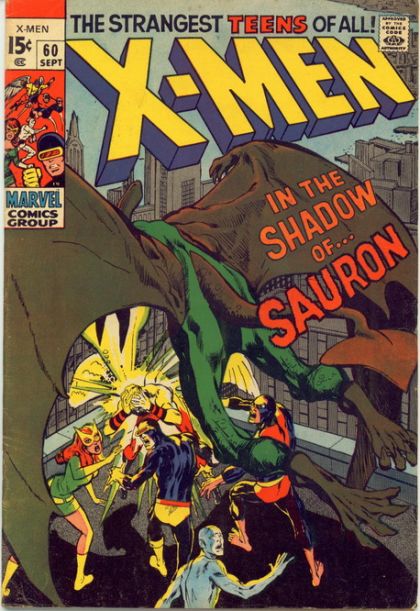
In the Shadow of...Sauron!


Once upon a time, there existed three things. There were X-Men comics, those purveyors of exciting, soap operatic angst. There was the Comics Code Authority, which carefully kept that soap opera from getting too exciting. And there were pterodactyls, which need no introduction at all.

In those days the Comics Code, that legendarily draconian arbiter of good taste, decreed vampires, werewolves and other such ghouls verboten on the comics pages of the 50s and 60s, primly stating that children had no business reading anything so gruesome. While this mostly served to stamp out the EC horror comics line, it proved something of a stumbling block for superhero comics as well.

Still, there's always potential in vampire stories, even when you can't use vampires, so it came to pass that Roy Thomas and Neil Adams, then creators of X-Men, created themselves a bloodsucker that could pass muster under the suspicious eyes of the Comics Code. They dreamt up a lurching were-dactyl, a vampiric hypnotist that fed on mutant “life energy” and wore the ripped purple pants that must adorn all green, monstrous things. But the creature they had created, burdened with so many contradictory parts, inherited one thing they did not intend.

For Sauron, evil incarnate, has an inferiority complex.


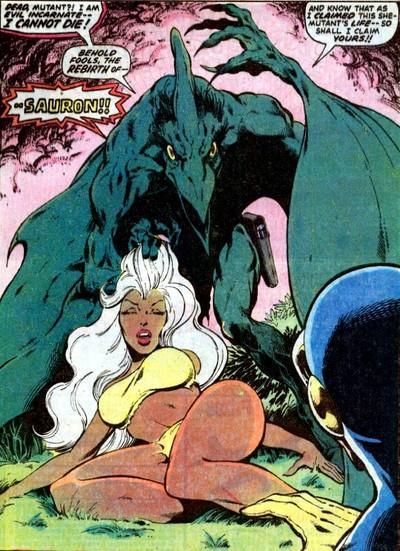
Is it any surprise, with so mixed up a creature as this? He has no fangs for the intimate sucking of blood, no fiery passion that leads one to tear off a shirt and go howling through the woods. He absorbs energy from an awkward, hesitant distance. Even his origin story is cluttered; an ordinary human, scratched by a pterodactyl, who gained energy draining powers and later mutated into his present evil form. And he got the form wrong! His membranous wings are those of a bat, his tail long and yet curiously unimportant looking. He has only to walk into a museum to see that not only is he neither proper vampire nor true werewolf, he’s a pretty poor excuse for a pterosaur too.


The sad thing is that Sauron clearly wants to be taken seriously. Works at it desperately, in fact--he went so far as to name himself after Tolkein's Sauron, which is a perfect a case of reach exceeding grasp as you're ever likely to see. You can imagine him roosting in a tree, watching the X-Men at play, thinking furiously of the most perfect monologue, the most vile threat, and as a result when he finally does come screeching out of the air he’s simply trying to hard. If nothing else, he's desperate to make sure everybody remembers who he is.


Of course, this is not entirely his fault. It’s hard to get the X-Men to focus on anyone other then themselves, and if Sauron overcompensates a little to get them to notice him, well, who can blame him? It’s not as if he can go and bother Tony Stark. Captain America has better things to do then fight weredactyls. The Hulk makes him feel inadequate. No, Sauron only feeds on mutant life energy. He’s stuck with the self absorbed little twits, even as they render him into a neurotic mess.


The X-Men persist, in a profusion of titles, their soap opera a little more risque and even more self obsessed. The Comics Code is gone, its grip on the industry waning in the early 80's. Now if Marvel wants vampires, they can have them. Dracula has a base on the moon. Blade lurks in grimy alleyways, stabbing monsters. Even Spider Man has a vampire supporting character of his very own.

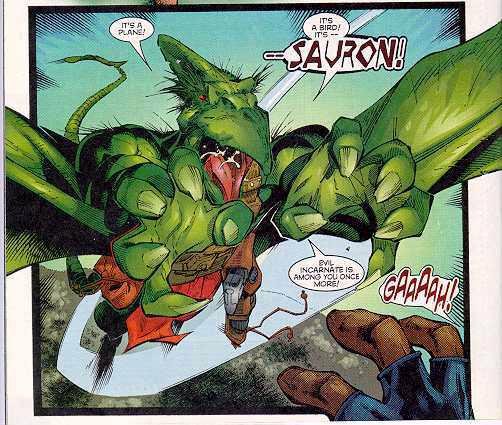
With this undead proliferation Sauron has been banished to the Savage Land, the Marvel warehouse for jungle -pulp characters and concepts. But even there, he pops up occasionally to scream at whichever hero happens to be passing by. This relic of a different time, this shambling anachronism, this histrionic, self pitying creature, refuses to be forgotten.


The pterodactyl, as they say, abides.

Tuesday, December 4, 2012

New duds!

If you're reading this from an RSS feed, bop on over to chasmosaurs.blogspot.com. Just finished a redesign of the site. Back to featuring an actual Chasmosaurus in the header!


Styracosaurs in Love and War

Ah, Dinosaur Revolution. Er, Dinotasia. Mishandled by the Discovery Channel, never allowed to blossom into its own splendid weirdness, reviled by critics (seriously, they did not like it). Director David Krentz has shared another bit of pre-production material on the Facebook page: an animatic depicting a story of Stryracosaurus intraspecific combat cut from the production. It's enjoyable on its own, but it would be wonderful to see it fully realized one day.


That desire to see it fully fleshed out just takes me back to those days of anticipating what I hoped would be a much larger phenomenon. It was always fun to see Krentz's promotional videos for DR before it aired; they were a perfect illustration of the joy so many of us take in prehistoric animals, as in this walkthrough of the Rahonavis sequence:


Regardless of the eventual handling of the work, Dinosaur Revolution must have been a joy to work on. And these rough sketches from Krentz's pen have more soul in one stroke than the entire horde of shoddy CG dinos populating the shelves of bookstores do (before you accuse me of prejudice, keep in mind that it's against the shoddy part, not the CG part). Eh. I'm feeling cranky. At least it doesn't seem that Krentz has given up; in a recent email to the Dinosaur Mailing List, he asked for other perspectives on the potential for scientific institutions to collaborate with media companies in mutually beneficial arrangements. I really hope we haven't seen the last of his work in documentaries.

UPDATE: Dinosaur blogger Mark Wildman has informed me in the comments of this post that in the UK at least, the production has been reaired under its original Reign of the Dinosaurs title. It will premiere this Thursday on the Discovery Channel at 9 o'clock GMT.

More on Dinosaur Revolution:
In Defense of Dinosaur Revolution
Review of Parts One and Two