Welcome back, everybody! Where last we left off, I'd done a brief, illustrated survey of some notable
Alabama Cretaceous marine fauna. Here, we turn out attention to some of the archosaurs that would have lived in the parts of the state not covered in seawater.
I speak, of course, of dinosaurs. Mostly.
 |
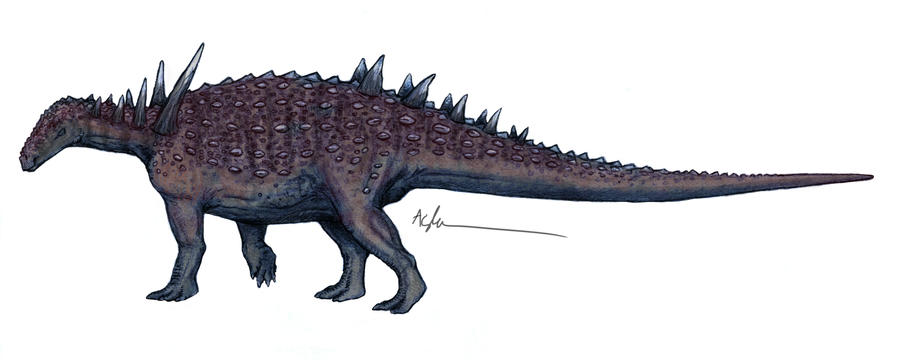
| Nodosaurid © Asher Elbein |
Alabama has quite decent nodosaur remains, most of them the product of carcasses washed out to sea by floods and river currents. There, the bodies bloated and were extensively scavenged before they sank to the bottom. This is my first ever attempt at an armored dinosaur (or at least, the first I'm willing to show in public) and I initially thought of restoring it with bright warning coloration, similar to that of a hornet or a yellow jacket. Suffice to say, it didn't really work, so I defaulted to a more hippo-like pattern instead.
I'm somewhat taken with the idea of nodosaurs dozing in mudpits, small feathered dinosaurs perching on their spikes. It might be worth illustrating at some point.
 |
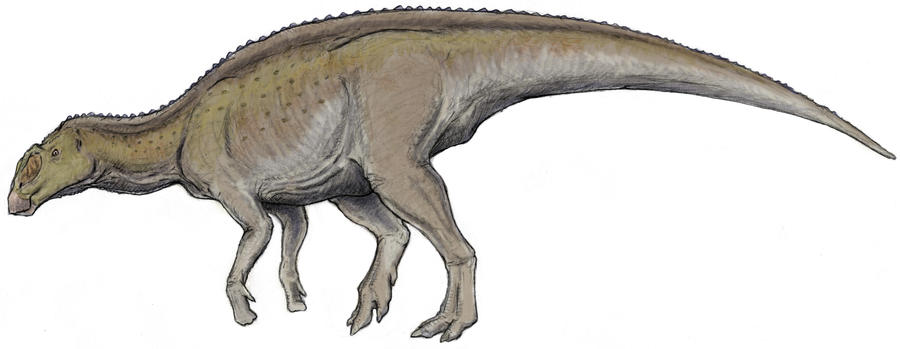
| Lophorhothon © Asher Elbein |
Lophorhothon is Alabama's main hadrosaurid, and like the nodosaur remains it occurs primarily in marine deposits. It has the twin dignities of being both Alabama's first recorded dinosaur genus and being one of its most taxonomically uncertain; there's some debate as to where, precisely, it fits with regards to other hadrosaurs (or if it's even a hadrosaur at all.) Following the prevailing opinion, I went ahead and restored it as something similar to
Prosaurolophus. I wanted something restrained and somewhat dignified, so I turned to a color scheme reminiscent of African grazing mammals.
 |
| Dromaeosaurid © Asher Elbein |
The most speculative reconstruction of the bunch. Dromaeosaur fossils in Alabama are extremely rare, centering around a few scattered bits and a preserved feather or two. It's not that surprising; small size and light bones make dromaeosaurs fairly chancy when it comes to preservation, and in marine deposits the likelihood of a carcass lasting is virtually nil. Given that, this is best understood as guess at what an Alabama dromaeosaur might look like.
I took this illustration as a chance to play around with some different ways to render feathers (I'm particularly proud of the neck region.) The patterns are based--extremely loosely--on the Caracara, a modern raptor that spends a fair amount of time on the ground.
 |
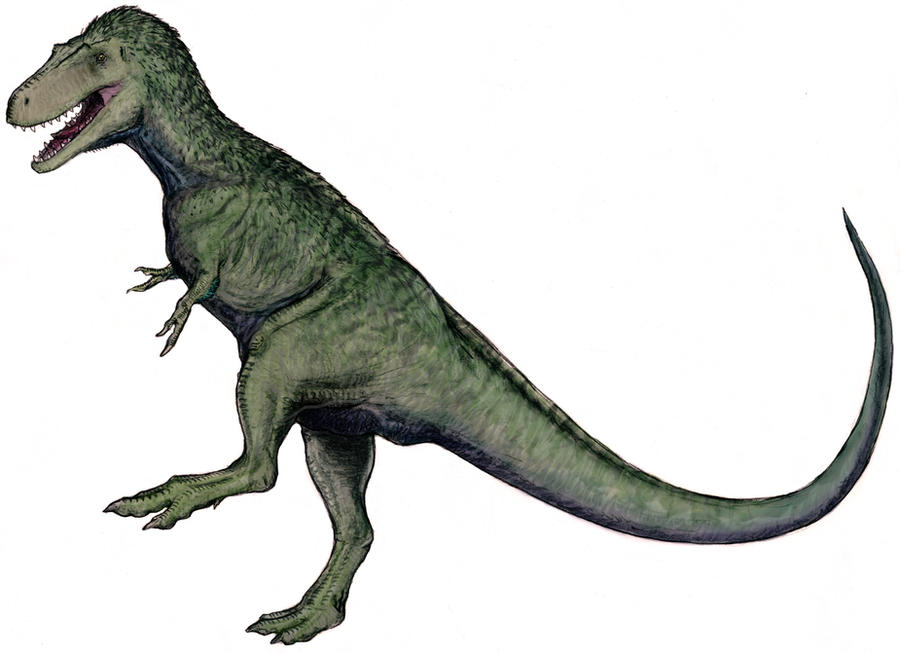
| Appalachiosaurus © Asher Elbein |
No Cretaceous dinosaur assemblage is complete without a big theropod, so here we have
Appalachiosaurus, the 30 foot tyrannosaurid.
Appalachiosaurus also has the distinction of being the most completely known theropod from the eastern coast of North America, a part of the country that lacks the excellent fossil fields out west. The mounted specimen at the McWayne Science Center shows large, three clawed arms. I'm unsure of the accuracy--nothing has apparently been published yet--so I chose to restore
Appalachiosaurus as a fairly typical albertosaurid. I gave it a sparse covering of protofeathers on the head and neck, and based the coloration on that of the Emerald Swift, an extremely pretty little lizard common in Central America. There was no particular scientific reason for doing so; I just liked the challenge of adapting the color scheme to an animal of radically different size and shape.
Of all of the reconstructions, this is the one I suspect is going to be rendered invalid by later publications, but one of the nice things about paleontological art is that it affords you the opportunity to make guesses that may or may not be correct.
 |
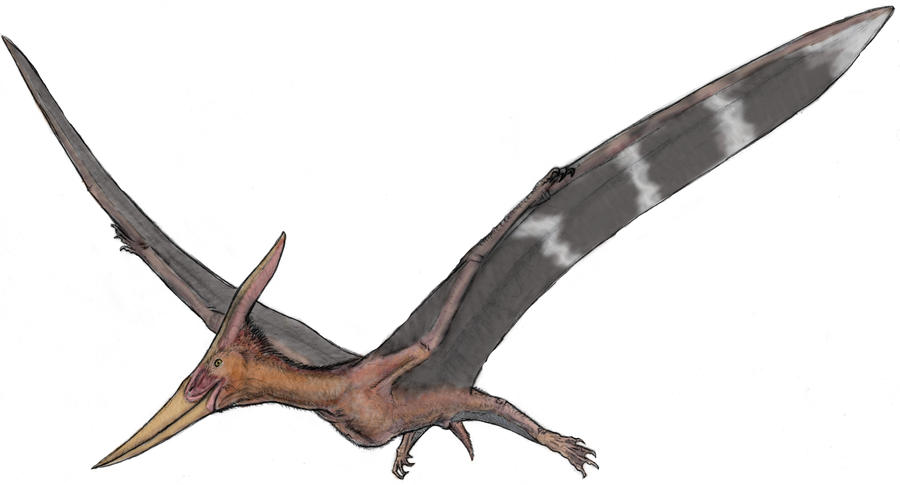
| Pteranodon © Asher Elbein |
Finally,
Pteranodon. Probably the most famous animal in this post, and naturally so. Everybody loves
Pteranodon. I chose to reconstruct this particular beast with the wing arrangement favored by John Conway, as I've always found it very aesthetically pleasing. I also gave the animal a small mane under the crest, which would fluff up for display purposes. I decided to avoid the typical sea bird coloration for this illustration. While there a good reasons to believe that
Pteranodon might have been so adorned, I wanted to try something different; to wit, a giant fruit bat. I also chose to make the crest less brightly colored, again for the sake of being contrary.
And that's it, folks! This artistic summary of Alabama's Cretaceous life now draws to a close. If you liked the art, feel free to head over to ashere.deviantart.com, for all your folkloric and dinosaurian needs.
Tune in next time for more comic book dinosaurs and a dissection of why, exactly,
The Valley of Gwangi is so great.