Showing posts with label field museum. Show all posts

Wednesday, February 22, 2017

Return to Evolving Planet

A line of people snakes through the north entryway, populated mostly by locals taking advantage of a promotion offering free entry for state residents. From the middle of a group of twentysomethings, I hear a man's voice express mild disappointment as he peers past the ticket counters at the famous tyrant dinosaur beyond.

"I thought she'd be bigger."

"Just wait 'til you're below her," I respond.

Queen Sue. Photo by David Orr.

After attending the Wild Things conference this weekend, conversing with all sorts of people about conservation and urban ecology in the Midwest US, I grabbed the chance to visit the Field Museum.

The Field is one of my favorite places to spend a day indoors. In a previous post, I did a walkthrough of the Field's dinosaur hall (with more photos here). I thought that this time, I might aim a more critical eye at the exhibit, especially concerning the role of paleoart. Due to the heavy weekend crowd, I didn't even try for exhaustive documentation, but I think I got enough to be worth sharing here, and I'll supplement with some of my older photos. I'd also recommend Ben Miller's thoughtful walkthrough and review of the entire Evolving Planet exhibit at Extinct Monsters.
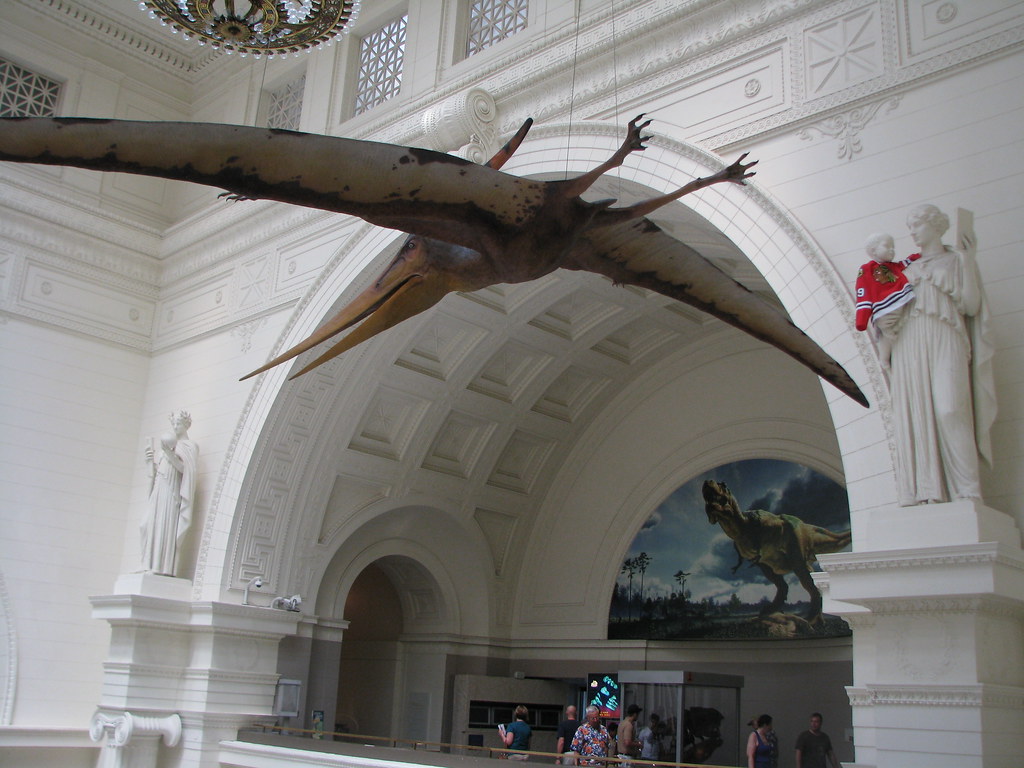
A Pteranodon model with the John Gurche "Sue" mural in the background.

The most visible pieces of 2-D paleoart in the Field are the Charles R. Knight murals, mounted high around the perimeter of the dinosaur hall as well as select positions along the exhibit's length. They surely deserve prominent display (the first paleoart visitors encounter would be Gurche's Sue mural overlooking the queen herself). I would love to see more contemporary artists given more prominence. Perhaps a revisit of classic Knight scenarios and compositions, with information given about the evolution of ideas in the last century of paleontological study.

Daspletosaurus mount with classic Knight Tyrannosaurus v. Triceratops in the background.
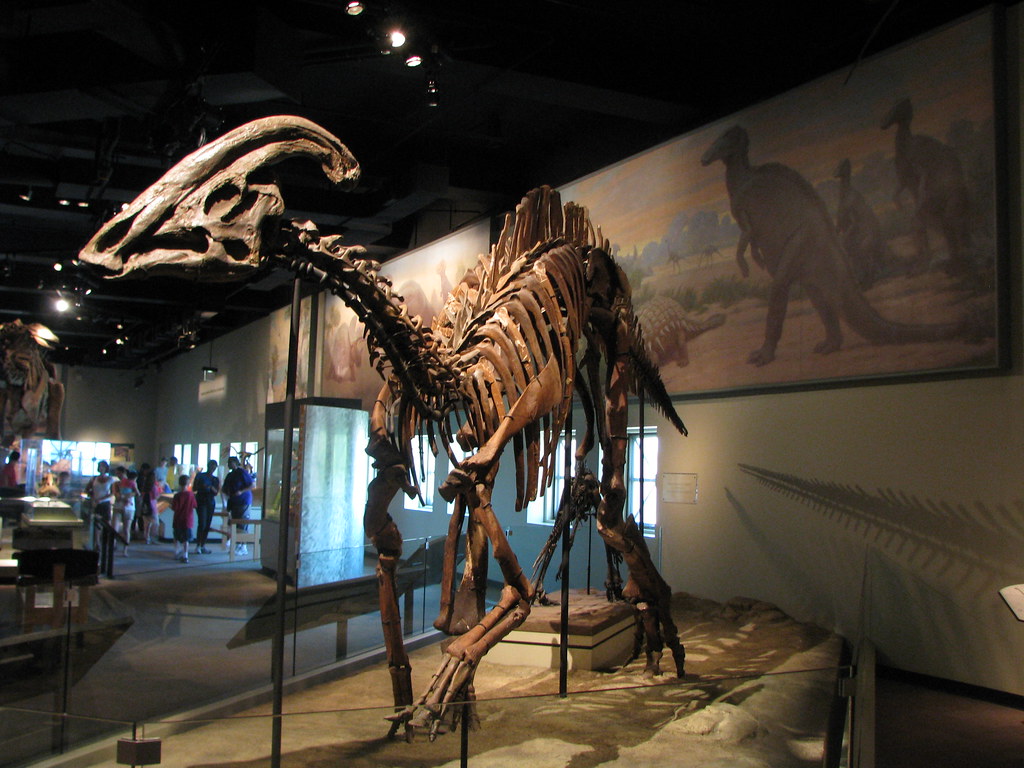
A mount of Parasaurolophus with retro Knight hadrosaurs in the background.
Pteranodon skeletal model with retro Tylosaurus and Archelon in the background.

Is that sacrilege? Maybe it is, but for the collection's importance to the history of paleoart, these pieces arguably work at cross-purposes to the content of the exhibit. In Evolving Planet, aside from "how do we know this?" passages on informational panels intended to counter creationist prejudices visitors may bring with them, the story of the science isn't foregrounded.* So it's a bit counterproductive to have so much antiquated scientific illustration present, without equally prominent discussion of how the science has progressed. In a museum where space is at a premium, it may be a pipe dream, but it's a pipe dream I like.

This is not to say that the art's vintage is entirely unremarked upon: for instance, Knight's place in the history of the science is called out in one of the informational panels, opposite the Stegosaurus mount.

Charles R. Knight's Stegosaurus

The exhibit isn't entirely devoid of newer art. The didactic panels accompanying fossil mounts include serviceable, if sometimes shrink-wrappy, occasionally GSP-posed, illustrations of the animals.

Illustration of Edmontonia, in a familiar pose.
Illustration of a skinny-necked Rapetosaurus juvenile.

There's no information on the artist. The style is sometimes too airbrushy, which doesn't do much for me personally.

Illustration of Stegoceras
Majungatholus, er, Majungasaurus illustration.

Some of the panels also include cladistic diagrams, which are helpful to ground the animals in their evolutionary context. There's even an explanation of what a cladogram is, and tough words like "Marginocephalians." Contrast this with a panel earlier in the exhibit, in which the Ediacaran biota is referred to simply as the "earliest animals." Such concision is understandable. But the amount of fine-grain information provided in the dinosaur hall implicitly confirms a visitor's idea that these animals are of the utmost importance.

Sauropod cladogram, with a scrawny-necked Apatosaurus in the middle.
Marginocephalian cladogram, featuring Triceratops. Protoceratops, and Anchiceratops illustrations. No pachycephalosaurs for you!.

In the small pocket of the hall dedicated to the evolution of birds, casts of Archaeopteryx and Sinornis fossils are accompanied by fully feathered models, as well as illustrations of Deinonychus and Sinornithosaurus in the old-school, grudgingly feathered mode.

A lightly feathered Sinornithosaurus illustration.
A similarly lightly feathered Deinonychus illustration.
The Archaeopteryx model.
The grumpy Sinornis model.

The theropods aren't the only 3-D work on display. The Parasaurolophus vocalization model is pretty great, and after visitors meet the iconic Herrerasaurus model upon entry to the dinosaur hall, they even get the chance to breeze by a big model of a plant.

Hey, look! A bennettitales model!

"Evolving Planet" is a great exhibit, and one I recommend to anyone visiting Chicago. Attentive visitors will definitely walk out of it with new knowledge of and appreciation for evolutionary history. Though this post may seem a bit nit-picky, it was valuable for me to visit with the intention of doing more than ogling the mounts one more time. After all, the exhibit turns 11 this year. It's reached the age of the exhibit it replaced, "Life Through Time." So it's only natural that it is starting to show its age. I think it's a good time to imagine the next form a paleontological exhibit may take at the Field. My wishlist? More on bird evolution in the dinosaur hall. And throughout, more contemporary paleoart integrated with displayed fossil specimens, more on the stories of how discoveries have been made and how they've enriched our understanding of life's history.

But hey, you can't complain too much when Tiktaalik is at the party.

Model of Tiktaalik roseae at the Field Museum.

* To see an exhibit at the Field that explicitly brings the scientific process into its narrative (see their compact-but-wonderful Lichens exhibit).

Thursday, August 4, 2011

The Field Museum's Antarctic Expeditions

In April, Chicago's Field Museum launched a podcast series called "Science at the FMNH." the last four episodes have focused on the museum's Antarctic expeditions led by Pete Mackovicky and Nate Smith. The team looks to flesh out our understanding of life there in the Mesozoic, when Antarctica was more like the Pacific Northwest than the icebound desert it is today. In these four videos, Mackovicky and Smith discuss what they aim to find, the difficulties of fieldwork at the South Pole, and what we know about the dinosaurs who lived there. For your convenience, here are those episodes. Grab a suitable portion of your preferred beverage, put your feet up, and enjoy.


Science at FMNH - Antarctica Paleontology from Science at FMNH on Vimeo.


Science at FMNH - Challenging Field Work from Science at FMNH on Vimeo.


Science at FMNH - Polar Dinosaurs from Science at FMNH on Vimeo.


Science at FMNH – Dinosaur Body Size and Environment from Science at FMNH on Vimeo.

Wednesday, May 18, 2011

The Captain Marshall Field Expeditions for Vertebrate Paleontology

Noon camp in Arroyo

The Field Museum Library has shared a collection of photographs from the institution's expeditions to South America in the 1920's. The expeditions were undertaken with the goal of finding Cenozoic mammals and comparing them to their northern hemisphere counterparts, but at least a couple dinosaurs popped up, as well. Not just any dinosaurs. Huge dinosaurs. Enormous Argentinian sauropods like Antarctosaurus and Argyrosaurus, which to this day aren't well-understood or studied.

John B. Abbott excavating dinosaur femur
Geology preparator John B. Abbott with Antarctosaurus femur

Argyrosaurus femur in situ

Some mammals turned up as well, of course, including Megatherium, Scelidodon, and Panochthus.

Excavation of fossils of Megatherium
Elmer S. Riggs excavates a Megatherium

Excavating skeleton of Scelidodon
Unidentified worker digs up Scelidodon

Robert Thorne at Panochtus skeleton
Robert Thorne with Panochtus, a glyptodont

The bulk of the collection, however, is made up of photos taken during the groups' travels, capturing snapshots of life in Argentina in the '20s. See more.

Wednesday, January 5, 2011

The Stupid Lizard

If you've got a bit of spare time, the library of the Field Museum's flickr photostream is well worth a look. It features a nifty set of photos from the days before the institution moved to its current home on the Lake Michigan Waterfront. During its first couple decades, it was located on the spot where the Museum of Science Industry stands presently.

Those were the days before the well-populated dinosaur halls we're lucky enough to wander through today. One Mesozoic denizen of the Field was a reproduction of America's first complete and mounted dinosaur, Joseph Leidy's Hadrosaurus foulkii, towering over a pair of Cenozoic mammals, as if to boast, "I'm basically a Mesozoic cow, y'all!"

Paleo reconstructions

Besides the simple enjoyment of old photos, online galleries like this one sometimes contain unexpected glimpses into paleontology as it happened. One of the photos shared by the Field library is this sauropod leg found in 1899, identified as Morosaurus impar. Morosaurus is probably one of the most hilariously awful names ever imposed on a dinosaur, meaning "stupid lizard." This was a flash of genius from the Great Dismal Swamp himself, O.C. Marsh.

Morosaurus impar right forelimb

Much of the plate was painted white to mask out the leg for photographic reproduction. That reproduction was then used for a 1901 paper written by Field geology curator Elmer S. Riggs. Besides describing this forelimb, Riggs briefly touches on the taxonomic status of Morosaurus and another sauropod, Atlantosaurus. In the kind of taxonomic bloat that characterized the Bone Wars era, Marsh had assigned about a dozen specimens between the two genera to their own species (see Morosaurus and Atlantosaurus at the Dinosaur Encyclopedia). Having visited with Henry Fairfield Osborn recently - who was preparing a monograph on E.D. Cope's Camarasaurus - Riggs foresaw the demotion of both of the genera, writing,
"In his original description Cope predicted the unusually long humerus which the Museum specimen has so well demonstrated. The three specimens may thus be regarded as representatives of a single genus, which, in view of its priority, should retain the generic name Camarosaurus [sic]. The description of the type specimen promised by Dr. Osborn will doubtless throw further light upon the relationship of this interesting group."
Though he produced a few works on sauropod anatomy in the years after Riggs wrote this, it wouldn't be until 1921 that Osborne's great monograph would be published. A mere four years later, it was topped by Charles Gilmore's monograph on Camarasaurus, starring what is still considered the finest sauropod skeleton ever excavated. Gilmore's monograph also spelled curtains for the stupid lizard, synonomizing it with Camarasaurus, which took precedent. Though "chamber lizard" isn't exactly glamorous, it's quite a step up from the demeaning epithet thought up by Marsh.

Camarasaurus - 01
The famous Carnegie Camarasaurus, star of the Gilmore monograph. Photo by Kabacchi, via flickr.

For more on the Camarasaurus monographs of the early 20th century, check out these two pages at the wonderful Linda Hall Museum Paper Dinosaurs digital exhibition.

Friday, July 30, 2010

Vintage Dinosaur Art: Charles R. Knight

knight_the_real_thing
Charles R. Knight's most famous painting. From Norman Felchle, via flickr.

There's really no other way to wrap up this week than with Charles R. Knight, one of the three early giants of paleoart and probably the best known. His work is showcased all over the Field Museum, and casts a long shadow over the paleoart of most of the last century. Many of his dinosaurs became the iconic representations of their taxa, arguably persisting even after the dinosaur renaissance of the last thirty to forty years radically altered our ideas of their posture, physiology, evolutionary affinities, and even behavior.

Knight, born in 1874, was working at a time that paleontology truly was a new frontier: the bitter rivalry between paleontologists Othniel Charles Marsh and Edward Drinker Cope had resulted in many fossils being pulled out of the American west, and exactly what they all meant was still being sorted out. It didn't help that Marsh and Cope's bone war produced a tangled taxonomy that's still being sorted out today. Witness Knight's Agathaumas, a piece based on a smattering of fossils named by Cope. It required him to fill in with his imagination what time did not preserve.


Knight's very reptilian Agathaumas. From wikimedia commons.

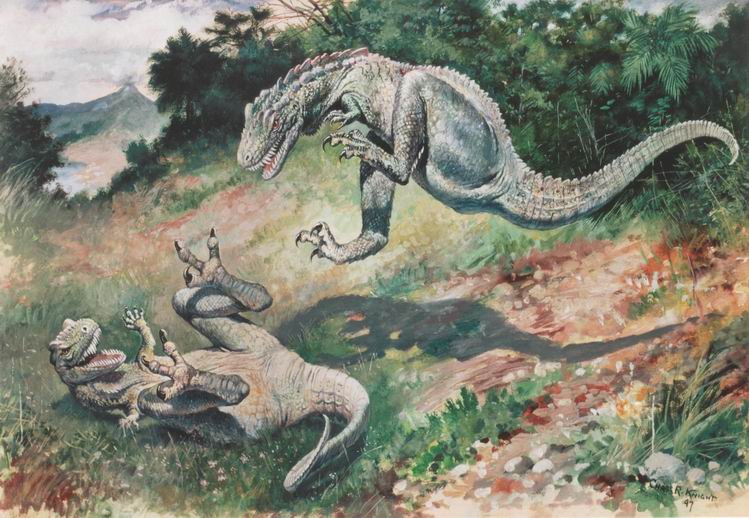
An astute commenter reminded me of the Knight Agathaumas a couple of weeks ago when I wrote about a similar version, by German artist Heinrich Harder. I had seen it before, but for some reason didn't associate it with Knight. It's not one of his truly iconic pieces, though I am oddly attracted to it. It's certainly a relic of a time when dinosaurs were believed to be much more reptilian than our modern conception of them as a truly unique branch on the tree of life. This Agathaumas has iguana-like features, and you can see an affinity to my favorite Knight piece, Leaping Laelaps.


From wikimedia commons.

Aggie could be right around the bend, really. This is my favorite dinosaur painting of all time. It's not posed; it's a snapshot of these dinosaur's lives. Laelaps is now known as Dryptosaurus, and though the anatomy here isn't up to date, it's irrelevant. This is the kind of piece that plants a seed and inspires a person to explore natural history.

Amazingly, Knight was nearly blind. Not only had he inherited astigmatism, an errant rock severely damaged his right eye when he was only six. These expansive visions of prehistoric life were created by a man who had to work with his face inches from the canvas to see what he was doing.


Trachodon, now Anatotitan. From wikimedia commons.

Knight's paintings were a doorway through which artists could explore prehistoric worlds, but I also think about the impact they had on other observers. Imagine stepping into the Field Museum or the American Museum of Natural History at a time before television existed. Knight's colossal murals would have plunged visitors into the depths of Earth's history, bringing them face to face with a cultureless world, expanding their imaginations. I wish I could rewire my brain so I could experience these paintings as purely as their original audiences did.


Knight's La Brea Tar Pits mural. From wikimedia commons.

I've recommended it before, and I'll do it again. Indiana University Press's commemorative edition of Knight's Life Through the Ages is a great addition to your bookshelf. It goes well beyond his Mesozoic reconstructions and shows just how absorbed he was by nature in general, and how vivid his imagination was when conjuring scenes lost to the ages. It's also a great read, having been published in the mid 1940's, when Knight was a science lecturer as well as artist. Some of his page-long descriptions read like he was pitching them to Walt Disney for use in Fantasia: "A gentle breeze blows softly through the forest glades; the silence is oppressive, for no song of birds, no cry of an animal breaks the stillness of that shadowed land," he writes, describing a scene from the Carboniferous. Stephen Jay Gould wrote a foreword for this edition, and as a long admirer of Knight's, it makes you wonder if some of his gaudier prose was inspired in part by Knight.


More on Knight: The official website, chock full of information and images. The Open Source Paleontologist reviewed Knight's autobiography. Check out the Field Museum's Knight collection on-line here. It would behoove you to check out William Stout's Knight sketchbooks. Browse the Vintage Dinosaur Art flickr pool to see plenty of examples of blatant Knight rip offs!

Thursday, July 29, 2010

Interview: Lindsay Zanno

Today, as part of Field Museum week, I'm very happy to present an interview with Dr. Lindsay Zanno, John Caldwell-Meeker Postdoctoral Fellow in the museum's geology department. After watching Waking the T. rex, I told my wife that I may have been the only person in the theater to think, "hey, there's Lindsay Zanno!" when she entered the frame, searching the desert for pieces of the Mesozoic.

Her profile may be low for now, but I suspect that her star will continue to rise as her career progresses: she was a natural on screen, and as you'll read, she's an enthusiastic, insightful ambassador of science. She gave her thoughts on the Field, Robo Sue, her doctoral advisor Scott Sampson, and her important work on North American therizinosaurs.

Can you tell us a bit about your own childhood experiences with museums, or any other formative experiences that encouraged your interest in natural history?

As a child I can remember visiting the American Museum of Natural History near my home in NY. It was a profound and wondrous experience, full of mysterious objects in looming glass cases. At the time I thought that to work there was the most venerable job to which one could aspire; and yet, I’d have to say my love for natural history stems from a deeper place. Put simply, I have a primal fascination with the ancient, an emotive connection with history (last week I had the immense pleasure of discovering a hand-forged tack in the 19th century sofa I am reupholstering and spent a few glorious moments imagining the workshop in which it was made and the man who hammered it in 150 years ago).

To my mind, fossils are the epitome of antiquity. Fossils illuminate a foreign world almost beyond human comprehension, yet incredibly accessible. You can stand where a tyrannosaur once stood, you can hold a dromaeosaur tooth that ripped the flesh of an unfortunate victim in your hand, and you never know what lies around the next hill waiting to be discovered. Therein lies the rub. It’s a simple draw to the antiquity and the wonderment of its history.

Had you been familiar with the Field Museum before you pursued your fellowship?

Yes of course! The Field Museum is a pillar of science and culture. It was founded on the idea that to educate the children of the Midwest about the natural world was a noble and paramount endeavor and it now continues that legacy by educating people all over the world about their past, present, and future.

Has working for the Field offered you any unique opportunities? What parts of their collections do you find most exciting?

Working at the Field is a great honor and not a day goes by that I don’t recognize it as a gift. The staff, scientists, and volunteers are extremely dedicated and exude a pure and contagious joy for their work. Being part of such a brilliant and talented team of individuals who strive every day to better understand the world we live in for the protection of our past and the uncertainty of our future is by far the grandest part. They are my favorite part of the museum’s “collections!”


Lindsay and Fossil Vertebrates Collections Manager Bill Simpson at a Waking the T. rex shoot. Photo credit: David Clark

What is your perspective on museum exhibits like "Robo Sue?" As a visitor, I have a pragmatic attitude towards them, though they're not really my cup of tea. Do you think that they have a real impact, positively or negatively?

Exhibits such as “Robo Sue” are not designed to educate the public and no doubt there are individuals who don’t favor the concept. To my mind the role of the modern museum is about more than just education and research, it’s also about inspiration. In our technologically frenzied and increasingly displaced world, inspiration brought on by tactile exploration, by physical interaction, is hard to come by. Many scientists that I know believe this is one of the greatest problems facing modern society—a disjunct with our own natural environment and I concur.

“Robo Sue” is intended to be an immersive experience; the point is to embrace visitors, allow them to step inside the Cretaceous for a moment and feel the enchantment. It may not transport everyone, but with a little bit of imagination, there is the great opportunity to ignite a fascination with the natural world.

You've done a lot of work on therizinosaurs. What brought you to their study and what questions about them do you most want to explore?

Therizinosaurs fell into my lap as a grad student and I knew very little about them. In fact, to be honest, I had never even heard of them! I had just graduated with a degree in biological anthropology and was a dinosaur neophyte. I feel terribly lucky to have been given the opportunity by Jim Kirkland and my advisor to work on a new species of therizinosaur from Utah and the more I studied the group the more interesting they became. Therizinosaurs are certainly oddballs in the “predatory” dinosaur world (in no small part because they were plant-eaters). I used to think this little incongruity set them apart from their maniraptoran cousins; however, my latest research supports the idea that plant-eating was widespread among maniraptorans and likely had a big impact on their evolutionary history. This is the aspect I am most interested in exploring.

Do you participate in the on-line science community (i.e. blogs, mailing lists, forums, open-source journals) at all? Do you feel that it's becoming an important part of the scientific dialogue?

Yes, somewhat on all counts. The on-line science community has its place but as I said I am a bit of a curmudgeon when it comes to technology--we are a TV-free house and I only carry a cell-phone because it was gifted to me! I fear that technology is taking the place of real exploration. Open-source journals are surely a positive advance and the increased ease of communication with colleagues a benefit of mailing lists etc., but we should take care to get away from the computer screen now and then. Science is best done hands-on.

Do you think you'll stick with Mesozoic beasts or are you interested in other extinct animals?

Surely I am interested in life beyond the Mesozoic. For now, however, my feet are firmly planted there, research-wise.

Scott Sampson has a growing reputation in pop culture, between Dinosaur Odyssey and his work on "Dinosaur Train." Do you think he could be a Sagan/ DeGrasse-Tyson level science popularizer?

Oh, I think he’d be delighted at the comparison. Scott is a brilliant man, a talented writer, and has a great passion for inspiring the populace to connect with their environment and take responsibility for securing its future. He seems to have found his niche in the public realm and I believe it is his true calling. Being a vector between science and the public is not something we all can do and, unfortunately, it is often greatly undervalued in the academic realm making it difficult to achieve in any great capacity. I am grateful he is out there fighting the good fight and I know that the rest of the paleontological community is as well.

* * *

Huge thanks to Dr. Zanno for doing this interview. For more, read my posts on her recent osteology of Falcarius and therizinosaurs' place in the maniraptoran family tree.

Wednesday, July 28, 2010

The Elizabeth Morse Genius Dinosaur Hall

Most of the Field Museum's dinosaurs and other mesozoic fossils are housed in the Elizabeth Morse Genius Dinosaur Hall. It takes up the middle third of the Evolving Planet exhibit, which leads visitors from the Precambrian beginning of life on Earth to the Cenozoic origin of our species.

The first dinosaur you meet after passing through the Field's impressive selection of Permian critters is Herrerasaurus, a beast so low on the dinosaur family tree that its status as a dinosaur has been doubted in the past.

Herrerasaurus

The hall is roughly divided by the great clans of dinosaurs. First up, the armor-bearers, the clade known as the thyreophorans, get a little action, in the form of a Stegosaurus and an ankylosaur skull and tail club.

Stegosaurus

Team sauropod is represented by a composite mount of Apatosaurus as well as diminutive Rapetosaurus, a fairly recently discovered Malagasy titanosaur. There's also a case showing off a variety of sauropod skulls.

Rapetosaurus and Apatosaurus

Theropods aren't neglected, of course, with a section devoted to dromaeosaurs, including Deinonychus and Buitreraptor.

Deinonychus and Buitreraptor

I've mentioned before that the entrance hall of the Field used to have a mount of an Albertosaurus standing over a fallen Lambeosaurus. When it was found that parts of the skull had been remodeled in plaster, it existed in a taxonomical limbo, until 1999, when Thomas Carr reassigned it to Daspletosaurus.

Daspletosaurus

Daspletosaurus and Lambeosaurus

Then it's back to the ornithischians, with a selection of ceratopsian material, including an Anchiceratops frill.

Ceratopsians

Triceratops

Partial Anchiceratops Skull

Besides the Lambeosaurus who so graciously provides Daspletosaurus with his supper, the ornithopods present are a Maiasaura calf and an impressive specimen of Parasaurolophus. One of the most popular features in the hall is the "musical" Parasaurolophus head, which lets visitors hear what one of the big honkers may have sounded like.

The Musical Parasaurolophus Head

Parasaurolophus

Maiasaura Calf

As you can see behind the Parasaurolophus above, one of the coolest parts of the hall is that the murals of Charles R. Knight are still hanging on the walls. An informational plaque near the Daspletosaurus also gives Knight's background. It's a good tie to Field history, and I hope that people take the time to appreciate them.

Beyond the Genius Hall, you should also stop in at the newly renovated Grainger Hall of Gems, home to an unexpected treat from the Mesozoic: an opalized Plesiosaurus vertebra. The first step in its formation was when water enriched with silica filled a cavity left by the decayed bone. A cast of the bone was left behind when the water evaporated, leaving behind a silica gel which hardened into opal.

Opalized Plesiosaur Vertebra

The dinosaur action didn't end inside the museum, though. After we exited the building, we saw that a small theropod was waiting to say goodbye: a gull, perched on a stone pillar overlooking the marina. I was pretty surprised that he let me get as close as I did. I kept inching closer, thinking I'd scare him away, but he stood his ground, completely at ease, as happy to pose for the camera as his fossil cousins inside.

IMG_4407

Feel free to check out more photos in this Flickr set.

Tuesday, July 27, 2010

Sue vs. Mecha-Sue

Sue

Entering through the Field Museum's north entrance, you are immediately greeted by the museum's centerpiece, the Tyrannosaurus rex nicknamed Sue. I'm not going to rehash the story of how Sue ended up at the Field again; instead I'll talk about the exhibits themselves: Sue herself, Robo Sue, and the new Sue 3-D movie.

The original is still the best. Sue is one of the best mounts I've ever seen; you really get a sense of the beast's power in life. There's not much to say. You just have to see it in person to appreciate it.

Sue's Healed Ribs
Her ribs show signs of injury and healing.

Sue
Those holes have been attributed to a Trichomonas-like infection.

Sue

Sue

The Field's dinosaur hall is located on the upper floor as part of the larger Evolving Planet exhibit, and before entering it, you get a chance to view Sue from above. The balcony to Sue's rear holds more of Sue, such as her original skull, which is too heavy to be mounted.

Sue Overhead

It's a clever set-up that allows you to take in the entirety of the dinosaur from a distance, as you check out casts of some of her tail vertebrae and wishbone.

Sue's Caudal Vertebrae

Sue's Furcula

To celebrate the 10th anniversary of Sue's unveiling, the Field teamed with Kumotek Robotics to create a temporary exhibit called "Robo Sue." As the Sue Escapes website says, "these fearsome dinosaurs will react to your every move, sizing you up as friend, foe--or their next meal!"

There are three main parts to the exhibit: a pack of the dromaeosaur Saurornitholestes, a Triceratops guarding her nest, and Robo Sue herself.

Saurornitholestes Robot

Robo Trike

Robo Trike Hatchlings

Robo Sue

I couldn't help but think of Richard Fortey's Trilobite when I was in the exhibit, in which he longed for the days of simple exhibits that highlighted the fossil above all; he saw the "herky-jerky" animatronics as a mockery, not a tribute. In a recent post on the exhibit, Brian Switek quoted a Stephen Jay Gould passage which echoed these thoughts.

I tend to fall into this camp, to be honest. I appreciated the engineering, but the fleshed out robots didn't do anything to spur my imagination - I find the life-size diorama of a Carboniferous forest in the Evolving Planet exhibit more compelling. The final stop in the Robo Sue loop is a game in which the visitor is tasked with guessing what behavior a Saurornitholestes puppet is displaying: threat, stalking, or calling to his flock. It's purely speculative and not terribly relevant, other than as a demonstration ofwhat the software could do. There was an elderly lady who found the whole thing marvelous, though.

I know that museums are in a pinch, and need to try new ways of engaging visitors. So I don't begrudge their efforts to use technology to do so. And I'm not even sure that it's not educational. Maybe most people come out of Robo Sue with some new knowledge. For me personally, I get my kicks out of the fossils themselves. I'd much rather spend time in a simpler exhibit chock-full with fossils. I'd love to hear other perspectives on how useful these sort of exhibits are. Are they merely ways to bring in money? Are museums acting on research that suggests they provide real educational value?

Museums aren't the problem, of course. Neither are animatronics. Maybe the problem is whatever constellation of social factors leads museums to consider animatronics necessary. That's something they can't really effect. Alternatively, maybe the problem doesn't exist. Would people really stay away from museums if these exhibits weren't put on? In my experience, it seems that what really generates interest are big traveling exhibits that focus on historically significant artifacts or fossils, but that's just my narrow opinion. Maybe we can convince a few museums to act as controls in an experiment to see what would happen if they kept their exhibits based strictly on fossils and other "authentic objects of nature and culture" as Gould writes in his essay. Then we'll see if these flashy "theme park" exhibits have a legitimate role to play, or are simply reactions to overhyped problems.

I'll tell you what I did really like, though: the 3-D movie about Sue's discovery and what we've learned about her life, Waking the T. rex. I didn't expect to enjoy it as much as I did; 3-D doesn't thrill me. But there was a nice amount of time devoted to field and prep work, with a great personal account of what life in the field is like from Field paleontologist Lindsay Zanno. The CG Sue was alright, but it was the real-world story of scientists figuring out how Sue lived that gave the most value, and it seemed that the audience reacted to it enthusiastically.

Tomorrow: The dinosaurs of the Field beyond Sue: The Elizabeth Morse Genius Dinosaur Hall.