

Showing posts with label Rotterdam. Show all posts
Showing posts with label Rotterdam. Show all posts
Monday, March 3, 2014
Robosaurs in Rotterdam
Rotterdam seems to be a city in which every puffed-up, ever-so-avant garde architect of the last fifty years has been given free rein to erect whatever glass, steel, and/or jutting concrete monstrosity that they fancy. (As John Conway would say, 'take that, Rotterdam!') It seems only fitting, then, that the city should play host to the Living Dinosaurs expo - an exhibition of diverse, often impressively large, but never less than butt-ugly robot dinosaurs. Fans of prehistory-related kitsch will have a field day; palaeontologists may wish to avert their eyes.

Saturday, August 4, 2012
More Natuurhistorisch Museum Rotterdam
Following a look at the Whales of Doom, it's only right and proper that we take a look at what else one might find in the Natuurhistorisch Museum Rotterdam. The museum is quite small - considerably smaller than the Dutch national natural history museum, Naturalis, in Leiden - but is still stuffed with plenty of interesting specimens. The 'lobby' of the original building (it's been extended) is tall but not especially wide, and this giraffe skeleton makes perfect use of the space. Thanks to the staircase winding around it, it's possible to take in this mount from numerous angles, both above and below, which is a real treat. The mammoth mural, just visible here, is very beautiful too (shame I don't have a photo!).

Most of the museum has a rather old-fashioned feel, which is by no means a bad thing. One room has long banks of glass-fronted cabinets absolutely stuffed with taxidermy and skeletal tetrapods, including an awful lot of birds (see below for a sample), with further specimens perched on top.
 More information on the individual species can be found by reading cards nearby, which means that the taxidermy displays are gloriously free of clutter.
 Opposite the taxidermy cabinets there are further displays of bird skeletons, mounted side-by-side for ease of comparison. If you wanted dinosaur skeletons, here they are! In fact, for us enthusiastic laymen who don't have easy access to bird skeletons, it's always useful to be able to peer at a good mount and see just how much like other theropods these animals really are under all the distracting feathers and soft tissue. (The animal in the foreground below, Ramphastos vitellinus, is known as the 'channel-billed toucan' in English.)
 With that in mind, I thought this 'cutaway' parrot was very cool. Notice the neck in particular, and consider how it appears with the feathers covering it - necks lie, after all. (Update: BrianL has identified this birdy as being an Amazona species, most likely Amazona ochrocephala, although the taxonomy of said bird is disputed. Of course, I know sod all about parrots, hadn't noted down which one this was, and was far too bone idle to look it up. That'll learn me!)
 So, no extinct dinosaurs here I'm afraid. However, there are plenty of other fossil animals represented, all of them discovered in or nearby the Netherlands. As one might expect, there is a cast of the famous Mosasaurus hoffmanii specimen from Maastricht among other mosasaur material and marine invertebrate fossils.
 Space is tight in the gallery, but they've still managed to cram in a number of great specimens, including this impressive wooly mammoth skull, the obligatory Megaloceros (just a skull, mind) and a big cat (Panthera) jaw. Got to love a big cat jaw.

 One of the most impressive mounts in the museum is this Asian elephant (Elephas maximus) skeleton. When alive, this elephant was a resident in the zoo in Rotterdam (Diergaarde Blijdorp). In death, its bones stand alone in the circular room that has become its mausoleum. It really is just the elephant in this room, and the lack of distractions really allows the viewer to appreciate this animal's might and majesty, even when reduced to its bare bones. Thanks to the circular nature of the room, it is again possible to walk completely around this skeleton and scrutinise it from a wide variety of angles. It certainly leaves an impression.
 And finally...a jackalope.
 If you're ever in Rotterdam, I thoroughly recommend giving this little museum a visit. Sure, there aren't any (nonavian) dinosaurs, but there are Whales of Doom, a lot of impressive extant animals, and Mark Witton postcards in the gift shop. Entry is only six euros, so there's no excuse!


Tuesday, July 31, 2012
Natuurhistorisch Museum Rotterdam: Whales of Doom!
The Natuurhistorisch Museum Rotterdam is tucked away in a rather unassuming location in the city's Museumpark, but is impossible to miss on immediate approach thanks to an outsized dinosaur silhouette standing proudly outside, while a sperm whale skeleton looms from within the building's glass extension. Thanks to a temporary exhibition (open until 2013), visiting the museum at the moment is all about whales - quite possibly the second most awesome group of animals to have ever lived.

Nature invents the best monsters. Livyatan melvillei, the gigantic physeteroid (or sperm whale relative, if you prefer), seems far too preposterously terrifying to ever have really existed. But exist it did, some 12 million years ago alongside the equally ridiculous 'Megalodon' shark. The Rotterdam exhibition is entitled 'De grootste muil ooit', which translates to 'the biggest mouth ever', and undoubtedly riffs on a quote from the paper describing the beast, in which the authors spoke of "the biggest tetrapod bite ever found". It's a rather good title, although I think it should be 'WHALES OF DOOM', mostly because I thought of that and I'm well funny.

As someone quite accustomed to seeing the large maws of predatory dinosaurs, my first reaction upon seeing the above monstrosity was "BLIMEY!". It's big and no mistake, resembling a squashed sperm whale skull with comically oversized spikes o' doom jutting from its jaws. Livyatan (they wanted to call it Leviathan, but that was preoccupied) was almost certainly a fearsome apex predator, gobbling up other, smaller whales like they were minnows rather than, you know, bloody whales. In the picture below, you can see just how large this animal's reconstructed skull is next to a rather serious-looking dorky man. The Rotterdam museum is hosting this exhibition as a team of theirs was involved in this whale's discovery in Peru.

The mounted skull reconstruction is accompanied by this very lovely artwork. Unfortunately, I didn't take note of the artist's name - if anyone out there does know who painted this, I will be all too happy to put things right.
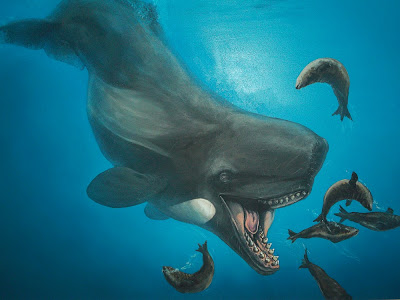
Somewhat later, and smaller, but no less ferocious-looking, Acrophyseter deinodon was discovered in the same part of the world as the mighty Livyatan. The specific name 'deinodon', or 'terrible tooth', is simply perfect.

The oceans of 12 million years ago were a weird world in which miniature baleen whales were gobbled up by gigantic great white-like sharks and sperm whale-like predatory whales. The museum presents an example of the skull of such a baleen whale, Cetotherium. Unfortunately, I can't remember the species...gah! I can only apologise.
 You'd be forgiven for thinking that modern sperm whales (Physeter macrocephalus) look a little toothless after Livyatan, but they remain absolutely awesome - an embodiment of power and mystery. Besides, suction-feeding only sounds wimpy until you consider exactly what these titans are feeding on down there. Gigantic representatives of our own class, tackling Lovecraftian horrors in some of the most inhospitable environments on Earth. #proudtobeamammal

The Peruvian fossil whale exhibition really is fantastic, and is easily worth the six euro entry fee on its own. Generous space is given to examine the whale skulls from every angle, and the fascinating and lengthy signage text is provided in both Dutch and English. I'm certainly not finished with this museum, either - in spite of the lack of nonavian dinosaurs, you can be sure there'll be more in the next few days!
 But for now...bonus nerd-o-points to anyone who can identify this skull, and why it might be in an exhibition alongside Livyatan.


Subscribe to:
Posts (Atom)