Showing posts with label Jane Burton. Show all posts

Wednesday, October 24, 2012

Vintage Dinosaur Art: one last look at The Age of Dinosaurs: A Photographic Record

A final airing for Jane Burton's glorious photographs, with a little 1980s nuttiness along the way! In case you've missed them, check out part 1 and part 2, too.

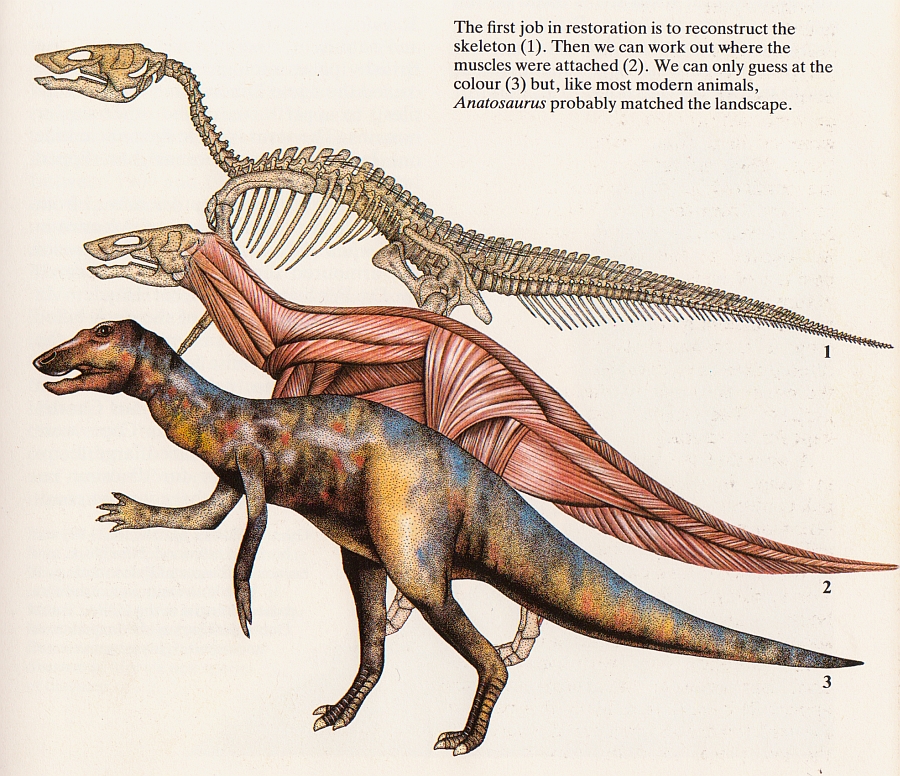
While this book is really all about the photography (of course), there are a small number of illustrations in the opening chapter which, to be honest, aren't really much to write home about. However, at least one is amusing in that it appears to be a lesson in the science of reconstructing extinct animals, as intended for pre-Dino Renaissance palaeoartists.
  1. Start with a thorough, modern skeletal reconstruction.
  2. Carefully apply musculature, based on knowledge of the skeleton and comparisons with living animals.
  3. Ignore all that shit and just draw something that basically resembles what you think the animal in question should look like. Dinosaurs were pathetic evolutionary dead-ends, so be sure to give them spindly limbs incapable of carrying their comically ponderous bulk.

For crying out loud, the skeletal reconstruction won't fit inside the life restoration, never mind the muscular reconstruction. What was the artist (Alan Male, if you were wondering) thinking? At least the hadrosaur is waving hello, albeit while delivering a rather withering look from its not-entirely-in-proportion face.

Back to the photography...we're safe there. In spite of the book's title, a lot of the best photographs actually feature Palaeozoic animals, going back as far as the Carboniferous (yes, the title of this blog series is revealed to be a swizz once again). This study of the minor celebrity and Permian synapsid Dimetrodon is very lovely; a moody depiction of the ever-popular creature rising at dawn, complete with a layer of fog to add that desired element of primordial mystery. The composition and lighting are excellent, and really draw attention to the animal's most famous feature.

Although it's somewhat less convincing overall (the waves in the background photograph make the animals look like the miniatures that they are), the models in this shot of Tanystropheus and Nothosaurus are still wonderful. The eye is drawn immediately to the two sparring nothosaurs in the centre of the scene, flashing their teeth at one another; once again, it creates a sense of the everyday drama of these animals' lives without resorting to over-the-top action and/or motion blur. The careful way that the models have been arranged helps enhance the feel that this is a casual snapshot of real creatures - it's just a shame about the backdrop...

While the main subject of the image below is the therapsid Lycaenops (depicted with very fetching stripy green skin), it's hard to avoid being drawn to the hulking brown brute behind it - what could it be? In fact, it's a rather odd-looking reconstruction of Pareiasaurus, which was closely related to the more popularly known Scutosaurus, and would have looked pretty similar. Still, I love the way that the fanged carnivore is made to look a pipsqueak by the bulky herbivore - it's good to see a pareiasaur standing its ground. Dougal Dixon would like to remind us, however, that
"[Lycaenops] has nothing to fear from the great plant-eater which it could easily kill if it were hungry."
Yeah, whatever, Dougal.

This scene, depicting a Cynognathus family group, is effective for similar reasons to the Dimetrodon picture - it's superbly and evocatively lit (but hasn't scanned well, for which I can only apologise), and while portraying the animals in near-silhouette may seem like a bit of a cop-out, closer inspection reveals that a lot of fine details have been put into the models. The poses are very well observed, too, particularly the juvenile raising its head as if begging for food from its mother.

Dougal Dixon posits that Lystrosaurus, the dicynodont famous for enjoying a global hegemony in the Early Triassic that would make Rupert Murdoch furious with envy, lived an amphibious lifestyle like a modern hippopotamus. Exactly how well-supported this idea is these days I'm not sure, but I have the feeling the answer is 'not very' (readers should feel free to enlighten me!). Regardless, the photo is quite well done, if a little uninteresting. You know, someone really ought to animate its stumpy limbs paddling along, and then we can all stare at it a while listening to a suitable musical accompaniment.

FINALLY...one of the best photos in the book. The Longisquama model is a marvel - packed with extremely fine detail, gloriously painted and shot in pin-sharp focus. These days, Longisquama is best known as the prime candidate for the ancestor of birds, something that Dougal Dixon very presciently mentions:
"It is thought that these specialised scales [on its back] represent an early stage in the evolution of feathers, and so this line of animals could possibly have developed into birds."
Genius. Of course, you do have to ignore all the evidence supporting a dinosaurian origin for the birds, including skeletal, integumentary and even behavioural links in sufficient stacks of specimens to fill the warehouse from Raiders of the Lost Ark. But that's easily done with a bit of harumphing and moving of goalposts, so that's OK.

And with that cheap shot out of the way, I'm all done! Don't worry - the recycling of books ends here, as I'm being loaned some all new tomes via the magic of the mail by a very kind reader. Stick around! Pretty please.

Tuesday, October 9, 2012

Vintage Dinosaur Art: more from The Age of Dinosaurs: A Photographic Record

It's time for another trip into the world of lovingly detailed miniature dinosaurs, as photographed by Jane Burton (with commentary from Dougal Dixon, because it was the 1980s). For those who missed the first part, FOR SHAME! Go back and check that out first - it's worth it for the Saltopus alone. In addition, I don't want to have to introduce the book again. I've got a stinking cold, you know, and am here as long as the mug of Lemsip lasts.

Anyway, without further delay, here's a slightly psychedelic hadrosaur!

While I appreciate a sudden explosion of pink blooms in a book otherwise filled with rather earthy tones as much as the next person, there's something quite uncanny about that eye.This picture is also rather jarring in that there aren't really any other close-ups like this in this book - this flower power Lambeosaurus profile shot seems a bit out of place.

Ah, that's more like it. As with the best shots in this book, there is an effective illusion of scale here, while the two Pachycephalosaurus models are wonderfully detailed and superbly posed, flashing their bright blue heads at one another. By far the best shots in this book are those that avoid any gimmicks and remain sharp and in focus, but this can also result in scenes that are rather static and dull. Having two animals displaying is an effective way to circumvent that problem, as it adds drama to the scene. This is further bolstered by the text, which describes this encounter as the warm up to a full-on headbutting session.

Where there is an attempt at gimmickry - as in the motion blur around these Struthiomimus - things can start to fall apart. Here, the blur is so extreme that it makes the animals look as if they have been fired out of a cannon; it doesn't help that the individual in the foreground appears to be flying over the water. Yeah, we get it, they were fast.

As I mentioned last week, there are only a couple of attempts at sauropods, and it's easy to imagine why - making tiny models of such huge animals look convincing in a photograph must be very tricky indeed. This Apatosaurus pic is a pretty decent attempt, and certainly a good job is made of forcing the viewer's perspective to create an illusion of depth. It's also rather pleasing to see that the dinosaurs are up and active, with elevated tails, although admittedly this was becoming more commonplace by 1984.

Here we have some egret(-like bird)s, and...an ankylosaur. But which one? It looks rather similar to Edmontonia, but - just to remind the reader that this book has plenty of throwbacks to the Palaeontology Dark Ages - it's labelled Palaeoscincus. Palaeoscincus, like the better known Trachodon, is a very dubious genus based on teeth that nevertheless popped up a lot in dinosaur books, and most specimens assigned to it have since been reclassified. Taxonomic issues aside, though, this is definitely one of the better photos - the model plants and the interaction between the dinosaurs give it a pleasingly naturalistic feel, and the lighting is superb.

Thecodontosaurus now, and another lovely scene. Perhaps the background doesn't quite fit in terms of perspective, but the composition is effective at simultaneously showing off the animals and, through the use of vegetation, drawing the viewer into the scene. I'm not sure you'd get away with a quadrupedal Thecodontosaurus these days, but this remains a beautiful depiction of a dinosaur that doesn't get an awful lot of attention in art.

Pterosaurs are often pretty nightmarish when they're done right, but tend to be much, much worse when people get them wrong. This depiction of Quetzalcoatlus is certainly an improvement on many of those that came before it (which often had tiny, teeth-filled heads), but is still pretty bizarre. It seems to be rather lacking in musculature, and its neck looks like it's been glued on to its body; that head is still a bit too small by comparison. Rather typically for the time, the animals are portrayed skulking around a huge slab of prime rib. Brrr.

I need to go and lie down with an ice pack on my head and a thermometer wedged in my mouth, feeling sorry for myself, but here's another of my absolute favourites to finish things off for now. The model might be outdated (it's Pterodactylus), but the execution of the photo is superb - the lighting in particular is excellent, and this really does just look like very fortuitous nature photography. Gorgeous stuff.

Monday, September 17, 2012

Vintage Dinosaur Art: The Age of Dinosaurs: A Photographic Record

A fairly unusual book for its time (although not unique - see, for example, the earlier Purnell's Book of Dinosaurs), The Age of Dinosaurs: A Photographic Record is not afraid to trumpet the supposed stunning realism that its miniature photography offers. In fact, the blurb on the back cover claims that "now we can travel back in time and observe how [dinosaurs] really lived...Never before has the age of dinosaurs been so realistically shown!" Quaint as the claim might seem these days, 28 years later, it's true that the scenes are wonderfully shot. The cover image is wonderfully striking, and creating a convincing silhouette shot is not as easy as it might seem.

I just have to get Tyrannosaurus out of the way first. Younger readers might suppose that the 'T. rex as obligate scavenger' hypothesis was something that Jack Horner came up with in the '90s to wind everyone up, but the idea is actually quite old. In fact, there was seemingly a phase in the late '70s to mid '80s when everyone decided that T. rex was actually a big toddling wuss with a mouth full of incredibly brittle teeth, and all you'd have to do to trump it in a fight was insult its mother in an arch fashion while calmly sipping tea (see Bev Halstead's work, for example). This trend is continued here, with Dixon claiming that
"The leg joints and position of the feet show that it could take only very short steps...[its teeth] were very thin and would have been easily broken in any kind of fight."
What? I mean...what!?!

Never mind, though - we're really here to talk about the photography. In each case, Dixon sets the scene - here we are told that this T. wuss is 'waddling' along by a soda lake looking for the next free meal, while "flamingo-like" (ahem) birds fly past "as if it were a rocky outcrop". Nevertheless, the model hasn't aged as badly as it might have, and it's beautifully photographed; the misty effect is lovely, and there's a decent illusion of scale and depth. The relative tranquility of this scene is quite welcome, too - it's a rather dignified portrait of the animal (unlike the text).

If it's action you want, you'll have to turn to Deinonychus. Again, the real skill of the photographer here is combining the disparate elements (namely, the models in the foreground and the painted backdrop) and making it all look convincing. I remember seeing these models in other dinosaur books back in the '90s, and for the time they're very good - not overly reptilian, and I love the way they appear to have been frozen in the middle of a scrap. The poses are just fantastic. It's worth mentioning that, while Jane Burton is (of course) credited for the photography in this book, it's Steve Kirk who was apparently behind many, if not all of the models.

It might be 1984, but you can still count on one feathered theropod - Archaeopteryx. It hasn't scanned very well, but take my word for it - this is a beautiful scene, and the animal looks stunning in its glossy pied plumage. It's a shame about the stick-on mini-hands (or is that polydactyly?), but still - a wonderfully crafted model. I'm especially fond of the subdued, autumnal lighting and tones (which contrast with the monochrome subject) and the shower of leaves.

Saltopus - it's a name that is impossible to say without hissing like a half-baked villain from a kids' TV show. There's just no way of resisssting it. Cursessss! Anyway, this is one of my favourite images in the book, as it genuinely appears as if the photographer has happened upon this animal going about its business in the night, catching a fortuitous snap before it scarpered back into the undergrowth. The lighting is superb, the creature (and its prey) are very convincing, and hey - it's quite an unusual subject, too. This animal is either a very basal theropod or not a dinosaur at all - rather, a dinosauriform. Unfortunately, it is only known from very fragmentary remains.

Another of my favourites is this shot of Hypsilophodon and Iguanodon - its creation of a convincing sense of scale is remarkable, as is the apparent motion of the very delicate-looking Hypsilophodon. Quite lovely.

One of the less convincing images in the book is this shot of two Ceratosaurus against rather dramatic red lightning. One almost expects them to be fighting with Dracula and Frankenstein's monster - actually, given the sort of movies that Hammer Horror made in the '60s and '70s, I'm surprised this has never happened. Dracula v. Frankenstein v. the Wolf Man v. dinosaurs? Yeah! Just picture Christopher Lee swooshing his cape around in front of a Ray Harryhausen beastie. It would be spectacular.

There aren't very many sauropods in this book, perhaps because their enormous size makes it very difficult to pass off scale models as the real thing. These Diplodocus (necks) are one such attempt, and they look a little bizarre - like rather shapeless grey hosepipes, or some nutty art installation in the woods. Still, one is able to appreciate the use of a very tricky and unusual perspective, which is likely to distort these animals to cartoonish extremes even when they are anatomically correct to modern standards. There is also, once again, an excellent unification of lighting in both the background and models. The text here is quite entertaining, too, as Dixon has some ideas about these animals' anatomy that seem quite charmingly old-fashioned now:
"The tail vertebrae had downward projecting arms with skids at the ends. These probably protected the nerves and blood vessels of the tail as it dragged on the ground."
"The whiplash tail evolved as a natural tripping hazard for the giant carnosaurs of the day," he doesn't go on to add. 

If you're a regular reader of this blog, you'll know by now that I have a soft spot for outdated reconstructions of Spinosaurus. It's mostly down to nostalgia - they were still about in the '90s - but it also provides a pertinent lesson in just how easy it is to misidentify an animal based on relatively scanty remains. These restorations made good sense in their day - there was little indication of just how strange this animal really looked, prior to the discovery of other spinosaurs and, of course, additional material. The 'carnosaur-headed' creature shown here is very typical and certainly sculpted well enough, even if the skin texture is a little crude. The birds are a nice touch, even if one could argue that they're basically just models of modern Leptoptilos storks. The dusky lighting here is particularly pleasing, giving an impression of a parched landscape while actually showing very little.


That just about wraps it up for now! There are many more images in this book of course, and I may well have to revisit it somewhen down the line. One final thing: I feel obliged to point out that Dougal Dixon has revised his thinking since 1984!