 |
| Dodgy photo from my sofa. |

Showing posts with label Dinosaur Art. Show all posts
Showing posts with label Dinosaur Art. Show all posts
Tuesday, November 7, 2017
Dinosaur Art II - Marc's review
You may find it difficult to believe (or just unsettling to contemplate), but it's been five years since the publication of the original Dinosaur Art, that gorgeous-looking coffee table compendium of "The World's Greatest Palaeoart". Five years is a long time in the world of scientifically-informed life reconstructions of prehistoric animals, and so now editor Steve White and Titan Books are back with Dinosaur Art II: The Cutting Edge of Palaeoart. Is it just more of the same? Well, not quite; there aren't too many surprises, and the format remains largely unchanged, but there is a little more stylistic variation than before, including a breakout into the world of model sculpting. What's perhaps most telling is how DA2 brings the series into the post-Paulian age.

Monday, August 11, 2014
Brontësaurus
 |
| Brontësaurus. Sepia ink and gouache on Strathmore grey toned paper, 151 x 147mm. |
'My literary and palaeo friends and audiences so rarely converge (which is a great pity), but I’m jolly well going to try.'
So I said when I first shared this drawing on my own illustration blog, Twitter, and Facebook page a few weeks ago. It has since gained what was for me quite unprecedented attention for a single piece of work on any of those media platforms.* Why, it's even been spread about on Tumblr without any attribution, which I daresay is about as 'viral' as it gets for me. As usual, I hesitated sharing it here from the first because it offers very little next to the nutritional goodness posted by my Chasmosaurs brethren, but I've been persuaded otherwise. Stay tuned, therefore, for more in this series.
*Except perhaps for Ol' Salty, which was shared by the Stan Winston School of Character Arts' Facebook page, though as they uploaded the drawing afresh instead of sharing it directly from mine, the figures were not reflected in the latter. *Chagrined mutterings*
Saturday, September 1, 2012
Dinosaur Art week concludes

Anchiornis huxleyi © Julius Csotonyi, used with permission of Titan Books.
I hope that you've enjoyed reading this week's long tag-team style review of Titan's new Dinosaur Art: The World's Greatest Paleoart. While our individual tastes naturally effected our feelings on the book, overall LITC heartily endorses it. I keep my copy in my workspace, and I love having it handy to get a little inspiration. I can turn to an artwork - say, Raul Martin's 2008 diplodocids spread on pages 172-173 - and focus on a single aspect. Right now, I'm appreciating Martin's rendering of these titans' feet. These brief excursions away from the task at hand are an important part of my creative process, and having large-format print pieces of paleoart within arm's reach is wonderful.
Predictably, my modest proposal as to the inclusion of Greg Paul's large color works met some pushback. John Conway and Douglas Henderson, AKA my two favorite chapters in Dinosaur Art, leapt to GSP's defense. Conway wrote in a comment on my Monday post:
I have to disagree on the subject of Greg Paul though. I think his colour work can be great, and unique amongst palaeo stuff. I especially enjoy his flat collage-like style that you see in the Omeisaurus in a forest painting and the Shunosaurus-Gasosaurus fauna piece (both of these are in the book). I would love to produce some things like that. Also, including anyone but Doug Henderson over Greg Paul would have been a massive error, in my opinion. He's clearly the most influential palaeontological artist, leaving him out would be silly.Okay, okay, I was probably a little harsh in the post. GSP seems to inspire hyperbole... At Facebook, Henderson wrote:
I've grown accustom to Greg's old oil technique--it is a unique Winslow Homer/Hopper/Grandma Moses painting style. Flat indeed, but perfect executions of first-revealed anatomy and animal interactions--if sometimes a little crowded. I think his technique has since evolved. The wild thing about Greg's old work is that the originals are gone--buried under repeated modifications to the original paintings. I can't quite get my head around the willingness and severe unsentimentality to just cover over one's earlier work. I wish there had been more of Greg's color work in the book--it was and still is a major foundation to a modern visual representation of reconstructed animals, plants and environments--a fountain we have all been dipping our cups in, whether acknowledged or not.I do prefer GSP's older color work, having explored some more of it again, and seeing there was a bit more depth to it. I thank Henderson by giving me some historical reference to put him into better context. But I stand by my opinion that the GSP color work selected for Dinosaur Art is outshone by most of the other work in the book. Different strokes, I suppose. I'll be interested to see if anyone else weighs in about this as more people get the books in their hands. What would be really fun would be a career-spanning review of GSP's work, but if you don't have every publication he's done, it's virtually impossible, as his site only features the work locked up in slideshows.

Elasmosaurs and Pteranodon © Douglas Henderson, used with permission of Titan Books. Yeah, Marc used it too. How could I resist?
In all, though we all had some criticisms, Dinosaur Art gets the LITC stamp of approval, a prestigious and much sought-after award. Its high quality and reasonable price make it ideal as a present for paleontology enthusiasts of any age. I can imagine unwrapping this as a child and losing myself for hours in the art, and as I grew up with it on my bookshelf, gaining valuable insight from White's essay and the artist interviews. I don't need to sell this to LITC's core audience: we all have been inspired by paleoart. But if you've wandered into this strange little corner of the web and there's a young boy or girl in your life who's dinosaur-mad: put Dinosaur Art in their hands. They'll learn the story of Leonardo the Brachylophosaurus and know the animal through Julius Csotonyi's haunting death portrait. They'll feel the weight of herds of sauropods. They'll dive into Paleozoic and Mesozoic seas, meeting bizarre arthropods, enormous marine reptiles, and titanic fish. That's a lasting value that far outweighs its modest cover price.
Love in the Time of Chasmosaurs reviews:
David Orr
Marc Vincent
Asher Elbein
Niroot Puttapipat
But don't take our word for it. Reviews from around the blogosphere:
Dave Hone
Brian Switek
Dan Chure
Dan Joslyn for Geek Life
Finally, LiveScience has done an interview with Steve White, as well as a brief slideshow of some of the featured work.
Thursday, August 30, 2012
Dinosaur Art: 'Time Machine Enough'
I am at a considerable disadvantage, following up David, Marc and Asher. Not only am I in possession of an inferior brain to those of the authors of this blog, I also happen not to have a copy of Dinosaur Art to hand, and am having to rely largely on my recollection of leafing through this gorgeous book from when Marc kindly shared his copy with me.
Given its title, I had initially imagined the book to be not dissimilar to Dinosaur Imagery in presenting almost a miscellany of renowned names in contemporary palaeo art. I was pleasantly surprised to learn of its focus on just ten artists, which affords a more in-depth look at their oeuvre and methods, as the others have already pointed out. This was especially welcome to me as an illustrator myself. On the purported premise of its featuring the very best in the genre, however, no doubt everyone will have their own quibbles as to who was left out of this exalted group. And in this, I have to agree with David that the absence of Mark Hallet and Michael Skrepnik is a notable one.
 |
| Raúl Martín; Sauropods |
Of the ten represented though, it heartens me to see that there does seem to be a degree of variety in terms of style and approach, and to see what might be regarded as 'newer' names in the palaeo art world sitting alongside the long-established greats. I confess at once that Robert Nicholls and John Conway, for instance, were artists whom I had only discovered within the last year or so. It is refreshing to contrast the latter's more stylised but highly atmospheric -- sometimes even elegiac -- digital illustrations with the exquisitely detailed and resolutely traditional gouache paintings of John Sibbick (to whom I kowtow); or to see two quite differing sides of the same coin in the works of Todd Marshall and Luis Rey, both of whom relish the opportunities for dramatic perspectives, postures, and wilder speculative features in their animals. Whilst Douglas Henderson's 'truly artistic approach to paleoart' breathtakingly ravishes every scientific and aesthetic sensibility with his evocative landscapes, convincingly populated by fauna. I do take Asher's point that the greater weight does still tend to fall on the naturalistic or photo-realistic approaches on the whole, and fully agree that the inclusion of William Stout would have added yet another facet of this world to this gem of a book.
 |
| Todd Marshall; Kaprosuchus |
Allow me, if you will, a brief moment of self-indulgence from the perspective of a traditional artist. I readily admit that I myself am guilty of the 'hand-wringing' which David mentioned with regard to digital media changing the craft. The exquisite watercolours and coloured pencil pieces of Julius Csotonyi were what made me fall in love with his work in the first place, and as much as I admire his stunningly wrought digital paintings, I lament that they seem to have supplanted his traditional work both in actual terms and insofar as they are represented in this book. A watercolour of Einosaurus is the sole instance of this here. I should so much have preferred several more in lieu of one or two of his less successful combinations of photography and digital painting.
 |
| Julius Cstonyi; Brachylophosaurus. Awarded The Lanzendorf PaleoArt Prize for Two-Dimensional Art (2010) by the Society of Vertebrate Paleontology |
I do agree with Marc that a little more light could have been shed on some of the decisions for certain idiosyncratic features the artists gave to their depictions. Though the whole science and art of restoration are so broad that I see how difficult these would be to bring into each interview, and one which would be better served by focusing on an individual work in its entirety than by random questions in amongst each section. But this would require many more pages and much more expense. For me, the 'highlight taxon' for each artist as mentioned by David suffices comparatively well enough in this effort for the book's purposes. I also recall that at least one blog reader was concerned that more is not made of dinosaur lives and evolution itself; but this, too, would be to make even more of an attempt to be 'all things to all readers', as Asher aptly pointed out.
My overall opinion, however, is quite simple: secure yourself a copy of this book with what despatch you may! Of its production values, I have little else to add. As has already been mentioned, the quality of the printing is sterling and the book is a treasure, appealing fully to the bibliophile and the dinosaur art lover in me. I even had to remonstrate with Marc regarding his customary cavalier handling of books when he brought his copy along. Even if does not, indeed, quite succeed in being all things to all readers, what it does offer in terms of insight into the artists' processes together with the wealth and quality of the images ought to earn it a place on the bookshelf of any dinosaur enthusiast of whatever degree.
Wednesday, August 29, 2012
Dinosaur Art: The Agony and The Ecstacy
I have some fairly mixed feelings about Dinosaur Art.
I've been carrying it around for a few days, browsing it in coffee shops, making random notes, and generally just drinking in the beautiful art and layout. There's no question that the book looks and feels spectacular. The art is crisp, the colors lush, the text margins pleasingly aligned. It's also worth noting that a lot of the selections for the various contributors are fantastic choices and do a great deal to show them off in their best light, and even those that miss the mark do so in an interesting way. If what follows seems to get a little bit nit-picky, it's because I don't really have any complaints about the book as a product--it's a beautiful package and its well worth your money.
Right up front, I think that Raúl Martín, John Conway, Douglas Henderson, John Sibbick and Todd Marshall all come off splendidly. Martin's deep canvas digital paintings are far and away the most successful of their kind, evoking photo-realism without ever straying uncomfortably close to it. Conway's stylistic playfulness (and fondness for flowers) is a wonderful jolt, and Marshall's work resembles nothing so much as a heavy metal solo played with paint and prehistoric subject matter. Douglas Henderson and John Sibbick, of course, are two of the current giants of paleoart, and their galleries reflect that standing excellently.
 |
| Elasmosaurs and Pteranodon © Douglas Henderson |
There are a few things in Dinosaur Art that don't work quite as well, though. I'm a huge fan of digital work when it's well integrated or stylistically experimental, but some of the examples used aren't as successful as they could be. For some reason, even the best photo-manipulations just don't seem to be well served by print. Julius Csotonyi comes the closest to escaping this trap, using as he does digitally manipulated backgrounds and animals alike to build his murals. A few, unfortunately, do tumble headlong into the uncanny valley, but on the whole his style is hyper-detailed enough that he pulls it off more often then not.
Luis Rey, unfortunately, doesn't pull it off a single time. His awesomely bombastic style meshes badly with digital effects, and produces a sloppy looking mixture that does more harm then good to the actual pencils. Perhaps most seriously of all, it makes his contributions look generic and cheap in comparison to the other artwork in the book. Robert Nicholls, likewise, has a lot of the good will from his gorgeous underwater paintings undone with a single digital collage. Frankly, I'm a little puzzled that some of this was considered worthy of putting up next to, say, Douglas Henderson.
 |
| Sanajeh and juvenile dinosaur © Julius Csotonyi |
The inclusion of Gregory Paul is to the book's credit, though. I differ from David here, of course; as Marc pointed out, he is an important progenitor of a lot of the current trends in paleoart, for good or ill, and having his gallery as an example of that baseline style is useful and informative. Both John Conway and Todd Marshall in particular seem to be reacting to his legacy in their own art, commenting on it and spinning it in fun ways. That kind of artistic communication gives the book a spark other compilations don't have, and it's worth wading through Paul's tetchy taxonomy to get it.
Finally, I feel more time should have been spent either elucidating the science behind some of the artistic choices, or going further into the process behind the artwork itself. Dinosaur Art tries to split the difference, and as a result spends little time discussing either process or science. The interviews are interesting, but not always terribly informative, and they tend to cover fairly similar ground. I wish the book had focused a little bit more on exploring one facet well, instead of trying to be all things to all readers.
 |
| © Raúl Martín |
You can read Marc and David's takes here. Next up, Niroot!
Tuesday, August 28, 2012
Dinosaur Art: it's quite pretty
Following David's review (not to mention Dave Hone's and Brian Switek's, whoever he is) is going to be quite some work. At the back of my mind is the persistent fear that I'll lose what respect (if any) you lot already had for me when you finally realise that I really don't know what I'm talking about. Far more importantly, publishers might not feel inclined to send me any more shiny shiny books in the mail for me to gloat over on Facebook.
Never mind, though. Wish me luck! And remember, all images are © the artist concerned and are used with the kind permission of Titan Books. Steal them and they will deploy the Lawyer-Bots.
Dinosaur Art is a coffee table book par excellence; it's huge, glossy and every single page is slathered with visually arresting artworks. Both David and Dave have remarked that the book's title can occasionally seem something of a misnomer; on a few occasions, that ever-popular diapsid reptile clade takes a break that lasts a number of pages. Indeed, Mauricio Antón's (beautiful) chapter only contains one of the blighters across no fewer than sixteen pages (oh yes it does - it's in the sky, page 62). I have no quibbles with this, however. Let's face it - dinosaurs are inevitably the headline-grabbers, and it's a struggle to think of a snappier title. What's more, it's also quite a provocative title that marries two words rarely seen side-by-side in the popular media.
As has already been noted, the print quality is excellent, and shows off some artwork in a new light. David has remarked on some of the photo-composite work suffering a little, and I'll have to agree - while of course none of it approaches If Dinosaurs Were Alive Today levels of "Look, ma! Photoshop!" cringe, the contrast between the photographic elements and the animals can be jarring. On the other hand, some artists' work benefits hugely from such a quality reproduction, and that includes John Conway, who works predominantly in the digital medium. Having only ever seen his work online, it was a revelation to view it in this book - it really comes alive. Sibbick's work is even more mind-boggling than usual, and it's simply marvelous to see his hyper-detailed preliminary sketches.
The choice of artists is bound to be rather divisive. I know a lot of people have mixed feelings about Luis Rey's work (I'm a fan), and David mentioned that maybe Greg Paul should've been left out (or switched for someone else) as he doesn't really 'fit'. While I might be tempted to agree simply because he casually dismisses my beloved Zdeněk Burian (the cad!) and espouses dodgy taxonomy (yes, even here), his artwork is still bloody gorgeous. In particular, I found it fascinating to see the evolution of his Giraffatitan piece over the decades - from rubber-necked '70s-o-pods to the more robust-looking, spiny beasts as featured in his Field Guide.
If there was something that I wish I could have seen more of in this book then it would have to be the science behind the art, and more particularly the artists' reasoning behind some of the necessary speculative decisions they had to make when creating a piece. For example - why does John Conway illustrate his theropods with 'lips', whereas Robert Nicholls opts for exposed gums? Why does Julius Csotonyi only feather the arms (and very minimally, the backs) of his tyrannosaurs? While it's absolutely fascinating to learn of the artistic techniques being deployed, and how they have evolved over time, a little more of the history of some of the pieces - and the decisions that went into them - wouldn't have gone amiss.
Of course, this is all a reflection of my own biases and interests - which might seem like an Attack of the Obvious, but do allow me to explain. Given my lack of artistic training and insight, I am naturally more interested in the scientific side of things. If you have a keen interest in the art from a purely artistic perspective, you are bound to get more from this book than if you are simply a comparatively ignorant and uncultured dinosaur nut suffering a quarter-life crisis.
Still, I am very keen to make it clear that I am not really complaining; you can never please everyone, but absolutely anyone with an interest in dinosaurs, or prehistoric animals more broadly, will get something out of this book - even if they just stare at the flabbergasting Raúl Martín cover for days on end. I very much enjoyed reading it, and still regularly peruse the pages and find something new in a work I thought I was very familiar with.
So buy it. It also has Todd Marshall, who is awesome and that's the end of it.
Never mind, though. Wish me luck! And remember, all images are © the artist concerned and are used with the kind permission of Titan Books. Steal them and they will deploy the Lawyer-Bots.
 |
| Diplodocus by Raúl Martín |
As has already been noted, the print quality is excellent, and shows off some artwork in a new light. David has remarked on some of the photo-composite work suffering a little, and I'll have to agree - while of course none of it approaches If Dinosaurs Were Alive Today levels of "Look, ma! Photoshop!" cringe, the contrast between the photographic elements and the animals can be jarring. On the other hand, some artists' work benefits hugely from such a quality reproduction, and that includes John Conway, who works predominantly in the digital medium. Having only ever seen his work online, it was a revelation to view it in this book - it really comes alive. Sibbick's work is even more mind-boggling than usual, and it's simply marvelous to see his hyper-detailed preliminary sketches.
 |
| Aucasaurus attacking titanosaur nests, by John Sibbick |
If there was something that I wish I could have seen more of in this book then it would have to be the science behind the art, and more particularly the artists' reasoning behind some of the necessary speculative decisions they had to make when creating a piece. For example - why does John Conway illustrate his theropods with 'lips', whereas Robert Nicholls opts for exposed gums? Why does Julius Csotonyi only feather the arms (and very minimally, the backs) of his tyrannosaurs? While it's absolutely fascinating to learn of the artistic techniques being deployed, and how they have evolved over time, a little more of the history of some of the pieces - and the decisions that went into them - wouldn't have gone amiss.
 |
| Brachylophosaurus and Daspletosaurus, by Julius Csotonyi |
Still, I am very keen to make it clear that I am not really complaining; you can never please everyone, but absolutely anyone with an interest in dinosaurs, or prehistoric animals more broadly, will get something out of this book - even if they just stare at the flabbergasting Raúl Martín cover for days on end. I very much enjoyed reading it, and still regularly peruse the pages and find something new in a work I thought I was very familiar with.
So buy it. It also has Todd Marshall, who is awesome and that's the end of it.
 |
| Rugops primus by Todd 'Awesome' Marshall |
Monday, August 27, 2012
Dinosaur Art week begins
Reviews of the new Titan Books publication Dinosaur Art: The World's Greatest Paleoart have been springing up around the dinosaur blogosphere lately in anticipation of its release (September 4 in the US, September 28 in the UK). Including the work of ten contemporary paleoartists, it is edited by Steve White. This week, Marc, Asher, myself, and special guest star Niroot will be teaming up to share our personal perspectives on the book. I'll be starting off with a general overview and my own thoughts, and then passing it off to Marc.

I'll start off by saying that most paleoart fans should find this an excellent addition to their book collection, and it has been priced to be attainable by most of us, available for $21.38 for US customers at Amazon. The reasonable price does not bring poor production values with it; as befitting an art book, it is sturdy, printed on nice, thick stock with excellent color reproduction, and the dust jacket is all pretty-fied with a foil stamped title and a spot varnish for the John Conway piece featured on the back cover. It's presented with a quality befitting the subject matter, and makes a terrific conversation piece (I've tried it). Sharing dinosaur artwork with friends is my favorite way to discuss current paleontological thinking, as the focus is on art rather than a stream of facts and fossils. When looking at artwork with someone, you can casually point out bits that are pure speculation and bits that are backed by good evidence; it's pretty fun to tell someone that the seemingly absurd or fantastical image they're looking at has some real science behind it.
Dinosaur Art covers a wide range of approaches: exhaustive murals, "white room" compositions which isolate an animal from its environment, exploratory sketches, and my favorite, animals as incidental components of a landscape (an approach well demonstrated by Douglas Henderson, who is rightfully included in the volume and indeed one of the highlights). Each chapter includes an interview with the artist, much of which covers familiar ground ("When did you start drawing dinosaurs?"; "What do you think of digital techniques?"). White also asks about the artists' evolving technique and touches on specific pieces. To that end, each chapter includes a feature highlighting one taxon which has been important in the artists' career. One of my design critiques is that all of these features should have been consistently placed at the ends of chapters; it's occasionally difficult to follow the flow of the chapter itself when a feature is placed in the middle of it. A background color or different typeface for these features would make them stand out more clearly. That aside, these features are illuminating in general, especially the one dealing with the evolution of John Sibbick's Scelidosaurus.

Polacanthus, © John Sibbickused by permission of Titan Books
One of the most surprising aspects was how poorly some of the digital artwork translated to print. It shed a new light on pieces I have only known by viewing them online. Throughout the interviews, there is a fair share of handwringing over how digital methods are changing the craft, and save for Raúl Martin and John Conway's work, there are few strong demonstrations of compelling digital technique. I personally find the use of digital motion blur filters and photo composites to be jarring; some of Nicholls' and Csotonyi's "mixed media" pieces sit in an uncanny valley in which the photographed environments and animals in them don't quite seem of a piece. It seems to me that photography is its own craft to master, and the subject matter is better served by landscapes rendered in the same medium as their denizens.
Now for the requisite niggling over who was and wasn't included, acknowledging that it would be impossible to satisfy everyone and come in on budget. As major names, Bob Walters and Tess Kissinger, Michael Skrepnik, and Mark Hallett are notably absent. While Maurico Antón's Cenozoic mammals are jaw-dropping, he's really not known as a dinosaur guy. As it is, his chapter is an odd inclusion and while I'm all for expanding the general publics' view of prehistory beyond the Mesozoic, it doesn't give Antón's subject matter the respect it deserves to be in a book explicitly devoted to dinosaurs. Many of the chapters include non-Mesozoic work which serves to round out the artists' dinosaur work, and that's fine. But a whole chapter devoid of dinosaurs is a bit of a stretch.
Heretically, I also might not include Greg Paul in the book - or at least change the selection of his work. A major voice to be sure, but his color work simply is not of the same caliber as the other artists in this book, and it's to the detriment of his lovely pencil work and skeletals. In a book like this, I suppose it's difficult to justify devoting a giant spread to a black and white piece, but that's Paul's strength and would serve him better.

Pterodactylus kochi, © John Conway. Used by permission of Titan Books
These quibbles aside, the book is a clear success, delivering many lovingly reproduced modern classics of the form. Readers who have never seen these pieces in person will gain much from seeing them in print. Conway's elegant graphic depictions of ancient life, Sibbick's obsessive attention to detail, Marshall's explosions of vitality, and Henderson's aching elegies to the Mesozoic are treasured additions to my bookshelf.
I've got so much more I could write, but I've gone on long enough. I know that my co-bloggers will bring much to this conversation, so now I will hand this mega-review off to Marc, whose own post will follow tomorrow. I'll be back at the end of the week to sum up the LITC crew's thoughts.

I'll start off by saying that most paleoart fans should find this an excellent addition to their book collection, and it has been priced to be attainable by most of us, available for $21.38 for US customers at Amazon. The reasonable price does not bring poor production values with it; as befitting an art book, it is sturdy, printed on nice, thick stock with excellent color reproduction, and the dust jacket is all pretty-fied with a foil stamped title and a spot varnish for the John Conway piece featured on the back cover. It's presented with a quality befitting the subject matter, and makes a terrific conversation piece (I've tried it). Sharing dinosaur artwork with friends is my favorite way to discuss current paleontological thinking, as the focus is on art rather than a stream of facts and fossils. When looking at artwork with someone, you can casually point out bits that are pure speculation and bits that are backed by good evidence; it's pretty fun to tell someone that the seemingly absurd or fantastical image they're looking at has some real science behind it.
Dinosaur Art covers a wide range of approaches: exhaustive murals, "white room" compositions which isolate an animal from its environment, exploratory sketches, and my favorite, animals as incidental components of a landscape (an approach well demonstrated by Douglas Henderson, who is rightfully included in the volume and indeed one of the highlights). Each chapter includes an interview with the artist, much of which covers familiar ground ("When did you start drawing dinosaurs?"; "What do you think of digital techniques?"). White also asks about the artists' evolving technique and touches on specific pieces. To that end, each chapter includes a feature highlighting one taxon which has been important in the artists' career. One of my design critiques is that all of these features should have been consistently placed at the ends of chapters; it's occasionally difficult to follow the flow of the chapter itself when a feature is placed in the middle of it. A background color or different typeface for these features would make them stand out more clearly. That aside, these features are illuminating in general, especially the one dealing with the evolution of John Sibbick's Scelidosaurus.

Polacanthus, © John Sibbickused by permission of Titan Books
One of the most surprising aspects was how poorly some of the digital artwork translated to print. It shed a new light on pieces I have only known by viewing them online. Throughout the interviews, there is a fair share of handwringing over how digital methods are changing the craft, and save for Raúl Martin and John Conway's work, there are few strong demonstrations of compelling digital technique. I personally find the use of digital motion blur filters and photo composites to be jarring; some of Nicholls' and Csotonyi's "mixed media" pieces sit in an uncanny valley in which the photographed environments and animals in them don't quite seem of a piece. It seems to me that photography is its own craft to master, and the subject matter is better served by landscapes rendered in the same medium as their denizens.
Now for the requisite niggling over who was and wasn't included, acknowledging that it would be impossible to satisfy everyone and come in on budget. As major names, Bob Walters and Tess Kissinger, Michael Skrepnik, and Mark Hallett are notably absent. While Maurico Antón's Cenozoic mammals are jaw-dropping, he's really not known as a dinosaur guy. As it is, his chapter is an odd inclusion and while I'm all for expanding the general publics' view of prehistory beyond the Mesozoic, it doesn't give Antón's subject matter the respect it deserves to be in a book explicitly devoted to dinosaurs. Many of the chapters include non-Mesozoic work which serves to round out the artists' dinosaur work, and that's fine. But a whole chapter devoid of dinosaurs is a bit of a stretch.
Heretically, I also might not include Greg Paul in the book - or at least change the selection of his work. A major voice to be sure, but his color work simply is not of the same caliber as the other artists in this book, and it's to the detriment of his lovely pencil work and skeletals. In a book like this, I suppose it's difficult to justify devoting a giant spread to a black and white piece, but that's Paul's strength and would serve him better.
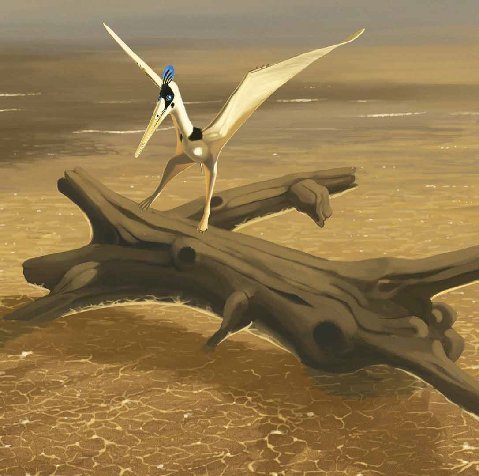
Pterodactylus kochi, © John Conway. Used by permission of Titan Books
These quibbles aside, the book is a clear success, delivering many lovingly reproduced modern classics of the form. Readers who have never seen these pieces in person will gain much from seeing them in print. Conway's elegant graphic depictions of ancient life, Sibbick's obsessive attention to detail, Marshall's explosions of vitality, and Henderson's aching elegies to the Mesozoic are treasured additions to my bookshelf.
I've got so much more I could write, but I've gone on long enough. I know that my co-bloggers will bring much to this conversation, so now I will hand this mega-review off to Marc, whose own post will follow tomorrow. I'll be back at the end of the week to sum up the LITC crew's thoughts.
Subscribe to:
Posts (Atom)