What's the logical next step from owning a chain of successful garden centres? Why, opening a taped-together, homebrew natural history museum adjoining to one of said garden centres, of course. And what really draws legions of screaming kids to a natural history museum, cash-cow parents in tow? Easy - model dinosaurs. Especially moving, roaring ones. One caveat - because of the DIY nature of your new attraction, all the dinosaurs have to be really, really weird.
It's time for another dinosaur safari. Journey beneath the half-tyrannosaur and we'll begin.
Remember the Terrible '90s Dromaeosaur Face-Off - my occasionally unduly mean bad palaeoart contest? Well, if you've ever wanted to see some of the strangest early '90s ideas of what dromaeosaurs looked like as man-sized robots, you're in luck. Presenting: Velociraptor, Paradise Park-style.
Oh yes - there's nothing I like doing more on a Sunday than heading down to a dreary warehouse in Newhaven and gawping at someone's eccentric idea of what dinosaurs looked like writ large. Such is the rock-'n'-roll lifestyle that I lead. Fortunately, I had artist and (surely, by now) LITC stalwart Niroot with me to share the nerdy giggles.
An aside: the above pictured model could be controlled by a button panel. Niroot was having a go and watching the results when, apropos of nothing, the monster's jaw flopped open and it emitted the Godzilla roar, which had me in absolute stitches.
Still, Paradise Park haven't limited themselves to oddly-proportioned, lizardy dromaeosaurs with stolen sound effects. They also have oddly-proportioned, lizardy troodonts.
When was this ever what a Saurornithoides looked like? Teeth limited to the front of the mouth - really? The explanatory sign is brilliant, too - "their slashing claws wearing down their victim to provide a meal for all".
A word of advice for the owners of dinosaur-related attractions - when you buy your huge moving Styracosaurus, make sure the manufacturer knows what they're doing and hasn't done something really dumb, like stick the nose horn between its eyes.
Actually, this Elasmotherium-style gigantor Styracosaurus seems to get around, although - perhaps in an effort to top other attractions in the shoddily-reconstructed ceratopsian stakes - Paradise Park have two of the bloody things. (Although the red head is attractive.)
This exhibit (yes - really) about dinosaur eggs speaks for itself, really, so I'll just let it sink in and then we can move on. Actually, it's almost tempting to find the brazen attitude towards creating cut-price dioramas quite laudible. Although on the other hand, it's just utterly laughable.
In a similar vein...I don't think this has been touched since the early '90s. Hopefully most of you will recognise these!
What's the most wrong-looking plesiosaur restoration you've ever seen? Forget it - it's just been instantly topped by this hugely fat, inexplicably land-borne monstrosity. It's looking very relaxed - perhaps even suave - about it all though.
And from the other way!
Speaking of things that are just perversely bizarre...
AAAAARRRRRGGGHHH *inhale* AAARRGGGHHHHH *black out, fall over*
Say, did someone order a 1960s Iguanodon with extra mammoth? Perhaps my favourite feature of this model - another one that has, as I'm afraid to admit that I know, made it into multiple attractions - is the pair of rather spindly humanoid arms it has attached to it. Bless.
That's enough heartless mockery for today. While I haven't even covered half of the abysmal, ugly, surreally anatomically incorrect dinosaur train-crashes present at this attraction, the whole thing is clearly a labour of love. Yes, even the text is frequently flat-out wrong (Jurassic Styracosaurus, anyone?), but someone has spent an absolute fortune gathering into one place what is undoubtedly one of the most repulsive collections of gigantic dino-gnomes in the UK, if not the world. For that, I salute them.
Also, this rather baffling, outsized version of one those wooden skeleton kits you used to get back in the '80s and '90s is cool for reasons that I am unable to put my finger on. Who made it? Why is it based on a cheapo, long-obsolete slot-together children's model? I guess we'll never know.
Many thanks to Niroot for letting me use his superior photos.
Sunday, December 11, 2011
Thursday, December 8, 2011
Welkom in het DinoBos!
I happened to be back in the Netherlands earlier this week. As a bit of an early birthday present, my girlfriend (yes - really) paid for my entry into DierenPark Amersfoort, a zoo in, er, Amersfoort. Although I always do like a good zoo, DierenPark Amersfoort had another draw for me - a large area dedicated to life-size fibreglass dinosaurs known as the 'DinoBos' (or 'Dino Forest'). What self-respecting dinosaur geek could possibly resist such an attraction? And so off I went, taking far too many photos. Fortunately, the place was pretty empty. Unfortunately, it was also bloody cold. Still, some of the models were really rather impressive.
The DinoBos is arranged as a circuit, the models being presented in roughly chronological order (that is, according to when the real animal was alive) starting in the Devonian. Or Devoon, as it apparently is in Dutch. Of course, the only animal from the Devonian present was the weirdo evil fish Dunkleosteus, with a model of a shrunken (or juvenile) fishy plonked rather unceremoniously in a small pond. Except the pond had filled with leaves, so the rather surprised-looking creature had the appearance of having been dumped in the middle of the woods and left to die. It's one of those occasions where one can't help but imagine that the attraction bought a load of models, noticed one of them was a fish and thought "what in holy hell are we going to do with THIS?"
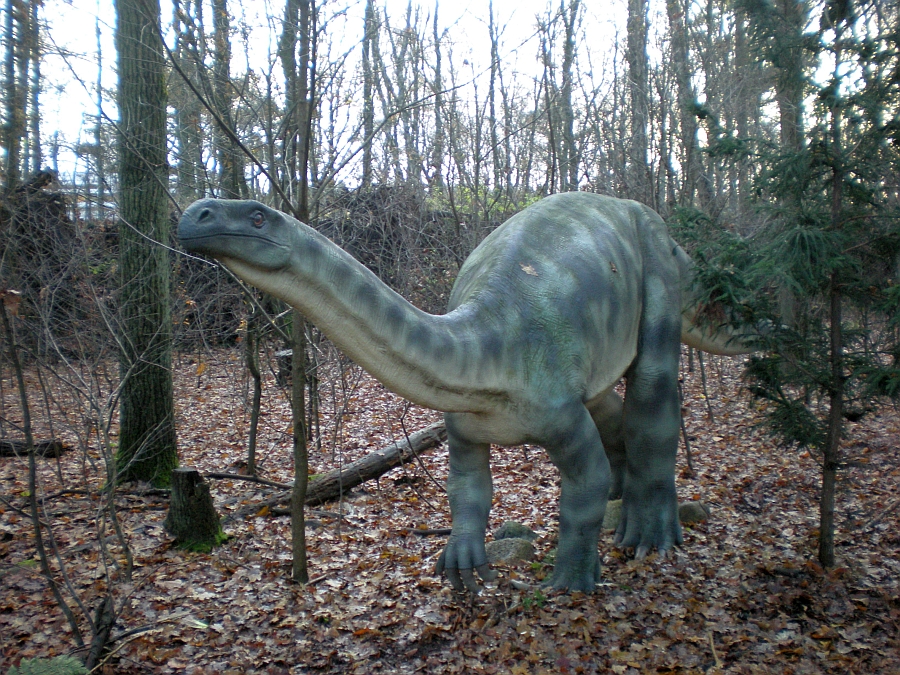
Of course, things picked up when it came to the dinosaurs themselves (for one thing, they look a little more suited to their woodland habitat). As a kid, I visited Blackgang Chine and the Dinosaur Park in Norfolk on a number of occasions. I can't speak for what the latter's like these days, but it's safe to say that whenever anyone mentions fibreglass dinosaurs (as they are often wont to do at the trendiest parties) I always picture the hilariously bad, 1970s creations from Blackgang. Therefore, the rather more modern-looking models at DierenPark Amersfoort (or DPA, as I'll be calling it from now on, thanks) came as something of a pleasant surprise. Particularly impressive were the sauropods because, well, they were life-size sauropods. And one of them was Giraffatitan.
Blimey, that's big. And look - it doesn't have elephant feet! Equally awesome was the Diplodocus. Perhaps they were a little overzealous in giving the animal a slimline neck, but otherwise the model was quite beautiful, from its dermal spines to its whiplash tail and graceful poise. The neck was erect, too (something that would no doubt make the SV-POWsketeers happy).
There was one serious plague upon these models - BUNNY HANDS. Unfortunately, every theropod had its hands orientated in the 'classic' palms-down style, which was a real shame as they were often rather good otherwise (see Albertosaurus and Tyrannosaurus below).
Bizarrely, while Coelophysis was modelled with a funky hairstyle, a Deinonychus pair were completely naked. This might have something to do with the old palaeoart meme of depicting "Syntarsus" (aka Megapnosaurus) with a 'badass mohawk' - some have argued that Megapnosaurus is a junior synonym of Coelophysis. In any case, it's a bother that the Deinonychus weren't feathered as they featured in the only scene with dinosaurs properly interacting - in this case, attacking Iguanodon. Rather anachronistically, it should be said (what happened to good old Tenontosaurus, the obligatory long-tailed buffet?), but it was executed quite well.
Interspersed among the nicely-sculpted static models were a smaller number of shabbier, rubbery-looking things that ocassionally spasmed with movement. I suppose it's good for keeping kids interested, but they inevitably ended up sticking out like a whole sad bunch of grey sore thumbs. Particularly goofy-looking was the Herrerasaurus (below), although it was also one of the most mobile. Just look at those eyes. The eyes alone!
Nevertheless, terrible and broken animatronics couldn't sour what was otherwise a very pleasant woodland jaunt beside a series of looming recreations of extinct animals. There's a surprising variety of them on offer here, too - besides the usual suspects, there are such unusual subjects as Maiasaura and Scelidosaurus (below), while the forest setting gives a suitable air of adventure and discovery. Of course, the rest of TPA is excellent too, with a surprisingly wide range of (actual living and breathing) animals that even includes Rhinoceros unicornis (with a baby born this year). It's well worth a visit.
And finally...here's one for Heinrich Mallison. (Sorry it's a quadruped, Heinrich...)
| I get acquainted with a Triceratops/umbrella stand. |
The DinoBos is arranged as a circuit, the models being presented in roughly chronological order (that is, according to when the real animal was alive) starting in the Devonian. Or Devoon, as it apparently is in Dutch. Of course, the only animal from the Devonian present was the weirdo evil fish Dunkleosteus, with a model of a shrunken (or juvenile) fishy plonked rather unceremoniously in a small pond. Except the pond had filled with leaves, so the rather surprised-looking creature had the appearance of having been dumped in the middle of the woods and left to die. It's one of those occasions where one can't help but imagine that the attraction bought a load of models, noticed one of them was a fish and thought "what in holy hell are we going to do with THIS?"
Of course, things picked up when it came to the dinosaurs themselves (for one thing, they look a little more suited to their woodland habitat). As a kid, I visited Blackgang Chine and the Dinosaur Park in Norfolk on a number of occasions. I can't speak for what the latter's like these days, but it's safe to say that whenever anyone mentions fibreglass dinosaurs (as they are often wont to do at the trendiest parties) I always picture the hilariously bad, 1970s creations from Blackgang. Therefore, the rather more modern-looking models at DierenPark Amersfoort (or DPA, as I'll be calling it from now on, thanks) came as something of a pleasant surprise. Particularly impressive were the sauropods because, well, they were life-size sauropods. And one of them was Giraffatitan.
| "It's...it's a dinosaur!" |
Blimey, that's big. And look - it doesn't have elephant feet! Equally awesome was the Diplodocus. Perhaps they were a little overzealous in giving the animal a slimline neck, but otherwise the model was quite beautiful, from its dermal spines to its whiplash tail and graceful poise. The neck was erect, too (something that would no doubt make the SV-POWsketeers happy).
There was one serious plague upon these models - BUNNY HANDS. Unfortunately, every theropod had its hands orientated in the 'classic' palms-down style, which was a real shame as they were often rather good otherwise (see Albertosaurus and Tyrannosaurus below).
Bizarrely, while Coelophysis was modelled with a funky hairstyle, a Deinonychus pair were completely naked. This might have something to do with the old palaeoart meme of depicting "Syntarsus" (aka Megapnosaurus) with a 'badass mohawk' - some have argued that Megapnosaurus is a junior synonym of Coelophysis. In any case, it's a bother that the Deinonychus weren't feathered as they featured in the only scene with dinosaurs properly interacting - in this case, attacking Iguanodon. Rather anachronistically, it should be said (what happened to good old Tenontosaurus, the obligatory long-tailed buffet?), but it was executed quite well.
Interspersed among the nicely-sculpted static models were a smaller number of shabbier, rubbery-looking things that ocassionally spasmed with movement. I suppose it's good for keeping kids interested, but they inevitably ended up sticking out like a whole sad bunch of grey sore thumbs. Particularly goofy-looking was the Herrerasaurus (below), although it was also one of the most mobile. Just look at those eyes. The eyes alone!
Nevertheless, terrible and broken animatronics couldn't sour what was otherwise a very pleasant woodland jaunt beside a series of looming recreations of extinct animals. There's a surprising variety of them on offer here, too - besides the usual suspects, there are such unusual subjects as Maiasaura and Scelidosaurus (below), while the forest setting gives a suitable air of adventure and discovery. Of course, the rest of TPA is excellent too, with a surprisingly wide range of (actual living and breathing) animals that even includes Rhinoceros unicornis (with a baby born this year). It's well worth a visit.
And finally...here's one for Heinrich Mallison. (Sorry it's a quadruped, Heinrich...)
Labels:
deinonychus,
diplodocus,
dutch,
giraffatitan,
sculpture,
tyrannosaurus rex
Monday, December 5, 2011
Vintage Dinosaur Art: Dinosaurs and Other Prehistoric Reptiles
Way back in April, when I was supposed to be finishing my undergradaute thesis, I wrote my first ever post for Love in the Time of Chasmosaurs - a Vintage Dinosaur Art guest post looking at an amusingly crap 1960s book named Dinosaurs of the Earth. When this book - simply titled Dinosaurs and Other Prehistoric Reptiles - arrived on Saturday, I was immediately struck by the similarities. Originally published in 1966 (with this fifth edition arriving in 1972), DaOPR similarly takes readers on a colourful journey through time from the origins of life on land in the Palaeozoic through to the end of the Mesozoic. The key difference is that the art here is much, much better, and that'll be down to the talents of one Rudolph F Zallinger, who surely needs no introduction to anyone reading this blog (but just in case).
Many of the animals in this book are obviously similar to their counterparts in Zalinger's The Age of Reptiles mural, but - and in spite of the book still being firmly 'Dino Dark Age' in style - they actually look a little more modern, and anatomical improvements have been made. Still, it seems that even Zallinger wasn't above ripping off (or more generously, 'paying homage to') other artists' work, in this case (below) Charles R Knight's bird-grabbing Ornitholestes which, as David has examined before, ended up turning into a meme. It never did seem to bother anyone that Ornitholestes and Archaeopteryx lived in rather different parts of the world...

Ah, the swamp-bound sauropod trope. Just as in Dinosaurs of the Earth, the text here (by Jane Werner Watson) is more interested in telling a story that conveying lots of facts about the dinosaur's anatomy and possible behaviour. Still, we are told that Brachiosaurus lives in the water much of the time not only to support 'his' (yes, the animals are always described as male) weight, but because for this gigantic animal "the safest thing to do is to hide" in a lake. Looking carefully, it's possible to see the nasal crest of one brachiosaur just poking out of the water in the middle, presumably where there is a sheer drop in the lake bed. I've said it before, and I'll say it again - how did this idea persist for so long without people realising how utterly barmy it was?

More memes! This time, Allosaurus sinking its teeth into the neck of "Brontosaurus". Both clearly draw on Zallinger's previous work, but Allosaurus looks leaner and meaner than in the AoR mural and no longer has its forelimbs growing out of its neck. Outdated as it obviously is, Zallinger's skill ensures that this remains a highly striking and evocative scene to behold - just compare it with the same scene in Dinosaurs of the Earth. (And then have another good laugh at the latter.)

Stegosaurus is still looking very old-fashioned here, as it did even into the '90s. Not a lot to say, really, other than the colour scheme is rather different to that featured in the AoR mural (unlike the Allosaurus and "Brontosaurus" which are broadly similar), and is if anything more typical - a green body with orange plates. I'd love to know who exactly invented that, and if other artists were copying them or just happened upon the same colours independently. There's an Ankylosaurus featured too, which I haven't scanned, but rest assured it is the same weird, super-squat, no-neck creature so prevalent in art of the time.

There's a very peculiar trope in old palaeoart that leads to Protoceratops having an unduly sprawling, lizardlike appearance for no good reason. Zallinger carries on the tradition here. Bizarrely, Oviraptor has transmorphed into an ornithomimosaur, although unlike the bigger theropods its tail is very clearly elevated above the ground.

There's something I quite like about this Gorgosaurus - maybe because depicting theropods squatting down at the water's edge still remains quite unconventional. Zallinger's also given it a lot of character, and it looks a little tense, as if it's eyeing something beneath the surface. Which it is, although not what one would expect - a Corythosaurus and Parasaurolophus have turned scuba diver, the text describing how "they fill their hollow skulls with air [like an aqualung], and down they go to the bottom". A lovely illustration and a totally nutty one based on a long-discarded idea on the same page - that's why I love old dinosaur books...

This Triceratops manages to combine the lovely and the nutty in the same animal. It's as beautifully painted as ever, and (quite literally) has a huge presence on the page. On the other hand...what's up with the head? The neck frill appears to fold out, fan-like, in a semi-circle behind the animal's head. Still, I love the way a lone Triceratops completely dominates this scene, and the surrounding environment just looks gorgeous.

It's Tyrannosaurus time. Sexy rexy puts in his (oh dear, now I'm personifying them) inevitable appearance near the end of the book, wading in and baring his fangs from stage right. Triceratops looks unimpressed. When compared with the AoR mural, this T. rex is notably nothing like as pot-bellied, while the head too looks somewhat more modern (although, as was seemingly typical for illustrators of this time, the animal's characteristic cranial lumps and bumps are smoothed out into a neat arch over the eye). In spite of its sleeker appearance, however, T. rex is still firmly a 'man-in-suit' tail dragger here, and the text describes it as such - when it loses its battle with a Triceratops, it's described as 'shuffling' away. We are also told that "like all cold-blooded animals, [T. rex] tires quickly". Strangely, although this is typical of the way dinosaurs are portrayed in the book, pterosaurs are described as probably being endotherms.

Although 'he' comes off worse in his fight with Triceratops, all is well for T. rex in the end as a rather alarmed Pachycephalosaurus is plucked from the ground and devoured. The T. rex looks stranger here, if still very muscular, but I just like the fact that it's in a scene with Pachycephalosaurus. Although the two species (T. rex and P. wyomingensis) lived contemporaneously, it seems like they're hardly ever seen together in palaeoart.

Overall I'd say the art in this book remains impressive, especially technically. Although the ways that the animals are portrayed are hopelessly out of date, Zallinger's characterful, intricate work remains beautiful. Like all the best palaeoart, even as they age to the point of scientific obsolesence one is still able to believe these creations as living, breathing animals.
Many of the animals in this book are obviously similar to their counterparts in Zalinger's The Age of Reptiles mural, but - and in spite of the book still being firmly 'Dino Dark Age' in style - they actually look a little more modern, and anatomical improvements have been made. Still, it seems that even Zallinger wasn't above ripping off (or more generously, 'paying homage to') other artists' work, in this case (below) Charles R Knight's bird-grabbing Ornitholestes which, as David has examined before, ended up turning into a meme. It never did seem to bother anyone that Ornitholestes and Archaeopteryx lived in rather different parts of the world...

Ah, the swamp-bound sauropod trope. Just as in Dinosaurs of the Earth, the text here (by Jane Werner Watson) is more interested in telling a story that conveying lots of facts about the dinosaur's anatomy and possible behaviour. Still, we are told that Brachiosaurus lives in the water much of the time not only to support 'his' (yes, the animals are always described as male) weight, but because for this gigantic animal "the safest thing to do is to hide" in a lake. Looking carefully, it's possible to see the nasal crest of one brachiosaur just poking out of the water in the middle, presumably where there is a sheer drop in the lake bed. I've said it before, and I'll say it again - how did this idea persist for so long without people realising how utterly barmy it was?

More memes! This time, Allosaurus sinking its teeth into the neck of "Brontosaurus". Both clearly draw on Zallinger's previous work, but Allosaurus looks leaner and meaner than in the AoR mural and no longer has its forelimbs growing out of its neck. Outdated as it obviously is, Zallinger's skill ensures that this remains a highly striking and evocative scene to behold - just compare it with the same scene in Dinosaurs of the Earth. (And then have another good laugh at the latter.)

Stegosaurus is still looking very old-fashioned here, as it did even into the '90s. Not a lot to say, really, other than the colour scheme is rather different to that featured in the AoR mural (unlike the Allosaurus and "Brontosaurus" which are broadly similar), and is if anything more typical - a green body with orange plates. I'd love to know who exactly invented that, and if other artists were copying them or just happened upon the same colours independently. There's an Ankylosaurus featured too, which I haven't scanned, but rest assured it is the same weird, super-squat, no-neck creature so prevalent in art of the time.

There's a very peculiar trope in old palaeoart that leads to Protoceratops having an unduly sprawling, lizardlike appearance for no good reason. Zallinger carries on the tradition here. Bizarrely, Oviraptor has transmorphed into an ornithomimosaur, although unlike the bigger theropods its tail is very clearly elevated above the ground.

There's something I quite like about this Gorgosaurus - maybe because depicting theropods squatting down at the water's edge still remains quite unconventional. Zallinger's also given it a lot of character, and it looks a little tense, as if it's eyeing something beneath the surface. Which it is, although not what one would expect - a Corythosaurus and Parasaurolophus have turned scuba diver, the text describing how "they fill their hollow skulls with air [like an aqualung], and down they go to the bottom". A lovely illustration and a totally nutty one based on a long-discarded idea on the same page - that's why I love old dinosaur books...

This Triceratops manages to combine the lovely and the nutty in the same animal. It's as beautifully painted as ever, and (quite literally) has a huge presence on the page. On the other hand...what's up with the head? The neck frill appears to fold out, fan-like, in a semi-circle behind the animal's head. Still, I love the way a lone Triceratops completely dominates this scene, and the surrounding environment just looks gorgeous.

It's Tyrannosaurus time. Sexy rexy puts in his (oh dear, now I'm personifying them) inevitable appearance near the end of the book, wading in and baring his fangs from stage right. Triceratops looks unimpressed. When compared with the AoR mural, this T. rex is notably nothing like as pot-bellied, while the head too looks somewhat more modern (although, as was seemingly typical for illustrators of this time, the animal's characteristic cranial lumps and bumps are smoothed out into a neat arch over the eye). In spite of its sleeker appearance, however, T. rex is still firmly a 'man-in-suit' tail dragger here, and the text describes it as such - when it loses its battle with a Triceratops, it's described as 'shuffling' away. We are also told that "like all cold-blooded animals, [T. rex] tires quickly". Strangely, although this is typical of the way dinosaurs are portrayed in the book, pterosaurs are described as probably being endotherms.

Although 'he' comes off worse in his fight with Triceratops, all is well for T. rex in the end as a rather alarmed Pachycephalosaurus is plucked from the ground and devoured. The T. rex looks stranger here, if still very muscular, but I just like the fact that it's in a scene with Pachycephalosaurus. Although the two species (T. rex and P. wyomingensis) lived contemporaneously, it seems like they're hardly ever seen together in palaeoart.

Overall I'd say the art in this book remains impressive, especially technically. Although the ways that the animals are portrayed are hopelessly out of date, Zallinger's characterful, intricate work remains beautiful. Like all the best palaeoart, even as they age to the point of scientific obsolesence one is still able to believe these creations as living, breathing animals.
Thursday, December 1, 2011
Why Thai zoos win
Recently, Niroot (yes! Him again!) went back to Chiang Mai in Thailand and visited the Chiang Mai zoo, where he found the below information board - among others - explaining how birds are dinosaurs.

Admittedly, I can't read most of the text since, well, I don't speak (or read) Thai. So the main text could contain complete nonsense, for all I know. But the diagrams! The wonderful diagrams! I've been to a reasonable number of zoos in my life and have never seen anything quite like this. Another sign even featured some of Matt Martyniuk's restorations of feathered nonavian theropods.
Zoos: more of this, please.
One other thing: if you're thinking that it's been a little quiet around here recently, you're right. David's been very busy with his degree work and I've just been rather short on cash, so unable to get out there and find interesting stuff as much as I'd like. Hopefully things will pick up again soon, though. If nothing else, I have a fantastically geeky day out among some awesomely terrible life-size dinosaurs planned for next weekend, as well as more Vintage Dinosaur Art from the '70s on the way. Stay tuned.
Until then, here's a photo of a cassowary's (Casuarius casuarius) big behind that Niroot took while at the zoo. Cassowaries are perhaps some of the birds that are most evocative of their nonavian theropod relatives, as was explored in the Inside Nature's Giants episode 'The Dinosaur Bird'. Enjoy.

Admittedly, I can't read most of the text since, well, I don't speak (or read) Thai. So the main text could contain complete nonsense, for all I know. But the diagrams! The wonderful diagrams! I've been to a reasonable number of zoos in my life and have never seen anything quite like this. Another sign even featured some of Matt Martyniuk's restorations of feathered nonavian theropods.
Zoos: more of this, please.
One other thing: if you're thinking that it's been a little quiet around here recently, you're right. David's been very busy with his degree work and I've just been rather short on cash, so unable to get out there and find interesting stuff as much as I'd like. Hopefully things will pick up again soon, though. If nothing else, I have a fantastically geeky day out among some awesomely terrible life-size dinosaurs planned for next weekend, as well as more Vintage Dinosaur Art from the '70s on the way. Stay tuned.
Until then, here's a photo of a cassowary's (Casuarius casuarius) big behind that Niroot took while at the zoo. Cassowaries are perhaps some of the birds that are most evocative of their nonavian theropod relatives, as was explored in the Inside Nature's Giants episode 'The Dinosaur Bird'. Enjoy.
Monday, November 28, 2011
Vintage Dinosaur Art: The Ultimate Dinosaur Book
I've been avoiding using this book for a long time since, well, it was very good at the time and remains pretty good today, in spite of how much the science has moved on since 1993. However, while very dated/plain bad books are the best for yucks, it seems only fair to sometimes include those that were, you know, actually put together with a great deal of care and attention to detail. This was also by far and away my favourite dinosaur book as a kid (I turned six near the end of 1993), even if some of the more complicated anatomical terms sailed over my head at the time.

As a child of the '90s, what is most fascinating about dinosaur books from the era is comparing exactly what has stood the test of time and what hasn't. This is particularly (although not solely) true of theropod restorations, quite a few of which have subsequently been subjected to a huge paradigm shift. Tellingly, many of the beautiful models and illustrations featured in The Ultimate Dinosaur Book actually stand up to modern scrutiny very well, with only a few comparatively minor faults (for example, the pronated forearms on the front cover Allosaurus). As always, because of the huge choice available, I've tried to go for some of the more dated, quirky and therefore interesting models/illustrations in the book. Like this one...

Say hello once more to early '90s 'carnosaur' Spinosaurus, whom we have encountered before. In fairness, however, David Lambert's text does note that this restoration is based on the work of Stromer, and that "the head may have been lower than Stromer thought" - other illustrations on the page show a more modern-looking, long and low snout. They all have the bizarrely four-fingered hands, though, likely based on Stromer's original monograph. I don't know why Stromer originally restored the animal with four fingers rather than three, but have a few ideas - if you happen to be a bit more informed then (as always) please do drop us a comment.

Poor old T. rex always seems to get a bit of a bum deal in these '90s books. While the model is mostly very good for the time, even as a kid the eyes struck me as being bizarrely huge. This, combined with the big ol' cute-puppy pupils, makes the big toothy one look all cuddly wuddly. Aww, bwess his piddly li'l twiggy arms. The same applies to the 'front view' head on the left, too. A look straight down the business end of Tyrannosaurus is intimidating enough when one is just looking at fossil bones (or, er, casts), but the oversized peepers make it look positively adorable.

Obligatory 'tee hee! They thought dromaeosaurs were scaly in the '90s!' Deinonychus pic for you. This model can actually still be viewed in London's Natural History Museum, where it's correctly placed in context with a lot of other outdated models, unlike certain other inaccurately naked Deinonychus. This image gains extra poignancy for having a 'scaly skin' label attached to it in typical Dorling Kindersley style. Of course, much like the miniature Crystal Palace-style Iguanodon figures that it sits next to in the Natural History Museum, this is still a beautifully sculpted work of art.
Speaking of outdated scaly deinonychosaurs, The Ultimate Dinosaur Book features a Troodon profile and, oh yes, that daft anthropomorphic freak from a David Icke slideshow is present and correct.

This one's especially for Trish. Poor old Dale Russell - apparently he feels a bit embarrassed if one brings this up with him nowadays. We forgive you, Dale. This image and its accompanying text are funny for a couple of other reasons - firstly, because a lot of the labels seem somewhat superfluous (toe? Foot? Really?), and secondly because the text literally describes Troodon as 'bird-like' before going on to say that Russell (sorry, sorry!) believed that this bird-like animal might have evolved into a humanoid creature. Oh dear. Time to move on to something a little less cringeworthy.

Yes, there are a number of things wrong with this picture of the therizinosaur Segnosaurus by modern standards (for one thing, it's another bald maniraptor), but for 1993 this is amazingly good. The foot with four well-developed toes - none of which are webbed - long neck with small head, and large hand claws are all present. Lambert even accurately speculates that the animal was most likely a strange, herbivorous theropod. Given that therizinosaurs were so poorly known at the time, I think The Ultimate Dinosaur Book is remarkably prescient. Its only bizarre slip-up is in placing this guy at the end of the sauropodomorph profiles section. Huh.

Two-fingered Compsognathus! That particular idea stuck around for quite a long time, with even the creatures in The Lost World: Jurassic Park having only two digits per hand. While, of course, the animal is now known to have the more usual three fingers, this model is notable for having the hands oritentated correctly. Whether by chance or not, I don't know, but it's still a plus point.
Oh dear - it appears that I've been far too biased in favour of theropods again. Typical. Here, have a ceratopsian.

This, of course, is Styracosaurus - and it's a rather good one at that. I've included this to draw attention to something that was acceptable back in the day. but isn't anymore - namely, giving ceratopsians elephantine feet. As I pedantically pointed out just last week, this is actually now considered inaccurate - ceratopsians had quite distinct, separated digits on both their hands and feet, actually retaining quite primitive characteristics in this respect. Still, I will once again say that the model pictured above remains quite lovely - I am especially fond of the colours, which I believe have been ripped off in dinosaur toys (and quite right too).
And now for an unceremonious end to this post. That's your lot for the time being! Although there's bound to be more in the future, unless DK's lawyers send me threatening e-mails. Given that these models were actually used across a range of DK books, I've hopefully brought back a few fond memories for you nonetheless.

As a child of the '90s, what is most fascinating about dinosaur books from the era is comparing exactly what has stood the test of time and what hasn't. This is particularly (although not solely) true of theropod restorations, quite a few of which have subsequently been subjected to a huge paradigm shift. Tellingly, many of the beautiful models and illustrations featured in The Ultimate Dinosaur Book actually stand up to modern scrutiny very well, with only a few comparatively minor faults (for example, the pronated forearms on the front cover Allosaurus). As always, because of the huge choice available, I've tried to go for some of the more dated, quirky and therefore interesting models/illustrations in the book. Like this one...

Say hello once more to early '90s 'carnosaur' Spinosaurus, whom we have encountered before. In fairness, however, David Lambert's text does note that this restoration is based on the work of Stromer, and that "the head may have been lower than Stromer thought" - other illustrations on the page show a more modern-looking, long and low snout. They all have the bizarrely four-fingered hands, though, likely based on Stromer's original monograph. I don't know why Stromer originally restored the animal with four fingers rather than three, but have a few ideas - if you happen to be a bit more informed then (as always) please do drop us a comment.

Poor old T. rex always seems to get a bit of a bum deal in these '90s books. While the model is mostly very good for the time, even as a kid the eyes struck me as being bizarrely huge. This, combined with the big ol' cute-puppy pupils, makes the big toothy one look all cuddly wuddly. Aww, bwess his piddly li'l twiggy arms. The same applies to the 'front view' head on the left, too. A look straight down the business end of Tyrannosaurus is intimidating enough when one is just looking at fossil bones (or, er, casts), but the oversized peepers make it look positively adorable.

Obligatory 'tee hee! They thought dromaeosaurs were scaly in the '90s!' Deinonychus pic for you. This model can actually still be viewed in London's Natural History Museum, where it's correctly placed in context with a lot of other outdated models, unlike certain other inaccurately naked Deinonychus. This image gains extra poignancy for having a 'scaly skin' label attached to it in typical Dorling Kindersley style. Of course, much like the miniature Crystal Palace-style Iguanodon figures that it sits next to in the Natural History Museum, this is still a beautifully sculpted work of art.
Speaking of outdated scaly deinonychosaurs, The Ultimate Dinosaur Book features a Troodon profile and, oh yes, that daft anthropomorphic freak from a David Icke slideshow is present and correct.

This one's especially for Trish. Poor old Dale Russell - apparently he feels a bit embarrassed if one brings this up with him nowadays. We forgive you, Dale. This image and its accompanying text are funny for a couple of other reasons - firstly, because a lot of the labels seem somewhat superfluous (toe? Foot? Really?), and secondly because the text literally describes Troodon as 'bird-like' before going on to say that Russell (sorry, sorry!) believed that this bird-like animal might have evolved into a humanoid creature. Oh dear. Time to move on to something a little less cringeworthy.

Yes, there are a number of things wrong with this picture of the therizinosaur Segnosaurus by modern standards (for one thing, it's another bald maniraptor), but for 1993 this is amazingly good. The foot with four well-developed toes - none of which are webbed - long neck with small head, and large hand claws are all present. Lambert even accurately speculates that the animal was most likely a strange, herbivorous theropod. Given that therizinosaurs were so poorly known at the time, I think The Ultimate Dinosaur Book is remarkably prescient. Its only bizarre slip-up is in placing this guy at the end of the sauropodomorph profiles section. Huh.

Two-fingered Compsognathus! That particular idea stuck around for quite a long time, with even the creatures in The Lost World: Jurassic Park having only two digits per hand. While, of course, the animal is now known to have the more usual three fingers, this model is notable for having the hands oritentated correctly. Whether by chance or not, I don't know, but it's still a plus point.
Oh dear - it appears that I've been far too biased in favour of theropods again. Typical. Here, have a ceratopsian.

This, of course, is Styracosaurus - and it's a rather good one at that. I've included this to draw attention to something that was acceptable back in the day. but isn't anymore - namely, giving ceratopsians elephantine feet. As I pedantically pointed out just last week, this is actually now considered inaccurate - ceratopsians had quite distinct, separated digits on both their hands and feet, actually retaining quite primitive characteristics in this respect. Still, I will once again say that the model pictured above remains quite lovely - I am especially fond of the colours, which I believe have been ripped off in dinosaur toys (and quite right too).
And now for an unceremonious end to this post. That's your lot for the time being! Although there's bound to be more in the future, unless DK's lawyers send me threatening e-mails. Given that these models were actually used across a range of DK books, I've hopefully brought back a few fond memories for you nonetheless.
Thursday, November 24, 2011
An oddball Iguanodon
Here's a curiosity from my local, small town museum. East Grinstead (a town I live but a couple of miles away from) is located on a ridge in the Weald, a large area in the South East of England where Cretaceous formations have been exposed. A number of important dinosaur fossils have been unearthed here, including Mantell's "Iguanodon anglicus", the original Iguanodon type species (the type is now the Belgian Iguanodon bernissartensis) and Baryonyx walkeri.
It's only natural for any local museum to trumpet dinosaur discoveries made in the vicinity (even if they were, in fact, made some miles away), which the museum have done by putting the cast of what they claim is an Iguanodon footprint on show. Of course, there's no way of telling if an Iguanodon species really did make the footprint, but given its age it's pretty safe to say that an iguanodont did. In any case, they also have a weird, weird Iguanodon statue on show that as far as I'm aware is completely unique. Check it out.

One of my favourite features of this statue is the little man included for scale, wearing as he does a double-breasted jacket, waistcoat, flat cap and handsome moustache (although he could do with a dusting).

Exactly how old it is I don't know, but judging by the attire of the tiny man and the dinosaur's bizarre anatomy it must date back at least 50 or 60 years. Perhaps the strangest part is the head, with its crazy-looking, bulging eyeballs and what appear to be tiny, fleshy ears.

Strange stuff, but a lovely little bit of vintage art all the same. The photo below shows the statue in the context of the museum's display, with the footprint cast alongside. Also worthy of note is that "Iggy" (yeah, really) is the museum's mascot. If you ever visit the town for whatever reason (which is pretty unlikely, granted, unless you live nearby or are a...shudder...Scientologist) entry to the museum is free, but do check the opening hours!
It's only natural for any local museum to trumpet dinosaur discoveries made in the vicinity (even if they were, in fact, made some miles away), which the museum have done by putting the cast of what they claim is an Iguanodon footprint on show. Of course, there's no way of telling if an Iguanodon species really did make the footprint, but given its age it's pretty safe to say that an iguanodont did. In any case, they also have a weird, weird Iguanodon statue on show that as far as I'm aware is completely unique. Check it out.
One of my favourite features of this statue is the little man included for scale, wearing as he does a double-breasted jacket, waistcoat, flat cap and handsome moustache (although he could do with a dusting).
Exactly how old it is I don't know, but judging by the attire of the tiny man and the dinosaur's bizarre anatomy it must date back at least 50 or 60 years. Perhaps the strangest part is the head, with its crazy-looking, bulging eyeballs and what appear to be tiny, fleshy ears.
Strange stuff, but a lovely little bit of vintage art all the same. The photo below shows the statue in the context of the museum's display, with the footprint cast alongside. Also worthy of note is that "Iggy" (yeah, really) is the museum's mascot. If you ever visit the town for whatever reason (which is pretty unlikely, granted, unless you live nearby or are a...shudder...Scientologist) entry to the museum is free, but do check the opening hours!
Subscribe to:
Posts (Atom)