Showing posts sorted by date for query crystal palace. Sort by relevance Show all posts

Wednesday, November 22, 2017

Meet the artist: Jed Taylor

As if you need any further reasons to attend TetZooCon, here's one more. A couple of years ago I ran into a fellow in the post-TZC-pub with a folder full of his own dinosaur drawings. Natee and I had a look, and were suitably impressed; there was room for improvement, but it was a very solid foundation.

Two years later, and the same bloke - Jed Taylor - approached me again in the pub. And this time, I was blown away. His dromaeosaurs are among the best I've ever seen, but it doesn't stop there; he's illustrated a plethora of dinosaurs in a gorgeous, naturalistic style that's very much in the post-Paulian (sorry again), Floof Revolution mould. Even Andrea Cau's heaped praise on his work, and he's very hard to please. I asked Jed if he could write about his work for the blog, and he supplied the following very many lovely words, which it felt quite criminal to edit down. It may be a little 'TL;DR' for some, but it wasn't for me. Enjoy.

Jed's gorgeous Acheroraptor portrait. All art © Jed Taylor, used with permission.

Wednesday, April 26, 2017

Vintage Dinosaur Art: Private Lives of Animals: Prehistoric Animals - Part 3

Since we've already looked at everything that's more important, let us now turn to the Cenozoic mammals of the wonderful Private Lives of Animals book on extinct beasties. And where better to begin than with a ground sloth with hair so wonderfully painted, you'll want to reach through the screen and run your fingers through it? (Just watch out for fleas and dandruff.)


Sunday, July 10, 2016

Recreating an Age of Reptiles: Marc's review

While recent years have seen a number of books that celebrate palaeoart for its own sake (rather than featuring it in a purely illustrative context), not enough of them feature explanations by the artists as to why they made this or that choice when restoring long-dead animals. Why that colour pattern? Why that crest of scales? Why that unusual plumage distribution? Informed speculation is an absolute necessity, but it doesn't mean that (good) palaeoartists are just pulling the lever on an extinct beastie fruit machine and cobbling together the results. Perhaps the best aspect of Mark Witton's new book, Recreating an Age of Reptiles (aka Rec-a-Rep), is that Mark consistently provides the informed thinking behind his speculative choices, as well as explaining the science that forms the foundation of all his art. It's easily one of the best palaeoart books in years, and not just because Mark's artwork is often very lovely.

Images copyright Mark Witton, used with permission. Remember, "there's a special circle of hell...located halfway up Satan's bottom" for art thievin' types. (And book pirates.)

Tuesday, June 7, 2016

The Tyrannosaur Chronicles competition: the contenders

Like undergraduate students everywhere, you lot submitted a flurry of entries for our Tyrannosaur Chronicles competition right before the deadline. But no matter! You still got in. While the final six winners will ultimately be decided by us, I thought (as with previous competitions) it'd be fun to put up a gallery of all the entrants and gather some of your opinions before we dole out the books. So, in no particular order, here's a gallery of T. rex...TRIUMPHING!

Thursday, May 26, 2016

Guest Post: The Pocket-Sized Crystal Palace Dinosaurs

Today we welcome back guest blogger Rohan Long of the University of Melbourne, who joined us in February for a look back at Crichton's The Lost World novel. This time, he shares some cool relics from paleontology in the Victorian era.

Every reader of this blog must surely be familiar with the Crystal Palace dinosaurs. These were the life-size dinosaur models made around 1854 by Benjamin Waterhouse Hawkins in collaboration with Richard Owen and placed in a naturalistic, outdoor setting in Crystal Palace Park. They were the very first dinosaur models ever made. The story of these magnificent and ground-breaking models has been told extensively elsewhere, but I’d like to share with you slightly lesser known versions of these famous sculptures.

From their inception, Hawkins and his supporters saw the sculptures as being primarily educational and accessible to everyone – not just the educated elite. Hawkins thought of his dinosaurs as ‘one vast and combined experiment of visual education’. The sculptures were envisioned not as mere spectacle, but as a public educational resource to improve the mind, for all classes of Victorian society. The dean of Hereford, Richard Dawes, a cleric and educator, suggested to Hawkins that small-scale models of the dinosaurs be made for the purpose of scientific studies in schools and other educational institutions. In the spirit of inclusiveness, Dawes said:

‘He should be glad to see those models multiplied at a price which would enable them to be introduced into village and ordinary school, as every one could not visit the Crystal Palace, and he therefore hoped that specimens like those before them might be rendered attainable by those in remote and secluded districts, who would not have the advantage of witnessing the splendid and gigantic illustration of the extinct creation of the early ages of the world which would be there exhibited.1

Knowing a good merchandising deal when he saw it, mineralogist James Tennant struck an agreement with Hawkins to produce the models, along with a series of six posters depicting the prehistoric animals that had been sculpted. Tennant, capitalising on the lucrative market of well-to-do gentlemen naturalists, and had built up a successful business selling fossils, shells, minerals and the tools needed to collect them. (By 1854, Tennant laid claim to the impressive and unique title of ‘Mineralogist to her Majesty’). Small- scale models were produced of the dinosaurs Megalosaurus and Iguanodon, the aquatic reptiles Ichthyosaurus and Plesiosaurus (combined as a tableau), the pterosaur Pterodactylus, and "Labyrinthodon," an obsolete name for the temnospondyl amphibian Mastodonsaurus.

Hawkins' Iguanodon in miniature, held by the Tiegs Zoology Museum. Photo by Lee McRae.

In addition to these models, replicas were made by Henry A. Ward, an American professor of natural science and dealer of in fossils, bones and other scientific specimens. Ward was advertising the models from at least 1866 and sold them from his business, Ward’s Natural Science Establishment, in Rochester, New York. According to Ward’s catalogue of the time, a full set of the five models could be purchased for $30, or individually from $5 to $10.2

We have two of these small-scale models in our Tiegs Museum Zoology Collection at the University of Melbourne, an Iguanodon and a Megalosaurus. They were donated to the collection sometime between 1916 and 1921 by trail-blazing zoologist Associate Professor Georgina Sweet. Due to the university’s historically close association with the British scientific establishment, I suspected our models were Hawkins’ originals rather than Wards replicas. After some detective work I found that although the two model types are very similar in their shape, there are differences in the models’ colouration. Ward’s models are a coppery-brown colour, with a green plaster underside. Our models, and all of Hawkins’ originals, are painted a glossy black, while the exposed plaster underside is a mottled white, grey and green.

Hawkins' Megalosaurus in miniature, held by the Tiegs Zoology Museum. Photo by Lee McRae.

While I was researching these models, I visited the collections of the Melbourne Museum to see their own Iguanodon (also a Hawkins’ original). A geologist friend of mine was there with the collection manager. He heard about my project and scoffed cheerfully; “Why are you interested in those things? They’re wrong!” This is a common reaction to these dinosaurs and I think it’s short-sighted. If I was writing this in the eighties, I’d be correcting Hawkins’ assumption that Iguanodon was quadrupedal and reconstruct it instead as the awkward, kangaroo-postured biped we all know and love. But paleontological research has brought us full circle and Iguanodon is again considered predominantly quadrupedal, albeit more lightly built than the Victorians had envisioned. Any student of the history of paleontological illustration should be wary of the notion that current reconstructions aren’t every bit a work in progress as their predecessors. Imagine how silly all of these featherless dinosaurs are going to look to the next generation of dinosaur devotees.

Footnotes

1. Benjamin Waterhouse Hawkins, ‘On visual education as applied to geology’, Journal of the Society of Arts, (London), vol. 2, 1853–54.

2. Henry A. Ward, 1866, quoted in Jane P. Davidson, ‘Catalogue of casts of fossils (1866) and the artistic influence of Benjamin Waterhouse Hawkins on Ward’, Transactions of the Kansas Academy of Science, vol. 108, nos 3–4, Fall 2005, pp. 138–48.


You can catch up with Rohan on Twitter @zoologyrohan and listen to his new musical project, Bronzewing, at bronzewing.bandcamp.com.

Sunday, July 5, 2015

Vintage Dinosaur Art: The Lost World (Ladybird)

Ladybird books are a firm favourite of mine, since (like many other Brits) I have very fond memories of learning to read with them as a child - not just those bought for me at the time, but also hand-me-downs, which were all the more special. Their factual dinosaur book remains a favourite - laughably outdated these days, but still beautifully illustrated by LITC stalwart Bernard Robinson. Ladybird also published simplified versions of classic tales; as a child, I had their version of Robinson Crusoe. Until last week, I had no idea that these included The Lost World, and happily it's just as lavishly illustrated (by Martin Aitchison, this time) and entertaining as ever.


Tuesday, April 21, 2015

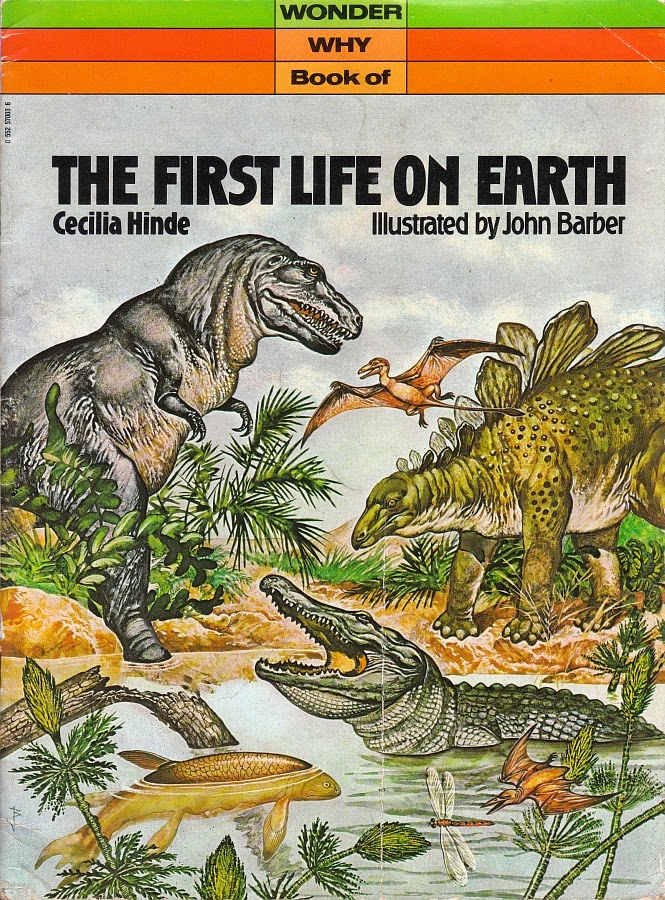
Vintage Dinosaur Art: The First Life on Earth (Wonder Why book)

We return to the 1970s this week, with a book that encapsulates why it was such a wonderful decade for kids' dinosaur books. The First Life on Earth (1977, a Wonder Why Book of) is typical of so many children's books on prehistoric life in that it purports to offer a potted history of the evolution of animal life on Earth, while focussing disproportionately on dinosaurs. Of course, this is most certainly a Good Thing, as dinosaurs are the bestest animals ever and all us mammals should feel thoroughly inadequate. In addition, illustrator John Barber might employ the gigglesome palaeoart tropes of the period, but his technique is quite intriguing - his work rewards a closer look.


Tuesday, October 7, 2014

The Damned Dromaeosaurs of Stock Image Island

If you have not read Witton, Naish, and Conway's State of the Palaeoart, make a point of doing so. The article is the culmination of a discussion that seems to have begun in earnest back in the spring of 2011, when the Dinosaur Mailing List played host to complaints from Gregory S. Paul about other artists copying his famous mid-stride skeletal pose. Though GSP kicked off a righteous ruckus with his assertion that he owned that pose, the argument was also a chance for people to air their opinions about why it's so difficult for artists to rely on paleoart to sustain, or even significantly contribute to, their career. I wrote about the brouhaha in two posts here, The Great Debate in Paleoart and Essential Links in the Paleoart-pocalypse. My post today is a deliberate follow-up to Witton et al's recent publication, in which the authors propose actions that invested parties can take to ensure that the paleoart the public sees in the news is original, creative, and accurate.


From Witton et al. (2014).

Earlier this month, Discovery News covered new research published in PLOS Biology which takes an embryological approach to resolving the relationship between modern birds and their ancestors, focusing on the development of the bones of the wrist. Certainly, a topic worthy of coverage. Unfortunately, they chose to illustrate the story with one of the most laughable restorations of Velociraptor I've ever seen. Here it is, reproduced with watermark from ThinkStock.


Image from ThinkStock. Image number 481455933.

Just soak in that for a few minutes.

Without paleoart, there is no paleontology outreach. It must be held to a higher standard than illustration done for entertainment. Bad images are being marketed on stock image services, then used by journalistic publications to illustrate stories like the one linked above. Using a sloppy, lazy, otherwise ill-conceived restoration to illustrate a science article diminishes the whole enterprise. Readers will remember that bizarre Velociraptor with its hastily slapped-on plumage more than the details of the research.

There is another, equally important effect of the use of these images: it takes money out of the wallets of conscientious artists whose work is passed over for garbage. A publication or website needs an image with an article (which says it all, really) but for some reason, decides the selection of the art doesn't require the amount of consideration as the article itself. The public loses. Responsible artists lose.

After sharing the above artwork on Twitter, I decided it was imperative that I delve into stock image services to see what other abominations I might find. As I trawled the services, the undisputed champion and holder of the Crown of Derpitude was Velociraptor. Sure, other taxa were victims of shoddy renders, boring compositions, and unintentionally comic poses. But Velociraptor was so badly botched, so often, that it demanded to be featured here overwhelmingly. My best guess is that the offending illustrators had a hard time accepting the idea of feathers covering the Jurassic Park raptors in their heads, so they just tacked 'em on as whimsy dictated. Whatever the reason, these illustrators have knocked out an army of pitiable creatures ugly enough to make Chickensaurus look exquisitely bred by comparison. I hereby dub these misbegotten beasts "Velocicraptors." Since the Mesozoic roots of birds is one of dinosaur paleontology's great stories to tell right now, these wretches are capable of doing real damage to public understanding of just how that evolution occurred. So I'm not pulling any punches.

On to the bloodbath!

The first two are fairly typical: botched feather attachment, bunny-hands, and in the second one, I'm not sure if the illustrator ever looked at the skull of the animal. You know, the way one might. If they wanted to make it look like the animal.


Image from ThinkStock. Image number 183993135.


Image from ShutterStock. Image number 172091483.

Speaking of skulls: that's not an eye socket.


Image from ShutterStock. Image number 1142484.

Here, naked and bunny-handed Velocicraptor is being chased by Tyrannosaurus. The pursuer actually outshines the quarry here, with bizarrely elongated fingers.


Image from ThinkStock. Image number 507796691.

This scene is stunning: It's as if we've been transported to the Cretaceous and have happened upon a family of curiously glossy Velocicraptors. As the mewling craplings beg for sustaining milk (why not?), mother cries out in agony, cursed as she is with woefully disjointed arms.


Image fromShutterStock. Image number 172091483.

My best guess: the Pilsbury Doughboy's defective clone is super-proud of his pet Velocicraptor, with its oddly undersized head, hands, and feet.


Image from ShutterStock. Image number 56398084.

Also in the "keep 'em scaly" camp is this super-reptilian fellow.


Image from Dreamstime. Image number 8751082.

Though Velocicraptors muscle out most of the competition, there are notable disasters for other taxa, too. Here's a Styracosaurus, seeming to channel the spirit of the Crystal Palace saurians.


Image from Dreamstime. Image number 783455.

According to the image's page, this low-slung Ankylosaurus is a "Photorealistic 3 D rendering, scientifically correct... with full bone skeleton superimposed." No indication of what bones actually constitute real finds and which are speculative, no scale bar, but you know. Scientifically correct.


Image from Dreamstime. Image number 31682514.

Remember ol' mohawked "Syntarsus?" Although the image's tags lead me to suspect this is a photo taken at this dinosaur sculpture park, I'm including it because it could plausibly be chosen to illustrate a story, and it's real derpy.


Image from Dreamstime. Image number 15948656.

Something about this noodle-necked Edmontosaurus is really unsettling to me.


Image from Dreamstime. Image number 22729752.

This poor, shrink-wrapped Compsognathus. Can someone toss it a few Slim Jims? It may not help: I'm guessing it ate one of those mushrooms and is afflicted with some awful wasting disease.


Image from Dreamstime. Image number 44911286.

We'll close out here with one last Velocicraptor image, which is particularly heart-warming to me, as it reminds me of one of my favorite images in the Vintage Dinosaur Art series, the Iguanodon Conga Line. Needs a few more 'craptors, but it's almost there.


Image from Shutterstock. Image number 55365946.

If you think this is mean-spirited, that's fine. We've been accused of such things over the course of the Vintage Dinosaur Art series, occasionally warranted, usually not. But my target today is people selling scientifically inaccurate scientific illustrations, which is plain wrong. I'm not dashing over to DeviantArt and insulting artists' work for kicks. My advice to publications turning to stock image sites as sources for illustrations? Emily Willoughby, Alvaro Rozalen, and Chris Masnaghetti are on StockTrek.

I have to admit that searching for stock images is by far my least favorite task in my work. So this was rough. I need a bubble bath and some pumpkin pie - maybe at the same time. So while I go do that, for crying out loud, support original paleoart.

Use of images in this post constitutes Fair Use for purpose of critique.

Friday, May 30, 2014

Crystal Palace, part II

I feel it incumbent upon me to open this appendix to Marc's Crystal Palace Park report by explaining to our readers that being referred to as an 'adorable mammal' is perhaps one of the highest compliments one could earn from him (grumpy misanthrope that he is)*.

With that in mind, here are a few more adorable mammals and other miscellaneous tidbits from the park which didn't quite make it into Marc's post.


Wednesday, May 28, 2014

Crystal Palace, finally

Eventually, one simply has to make the pilgrimage. Frankly, I'm not sure how I managed to delay it for so long. For anyone with an interest in palaeontology - and especially for those with an interest in palaeoart - a visit to Crystal Palace Park is simply a must. More than that - it's unavoidable. You will end up here, one day, staring up at Benjamin Waterhouse Hawkins' concrete monstrosities. Here is the Land Where Ugly Life-Sized Dinosaur Models Began. And it's quite wonderful.


Tuesday, January 21, 2014

Vintage Dinosaur Art: Dinosaurs and How They Lived - Part 2

Time for some more Fornari and Sergio (see also: part 1), and I think it would be pertinent to begin with what seems to be one of the most fondly-remembered illustrations from this book (based on Facebook comments) - an oversized Stegosaurus skeleton, swarming with diminutive museum workers.


Monday, August 19, 2013

Vintage Dinosaur Art: Dinosaurs and more Dinosaurs - Part 2

Onwards with the second part of our exploration of this frequently unsettling book. Do take a look at part 1 and David's 2010 post on the artist (George Solonevich) for more background.


Dinosaurs and more Dinosaurs might boast a significant number of relatively obscure beasts when compared with similar books, but that doesn't mean it shies away from the staples. Here, for example, we have an Iguanodon, easily identified by its approving hand gestures. There's something particularly peculiar about the head on this beast - it seems to have borrowed the head of a theropod from a more sober book (in DaMD, it would have dozens of moray-like teeth and/or a snaking tongue). The oddly humanoid proportions of the forelimbs are, of course, entirely in keeping with contemporary depictions of the animal. All in all, this one isn't too 'out there'; it's not like it's scaling a tree trunk, flicking out a lizardy tongue and brandishing a feathered tail, for example.


Yeah, you saw that one coming, I know.  In any case, Hypsilophodon is hardly known for bringing the crazy; the poor little creature is normally depicted scurrying around (or running hastily away from) much larger, more awesomebro species. Sure, there was the infamous 'tree kangaroo' Neave Parker depiction, but even then it was just standing around, looking suitably placid and harmless. Leave it to Solonevich to make even this most innocuous of animals into a creeping, crawling nightbeast with many-jointed limbs, a feathered (or is that beaver-like?) tail and Venom's tongue. By comparison, the gangly, vertical Ornithomimus on the right looks very conventional indeed, and there is something quite beautiful about its lovingly 'sculpted' legs.


Speaking of the conventional versus the very unconventional, the majority of the book's ankylosaurs follow the era's rather dull tendency to produce squat, short-tailed, no-necked armadillo-turtles. This more unusual depiction, then, is surely to be welcomed, even if it looks still more outlandish. The bony nodules are superbly painted - it's almost possible to get a tangible sense of how rough this animal's hide is - but I'm sure you're nevertheless wondering what on Earth this thing is supposed to be. Well, it's Pinacosaurus (here identified as Syrmosaurus). Hey, at least it's got a nice long tail, right?


Now here's a fun exercise in pointless hypothetical alterna-history - what if, just as Waterhouse Hawkins was sculpting the mighty Crystal Palace monstrosities, someone had tripped over a hadrosaur skull weathering out of a hillside somewhere? What would have happened had Hawkins hurriedly incorporated it into his dino designs? I like to think that the result would have looked something like the above. I'm particularly fond of the melty feet and hugely thick neck and tail. Magnificent stuff.


While the above Anatosaurus (aka Anatotitan, aka Edmontosaurus) is furnished with the full-mega-portly-body treatment, only the head of Pachycephalosaurus is shown. There's a good reason for this, of course; Pachycephalosaurus isn't known from very much else, so any full-body reconstruction would be subject to a great amount of speculation, and might end up looking a bit freaky some decades down the line.

I love its angry little face. Bless.


If you want marginocephalians in all their glory, you'll have to consult the ceratopsian pages. The above animal has a masterfully textured toad body. Somehow, it's ended up with the (not all that bad, for the time) head of a Styracosaurus. I'm sure it's a mask.


Of course, bring in the ceratopsians, and you also have to present their perpetual foes. Opposite Styracosaurus we have the frightful Gorgosaurus, a cross between a hen, a snake and a Cornish pasty. The character that Solonevich brings to this hunchbacked killer pastry is fantastic; note also the way in which the viewer's eye is expertly drawn to that hideous, bristling maw. Nevertheless, there's only one animal we could possibly end on...


Disappointingly, Solonevich's Tyrannosaurus isn't particularly unusual for the time; there are definite shades of both Neave Parker and, especially, Zdenek Burian. This Rexy is a dead ringer for Burian's monochrome Gorgosaurus, in particular, right down to the gleaming, greasy skin textures. What the prey is intended to represent isn't mentioned. Dave Hone noted that its head looks remarkably like those on contemporary reconstructions of small pterosaurs like Rhamphorynchus; the combination of this mismatched head, extremely thin skin-flap neck and leggy bipedal body is a bit of a mystery. We can only assume that, as with so many of the other illustrations in this book, Solonevich just thought it looked pretty damn...interesting. And it certainly does.

Saturday, December 8, 2012

All Yesterdays: the live conference room spectacular

If you're a dinosaur enthusiast with the means to access the internet, you've surely heard all about All Yesterdays by now. It's managed to garner quite the publicity, appearing everywhere from io9 (whoever they are) to the website of the terrifyingly popular British tabloid the Daily Mail, where it inevitably attracted comments from Young Earth Creationists (of course). There may be plenty of reviews already out there, but the champagne wasn't smashed across the bow of All Yesterdays until December 7, when it was launched in London by John Conway, C M Kosemen and Darren Naish. And wouldn't you know it, Niroot and I turned up - attracted by the promise of an intriguing presentation, book signings and free box wine. No disappointments!

A very spiky Triceratops, by John Conway.


The night opened with a lecture from Dr Naish of raccoon corpse-identifying TV fame. Darren delivered a highly insightful, but concise history of palaeoart - its origins, evolution, and of course its pitfalls. He reminded us of something that's all too easy to forget - that the first life reconstructions of prehistoric animals arrived at about the same time as the first skeletal reconstructions, and the two have gone hand in hand. Animals were being restored when the science of palaeontology was still in its infancy, and spectacular reconstructions like the Crystal Palace models raised the bar in terms of what the public expected to see.

In other words, dinosaur life restorations have been in demand since the word 'dinosaur' was coined, and now more than ever. In attempting to explain some of the 'memes' of palaeoart - blatant copies of previous works, repeated again and again - Darren mentioned how artists are often on tight deadlines, paid little, and have trouble gleaning advice from scientists disinterested in life restorations. (Publisher pressure is also a factor - during the Q&A, Luis Rey informed a fellow audience member that he had been asked to illustrate unfeathered feathered dinosaurs, but had declined.) There are also precious few 'how to' guides when it comes to restoring prehistoric animals, with Greg Paul being the last person to provide one, some years ago now.

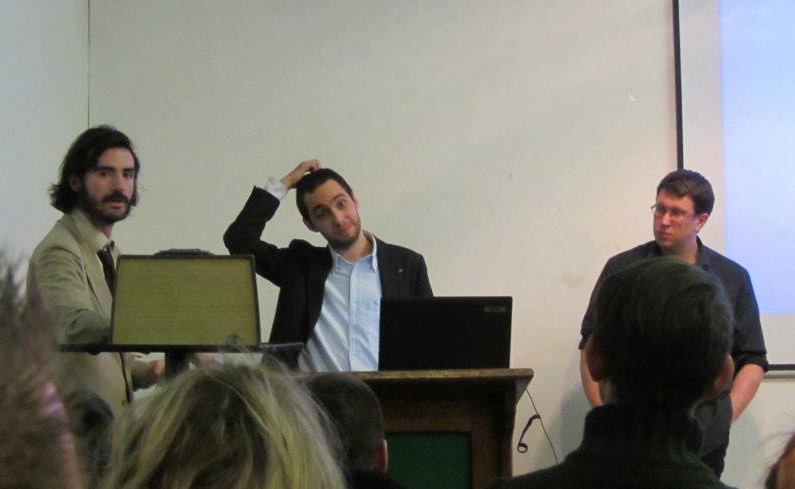
I hope you're keeping up. L-R: Conway, Kosemen, Naish.
Darren described the current palaeoart era as the "Age of Paul". However, some people have adopted Paul's sleek style and run too far with it, in the process creating "zombie dinosaurs" - emaciated husk-o-saurs with virtually every bone on show through a paper-thin draping of skin. There is also a certain conformity, or conservatism, in palaeoart, with animals retaining certain looks and stereotyped behaviours in every work that they feature in. This was something that C M Kosemen (aka Nemo Ramjet) would pick up on later on.

After Naish came Conway, who talked us through both the process of restoring an animal and phylogenetic bracketing, and how things had changed since the "bad old days of the Clumpers". With the focus on Velociraptor, he illustrated how and why approaches to reconstruct the animal had changed over the years. Nothing that most readers of this blog won't already be familiar with, but John is an absolute delight to listen to, and the presentation was clear and straightforward enough that I'm sure the non-scientists/enthusiasts in the audience were very well informed.

John Conway gives Niroot a very manly hug.
Last up was Nemo, who talked about what he dubbed 'lenses of distortion' - the glasses that everyone looks through when they envisage a long-dead animal. Scientific consensus and pop culture feed into one another, and both exert a grip on people's imaginations that can prevent boldness and necessary speculation (or educated guesses). He argued that there was a need to 'de-mystify' the past by encouraging people to think more creatively when they produce palaeoart. There was also talk of 'known unknowns' and 'unknown unknowns' which, I must confess, really did remind me of Donald Rumsfeld.

As you can probably tell, my note-taking got progressively worse as the evening wore on (hence Darren's talk getting the most words...sorry!). Fortunately, all of the presentations were recorded and will soon be uploaded to the internet for posterity. Hurrah!

"So, how long would you like the penis?"

Following the lectures, the book-signing marathon could commence. Here's mine, so that I can gloat and you can be WELL envious. Er, unless you were there.

Tanystropheus, Naish: Tyrannosaurus, Conway: Retro T. rex, Kosemen.

Darren inks an Olorotitan for Niroot.
All Yesterdays is a fantastic book (but more on that to come), and this was a marvellous event that not only critically examined palaeoart, but celebrated it. Darren noted that it's important to remember the history of palaeoart - something that's certainly reflected in the book on one memorable occasion - even as we look to innovate and progress. Hopefully, All Yesterdays will prove potent inspiration for the next generation.

Thanks to all involved for a top evening, and the box wine wasn't that bad either (at least I didn't think so)!

Stegosaurus, doing something...unspeakable. By C M Kosemen.

Thursday, April 26, 2012

Down the pub with Mantell

Down one of the local boozers yesterday I was thrilled to discover this - a beer dedicated to none other than Gideon Mantell. (You'll have to forgive the photo - my phone's flash has a very blue hue that I had to try and correct...)


It turns out that Harveys of Lewes have been brewing this ale seasonally (it's out this month to coincide with St George's Day on April 23) since 2010. It's only fitting that Harveys should pay homage to Mantell, whom they describe as "the original Father of Paleontology [sic]", as he hailed from the East Sussex town. Mantell's hugely signficant work in the fledgling fields of geology and palaeontology, as well as his ultimately very tragic life story, are described at length in Deborah Cadbury's The Dinosaur Hunters, a book that I really recommend you grab a copy of if you haven't already.

One can only presume that that illustration is meant to look like it's from the 19th century - I love the skull! Mantell orginally restored Iguanodon, very speculatively, as being essentially a massively scaled-up lizard. By the time the Crystal Palace models were commissioned, he'd come to realise that the animal's forelimbs were much less robust than its hind limbs, but the far more powerful (and often ruthless) Richard Owen had other ideas.

Naturally I had a pint and, well, it wasn't bad - rather fruity, but not a complex taste and it didn't really grab you. A shame, as naturally I wanted it to be a beer that I really loved. Still, if you're interested in giving it a go and can't find it on draught, you can buy bottles from the Harveys website.

Monday, March 5, 2012

Vintage Dinosaur Art: Sea and Land by J.W. Buel

A book I recently stumbled upon while browsing Flickr is this week's feature in Vintage Dinosaur Art. Published in the 1880's (dates vary with either 1887 or 1889 being likely years of publication), Sea and Land is one of many natural history books written by J.W. Buel, who also wrote a number of adventure books cashing in on the hunger for the exotic so prevalent in that era. The engravings, shared by Steve Lew, are a mixed bag of science and superstition. Included here are the Mesozoic-related plates, but there is plenty more fun stuff to check out.

I said a mixed bag of science and superstition, and to show what I meant, here's one of the dubious claims: that of early humans squaring off against plesiosaurs.

Early man contending with the plesiosaurus

It's a silly, cartoonish thing to imagine a plesiosaur doing. About as silly: a plesiosaur striking out at a passing pterosaur and catching it on the wing. Blowhole-sporting ichtyhosaur included for additional fun.

The flying Pterodactal

The plesiosaur gets it in the end, however. Luckily for us, all of this action is taking place above the water's surface, which is where sea creatures tend to settle their disputes.

Combat between the Ichthyosaurus and Plesiosaurus

Of course, they all got it in the end, don't they? Here, the denizens of the Western Interior Seaway share their last flailing moments of life together. Since the text is not available, I'm left to imagine that Buel is supposing that the seaway literally dried up suddenly, stranding the wretched fauna to die agonizing deaths.

Monsters of the Kansas Plains in their last struggles

Here's a Rhamphorynchus we've seen before, in a last year's post about Victor Meunier.

The Ramphorynchus

About time to get to the actual dinosaurs. There aren't many, but we get this take on Megalosaurus and Iguanodon, betraying a loyalty to an older vision of the Mesozoic as displayed at the Crystal Palace. This may also be ganked from an earlier source, as by the time of this title's publication, the Bernissart Iguanodons had jettisoned the old quadrupedal, spike-nosed version.

The Megalosaurus and Iquanodon

Finally, we head back to North America to see the early vision of the Mesozoic uncovered by early American paleontologists such as Leidy, Marsh, and Cope. The illustration is titled "The Hadrosaur and Contemporary Animals," one of which may well be Dryptosaurus, making this yet another early depiction. I'd love to confirm this from the text, but it doesn't seem to be available anywhere online, so this remains a mere guess.

The Hadrosaur and contemporary animals

Sorry for anyone who saw this in its incomplete state - I accidentally pressed "publish" instead of "save" earlier, also accounting for the hurried nature of the writing. As always, please feel free to submit art from old dinosaur books to our Flickr Group.