Wednesday, July 3, 2013

Vintage Dinosaur Art: Prehistoric Animals and Fossils

Another Ladybird book! I have a particular affinity for Ladybird's numerous and varied dainty hardback books, as I had a collection of them as a child (some of them inherited, which made them extra special). Prehistoric Animals and Fossils is a 1974 title from Series 651(!), which was dedicated to natural history. It may run the gamut from the Palaeozoic to the last Ice Age, but it's the Mesozoic fauna we're most interested in, and fortunately there's a pretty decent amount of it.


In fact, the cover is dominated by two duelling dinosaurs, which appear to be Styracosaurus and a tyrannosaur of some sort. It's a bit of an odd choice, as many of the illustrations inside - by Robert Ayton - depict much more active, exciting-looking animals. These two look like they're going through the motions, although you've got to admire a tyrannosaur that won't let go even when it's been stabbed in the nether regions. There's also a 'wings...but with hands!' Archaeopteryx. On the other, er, hand, you've got to admire the beautifully detailed fossil sea creatures.


Since it's not, lest we forget, all about dinosaurs looking all mean and cool and stabbing each other with the blood and guts, this book also features a fair amount on geology and palaeontology, both the scientific and hobbyist sides. Hence, an image of a theropod running at full pelt is juxtaposed with a fossil trackway in the modern day. The animal's depiction owes much to Neave Parker's hugely influential Megalosaurus illustration, from its peculiar hunchback (don't think too much about how the neck and shoulders work anatomically...it's a bit mind-blowing) to its equally odd, but quite adorable, tiny hands with four little piggies. Nevertheless, this is notable for showing an animal with powerful thigh muscles travelling in a real hurry, its tail well clear of the ground - pointing away from the ground, in fact.


Now, I know what you're thinking and, yes, the text does explain that Dimetrodon and Stegosaurus did not live at the same time. It's still a fun scene, particularly as the Stegosaurus is providing a perfect comedy reaction. He's like, "Woah, what!?!" Again, the rearing posture is surprisingly active, and provides a wonderful contrast to all those pre-Renaissance illustrations in which it appears as if the stegosaur is pushing its head through the dirt in front of it.


There are some illustrations in this book that are more akin to what one might typically expect; namely, dinosaurs standing around, looking like fat toads with monster overfed python tails, and generally being a bit brown and dull. At least Styracosaurus is sedately munching plants here, rather than goring someone in the privates. Polacanthus is notably sporting its old-school, Neave Parker-esque armour configuration, which prevailed well into the '90s.


It's inevitable that Tyrannosaurus will show up at some point, so here it is, battling Triceratops amidst a wonderfully energetic swirl of colour. While T. rex, rather oddly, resembles a slightly modified version of the earlier megalosaur-beast, I am still very fond of this illustration - there's a real energy to it, and the sparring animals appear convincingly engaged in battle, rather than the ceratopsian being launched at a tyrannosaur standing on one leg while pulling up the edges of its frilly skirt and shrieking. There's also a sauropod (and its skeleton), inevitably identified as "Brontosaurus". It's a bit boring, though, so never mind that. Look, marine reptiles!


If you're not going to have a mosasaur and a plesiosaur fighting then, well, what's the point of your prehistoric animal book? Again, there's a wonderful energy and fury about this scene, with the mosasaur (complete with fancy frilly bits) lunging ferociously at its preposterously long-necked foe. The foaming, churning sea is excellently painted. According to the book's caption, the calm-looking ichthyosaur is 'awaiting results', presumably because it has £10 on the mosasaur down at Ladbrokes.


I mentioned the book's hobbyist bent earlier, and here it encourages the hoarding of specimens in your private collection, where you can keep them away from the grubby hands of the scientific community and gloat like a palaeontological Scrooge McDuck. (I'm kidding, of course - it's just suggesting that the reader make a nice display of the bits and pieces they find on holiday in the West Country). I remember reading this book as a child and being suitably inspired; at one point, I did indeed have my favourite specimens on show with corresponding informative labels (although most of mine were obtained from such places as the gift shop in Wisbech Museum). It's a charming picture in a genteel sort of way. For crying out loud, though, please don't go thinking that all museum curators are the genteel sort, should you meet any...


In a similar vein, here we see two people in appropriate period dress assembling a brontosaur diorama. Model dinosaurs being a particular love of mine, this is one of my favourite illustrations in the book; being beautifully painted doesn't do it any harm, either. This illustration accompanies a page suggesting that the reader set up a 'fossil club' with some of their fourth-form school chums, what ho. Actually, that's not fair - it's the way that this book completely avoids patronising its young audience that makes it so charming and inspiring. There's the sense that this is a world that you could be part of, even if you're only knee high to a grasshopper.


And finally...it's Leonardo da Vinci.

Many thanks to Dominic Murray for letting me borrow this one! You're the best. I'll send you a nice card.

Monday, July 1, 2013

Dinosaurs in the Bible

While preparing this week's Vintage Dinosaur Art post, I was struck by how the illustrations were reminiscent of those in a certain other book that I'd owned as a child. A book that I hadn't seen for a long time, but was sure that I still had stashed away in a dark corner of my wardrobe. Eventually, it dawned on me...it was an illustrated Bible that I'd been given for my christening in 1988.

Hang on - didn't that Bible have dinosaurs in it? I just had to go and check it out - and oh yes, it has dinosaurs all right.


Well, OK, it has a Burianesque amphibious brachiosaur, sharing its habitat with a black marine reptile thingy and some pterosaurs (one of which is unmistakably Pteranodon). They pop up while the book's main character, a sort of all-powerful supernatural lunatic, is poofing things into existence as is his wont. There's no mention of them anywhere in the text (excepting birds, obviously), which is essentially a light simplification of the King James version (this isn't an attempt to lure in the kids by some Ken Ham-alike).

Furthermore, this is the only appearance made by any prehistoric animals in the entire book; there are no banana-munching tyrannosaurs gambolling in the Garden of Eden, nor any distressed-looking Triceratops being swept up in the swirling waters of a global flood. Nor, indeed, are the angels depicted as pterosaurs, although they should have been. And that's what's wonderful about these beasties - they're here apropos of nothing.

I should probably get back to that other book, though. See you later in the week!

Vainglorious Velociraptor

I am still working away at the prehistoric alphabet book I teased a while back. With most of the animals illustrated, I'm working on backgrounds, working out how much detail to use. Some seem to work better with little more than abstract color and shape, while some seem to call for a bit more detail. Such was the case for Vainglorious Velociraptor, who seemed to need a desert backdrop against which to display his fine crimson plumage.

Vainglorious Velociraptor updated

Clearly, I'm going for something fanciful, and they get even goofier than this, depending on the adjective pairing I chose for each. Rest assured that I'm not sticking to popular dinosaurs; I've got plenty of phylogenetic variety in the mix. I'll definitely be sharing more as I get closer to completion of the project!

Friday, June 28, 2013

A bipedal Apatosaurus and a Deinonychus

Bipedal Apatosaurus. Sepia ink, sepia powder, coloured pencils, and gouache on recycled paper 278 x 190mm.
Inspired by Mike Taylor's article on the probability of bipedal sauropods and by Scott Hartman's accompanying skeletal on the Walking with Dinosaurs blog. This drawing is another of those curious things which should serve more as a study, but which I nevertheless spent too long working on and eventually 'lost my way' with. One of the perils of being obliged to work on something at sporadic intervals.

A not dissimilar fate befell this Deinonychus study.

Deinonychus. Sepia ink, coloured pencils and gouache, sketchbook page.
Inspired, of course, by birds of prey in general, I made a conscious effort of bulking up its feathers much more than my earlier attempts, and aiming for a yet smoother, more avian silhouette (it suddenly occurs to me how long ago I actually began this study, as it went on to form the basis for Marc's Deinonychus portrait in the New Year greeting I completed back in January). I think perhaps its front third is fairly respectable, which perhaps is just as well, since that third eventually made its way upon a garment after some persuasion.

I also note that the Apatosaurus features what might be considered my signature 'dappled leaves' markings which I seem to apply on all and sundry when I'm not thinking too hard about coloration. I ought to devise something with which it can alternate...

N

Tuesday, June 25, 2013

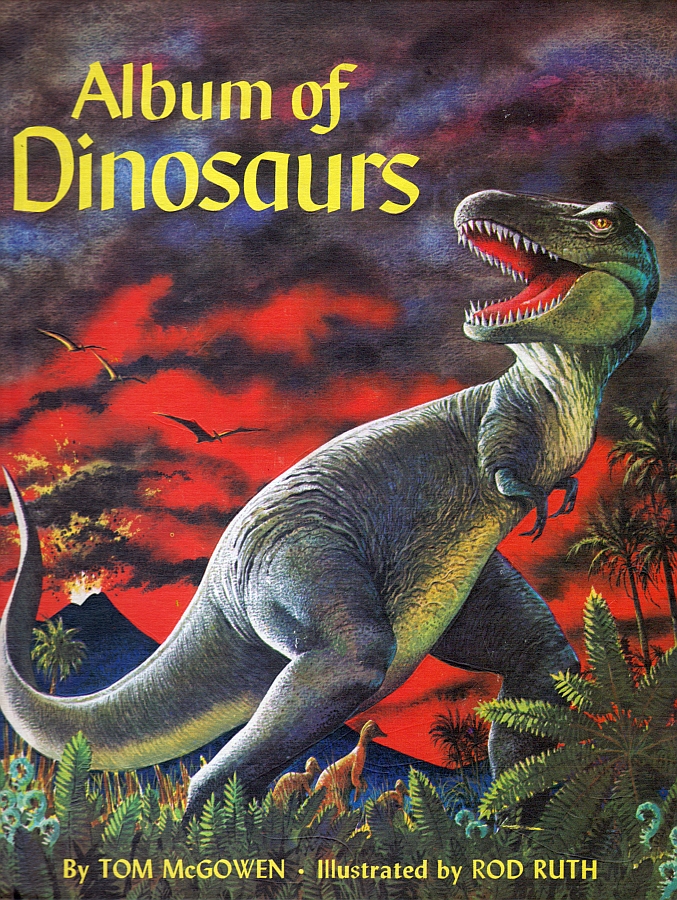
Vintage Dinosaur Art: Album of Dinosaurs - Part 2

In our last look at the Album of Dinosaurs, we established that it was a beautifully illustrated book, thoroughly out-of-date scientifically for the most part, but lively and occasionally slightly silly enough to be very entertaining. It features its fair share of Daft Old PalaeoArt Tropes (or DOPATs, as they perhaps shouldn't be known), including any number of animals living an aquatic lifestyle that they don't appear eminently suited to.


As far as DOPATs go, everyone remembers the snorkelling sauropod as the poster boy of pre-Dino Renaissance wrongness. However, just as prevalent back in the day were web-fingered, amphibious hadrosaurs. Borne of a misinterpreted skin impression and a far too literal comparison with ducks, no dinosaur book was complete without a hadrosaur swimming party. It's not to say that hadrosaurs couldn't or didn't swim, of course, but the idea that they were adapted for an aquatic life and primarily fed (with their packed dental batteries) on soft water plants is pretty silly indeed.

Nevertheless, there's something quite lovely about Rod Ruth's illustration; I think it's again in the composition, and the graceful arc of the hadrosaur's body.


Let's not leave the sauropods out of it, though. This rather unusual brachiosaur would be none too happy about that.


There is an admirable attempt made in the Album to flesh the Mesozoic world out around its dinosaur stars. As such, we are treated to plenty of illustrations in which the landscape is packed with foliage, and small animals go about their own business (when they're not escaping the attentions of some goggling theropod). The Struthiomimus illustration stands alongside the Compsognathus piece (see part 1) in having some gorgeous greenery, even if it's not as interesting compositionally. Just as with the Compsognathus, the animals are notable for their Knightian weedy muscles, particularly on the thighs.


Although it can be considered something of a DOPAT now, the ever-nesting-Protoceratops did make sense at the time, even if it eventually became a very tiresome cliché. Ruth's take is unusual in that the Protoceratops adults, which are dotted at different levels around the landscape like they're posing for a moody album cover, don't appear to give a flying Zalambdalestes about their tiny, squishy offspring. Won't somebody think of the children?


Quite a few millions of years down the line we come to Triceratops, the rockingest ceratopsian of them all (and also the last). The scenery here is wonderful; Ruth evokes an unusually chilly atmosphere, and it's almost possible to feel that brisk wind on one's face. The animals themselves aren't too bad for the time, but are still weirdly inconsistent. The individual on the left appears to have a horn emerging from directly behind its eye, while the head of the middle animal seems to be turning into a potato crisp. There's also a niggling sense of the scale not being quite right - those must be some seriously bloody massive bushes back there. Did you notice T. rex sneaking around at the back, too? Do you think he'll get away with that? No chance.


So far, I've only mentioned this book's text (by Tom McGowen) in passing, but it deserves more attention. Each showcased dinosaur is the subject of a factual rundown, naturally, but also a wee narrative detailing its exploits on a typical day. So, Apatosaurus vacuums pondweed like a chump, while Allosaurus flashes its glinting teeth and twirls its moustache while cackling loudly to itself. It's all gloriously dramatic and rather breathless stuff, and like any good writer of children's factual books, McGowen is notably bloodthirsty.
"The horned dinosaur slams into the flesh eater, jerking its head upward savagely so that its two long horns rip deep into the tyrannosaur's belly! The impact lifts the flesh eater off its feet and hurls it backward to sprawl on the ground. Moving forward quickly, the triceratops [sic] jabs its horn again and again into the fallen tyrannosaur's body."
That's one stab-happy Triceratops. The text is further accompanied by smaller, monochrome illustrations that frequently continue the 'story' started in the main image. Naturally, Triceratops is depicted being fired out of a cannon towards a rather limber T. rex. At least it's not ambushing the tyrannosaur in the shower, I suppose.


Happily, T. rex is allowed to have his own way at least some of the time (for in the tradition of pre-1980s dinosaur books, he is surely male). Here, his yoga practice has paid off as he manages to flip over a no-neck ankylofreak like so many pointy pancakes, although that right leg still looks like it would take some work to pop back in. As McGowen explains, presumably while salivating, if an ankylosaur were ever to be inverted like this, then "in an instant the flesh eater's teeth would have been savagely tearing into the unprotected flesh!" He really had a thing for 'flesh'...so to speak.


One of my favourites of the monochrome illustrations is this one, depicting Stegosaurus toppling Ceratosaurus. As noted above, it's a charming continuation of the scenario depicted in the main illustration, as well as being a pleasing piece in itself.


Another of my favourites, but for quite a different reason, is this 'Iguanodon forefoot'. Quite where Ruth found the inspiration for this mutant aberration, I'm not quite sure; it's like a diseased lizard wielding a machete blade.


But I don't want to end on a downer, so here's a wonderful addition to the 'Ornitholestes catching a bird' DOPAT. Ruth's is unusual in that his Ornitholestes hasn't quite caught up with its prey, although it's still stretching out its adorable little arms in anticipation. Just brilliant.

Next week: something else entirely!

Wednesday, June 19, 2013

Vintage Dinosaur Art: Album of Dinosaurs - Part 1

Not every kids' dinosaur book of the early 1970s featured lumpen and entirely static mounds of flesh dotted around belching volcanoes. Album of Dinosaurs - from 1972 - is a beautifully illustrated (by Rod Ruth) and sizeable book that's absolutely dedicated to dinosaurs being exciting animals. Yes, there's a fair amount of volcanic activity and typically, er, loose interpretations of the animals' anatomy, but this is still a fantastic book for the time.


Of course, in many ways this remains a fairly conventional pre-Dino Renaissance tome - complete with such well-worn and now discredited tropes as the swamp bothering sauropod and tottering upright tyrannosaur, alongside a number of palaeoart memes that still receive the occasional airing today. However, the illustrations have an undeniably bold and lively quality that adds greatly to the impression of dinosaurs being animals worth taking a second glance at. We may still be some way away from flashy display organs (oh yes) and vibrant colour schemes, but it's undeniably engaging material.


The book starts out, naturally enough, in the Late Triassic, where a rather spindly-limbed Coelophysis is busy dashing after the lizard-like reptile Trilophosaurus. Meanwhile, the customary volcanoes are making the atmosphere resemble Beijing's on a bad day. Although this illustration depicts a distinctly active creature, the lizardy muscles remain tellingly Knightian. It's nice enough, but what one really wants from one's old-time dinosaur books is a bit of hot bronto action, and of course the Album is happy to deliver.


Now, what with it being a book that actually listened to its scientific consultants and all, the animal is correctly labelled Apatosaurus. Nostalgia isn't eschewed completely, however, as the illustration clearly depicts a chimeric 'brontosaur', complete with boxy macronarian head and twenty-milkshakes-a-day fatness. Ruth effectively emphasises the animal's great size through judicious placement of foliage and puny pterosaurs, not to mention the fact that the animal's head threatens to disappear up out of frame. The cloudless, solid yellow area of sky at the top draws further attention to the animal's mismatched fizzog. Ol' Bronto has a highly endearing facial expression, appearing rather disheartened by it all. Perhaps it's tired of all those boring, mushy aquatic plants. No one in the right minds loves gloopy plant material, which is why you should stay a good number of paces away from anyone consuming mushy peas with their fish and chips. Those dangerous lunatics...


Just as the bronto illustration makes excellent use of flora in emphasising the subject's huge size, so the Compsognathus illustration is dominated by looming vegetation that dwarfs the tiny theropod. Ruth's composition is excellent, drawing attention to the animal while also giving the foliage plenty of space in which to show off. This is also a wonderful piece for presenting the animal as part of a much larger ecosystem in a way that was quite rare at the time, while its body forms a beautiful shallow U-shape.


Of course, most of the book's illustrations are more conventional 'dinosaur book' fare, with the animals up front and centre. This feeding Allosaurus is obviously based on the famous mount in the American Museum of Natural History, as also brought to life by Charles Knight several decades prior. Noteworthy here are the suspiciously modern-looking crocodilians and grasses, and the way that Ruth has ignored Allosaurus' distinctive horns, as was the annoyingly baffling norm at the time. More positively, the hind limbs are at least nice 'n' meaty, and it's good to see an Allosaurus illustration in a book this old in which it isn't improbably sinking its teeth into the neck of a much, much larger (but of course utterly helpless) lardy sauropod. Oh, and the water looks lovely.


In fact, there aren't too many depictions in Album of Dinosaurs of giant predators having it all their own way; there seem to be rather more of 'peaceful' herbivores teaching them a thing or two about staying away from their spiny business ends. Ruth's Stegosaurus is actually rather good for the time, given its appropriately small head, upright posture and (almost) dead-on number of plates. Its scaly skin texture is also quite expertly painted, and the row of osteoderms are a pleasing touch. Its adversary, Jazz Hands Ceratosaur Guy, doesn't fare so well (hey, at least the nose horn isn't rounded). Nevertheless, this is another painting filled with gorgeous, tiny incidental details, such as the trackways and dragonfly in the bottom left.


Everyone knows that before David Norman et al came along, Iguanodon was invariably depicted standing stiffly upright, feeding from a tree, with its tail dragging limply (and impossibly) along the ground. While Ruth's illustration is indeed dominated by this rather dull and predictable stereotype - note also the obligatory wattle/dewlap that somebody, somewhere, at some point must have invented and everyone else thought was absolutely spiffing, pip pip - there's also an individual wandering along in the background with its tail in the air. In spite of its retention of the perma-flexed elbows, this Iguanodon is surely taking great strides (geddit?) towards modernity. Once again, the trees are fabulous (the background silhouettes!), and look - a cute widdle tortoise! Hope he doesn't get stepped on, or swallowed as a gastrolith.


Sexy Rexy's giving you the eye. For all its strange contortions of anatomy (that torso...what the hell?), there's something I really like about this painting - the murky green tones are suitably forbidding, while the eye is drawn immediately towards the gleaming highlights of the animal's eye and pearly whites. Ruth also realises that the key to making a predator appear sinister is not to remove all the mystery by having it charge at the viewer with its jaws agape - this is a beast that's quietly reflecting you, and clearly pondering its next move. In other words, less is often more, as John Conway recently demonstrated.


While there's a great deal to admire in this book, there's also a lot of silliness (which I hope to explore more in later posts). Ruth isn't afraid to add to the 'tyrannosaurus stooping down so that armadillo-like ankylosaurs can thump them on the noggin' canon. The Ankylosaurus is like an angry pineapple on legs (or maybe just feet), while T. rex's torso is up to its usual laterally flattened, super bendy tricks (in spite of the fact that T. rex had a ribcage like a beer keg). So gloriously retro and wrong, it's really quite adorable - and lovely trees as always.

Next time: more illustrations, including the supplementary monochrome ones, plus a few words on the often quite brilliantly dramatic text. If you thought Part 1 was a bit limp, you're probably right, and apologies. But there's more!

Tuesday, June 11, 2013

Vintage Dinosaur Art: Prehistoric Life

Let's face it, the majority of kids' dinosaur books around at any particular time can be pretty hard to tell apart. As has been discussed countless times here and elsewhere, this is typically because the illustrators involved, often with little knowledge of their subjects, resort to copying a very few renowned palaeoartists. Therefore, not only do animals attain a fixed 'look' that can be very hard to shake off, there is something of a stylistic uniformity in the artwork.

Happily, Prehistoric Life is one of those books that broke free from stylistic convention...for better and worse. But mostly better.


What might otherwise have been a rather bland paperback for the more discerning anklesnapper is completely transformed by Robert Gibson's illustrations. They have a feel of constant motion about them, and are rather reminiscent of the work of the wonderful Victor Ambrus (as was pointed out to me by a certain illustrator friend). That's not to say the animals don't often look pretty grotesque, of course - that much is evident from the tyrannosaur on the cover - but there's much to enjoy in this unusual take on the Kids' Dinosaur Book.


Just look at that volcano! I'd love to proffer a more intelligent comment, but I'm afraid I'll have to point out how much it reminds me of Vincent Van Gogh's painting of an exploding TARDIS. Gibson's style, with its precisely controlled swirling disorder, couldn't be better suited to depicting the earliest moments of life on Earth. There is something fittingly dreamlike in this depiction of a time so completely mysterious. Oh, and the protozoic thingy is properly lovely too. Like a gloopy flower.


For whatever reason, only Gibson's Mesozoic beasties take a stylistic turn for the fancifully gruesome. It may be because it's impossible to make Dunkleosteus look anything more like a child's drawing of a Really Scary Fish, but his depiction of Devonian sea life is really quite sober-looking. (It also looks rather familiar, mind you, so I look forward to the first commenter pointing out which artist's work it's cribbed from.) The vibrant colours are a delight - in fact, it's only just occurred to me that the majority of restorations of prehistoric sea creatures seem to depict them in the forbidding murk, murderising the guts out of each other.


Even so, the most memorable illustrations in this book are most definitely the monochrome ones, and 'murky' is a certainly a word that can be applied here. For whatever reason - and in spite of the fact that the text is actually very accurate for the time - once the book hits the Mesozoic, all sorts of animals dating from across tens of millions of years are thrown into the same scene. Naturally, the above illustration's all about the porky Diplodocus, so it's a little odd to see an unusually crocodilian Kronosaurus flopping about at the foot of the page. Understandably, the poor plesiosaur is wearing something of an humiliated snarl, like a shaven-headed gentleman who's just had an embarrassing accident in the street. What's particularly odd about this is that elsewhere...


...There are perfectly happy plesiosaurs, splashing about in their element like 'partly submerged submarines' (huh?). Of course, this one is upstaged by the impossibly adorable ichthyosaur, which should be given its own cartoon show post haste. There's something quite brilliant about that huge eye, shooting you the look of utter disdain that you surely deserve. Oh, and Gibson's style is, once again, perfectly suited to creating a succinct impression of tumultuous surf.


In order to encourage you to forget the fact that I just wrote that: it's a Hypsilophodon in a tree! But what's this obvious Neave Parker rip doing here? I've no idea, but let's all take this opportunity to marvel at how Gibson brings a wonderful gangly strangeness to the forms of pterosaurs. They might have too many fingers, but these Quentin Blakeified visions are far superior to any skeleton gliders. Also, roadkill "Proavis". Ha ha, charade you are.


Archaeopteryx makes an appearance too, and in spite of its having too many fingers, still manages to look considerably more dignified than in many other depictions, before and even since. This is perhaps because the monochrome format prevents it being painted as a flamboyant Sparkleraptor, and it hasn't been given a preposterously lizardy head. The feathers are rather well drawn, too - they are convincingly birdlike, rather than scraggly and haphazard. In spite of the hands, this is a real bird rather than a chimeric monster - although you don't have to look very far for them.

Ah yes, Tyrannosaurus rex, that unrepentant Killingyoubeeste. It's an image that's so utterly wrong, and yet so deliciously right (although mostly the former, admittedly). There's a distinctive Burian/Parker influence in the animal's rather ample, stooped frame; it was likely Burian's work that informed the huge thigh muscles. But never mind that - just check out the mouth, with teeth like Satan's zipper, around which there is only a vortex of pure despair and liquefied stegosaur entrails. Something about this illustration of tyrannosaur feeding habits reminds me of the frantically scribbled artworks produced by the inmates of insane asylums - as if Burian collapsed into bibbling madness and was locked in a closely-monitored room with only his art materials for company. In short, it's ever so slightly bonkers and very frightening.

In addition, Stegosaurus didn't live at anything like the same time as Tyrannosaurus. But you know that, your friend's nephew knows that - in fact, anyone who isn't as bafflingly deluded as Ken Ham knows that. So never mind, I guess.


And finally...humans! Fortunately, it really is only the Mesozoic animals that are drawn in quite such a scary fashion, and so these humans, proto-humans and, er, a Neanderthal are notably less nightmare-inducing than they might have been. In fact, the Modern Man on the right is actually rather handsome. "Hey girl. You know, Homo neanderthalensis wasn't ancestral to Homo sapiens; in fact, they evolved from a common ancestor." Yes. In any case, here's a commendable display of the artist's skill in creating humans and not-quite-humans that steer clear of the dreaded valley that is uncanny - I really hope someone gave Robert Gibson a book on human evolution to illustrate at some point. Now that would be a find!

Coming up next: an entire Album of Dinosaurs. Looks like fun...

Guest review: Walking with Dinosaurs - The Arena Spectacular

Dr. Adam Stuart Smith is back with another review, this time covering Walking with Dinosaurs - The Arena Spectacular. Dr. Smith is a paleontologist, plesiosaur expert, and curator at the Nottingham Natural History Museum at Wollaton Hall, as well as running The Plesiosaur Directory. and The Dinosaur Toy Blog and Forum.

*   *   *


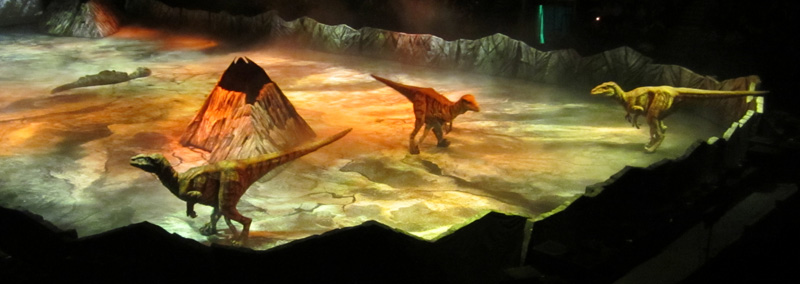
Utahraptors
A pack of ill-mannered Utahraptors at Walking with Dinosaurs - The Arena Spectacular


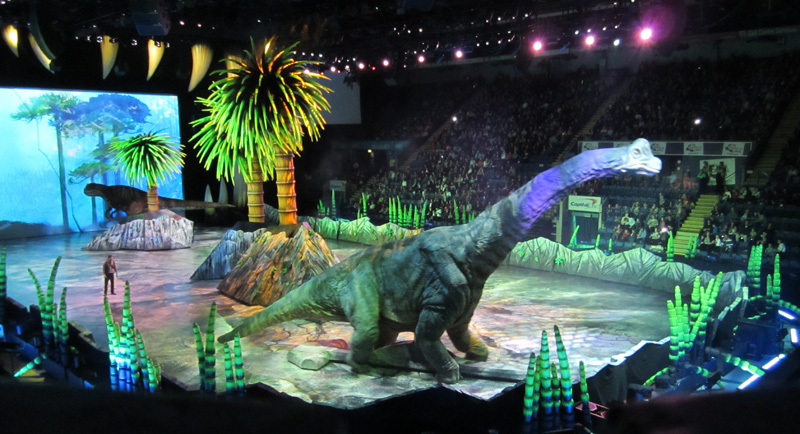
Walking with Dinosaurs - The Arena Spectacular is a live-action touring show of life size dinosaur puppets, based loosely on the TV show of the same name. Presented by Global Creatures in association with BBC Worldwide, it first did the rounds in 2008-9. However, due to popular demand the dinosaurs are ‘back for another bite” (as the publicity tagline reads). I was living in Ireland, one of the few countries to miss out on the tour, so I was fortunate to have the opportunity to attend this time around. I should say before I get going that I’ll be indulging plenty of details in this review, spoilers if you will, so if you’re planning on going to the show (although the last day of the UK tour has been and gone), and want to keep the details a surprise, then probably best to skip to the conclusion.

The show is structured similarly to the original series of the show, beginning in the Triassic and ending in the Cretaceous. There’s an actor-narrator, Huxley The Palaeontologist, whose role is to set the scene and provide nuggets of information along our journey, although he also comes in handy as a scale bar when the dinosaurs show up.

I’d seen enough online footage of the dinosaur puppets in action to know more or less what to expect. The smaller dinosaurs are people in suits, while the larger ones are hefty constructions attached to a mechanical bases. These contain a ‘driver’ and several puppeteers to control the movements. All of the dinosaurs are pretty snazzy, an amazing achievement. Their movements are fluid and graceful and the range of motion is extensive. Their fleshy parts wobble back and forth when they move, and when several dinosaurs take the stage together they’re all well coordinated and choreographed, interacting with each other as much as puppets can (not really very much to be honest). Some tiny baby dinosaurs (Plateosaurus) make an appearance too, presumably radio-controlled, and they worked really well, evoking lots of coos from the audience.

Still, a small quantity of suspension of disbelief is required. I found myself noticing the tight-glad knobbly knees of the human operators, and despite best efforts to camouflage the mechanical bases of the larger dinosaurs, they are still obvious. As such, I can’t say I was ever entirely immersed in the experience. However, that might be more to to with the pitfalls of experiencing the show as part of a group of thousands, the majority children, waving flashing T. rex head glow sticks. I was even treated to some uninvited audience participation from one of the youngsters in my immediate vicinity.*

Ankylosaurus
The lumpy charms of Ankylosaurus


Allosaurus
Allosaurus, facing down a thagomizer

Anatomically, the dinosaurs aren’t bad. Each is recognisable as the species it’s supposed to represent, although they haven’t quite hit the nail on the head with all of them. Most of the creatures look like slightly blobby versions of their on-screen counterparts. The Stegosaurus, Allosaurus, Torosaurus, Ankylosaurus, Ornithocheirus all have that WWD look. The Tyrannosaurus, Plateosaurus, Brachiosaurus, and Utahraptors, far less so. The only species in the show that does’t also appear in the original WWD series is Liliensternus, which takes the role of Triassic predator occupied by Coelophysis/Postosuchus in the TV series.

What inaccuracies did I notice, apart from the slightly cartoony appearance? Well, the gait of the smaller dinosaurs is limited by the stride of their human operators, so they have a sort of ungainly shuffle. The head of the Stegosaurus looks oversized, the dromaeosaurs are featherless, the Brachiosaurus have stunted arms. It’s difficult to be too critical of these errors given the obvious underlying technical and theatrical constraints involved, although no scientific advisor is credited in the show programme (£12 - crikey), so maybe that would have helped.

Brachiosaurus
The "stunted-arms" of Brachiosaurus

I was most impressed with the small details. A clutch of Plateosaurus eggs hatching before our eyes (how did they do that?), a brachiosaur stripping off and gulping down a leaf (I worked that one out), the snap of a Torosaurus horn mid-battle. These touches of realism were vital for providing a sense of interaction between the dinosaurs and their environment, and really made it for me. There’s also some welcome humour sprinkled throughout the show. After a big build up, a juvenile Tyrannosaurus squeaks onto the scene raising a few chuckles. Of course, mummy then comes along, but the happy family meet their doom shortly thereafter when the meteor strikes - not so funny. It’s ups and downs.

There’s a scene with an Ornithocheirus that differs from all the others because the model is basically static. They shake it about a bit on some wires while a video screen behind it shows passing landscapes to provide the illusion of motion and swooping. I was urging it to break free of its suspensions and soar about the arena. I was also also hoping for a marine reptile or two to do the same, but none ever make an appearance. I’m surprised they didn’t turn the set into the watery home for a Liopleurodon - they surely must have considered it.

Actually, the most impressive aspect of the entire show for me was the set, which is something I wasn’t anticipating. I guess I was all geared up for the dinosaurs themselves. The set starts off in the Triassic, all bland and rocky, with a single mountain in the centre of the arena representing Pangaea. As the show goes on, the set transforms in real time. Pangaea breaks up to become two and then three ‘islands’, which the dinosaurs navigate around. Vegetation springs up before our eyes: horsetails, ferns and trees sprout up, seemingly from nowhere, and then later in the Cretaceous Period, flowers bloom. This was achieved with some wonderful inflatable work and the resultant time-lapse effect was stunning, and all in keeping with the narrative. The stirring score, produced especially for the show, is also noteworthy, and added considerably to the spectacle of the event.

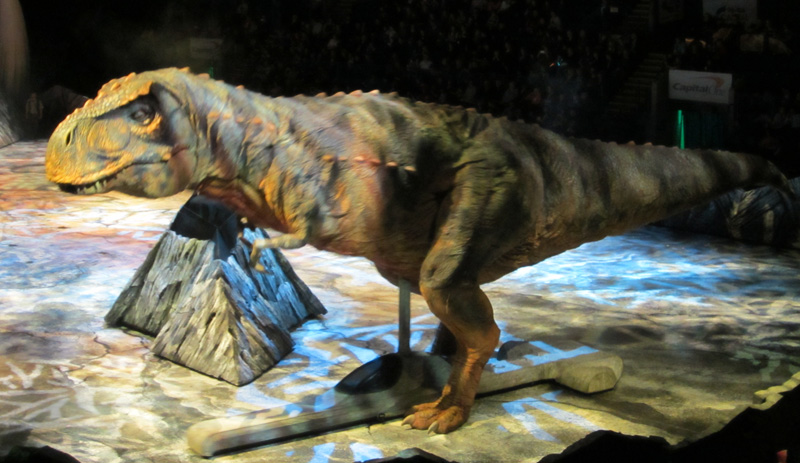
Tyrannosaurus
The obligatory Tyrannosaurus

In conclusion, I highly recommend Walking with Dinosaurs - The Arena Spectacular. The story is engaging, exciting, funny at times, even. The show as a whole is entertaining, educational, and the closest you’ll ever get to seeing a living dinosaur in the flesh (birds are what now?). So, it really did live up to its name - spectacular.

*“They’re only dancing!...what dinosaur’s next?...it’s gonna KILL him!...I want to see a different dinosaur!...It’s behind you!...RAHHHHHHH!”. An unwanted and distracting running commentary in my right ear constantly undoing any atmosphere. Kids, eh? I suppose they can be forgiven, though be frank the adults weren’t much better...“What do you think the Stegosaurus will do now; play cards, watch telly, paint his plates with nail varnish?”

Friday, June 7, 2013

The Meanest Landlord in the History of the World

The Children's Museum of Indianapolis should be well-known to long-time readers of this blog. It really is a standout as a science outreach organization in the midwest, and is a necessary regional antidote to the corrupting influence of a certain Kentucky "museum" which shall not be named. It's also another museum embracing YouTube to reach the public, with their weekly "This Week's WOW" features as well as charming little pieces like this one, in which children offer their own descriptions of dinosaurs.


I love the idea of Tyrannosaurus rex as a particularly awful landlord.
Thursday, June 6, 2013

Mesozoic Miscellany 60

Round-up time, and I've decided to resurrect the old format, which I hope will please everyone.

News

Sincere condolences to the friends and family of paleontologist Derek Main, who researched and publicized the Arlington Archosaur Site in Texas. This UT Arlington article about his work expresses his enthusiasm for his field nicely.

Three Triceratops individuals are currently being excavated by Peter Larson and crew in Wyoming. Read more from Will Baird at the Dragon's Tales, CNN (with video), and Discover D-Brief.

The chompers of spinosaurs were the subject of recent research, and Brian Switek at Laelaps explains why they needn't be thought of as merely mimicking crocodilians.

Around the Dinoblogosphere

Matt Martyniuk has written a post addressing the butt-ugliness of so many CG feathered theropods that is brilliant in its insight.

The Holliday Lab blog gives a quick rundown of the dietary diversity among theropods.

The International Symposium on Pterosaurs just happened in Rio. Darren Naish writes about the conference and Jaime Headden shares some posters he was regrettably not able to present (with spirited debate in the comments).

And speaking of pterosaurs, check out Natee's charmingly incompetent cookie delivery Pteranodon if you haven't already.

And speaking of baked goods, Lee made Ashley something yummy. In order to bake an apple pie with dinosaurs on it from scratch, you must first invent...

If you're a fan of our Vintage Dinosaur Art posts and are not reading Trish Arnold's blog, time to shape up. She continues her occasional Let's Read posts with the Prehistoric World series, including the horned dinosaurs (you know, Ceratosaurus and kin).

Fun in the field: Victoria Arbour wrote about her field work at Dinosaur Provincial Park at Pseudoplocephalus. Anthony Maltese at the Rocky Mountain Dinosaur Research Center blog shows progress on prep of a Platecarpus skull discovered by a visiting group of University of Tennesseee students in 2011. Brian Switek is in the field in Utah; follow the hashtag #jurassicutah for his dispatches.

Paleoart Pick

I'm in a pterosaur mood, so here's Azdarcho lancicollis by the great Andrey Atuchin.


Outrageously Off-Topic Indulgence

I got into Fringe a few months back, and it has been the perfect balm for a long-time X-Files and Lost fan still smarting from the many stupid decisions those shows made. Heart-tugging, mind-bending sci-fi. If you've never seen it, all I can say is prepare to be profoundly affected by a late-night phone call from a janitor...