Artist and researcher C.M. Kosemen has begun a series of video blogs, and in his first installment, he rants about a certain habit of publishers when printing material about prehistoric animals: using "item mentality" or bullet points to describe them. He argues that it takes them out of ecological context and reduces them to mechanical objects.
A review of my library is in order to really respond to this, but I generally agree, and wouldn't you know it, I see it as a design problem. I think about my treasured DK Visual Dictionary of Dinosaurs, and one reason it was a favorite was that the spreads put all of the animals and their anatomical features in context. A reason I love the old Rourke books is that it does the same, though through narrative rather than informational graphics. I'm not quite sure how prevalent this "item mentality" is, but it may simply be that since I'm pretty stingy and choose where to spend my money carefully, I'm not paying attention to the lower-quality projects where it may be used as a quick way to fill in content.
And there's more! Kosemen recently uploaded a short video from 2008 called Tetrapod Zoology: the Movie, in which his All Yesterdays comrade Darren Naish shares his collection of animal toys and talks about how even the silly, inaccurate toys in his plastic menagerie can be useful for education.
Delightful stuff. Keep an eye on his Youtube channel for more.

Thursday, January 31, 2013

Wednesday, January 30, 2013
Project Daspletosaurus Merch Now Available

If you haven't yet pitched a few monetary units Dave Hone's way to support his research into cannibalism and intraspecific combat in tyrannosaurs, you've got a few more options available to you. Project Daspletosaurus clothing, stickers, and stationery is now available in my Redbubble print shop. All proceeds will go to Hone's Microryza crowdfunding campaign. Here's a handy list of quick links to the product pages; all clothing has a wide range of options for style, size, and color.
- Project Daspletosaurus light colored tee shirts, baby gear, and hoodies.
- Project Daspletosaurus dark colored tee shirts, baby gear, and hoodies.
- Project Daspletosaurus stickers
- Project Daspletosaurus greeting cards and postcards (design featured above)
Crowdfunding is sexy now, and the press loves outlier stories about projects taking off and demolishing their goals. In reality, it's mighty tough to build excitement for a campaign. I love helping Dr. Hone out with this, and luckily some other artists have stepped up. Paleoart giants Julius Csotonyi and Brett Booth have both pitched in with wonderful perks to encourage funding.
As paleontology finds it harder to scrape together money, crowdfunding could potentially be a way for enthusiasts to directly benefit the researchers who shed light on the ancient life of our planet. It's an endeavor of pure curiosity, seeking to understand the shared heritage of life on Earth. It binds us ever more closely with other species. A very kind commenter at the Archosaur Musings post linked above wrote that he'd ordered a Project Daspletosaurus shirt for his young nephew, and that "It’ll be really cool to show him the results of the study when he’s older." That's incredibly inspiring, and it's a nice feeling to be even tangentially connected to that.
Even if you can't afford to donate, please help out by spreading the word on Facebook, Tumblr, Twitter, Pinterest, Google Plus, wherever. I mean, look at what this is about: Cannibal dinosaurs. That's a hook if ever I've seen one. I'll be hashtagging my tweets #cannibaldinosaurs. Huge thanks to Mark Wildman for promoting the campaign at his excellent blog Saurian!
A brief note about the money: Microryza does not host perks in the way Kickstarter or Petridish do, but neither do they discourage efforts like this. Although it's one step removed from a direct donation via Microryza, it is very nice that it removes the need for Hone to budget for and then produce and ship perks. Everything after the cost of the product will be going to the Microryza campaign.
Monday, January 28, 2013
Vintage Dinosaur Art: Dinosaurs: Giants of the Earth (a Pop-Up Book)
An obscure 1980s children's book - it feels like it's been a while. Dinosaurs: Giants of the Earth was published in 1988, and is illustrated by Richard Courtney, with paper engineering by Keith Moseley. The author is unknown, but it's interesting to note that Paul Sereno apparently 'cooperated' in the making of this charming, chunky little book. Of course, I always love a pop-up.

This is definitely one of those books for which the illustrator threw together some stuff based on his general experience of palaeoart over the years. There's no outright copying going on, but the animals have clearly been painted freehand, and veer between the semi-serious and the rather cartoonish. In the tradition of many kids' dinosaur books to this day (and even some godawful coffee table fare aimed at a more general audience), the look of the animals is also a good decade out of date - the tripod tyrannosaur being an excellent start.

All that said, this prancing Coelophysis isn't such a bad start (you know, for 1988). It's a nice active pose if nothing else, and the pop-up leg-swinging action is quite hilarious - like it's performing high kicks in a saurian chorus line (although it's missing a frilly skirt and feathered headdress, and of course you need the right music). The look of this one is a little early-1980s Sibbickian, which probably isn't a coincidence. As can be seen here, a lot of the foliage in this book is actually quite carefully observed and pleasingly painted, even if it's a little generic - as is so often the case, the illustrator was talented, but dinosaurs were outside of his area of expertise.

Veering towards the more cartoonish end of the scale, this piece ingeniously takes the classic 'neck-chomping theropod' meme and applies it to the pop-up format in the most wacky way possible. The Ceratosaurus, with its great big googly eye wedged firmly into the wrong hole in its skull, is seen applying its mouth like a giant pair of shears to the neck of the unfortunate sauropod, which itself sports a head that looks nothing like that of a Diplodocus, or of any other sauropod for that matter. In other respects, the Diplodocus definitely resembles any number that appeared in dinosaur books prior to 1980, which were normally riffing on art produced by one of the greats, like Burian.
I posted this on Facebook, and may I present an excellent caption subsequently provided by the quite dazzlingly witty Natasha Sizzy Hansen.

Tubby as this pair may be, you've got to love the audacity of those dazzling colour schemes - and the horizontal, ungulate-esque pupils are a nice touch. The pop-up mechanism works well here too, with the Parasaurolophus rearing up to feed from a conifer. It's just unfortunate that it doesn't seem to have any shoulders. You can tell that the Ouranosaurus is a little perturbed.


Saltasaurus rearing: definite shades of Mark Hallett. Still, again the use of the pop-up format is excellent here - the crazy necks and tails of sauropods are just begging to be turned into sprawling pop-up spreads, and it always feels like a wasted opportunity when they're not (er, in a pop-up book that is). It's a superb way to given an impression of the animals' sheer size. Bizarrely, while the underside of the tail of this Saltasaurus boasts large,flat, crocodilian 'belly scales', the underside of its neck is, er, the same as the top. Consequently, no doubt, it has sprouted the head of some angry armadillo-like beast. It's purple with rage!

Remember the shoulderless Parasaurolophus? Look at this attempted Albertosaurus skeleton, and it suddenly makes a lot more sense - it has uniform ribs that appear to continue, snake-like, all the way up to its head.


Meanwhile, tangerine Tyrannosaurus appears to be mischievously wiggling its little arms about while clutching its hapless, brightly-coloured nondescript victim, in front of the awe-inspiring Mt Ubiquitous Primordial Volcano. The Albertosaurus skeleton gnashes its teeth when the page is opened and closed, which is pretty well constructed and amusing enough.
Yes, we might be worlds away from the splendour of highly accomplished pop-up Sibbick, but I needed a break from all the high-end palaeoart - I'm starting to run dangerously low on hyperbole and slavish, doting praise (in particular, my stocks of 'intricately detailed' and 'masterful' have hit rock bottom). Nevertheless, it's a return to Kish for next week!

This is definitely one of those books for which the illustrator threw together some stuff based on his general experience of palaeoart over the years. There's no outright copying going on, but the animals have clearly been painted freehand, and veer between the semi-serious and the rather cartoonish. In the tradition of many kids' dinosaur books to this day (and even some godawful coffee table fare aimed at a more general audience), the look of the animals is also a good decade out of date - the tripod tyrannosaur being an excellent start.

All that said, this prancing Coelophysis isn't such a bad start (you know, for 1988). It's a nice active pose if nothing else, and the pop-up leg-swinging action is quite hilarious - like it's performing high kicks in a saurian chorus line (although it's missing a frilly skirt and feathered headdress, and of course you need the right music). The look of this one is a little early-1980s Sibbickian, which probably isn't a coincidence. As can be seen here, a lot of the foliage in this book is actually quite carefully observed and pleasingly painted, even if it's a little generic - as is so often the case, the illustrator was talented, but dinosaurs were outside of his area of expertise.

Veering towards the more cartoonish end of the scale, this piece ingeniously takes the classic 'neck-chomping theropod' meme and applies it to the pop-up format in the most wacky way possible. The Ceratosaurus, with its great big googly eye wedged firmly into the wrong hole in its skull, is seen applying its mouth like a giant pair of shears to the neck of the unfortunate sauropod, which itself sports a head that looks nothing like that of a Diplodocus, or of any other sauropod for that matter. In other respects, the Diplodocus definitely resembles any number that appeared in dinosaur books prior to 1980, which were normally riffing on art produced by one of the greats, like Burian.
 |
| Ceratosaur: BLARRGKEJKJJJH |

Tubby as this pair may be, you've got to love the audacity of those dazzling colour schemes - and the horizontal, ungulate-esque pupils are a nice touch. The pop-up mechanism works well here too, with the Parasaurolophus rearing up to feed from a conifer. It's just unfortunate that it doesn't seem to have any shoulders. You can tell that the Ouranosaurus is a little perturbed.


Saltasaurus rearing: definite shades of Mark Hallett. Still, again the use of the pop-up format is excellent here - the crazy necks and tails of sauropods are just begging to be turned into sprawling pop-up spreads, and it always feels like a wasted opportunity when they're not (er, in a pop-up book that is). It's a superb way to given an impression of the animals' sheer size. Bizarrely, while the underside of the tail of this Saltasaurus boasts large,flat, crocodilian 'belly scales', the underside of its neck is, er, the same as the top. Consequently, no doubt, it has sprouted the head of some angry armadillo-like beast. It's purple with rage!

Remember the shoulderless Parasaurolophus? Look at this attempted Albertosaurus skeleton, and it suddenly makes a lot more sense - it has uniform ribs that appear to continue, snake-like, all the way up to its head.


Meanwhile, tangerine Tyrannosaurus appears to be mischievously wiggling its little arms about while clutching its hapless, brightly-coloured nondescript victim, in front of the awe-inspiring Mt Ubiquitous Primordial Volcano. The Albertosaurus skeleton gnashes its teeth when the page is opened and closed, which is pretty well constructed and amusing enough.
Yes, we might be worlds away from the splendour of highly accomplished pop-up Sibbick, but I needed a break from all the high-end palaeoart - I'm starting to run dangerously low on hyperbole and slavish, doting praise (in particular, my stocks of 'intricately detailed' and 'masterful' have hit rock bottom). Nevertheless, it's a return to Kish for next week!
Saturday, January 26, 2013
The LITC All Yesterdays Contest: Update
Just a quick note to thank all of our submitting artists for the LITC version of an "All Yesterdays" contest. They've been coming in regularly, and I'm thrilled that some new names are among the creators. I know there's plenty of excitement around Naish, Conway and Kosemen's book and their own contest, so it's nice to know that our twist on the idea has gotten a response. The more the merrier, that's how I see it! Anyway, to review our contest rules and requirements, as written by Asher in the original contest announcement:
The first place winner will recieve a copy of Dinosaur Art, as supplied by Marc.
The second place winner will recieve a vintage book of dinosaur art, hand selected by David himself.
The third place winner will receive a signed sketch from myself, depicting any prehistoric creature he or she so desires.
All art we receive will be displayed here, at Love in the Time of Chasmosaurs. Niroot, Myself, David, and Marc will all be participating, of course, but for obvious reasons we will be ineligible to win.
Happy creating!
- A distinct sense of style. Give us a break from the detail oriented realism that's so common. Experiment a bit. Cubism? Art Nouveau? Impressionism? Gesture drawing? It's up to you.
- Interesting speculation. At the same time, we're looking for interesting and unusual subject matter. Dust bathing proto birds? Symbiotic pterosaurs? Odd soft tissue? We'd like to see all of it. Hit us with your craziest stuff.
- Accuracy. Your only guideline is that the animal must at least adhere to current knowledge. No naked raptors and tail dragging sauropods, please.
- Feel free to send along an artists statement explaining your influences or ideas!
- All art is due March 1st, 2013. Send all art to chasmosaurs@gmail.com.
The first place winner will recieve a copy of Dinosaur Art, as supplied by Marc.
The second place winner will recieve a vintage book of dinosaur art, hand selected by David himself.
The third place winner will receive a signed sketch from myself, depicting any prehistoric creature he or she so desires.
All art we receive will be displayed here, at Love in the Time of Chasmosaurs. Niroot, Myself, David, and Marc will all be participating, of course, but for obvious reasons we will be ineligible to win.
Happy creating!
Dinosaurs in Dominoes
A fun, no doubt laboriously conceived video by Youtuber named Flippycat.
My favorite bit was the T. rex skeleton.
My favorite bit was the T. rex skeleton.
Friday, January 25, 2013
Project Daspletosaurus 2013

Last Autumn, Dr. Dave Hone approached me with the opportunity to design a logo for a crowdfunding campaign he was preparing to launch, after he had seen my Dinosaur Family Crest designs. I jumped at the chance to help out. I mean, pitching in to help a paleontologist and science communicator I respect do significant research? I couldn't resist, and I'm happy to report that his campaign has begun.
Hosted by the science crowdfunding platform Microryza, Hone's project will see him travelling from the UK to the Royal Tyrrell Museum in Alberta to work with Darren Tanke, studying fossils which seem to show evidence of cannibalism amongst the tyrannosaurid Daspletosaurus. Hone wrote about it yesterday at Archosaur Musings, where you can see images of the fossils he'll study. More importantly, kick some money his way via Microryza, and check out the excellent video Hone and Matt Van Rooijen made to promote the work. It is humbling to think of how much we've learned about the mighty tyrannosaurs since I was born; what was a lumbering monster has gained more and more nuance to become a real animal. Hone and Tanke will get to tell more of that story with their research.
A bit about the process of designing the project logo, if you'll indulge me. Dr. Hone and I had a meeting via Skype to discuss the project goals and the sort of graphic he wanted, and I began sketching immediately. It was decided to use two Daspletosaurus individuals facing off in some way, and in general to continue the modernist aesthetic established in my family crest project. Because this graphic would represent a more complex idea than those crests and involve more text, I began sorting out ways to flesh out the extremely minimal forms of the earlier project.
The result is above. The shape is inspired by the crest on Alberta's flag. I accommodated the long forms of the daspletosaurs by posing them on an incline, further amping up the drama of the moments-from-happening battle. The field under the peak is filled with a pattern based on a geological symbol for silty sandstone, inspired by the make-up of the Dinosaur Park Formation. Dr. Hone was very easy to work with, providing valuable constructive feedback. It was a small project, but a great privilege.
So. Let's send Dave Hone to Canada!
Wednesday, January 23, 2013
Sketchbook: The Challenges of the Smoking Brachiosaurus

Sexy rexy's got nothing on the nicotine-craving Brachiosaurus. My doodles always have at least one wonky limb.
Monday, January 21, 2013
Vintage Dinosaur Art: An Odyssey In Time: The Dinosaurs of North America
Taking a break from De Oerwereld, we return this week to an artist who's probably been a little under-appreciated. Eleanor 'Ely' Kish produced her most important work in the 1970s and early 1980s, and a great deal of it is gathered together in Dale Russell's hefty An Odyssey In Time: The Dinosaurs of North America. It's a beautiful book, and one that is truly brought to life (as Russell acknowledges) by Kish's stunning paintings, even if time has not been kind to the way that many of the animals have been restored.

Now don't get me wrong - I wish to make it very clear that I consider Kish's work to be truly masterful. This particularly applies to the reconstructed palaeoenvironments that the animals inhabit; not only did Kish take the task of including the correct flora very seriously, the worlds depicted in her work are frequently breathtaking in scale and detail. In short, they are utterly believable. Kish also paid keen attention to composition and technique, such that - as with all the best palaeoartists - her work stands proudly as art for its own sake, even without considering the palaeontological element.

All of that said, show someone a '70s or early '80s Kish dinosaur these days and the first thing they'll say is "Holy crap, that's skinny!". Kish's restorations represent one of the most extreme faces of what's come to be known as 'shrink-wrapping' in palaeoart - that is, the animals are little more than skeletons with dust sheets thrown over them. Indeed, the above piece - depicting an Apatosaurus pair crossing a mud flat - was even used by Darren Naish in his All Yesterdays presentation to exemplify the 'shrink-wrapping' style. It's easy, here, to appreciate the beauty of the landscape, and the skillful creation of moonlit reflections in the shallow waters of this peaceful delta - but, to modern eyes, the emaciated sauropods are jarring and horrific. 'Zombie dinosaurs', indeed.

Of course, it's always important to remember the era in which works were produced. Such ultra-skinny dinosaurs may well have been an over-reaction to the lumpen, lardy 'evolutionary failures' that had dominated palaeoart for decades; in Kish's case, it might also have been down to the scientific advice she was being given at the time (although I've only heard that one on rumour!). Whatever the case, it's perhaps most important to note the rigorous approach to restoration that Kish employed - an approach that contrasted with even the best of the 'classic' palaeoartists (although Burian did try, using what limited resources he had available to him). The skins of her dinosaurs might adhere too closely to their skeletons, but at least the skeletons themselves adhere closely to their real counterparts.

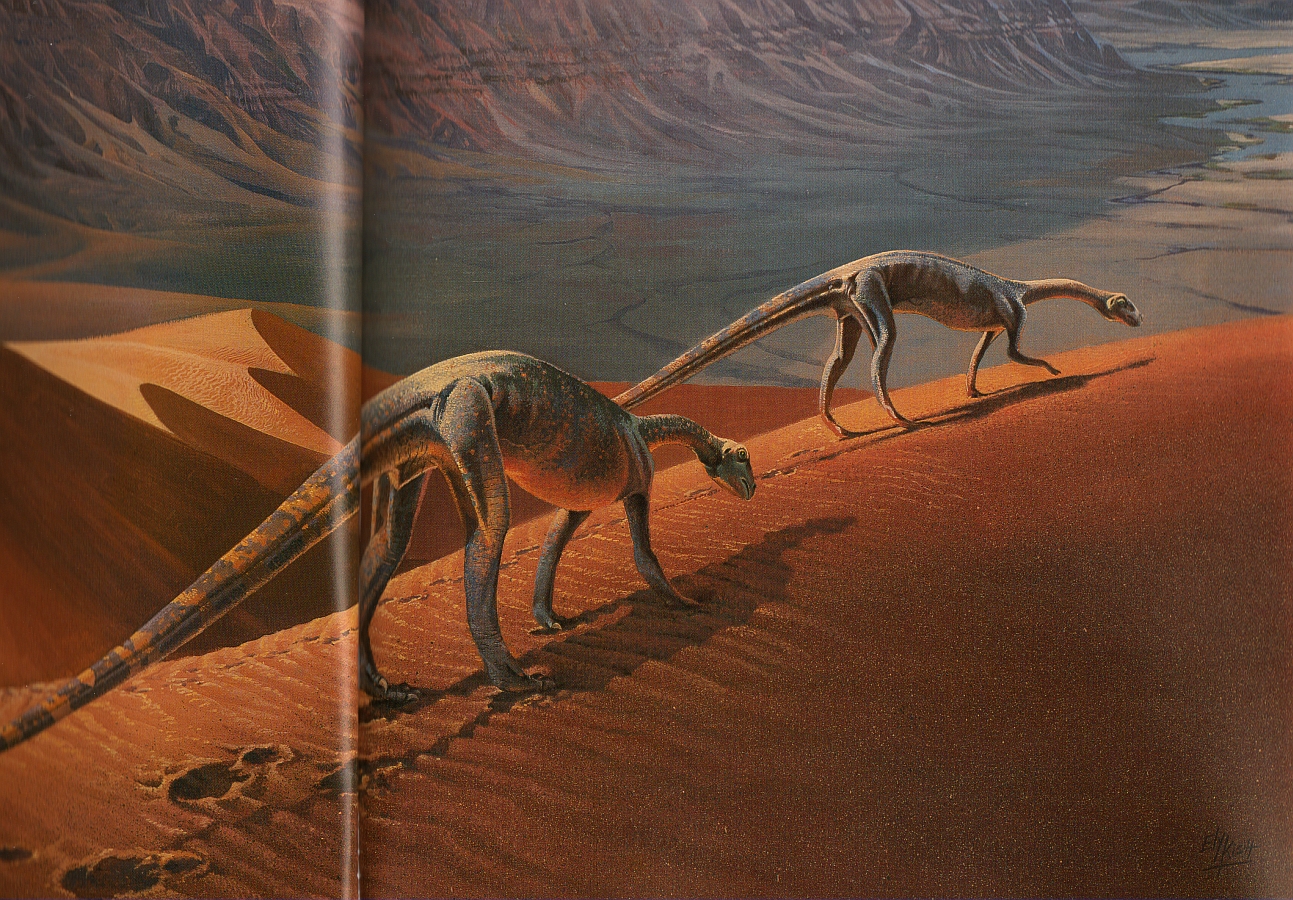
Naturally, there are cases in which one can justifiably portray a skeletal dinosaur - and I'm not only saying that as a cheap joke with regard to the Diplodo-corpses above. Scroll up a little, and you will notice that Kish's Massospondylus are tragic, doomed wanderers in a vast desertscape that is utterly barren, save for the faintest glimmer of water in the distance. The scene invites us to imagine these two desperate, starving dinosaurs wandering for days over the dunes in search of a water source. They might even then be too skinny (they do need room for their internal organs), but at least their painfully thin appearance makes sense to a contemporary viewer. Those corpses aren't bad either...

On other occasions, Kish's work has aged better than it might have scientifically because the animals are not the focus. Show the above painting to someone who isn't palaeontologically inclined, and they'll probably only notice the astonishing realism and beauty of the shoreline at first, in spite of the sauropods ("Pleurocoelus") milling around casually in the background. Kish broke new ground in making dinosaurs a component of a wider environment and ecosystem in her art.

The history of hadrosaurs in palaeoart isn't explored all that often (now there's an idea...), but their depiction has gone from tubby tripods, to more slimline bipeds/quadrupeds, to more fleshy and bulky quadrupeds and occasionally outright porkers. As one might expect, Kish's Corythosaurus represent the second stage in that evolution; they are so thin as to be near-unrecognisable next to today's much more massive-looking restorations, but represent a leap forward from the embarrassing, web-handed 'duckbills' of the previous generation. Dale Russell's influence on this beautiful bayou can be felt with the Troodon stage left, which bears more than a passing resemblance to a certain well-known model. The sharp-eyed will also spot a fragment of long-dead tyrannosaur hanging out in the bottom left.

Speaking of hadrosaurs, someone - like me - who grew up with the palaeoart of the 1990s would be hard-pressed to recognise these creatures as Maiasaura, such is the extent of the shrink-wrapping. One especially peculiar, but inevitable result of shrink-wrapping that Kish does not hide is that the pubic bones protrude to the extent that the animals could seemingly use them as crude stabbing weapons. Still, the painting makes wonderful use of light and shade, as does...

...Kish's depiction of two Dryptosaurus engaging in a mating ritual. These two might just be the nadir of the corpsetastic, Tim Burton, heroin chic approach to dinosaur restoration, but the scene behind them is a mind-kersploder. It's almost possible to feel the warmth of the setting sun, and to hear the cries of the flocking birds as they fly to their evening roost. The composition here, too, is uncommonly superb for a work of palaeoart. In spite of how unsettling I might find the wiry tyrannosauroids in the foreground (is anyone else reminded of the Jurassic Park Coelophysis toy?), this is one of my favourite pieces in the book, simply for its dazzling display of artistic skill.

Some dinosaurs, of course, are just too chunky to shrink-wrap, and Tyrannosaurus is surely one of them. Sure, you can choose to display every facet of its skull through the skin in ghoulish detail, but there's no getting away from its absurdly massive, beer keg chest and enormous hips and thighs. Here, again, we see Kish's skill in composition (and Niroot is quite envious of the well-executed palm tree). This is also one of the few Kish pieces to feature dinosaurs in 'action' poses - never mind the fact that T. rex is busy reducing Edmontosaurus to delicious, filleted meaty strips. They'd be finger lickin' good, if only it could lick its fingers.

The same principle can also be applied to ankylosaurs - the spiny walking coffee tables of the Mesozoic are simply too wide to be restored in a truly anorexic fashion. While the browsing Sauropelta are quite fetching in themselves, I again regret not being able to present the entire picture here, which is far more expansive and lovingly created than this detail suggests. I guess the only course of action is for you all to find a copy of the book...
Eleanor Kish, then. Come to ogle the super-skinny dinosaurs, but stay for the masterful artistry. We've covered Kish on three occasions before, and I may well return to An Odyssey In Time somewhere down the line - not only to feature more glorious Kish artwork, but because it also features that perennial favourite, the 'Dinosauroid' (nothing to do with Kish, I might add). As for next week...there'll be something completely different!

Now don't get me wrong - I wish to make it very clear that I consider Kish's work to be truly masterful. This particularly applies to the reconstructed palaeoenvironments that the animals inhabit; not only did Kish take the task of including the correct flora very seriously, the worlds depicted in her work are frequently breathtaking in scale and detail. In short, they are utterly believable. Kish also paid keen attention to composition and technique, such that - as with all the best palaeoartists - her work stands proudly as art for its own sake, even without considering the palaeontological element.

All of that said, show someone a '70s or early '80s Kish dinosaur these days and the first thing they'll say is "Holy crap, that's skinny!". Kish's restorations represent one of the most extreme faces of what's come to be known as 'shrink-wrapping' in palaeoart - that is, the animals are little more than skeletons with dust sheets thrown over them. Indeed, the above piece - depicting an Apatosaurus pair crossing a mud flat - was even used by Darren Naish in his All Yesterdays presentation to exemplify the 'shrink-wrapping' style. It's easy, here, to appreciate the beauty of the landscape, and the skillful creation of moonlit reflections in the shallow waters of this peaceful delta - but, to modern eyes, the emaciated sauropods are jarring and horrific. 'Zombie dinosaurs', indeed.
Of course, it's always important to remember the era in which works were produced. Such ultra-skinny dinosaurs may well have been an over-reaction to the lumpen, lardy 'evolutionary failures' that had dominated palaeoart for decades; in Kish's case, it might also have been down to the scientific advice she was being given at the time (although I've only heard that one on rumour!). Whatever the case, it's perhaps most important to note the rigorous approach to restoration that Kish employed - an approach that contrasted with even the best of the 'classic' palaeoartists (although Burian did try, using what limited resources he had available to him). The skins of her dinosaurs might adhere too closely to their skeletons, but at least the skeletons themselves adhere closely to their real counterparts.

Naturally, there are cases in which one can justifiably portray a skeletal dinosaur - and I'm not only saying that as a cheap joke with regard to the Diplodo-corpses above. Scroll up a little, and you will notice that Kish's Massospondylus are tragic, doomed wanderers in a vast desertscape that is utterly barren, save for the faintest glimmer of water in the distance. The scene invites us to imagine these two desperate, starving dinosaurs wandering for days over the dunes in search of a water source. They might even then be too skinny (they do need room for their internal organs), but at least their painfully thin appearance makes sense to a contemporary viewer. Those corpses aren't bad either...

On other occasions, Kish's work has aged better than it might have scientifically because the animals are not the focus. Show the above painting to someone who isn't palaeontologically inclined, and they'll probably only notice the astonishing realism and beauty of the shoreline at first, in spite of the sauropods ("Pleurocoelus") milling around casually in the background. Kish broke new ground in making dinosaurs a component of a wider environment and ecosystem in her art.

The history of hadrosaurs in palaeoart isn't explored all that often (now there's an idea...), but their depiction has gone from tubby tripods, to more slimline bipeds/quadrupeds, to more fleshy and bulky quadrupeds and occasionally outright porkers. As one might expect, Kish's Corythosaurus represent the second stage in that evolution; they are so thin as to be near-unrecognisable next to today's much more massive-looking restorations, but represent a leap forward from the embarrassing, web-handed 'duckbills' of the previous generation. Dale Russell's influence on this beautiful bayou can be felt with the Troodon stage left, which bears more than a passing resemblance to a certain well-known model. The sharp-eyed will also spot a fragment of long-dead tyrannosaur hanging out in the bottom left.
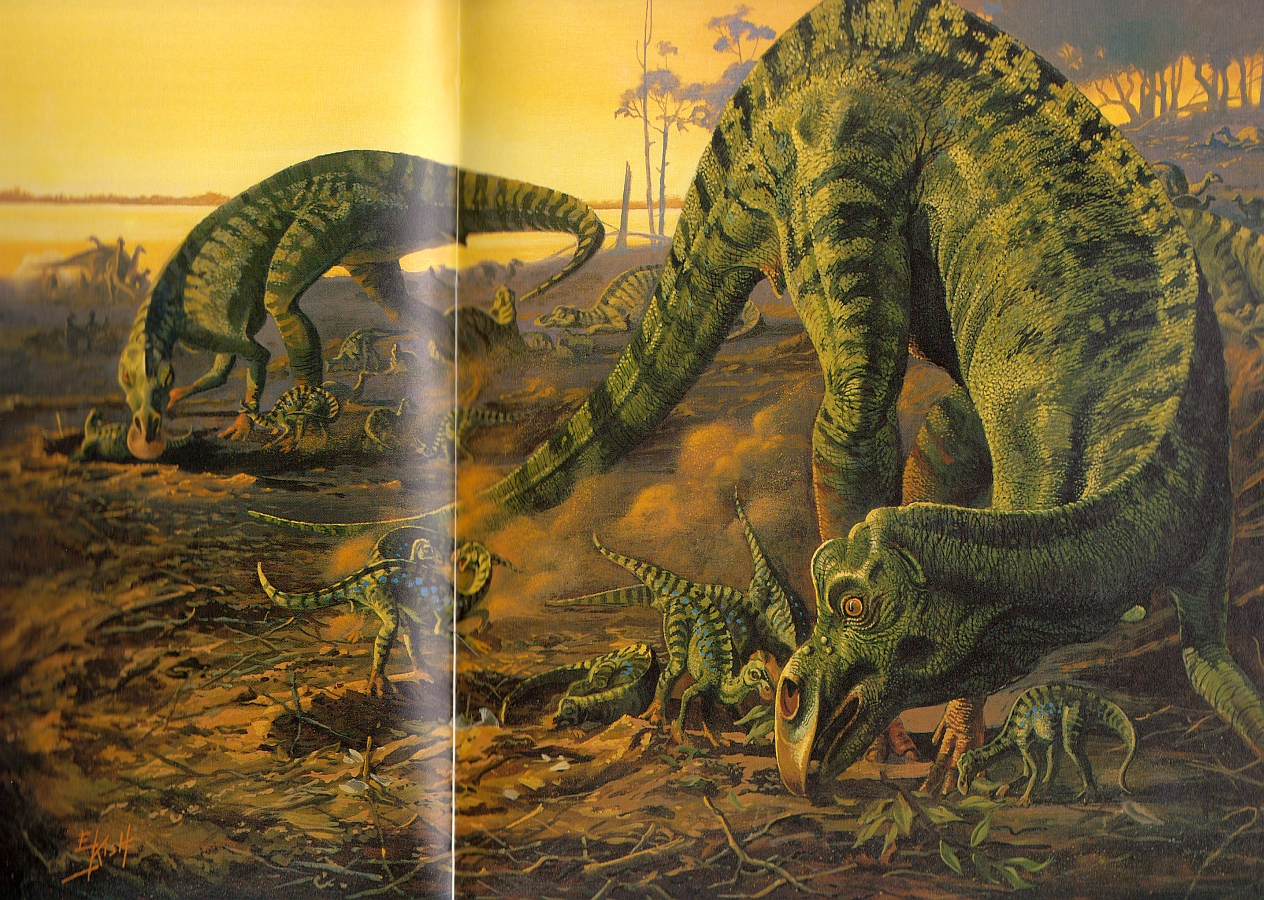
Speaking of hadrosaurs, someone - like me - who grew up with the palaeoart of the 1990s would be hard-pressed to recognise these creatures as Maiasaura, such is the extent of the shrink-wrapping. One especially peculiar, but inevitable result of shrink-wrapping that Kish does not hide is that the pubic bones protrude to the extent that the animals could seemingly use them as crude stabbing weapons. Still, the painting makes wonderful use of light and shade, as does...

...Kish's depiction of two Dryptosaurus engaging in a mating ritual. These two might just be the nadir of the corpsetastic, Tim Burton, heroin chic approach to dinosaur restoration, but the scene behind them is a mind-kersploder. It's almost possible to feel the warmth of the setting sun, and to hear the cries of the flocking birds as they fly to their evening roost. The composition here, too, is uncommonly superb for a work of palaeoart. In spite of how unsettling I might find the wiry tyrannosauroids in the foreground (is anyone else reminded of the Jurassic Park Coelophysis toy?), this is one of my favourite pieces in the book, simply for its dazzling display of artistic skill.

Some dinosaurs, of course, are just too chunky to shrink-wrap, and Tyrannosaurus is surely one of them. Sure, you can choose to display every facet of its skull through the skin in ghoulish detail, but there's no getting away from its absurdly massive, beer keg chest and enormous hips and thighs. Here, again, we see Kish's skill in composition (and Niroot is quite envious of the well-executed palm tree). This is also one of the few Kish pieces to feature dinosaurs in 'action' poses - never mind the fact that T. rex is busy reducing Edmontosaurus to delicious, filleted meaty strips. They'd be finger lickin' good, if only it could lick its fingers.
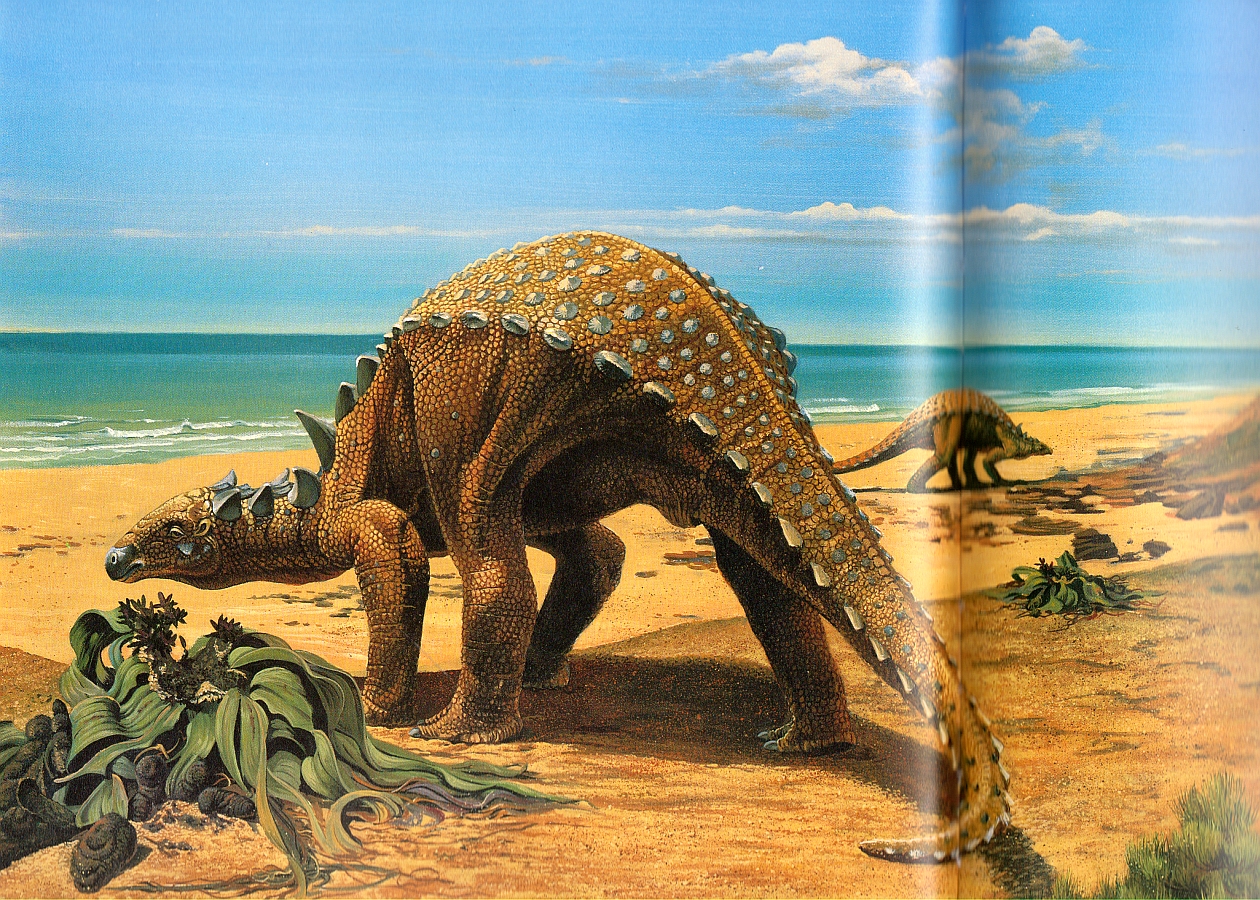
The same principle can also be applied to ankylosaurs - the spiny walking coffee tables of the Mesozoic are simply too wide to be restored in a truly anorexic fashion. While the browsing Sauropelta are quite fetching in themselves, I again regret not being able to present the entire picture here, which is far more expansive and lovingly created than this detail suggests. I guess the only course of action is for you all to find a copy of the book...
Eleanor Kish, then. Come to ogle the super-skinny dinosaurs, but stay for the masterful artistry. We've covered Kish on three occasions before, and I may well return to An Odyssey In Time somewhere down the line - not only to feature more glorious Kish artwork, but because it also features that perennial favourite, the 'Dinosauroid' (nothing to do with Kish, I might add). As for next week...there'll be something completely different!
Friday, January 18, 2013
Return to the Valley of Dinosaurigami
It's been well over a year since I put together a post of origami dinosaurs, which is entirely too long. This time, I'm focusing on one artist. All of the pieces below have been designed and folded by paper artist Tran Trung Hieu, who shares work on Flickr as well as the Vietnam Origami Group.
I'll kick this post off with a gorgeous Therizinosaurus. Love the feathery-fin detail on those majestic forelimbs.

Here's one I'd not seen tried before: ribbon-tailed Epidexipteryx.

Another refreshing oddball, the alvarezsaur Mononykus.
And yet another I'd not seen tried before, and a beauty it is. The mighty Balaur bondoc, in mid-pounce.
Back to more popular forms with a royal red Spinosaurus.

Comprised of over 90 pieces of paper, a skeletal Sarcosuchus.

Finally, looking quite handsome in white against a black backdrop and hailing from the forests of the antarctic, a fetching Cryolophosaurus.

Amazing work, Tran! Please be sure to show your appreciation at his Flickr photostream. There are many more treasures to find there, but since he hasn't organized them into sets, it will take a little work to find them. But it's well worth it.
Earlier posts in this occasional series:
Dinosaurigami
More Dinosaurigami
Further Adventures in Dinosaurigami
Deeper Into Dinosaurigami
We'll have fun, fun, fun, until daddy takes the dinosaurigami away
I'll kick this post off with a gorgeous Therizinosaurus. Love the feathery-fin detail on those majestic forelimbs.
Here's one I'd not seen tried before: ribbon-tailed Epidexipteryx.
Another refreshing oddball, the alvarezsaur Mononykus.
And yet another I'd not seen tried before, and a beauty it is. The mighty Balaur bondoc, in mid-pounce.
Back to more popular forms with a royal red Spinosaurus.
Comprised of over 90 pieces of paper, a skeletal Sarcosuchus.
Finally, looking quite handsome in white against a black backdrop and hailing from the forests of the antarctic, a fetching Cryolophosaurus.
Amazing work, Tran! Please be sure to show your appreciation at his Flickr photostream. There are many more treasures to find there, but since he hasn't organized them into sets, it will take a little work to find them. But it's well worth it.
Earlier posts in this occasional series:
Dinosaurigami
More Dinosaurigami
Further Adventures in Dinosaurigami
Deeper Into Dinosaurigami
We'll have fun, fun, fun, until daddy takes the dinosaurigami away
Thursday, January 17, 2013
Mesozoic Miscellany 57
High time for another round-up, I reckon! Saddle up, pard'ners.
First up: the plate-backs have arrived at ART Evolved! January's gallery is devoted to stegosaurs, and a fetching group it is.
John Conway's log is essential reading, both for the artwork he shares and his insights. He recently wrote a piece on Gregory S. Paul, lamenting the paleoart titan's obsession with taxonomic acts. He writes:
It's always fun when The Onion writes dinosaur pieces, as in October's New Evidence Suggests Dinosaurs Died in Cretaceous Period Hospice.
 Mark Witton's evocative illustration of a Pachyrhinosaurus family braving the Cretaceous arctic. © Mark Witton, of course.
Mark Witton made a splash with his speculative, musk ox-inspired Pachyrhinosaurus illustration recently, and he writes a characteristically insightful piece on why it's not such a nutty idea, existing ceratopsid skin impressions be damned.
Mark Wildman wrote about the joys of finding shark teeth in the doldrums of winter at Saurian.
At Symbiartic, Kalliopi Monoyios begins a series of posts on University of Chicago superstar paleontologist Neil Shubin's new book The Universe Within.
Kalliopi and her Symbiartic comrade Glendon Mellow have started a Google Plus community devoted to Science Art. It's been the shot in the arm I needed for G+ to make sense for me. Come on over.
Matt Wedel explores the sauropod nervous system at SV-POW, in a post hilariously titled Oblivious Sauropods Being Eaten.
Speaking of sauropods, Matt Martyniuk, author of A Field Guide to Mesozoic Birds, responds to a recent Andrea Cau post about the All Yesterdays-flavored work of Emiliano Troco with his own double-dewlap bearing sauropod.
Finally, I'd like to share one sneak peek into a project I'm working on. I'm writing and illustrating a children's book! It's a paleo book. Of course it is. I've been sharing bits of it on various social media outlets, so it's high time I shared some here. I humbly present an artistic Ankylosaurus.
 It's a work-in-progress, but it will give you an idea of what to expect. More details as 2013 rolls on!
First up: the plate-backs have arrived at ART Evolved! January's gallery is devoted to stegosaurs, and a fetching group it is.
John Conway's log is essential reading, both for the artwork he shares and his insights. He recently wrote a piece on Gregory S. Paul, lamenting the paleoart titan's obsession with taxonomic acts. He writes:
Why is one of the greatest dinosaur artists of all time spending so much time on this? Considering he hasn’t a hope in hell of convincing the majority of people working on dinosaur taxonomy that his approach is right, continuing to fight this fight feels like a criminal waste of time and effort.For more of Conway's thoughts, click on over.
It's always fun when The Onion writes dinosaur pieces, as in October's New Evidence Suggests Dinosaurs Died in Cretaceous Period Hospice.
Mark Witton's evocative illustration of a Pachyrhinosaurus family braving the Cretaceous arctic. © Mark Witton, of course.
Mark Witton made a splash with his speculative, musk ox-inspired Pachyrhinosaurus illustration recently, and he writes a characteristically insightful piece on why it's not such a nutty idea, existing ceratopsid skin impressions be damned.
Mark Wildman wrote about the joys of finding shark teeth in the doldrums of winter at Saurian.
At Symbiartic, Kalliopi Monoyios begins a series of posts on University of Chicago superstar paleontologist Neil Shubin's new book The Universe Within.
Kalliopi and her Symbiartic comrade Glendon Mellow have started a Google Plus community devoted to Science Art. It's been the shot in the arm I needed for G+ to make sense for me. Come on over.
Matt Wedel explores the sauropod nervous system at SV-POW, in a post hilariously titled Oblivious Sauropods Being Eaten.
Speaking of sauropods, Matt Martyniuk, author of A Field Guide to Mesozoic Birds, responds to a recent Andrea Cau post about the All Yesterdays-flavored work of Emiliano Troco with his own double-dewlap bearing sauropod.
Finally, I'd like to share one sneak peek into a project I'm working on. I'm writing and illustrating a children's book! It's a paleo book. Of course it is. I've been sharing bits of it on various social media outlets, so it's high time I shared some here. I humbly present an artistic Ankylosaurus.
It's a work-in-progress, but it will give you an idea of what to expect. More details as 2013 rolls on!
Subscribe to:
Posts (Atom)